Crypto market participation continues to dip


Key Takeaways

  • Trading volume, liquidity and volatility are all falling in the crypto markets
  • Even Bitcoin’s strong rise thus far this year has been steady and methodical rather than via sudden spikes, as in the past
  • Bitcoin dominance is rising, uncharacteristic during periods of price increases, highlighting a potential divergence 
  • Regulatory crackdown is suppressing market participation through lawsuits against exchanges and heightened legal uncertainty 
  • Volatility should return eventually, but previous six months have been the most placid in recent memory

It’s all quiet on the blockchain front. 

The crypto markets continue to plod along with volume, liquidity and volatility all extraordinarily low. All across the board, the numbers point to market participation lowering incessantly. 

Even Bitcoin’s rise year-to-date, which is impressive thus far at 76%, has come through steady, methodical gains. This contrasts sharply with previous bull markets, which have seen the asset spike higher in very short time periods. Then again, the market seems unsure of whether this is a bull market, a bear market, or something in between.

The slow but steady incline this year has come amid a further fall in trading volume. Last year, volumes on centralised exchanges fell 46%. This came amid a vicious bear market, highlighted by several scandals, such as the FTX collapse, Terra’s death spiral and numerous bankruptcies. 

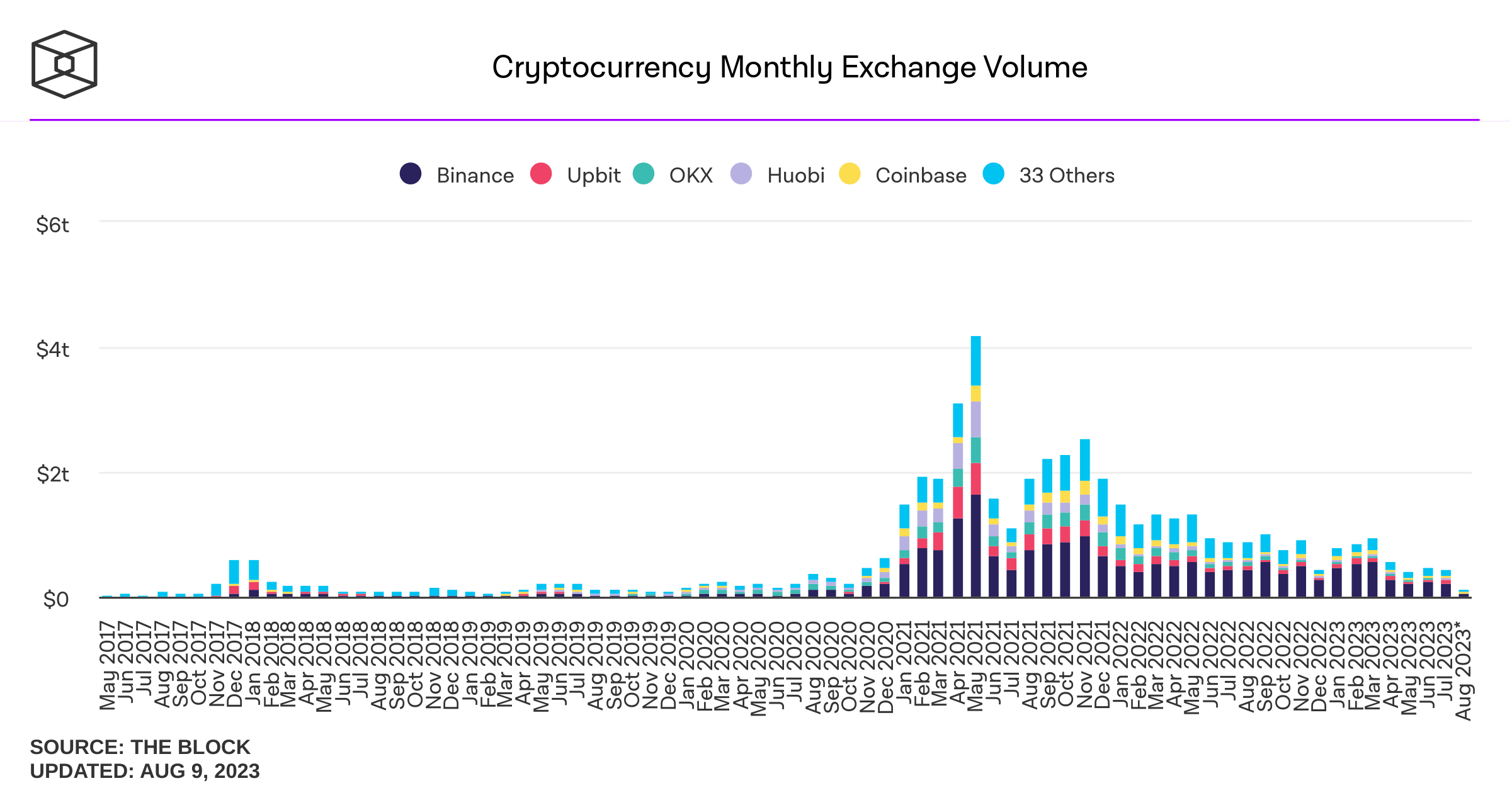
The year 2023 has seen the trading slump continue lower, without even the dramatic episodes of volatility such as those aforementioned scandals. The Block’s data for July has trading volumes now at levels last seen in 2020: 
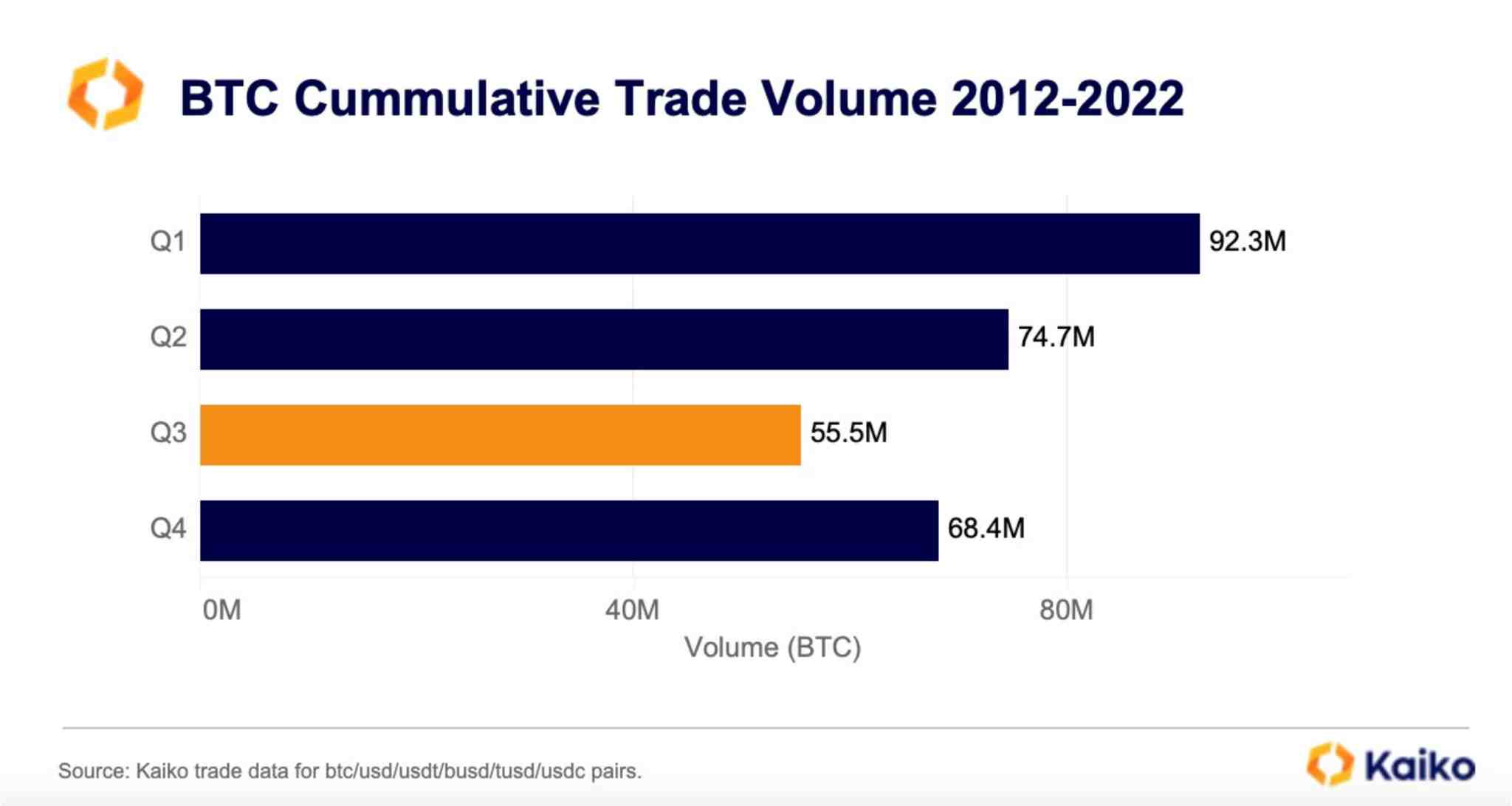
As we analysed here recently, this is partially a result of a typical summer trading lull, something which affects asset classes beyond crypto, too. The next chart from Kaiko shows this, with Q3 frequently yielding the lowest volume in Bitcoin’s short history. However, it is prudent to note that this is heavily skewed towards the last couple of years, with Bitcoin surging into mainstream consciousness and its liquidity therefore rocketing. Hence, blaming this lull on seasonality alone feels misguided.
Bitcoin dominance is rising 

Looking beyond Bitcoin, altcoins have also been quiet. There have been stories of the odd meme coin (Bald and Pepe, to name a couple) that have gained attention, but in comparison to previous years, the altcoin market has been devoid of the usual intrigue. 

One way of looking at this is the notable rise of Bitcoin dominance, which measures the ratio of the Bitcoin market cap to the entire cryptocurrency market cap. It has risen above 50%, up from around 40% at the start of the year. 
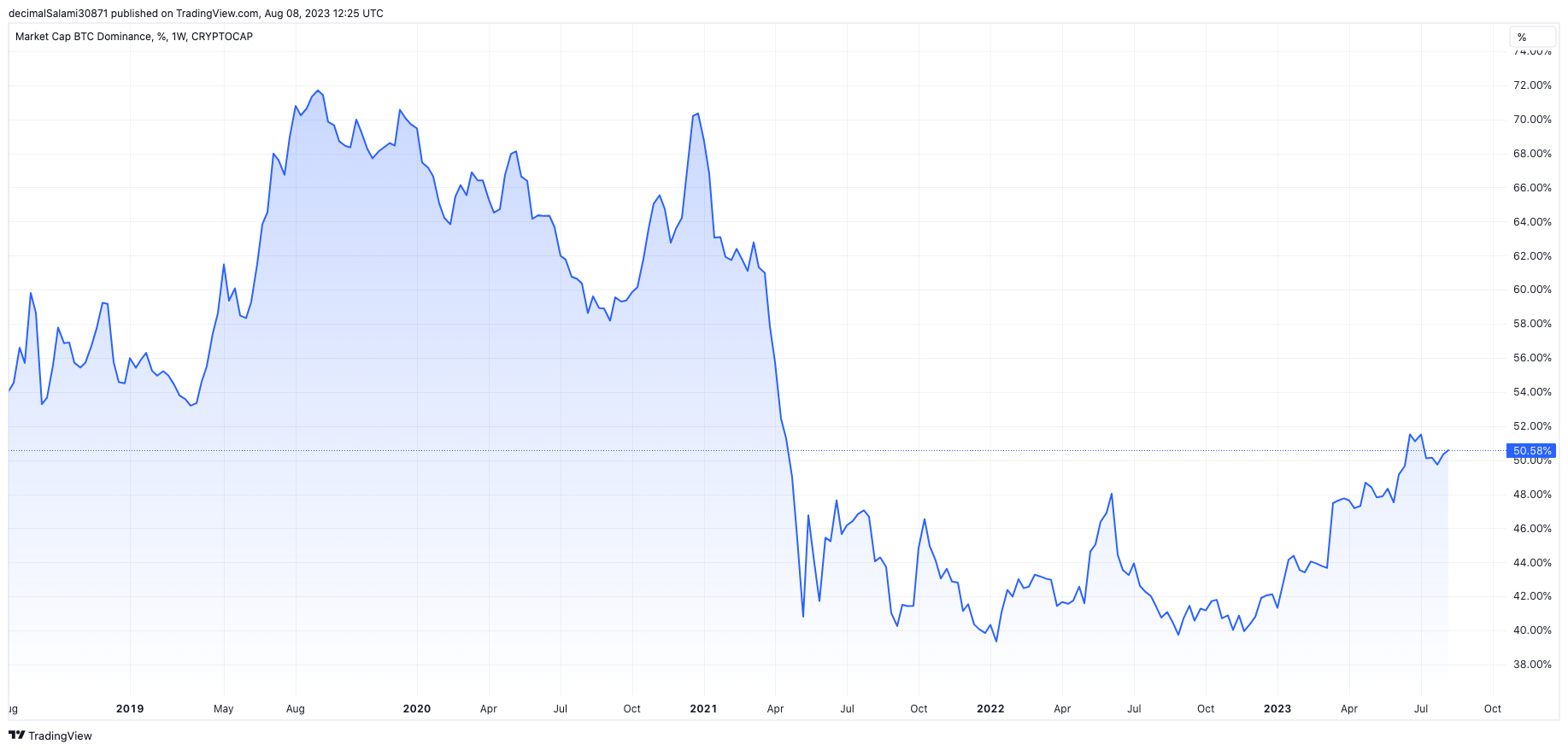
This rise in Bitcoin dominance is unusual because it has occurred during a period of price expansion across the industry. Previously, Bitcoin has tended to underperform alts in bull markets, with dominance therefore falling.

One factor in both the rise in Bitcoin dominance and the low market participation across crypto is the impact of the regulatory crackdown in the US. The SEC outlined several coins as securities, including Solana (SOL), Polygon (MATIC) and Cardano (ADA), and while Ripple secured an optimistic ruling in its own case against the SEC, the climate is undoubtedly more uncertain with regard to where all these tokens fit in. 

Bitcoin, on the other hand, has largely been left out of the securities wars, and has even seen a slew of spot ETF applications lodged in recent months. Lawmakers very much seem to be dealing with Bitcoin as a separate genre of asset (as many in the sector have long done). 

The regulatory crackdown on exchanges themselves has also been severe, and has certainly contributed to falling volumes across the space, Bitcoin or otherwise. Both Coinbase and Binance were sued in June, with Binance also the subject of a Department of Justice investigation, with some reports claiming charges may be imminent. 

Moreover, we need to be careful when assessing the apparent trading volumes. One of the (many) accusations in the SEC case is that Binance manipulated trade volumes, meaning the true figures could be even lower. 

Then there is the issue of, even if real, how much volume is meaningful. Binance ceased zero-fee trading for all Bitcoin pairs in March, and before this, zero-fee trading accounted for approximately 75% of volumes on the exchange. After the promotion ended, however, it promptly fell to 36%, with the majority through the stablecoin which Binance continued to promote zero-fee trading on: TrueUSD. Prior to this development, TrueUSD was seldom used with minimal liquidity. 

Volatility

With the fall in volume, it follows that there is also a fall in volatility. Traders live and die by volatility, and it is closely correlated with volume. In fact, volatility is currently around three-year lows.

The effects of the drain in market participation are being seen on volatility beyond Bitcoin, too. The below chart shows that Ethereum volatility has recently dipped to the level of Bitcoin’s, or even below it. That contrasts with what we have come to expect historically, with Ethereum typically trading with higher volatility than its big cousin. 

The volatility is more notable when considering that liquidity is also so thin. Order books are as shallow as they have been in a long time. Liquidity took a particular fall in November when prominent market maker Alameda collapsed amid the FTX scandal. Since then, not only has its capital not been replaced on order books, but more US market makers have pulled out or scaled back operations in the wake of the regulatory climate. 

All things considered, the crypto markets are showing remarkably low levels of liquidity, trading volume and volatility. This comes via a combination of factors, from investors retreating on the risk curve to other bear market-related factors. Regulation is also a key factor, however, and undoubtedly suppressing market activity while uncertainty is so high. 

The turbulent price action will return. But for now, crypto charts are not throwing up their trademark chaos.

The post Crypto market participation continues to dip appeared first on CoinJournal.
Bitcoin Drops Below $29k: Is this a buying opportunity for traders?

Key takeaways

  • Bitcoin has dropped below the $29k level, presenting a buying opportunity for some investors.

  • Shiba Memu’s presale has now surpassed the $2 million mark.

The cryptocurrency market has been bearish this week, with the prices of most cryptocurrencies currently in the red zone.

Bitcoin, Ether, XRP, and SHIB have all lost more than 2% of their values this week and could experience further downward movement in the short term. 

Bitcoin drops below $29k level

Bitcoin has dropped below the $29k level as the cryptocurrency market recorded huge losses over the last 24 hours. At press time, the price of Bitcoin stands at $28,479 per coin. 

The other leading cryptocurrencies including ETH, SOL, SHIB, and XRP all recorded massive losses over the past few days. The decline in prices could serve as an opportunity for investors to purchase more cryptocurrencies. 

Despite the bearish sentiment in the market, Shiba Memu’s presale has hit a new milestone. The team has now raised more than $2 million in this presale round. 

What is Shiba Memu?

Shiba Memu is a cryptocurrency project that seeks to make it easier for people and organisations to carry out marketing campaigns. Although it is a meme coin, Shiba Memu has real-world use cases and offers value to the users.

It is still in its presale stage but Shiba Memu holds promise, with investors already pledging millions of dollars to the project’s development. 

So far, the Shiba Memu stage two presale has raised more than $2 million, with over 65 million SHMU tokens sold so far. 

In their whitepaper, the Shiba Memu team said the project combines AI and blockchain technology to develop an unstoppable, entirely self-sufficient marketing powerhouse.

Shiba Memu can execute the work of 100 marketing agencies thanks to how it leverages AI. As an AI-based platform, Shiba Memu will provide users with operational transparency thanks to its use of blockchain technology. 

If deployed, Shiba Memu will work 24/7 to identify ideal creative scenarios and work round the clock to develop excellent marketing campaigns. 

The project was launched as a meme coin as the team decided to take advantage of the recent popularity of meme tokens. Meme coins have become important in the crypto ecosystem, growing from a market cap of $0 in 2019 to $20 billion in 2022. 

With Shiba Memu, the platform has self-sufficient marketing capabilities powered by AI technology. When deployed, Shiba Memu will develop its own marketing strategies, write its own PR, and promote itself in relevant forums and various social media platforms.  

Currently, Shiba Memu operates on BNBChain and Ethereum, two of the leading DeFi blockchains in the world.

Shiba Memu’s presale hits $2 million

The cryptocurrency market has been bearish in recent weeks but that hasn’t deterred investors from investing in projects.

Shiba Memu’s stage two presale recently hit an important milestone. The team has raised more than $2 million in this current presale round and could reach its target very soon. 

Shiba Memu has been attracting interest from investors despite the current market conditions. Funds generated from the various presale rounds would be diverted towards developing the Shiba Memu products. The team will use most of the funds to develop the Shiba Memu AI technology. 

Click here to find out more about Shiba Memu’s presale event. 

Should you invest in Shiba Memu today?

The cryptocurrency market has underperformed this week, with the prices of most coins in the red zone. The recent bearish trend could serve as an opportunity for investors to buy more cryptocurrencies. 

As investors continue to look for worthwhile projects, Shiba Memu could be one to consider. By combining the power of blockchain technology and AI, Shiba Memu could turn out to be a unique project. The platform will look to ease marketing strategies for companies and organisations. 

With the right level of adoption, its native SHMU token could rally higher over the coming months and years.

The post Bitcoin Drops Below $29k: Is this a buying opportunity for traders? appeared first on CoinJournal.

Dogecoin price prediction: multi-time technical analysis

  • Dogecoin price has joined other cryptocurrencies in a strong sell-off.

  • Technical analysis shows that the coin will continue falling.

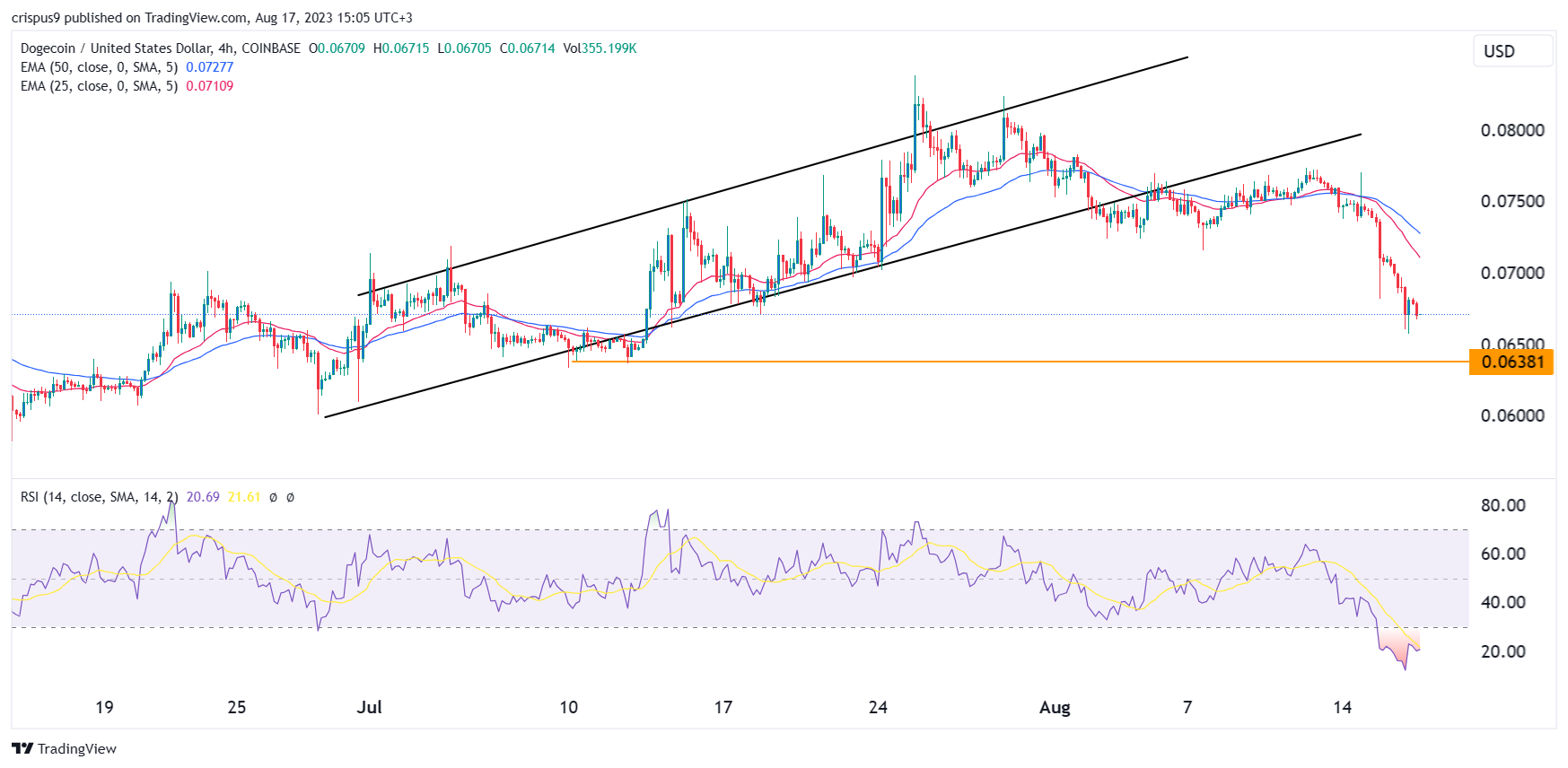
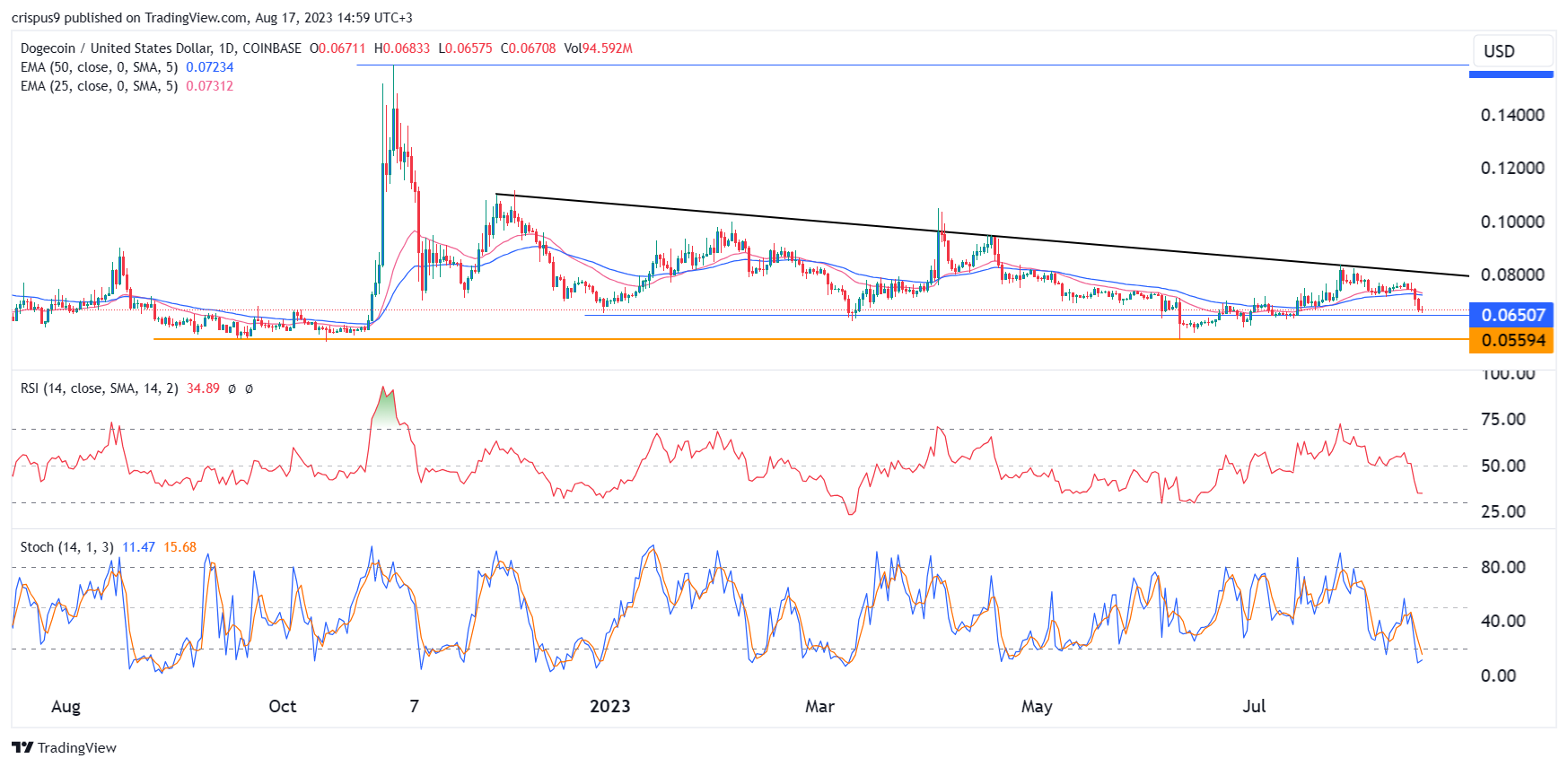
Dogecoin price was not left behind in the recent cryptocurrency sell-off. The coin dropped to a low of $0.067, the lowest level since July 18th. It has dropped by more than 20% from the highest level in July and over 58% from the highest level in 2022. Other coins like Bitcoin, Litecoin, and Hedera Hashgraph have also dipped.

Dogecoin price forecast (daily chart)

The daily chart shows that the DOGE price has been in a strong bearish trend after peaking at $0.1587 in October last year. It has underperformed the crypto market, partly because of the strong growth of alternative meme coins like Bone Shibaswap, Pepe, and Bad Idea. 

The coin has remained below the descending trendline, which connects the highest levels since December last year. At the same time, the coin has moved below the 25-day and 50-day exponential moving averages (EMA). 

Dogecoin price is hovering slightly above the important support level at $0.065, the lowest point in March and December last year. The Relative Strength Index (RSI) has moved below the neutral point at 50 while the Stochastic Oscillator has moved below the oversold level.

Therefore, DOGE price will likely have a bearish breakout in the next few days. If this happens, the next level to watch will be at $0.055, the lowest level on June 10th 2023 and September last year. The stop-loss of this trade is at $0.080, the descending trendline.

DOGE price analysis (4H chart)

Turning to the four-hour chart, DOGE price has been in a downtrend in the past few weeks. It has managed to move below the ascending channel shown in black. It dropped below that level on August 2nd and then retested it on August 5th. In technical analysis, a break and retest pattern is usually a sign of a bearish continuation.

Dogecoin has also retreated below the 25-period and 50-period moving averages while the Relative Strength Index has moved below the oversold level. Therefore, the outlook of the token is bearish, with the next level to watch will be at $0.063. 

How to buy Dogecoin

eToro

eToro is a multi-asset investment platform with more than 2000 assets, including stocks, ETF’s, indices, commodities and Cryptoassets. eToro offers over 60+ Cryptoassets to invest or invest in their CryptoPortfolio where investors can benefit from the accumulated growth of Bitcoin, Ethereum, XRP, Litecoin and other leading cryptocurrencies. eToro users can connect with, learn from, and copy or get copied by other users.

AVATrade

Ava Financial Ltd operates the AvaFX and AvaTrade forex brands and all business associated with them. The company has a branch office in Dublin, Ireland, which enabled it to get an operational license from the Irish authorities.

The post Dogecoin price prediction: multi-time technical analysis appeared first on CoinJournal.

Is Chancer a profitable bet in 2023 and 2024?

  • Chancer aims to take the mainstream betting market to the blockchain.

  • The P2P betting has been in demand, as the presale raises $1.4 million

  • Chancer has huge potential after listing and could rise more after the platform launches

Blockchain is fast infiltrating traditional sectors. Betting is one of them, with Chancer taking steps to take the predictive market to the blockchain. Chancer lets users bet on a fully decentralised ecosystem powered by a crypto token. Since launching a presale, investors have bought over $1.43 worth of tokens. But is Chancer worth buying at presale ahead of the listing?

How Chancer works

Chancer is coined under the phrase “Your Game, Your Rules, Your Odds.” That partly explains how the platform works.

Chancer allows users to dictate the game of betting. Users can determine what they want to bet on, from mainstream events like football to social events. There is no limit on what users can bet on, making Chancer a game-changer in new betting experiences. 

To bet, users create a peer-to-peer Chancer market via the decentralised ecosystem. Users can invite others (peers) to their markets. 

Once created, users develop rules that will govern their P2P betting market. They also determine the odds of claiming winnings.

The P2P model of Chancer is unique from the mainstream betting platforms. Users are not constrained to what bookmakers provide. This aspect is expected to bring limitless betting opportunities and attract new users. The revolutionary features explain the fast presale of the token. 

What is the value proposition of Chancer?

Betting is one of the fastest-growing and most popular sectors globally. By bringing it to the blockchain, Chancer has a huge potential to find unlimited uses. Users need not turn to their local or bookmaker currencies to bet and claim winnings. They will do so with the Chancer token. This means the potential for the token to skyrocket is high as demand increases, delivering returns.

Owning Chancer is also an opportunity to earn through market-making rewards. Users get rewarded for creating the P2P markets. The native token can also be staked for passive income-generating opportunities. Those who like to spread the word about Chancer are rewarded for their efforts through a Share2Earn feature.

Betting does not also need to be boring too. Chancer features real-time or live streaming powers via P2P markets. This is a good way to engage with wagers in one’s betting cycles and have fun. 

Chancer price potential and prediction in 2023 and 2024

The magic of creating one’s betting market through Chancer gives the token a lot of potential. Analysts have lauded the token as a 10x investment, which is realistic and attainable.

Based on the project’s roadmap, Chancer will be listed on Uniswap in Q3 2023. The company seeks a minimum of two CEX listings in the quarter. The listing will open up the token for more buys and unlock value. It means the value of Chancer could start to rise then.

But from a prudential perspective, Chancer’s value could rise by 1,000% in 2024 or more in the future. This is after the main platform launches, and the value is unlocked from organic use rather than speculation. For 2023, investors should be comfortable with 100% or more increases. A 10x increase could be overambitious in the near term.

Is it the right time to buy the Chancer token?

There is a clear expectation that Chancer will surprise the markets, looking at its successful presale. The price will be ready for takeoff when the token is listed in the third quarter. Investors that miss the presale may be forced to buy the token at a higher price on exchanges. 

Buying the token at the presale is advantageous as the token’s price is low. More so, the token is most attractively priced at the initial stages. For example, while Chancer started the presale at $0.01, it now goes for $0.011. That makes it worthwhile to buy it now rather than later.

The post Is Chancer a profitable bet in 2023 and 2024? appeared first on CoinJournal.

Coinbase stock: bouncing back but a disaster for investors to date


Key Takeaways 

  • Coinbase went public in April 2021, close to the top of the crypto market and near a $100 billion valuation
  • Despite a stout 141% rise thus far this year, it remains 77% off its IPO price
  • It has underperformed Bitcoin significantly
  • Regulatory issues cloud picture but hope remains that it can establish itself as largest fiat on-boarder

Coinbase stock is having a bumper year. The cryptocurrency exchange is up 141% year-to-date, far exceeding both Bitcoin and the Nasdaq, which have risen 77% and 31% respectively.  This year-to-date gain comes despite a 24% fall over the last month. 

And yet, despite the boisterous performance thus far this year, for those who invested in Coinbase a couple of years ago, it has been nothing but pain. The stock remains 76% below its IPO price from April 2021. At one point flirting with a $100 billion valuation, today it has a market cap of $19 billion. 

The travails of the stock sum up the struggles in the wider cryptocurrency industry over the last eighteen months. Booming during the pandemic as stimulus cheques flowed and interest rates were non-existent, the music stopped last year once inflation began to spiral. Central banks were forced to hike interest rates, with the US Federal Reserve particularly aggressive. Today, rates are north of 5%, with risk assets pulling back severely last year as a result. 

Trouble within crypto

In addition to the harsh macro climate, the crypto sector has done itself no favours. There have been several startling collapses which triggered mass contagion across the industry. The first was the death spiral of the UST stablecoin, taking down the entire Terra ecosystem and leading to a host of bankruptcies, including hedge fund Three Arrows Capital.

Crypto lender Celsius were among the other firms to follow, but it was the demise of FTX, the Bahamas-based exchange, that was the cherry on top. Bitcoin fell to $15,500 and the entire industry was in disarray. For Coinbase shareholders, despite the evaporation of a key competitor, the stock price suffered further, such was the damage to the ecosystem. 

In retrospect, Coinbase went public right at the top, walking into an oncoming storm. Marking their IPO on a Bitcoin price chart below shows how poignant the timing was. 

Yet even with bad timing, it has underperformed Bitcoin. While the two assets have been highly correlated, since the start of 2022 (roughly coinciding with the start of the crypto bear market), Coinbase has headed lower than the world’s biggest crypto. 

Regulation

A big part of the issue is regulation. US lawmakers are cracking down on the cryptocurrency industry, and Coinbase is squarely in the line of fire. The exchange was sued in June for securities violations. 

“(The SEC) came back to us, and they said . . . we believe every asset other than bitcoin is a security,” Brian Armstrong, CEO of Coinbase, said. “And, we said, well how are you coming to that conclusion, because that’s not our interpretation of the law. And they said, we’re not going to explain it to you, you need to delist every asset other than Bitcoin.” 

“We really didn’t have a choice at that point, delisting every asset other than bitcoin, which by the way is not what the law says, would have essentially meant the end of the crypto industry in the US,” Armstrong continued. “It kind of made it an easy choice . . . let’s go to court and find out what the court says.”

The court case will be pivotal not only for the future of Coinbase’s business, but the entire crypto industry in the US. Yet despite the regulatory troubles, Coinbase is arguably the most reputable major exchange. Its legal trouble centres on securities violations, a far cry from the laundry list of accusations against the biggest exchange, Binance. Changpeng Zhao’s company faces charges of trading against customers, manipulating volume, circumventing AML and KYC laws, and more. 

Institutional on-boarder

Additionally, many of the spot ETF applications which have been lodged with the SEC recently outline Coinbase as a proposed custodian. This, in addition to its cleaner reputation as mentioned above, highlights an angle that Coinbase could exploit if it does manage to fight its corner in court successfully: institutional money. 

If or when institutional capital is allowed to flow freely into crypto, Coinbase – at least right now – appears well placed to vacuum up all that volume and offer as a vital on-boarding into the on-chain world for all this trad-fi capital. 

It is difficult to forecast how the legal case will play out, and in any case, it will not be resolved quickly. On the positive side for COIN investors, last month’s ruling in the landmark Ripple security case provided hope, even if it was only a partial win, with the result also pushed back against by the SEC.

Whatever happens with that case, COIN investors will hope that the future brings more positive results than the past, as the stock has been a disaster for most. Perhaps the best way to sum it up is this: had investors put their money in FTX, and if FTX creditors end up securing 24 cents on the dollar or greater, they would be better off than Coinbase investors. Obviously, that is a silly comparison and assumes Coinbase trades flat from here (not to mention the fact that bankruptcy proceedings will take years), but it does indicate quite how badly Coinbase stock has performed since those dizzying days of 2021. 

The post Coinbase stock: bouncing back but a disaster for investors to date appeared first on CoinJournal.