
Bitcoin miner Canaan’s mining revenue rose 43% in Q2

  • Canaan Inc. (NASDAQ: CAN) has released its Q2 financial report showing an increase in mining revenue.
  • The Bitcoin miner’s total revenue rose to $73.9 million, increasing by 33.7% compared to Q1, 2023.
  • Canaan reportedly held 1125 bitcoins as of June 30, 2023.

Canaan Inc. (NASDAQ: CAN), one of the leading Bitcoin mining companies, has reported its unaudited financial results for Q2, 2023. According to the report, revenue from BTC mining jumped 43.3% quarter-on-quarter, from $11.1 million to $15.9 million.  

Meanwhile, total revenues rose to $73.9 million in the quarter, 33.7% up on Q1 revenues of $55.2 million. However, with the crypto market still heaving from the bear market impact, Canaan’s second quarter revenue is significantly lower compared to the $245.9 million reported in Q1, 2022.

Commenting on the financial results, Canaan CEO Nangeng Zhang, said in a press release: 

“We navigated the challenges in the second quarter of 2023, surpassing our topline guidance to achieve $73.9 million in revenue. Despite the relatively stagnant bitcoin price in the second quarter, our endeavor to drive sales across various fronts, including major clients, channels, and retail, yielded encouraging results. This effort propelled our total computing power sold to a remarkable 6.1EH/s, up 44% sequentially.”

Canaan held 1,125 bitcoins

According to Mr. Zhang, the company benefited from its collaboration with channel clients, and saw its online retail store attract new clients from across the globe.  The firm has recently looked to cement its footprint in the sector, setting up mining ventures in Africa and South America.

As noted above, Canaan sold 6.1 million Thash/s – this up from 4.2 million Thash/s in Q1, 2023. The company had sold a total of 5.5 million Thash/s in Q1, 2022.

CFO James Jin Cheng stated: “In the second quarter of 2023, we observed improvement in both our sales and mining activities, which contributed to our better-than-expected revenue performance. Despite a decrease in average selling price, our product sales grew by 31.3% quarter over quarter, driven by increases in total computing power sold.”

While the company expects Q3 revenue to decline to $30 million owing to the market conditions, net loss in Q2 was $110.7 million, compared to $84.4 million in Q1. The company had seen a net income of $90.1 million during the same quarter in 2022.

Per the report, Canaan held 1,125 bitcoins worth $28.8 million as of June 30, 2023. The company owned 747 of these bitcoins, while 378 BTC was from customer deposits. Impairment on the crypto in Q2 was $2.4 million, compared to $0 in Q1 and $4.5 million in Q2, 2022.

The post Bitcoin miner Canaan’s mining revenue rose 43% in Q2 appeared first on CoinJournal.
Crypto exchange Binance is considering a full exit from Russia

Key takeaways

  • Binance is considering exiting the Russian market as it continues to face regulatory challenges in other parts of the world. 

  • The crypto exchange recently revealed that its users in Belgium will access its services via its Poland unit.

Binance to exit the Russian market

Binance, the world’s leading cryptocurrency exchange by market cap, is reportedly considering exiting the Russian market. This is according to a recent report by the Wall Street Journal. 

This latest cryptocurrency news comes as the crypto exchange continues to face regulatory challenges in Europe and the United States. 

The report pointed out that Binance is currently tackling multiple lawsuits with US regulators and is currently considering numerous options, including a full exit from the Russian market.

Binance is working to align itself with international sanctions

Binance said it is working to align itself with international sanctions following allegations that it is helping nationals move funds outside the United States earlier this year. 

The cryptocurrency exchange is working to block accounts belonging to Russian nationals with connection to the Kremlin. 

In 2022, the crypto exchange took steps to block accounts belonging to Elizaveta Peskova, the daughter of Dmitry Peskov, spokesperson for Russian leader Vladimir Putin. 

Binance also said it shuttered accounts from others connected to family members of top Russian officials. The moves came following sanctions against Peskova by the US Treasury. 

The cryptocurrency exchange has been facing regulatory challenges in the United States and other parts of the world.

Earlier this month, Binance informed its users in Belgium that they could now access its services via Binance Poland, the crypto exchange’s Polish-regulated arm. The move was to ensure that Binance complies with regulatory requirements in the country.

The cryptocurrency exchange also discontinued support for its crypto-backed debit card for customers in Latin America and the Middle East earlier this month. However, Binance didn’t specify the reasons behind its decision. 

The US and EU have imposed sanctions on Russia after it invaded Ukraine last year. They have imposed bans on the acquisition, import, or transfer of coal and other solid fossil fuels.

The post Crypto exchange Binance is considering a full exit from Russia appeared first on CoinJournal.

Genesis and DCG reach in-principle agreement to recover creditors’ funds

  • Digital Currency Group (DCG) moving toward resolving the financial challenges of its crypto lending subsidiary, Genesis.
  • The agreement could possibly lead to a fair recovery for creditors.
  • The agreement is still subject to several handles, but Genesis expects the agreement to be completed in the coming weeks.

According to a document submitted on Monday to the US bankruptcy court in the Southern District of New York, Digital Currency Group (DCG) and Genesis Global’s creditors have struck an in-principle agreement to settle the claims that surfaced during the crypto lender’s bankruptcy proceedings.

Genesis Global Holdco, LLC, Genesis Global Capital, LLC, and Genesis Asia Pacific Pte. Ltd. voluntarily filed petitions under Chapter 11 of the US Bankruptcy Code in January 2023.

Genesis creditors to get refunds in US dollar

Genesis, the crypto lending subsidiary of Digital Currency Group (DCG), had almost $3.5 billion in debt to its top 50 creditors, one of them being Gemini, according to the bankruptcy documents. Gemini and Genesis collaborated to give its users the option to lend Genesis their cryptocurrency holdings in return for the promise of interest payments through the now-defunct Genesis Earn program.

The recently reached in-principle agreement indicates that unsecured creditors may receive a recovery of between 70% and 90% in US dollar equivalent, potentially settling lingering disputes and securing a fair recovery for creditors.

Depending on the value of the digital assets involved, the recovery on an in-kind basis is anticipated to be between 65% and 90%.

Existing Digital Currency Group liabilities

The resolution of DCG’s current obligations, which total about $630 million in unsecured loans due in May 2023 and $1.1 billion under an unsecured promissory note due in 2032, is one of the agreement’s essential components.

According to the agreement, the payback will take place in two stages: an initial repayment of about $328.8 million with a two-year maturity and a second repayment of $830 million with a seven-year maturity.

DCG has also agreed to make a further $275 million payment, which will be made in four equal installments. These payments, which will take care of the maturing debts connected with the unsecured loans due in May 2023, are scheduled to be made after the partial repayment agreement date.

Notably, neither the Ad Hoc Group of Genesis’ lenders nor Gemini support the in-principle agreement.

The post Genesis and DCG reach in-principle agreement to recover creditors’ funds appeared first on CoinJournal.

Akropolis (AKRO) up 441%: here’s why the crypto is rising

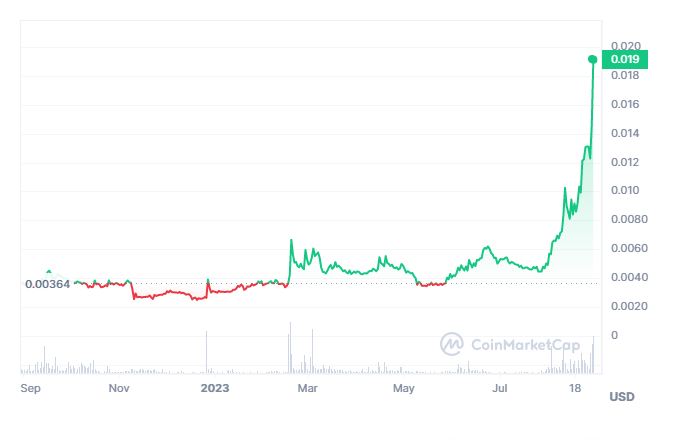
  • The price of Akropolis (AKRO) cryptocurrency has risen by 441% over the past year.
  • In the past 24 hours, the coin has surged by 30% to trade at $0.0192.
  • Akropolis is one of the best-performing cryptocurrencies in 2023.

The native token of Akropolis, a decentralized finance (DeFi) protocol focusing on under-collateralized loans, has been on steroids since the beginning of the year. Akropolis (AKRO) price has risen by 441% since the beginning of the year, marking a splendid growth of the DeFi token.

While those who invested in AKRO early are enjoying their profits, new investors are hesitant since the cryptocurrency could be heading into the overbought region after such a magnificent price surge. However, that can be only determined by understanding what is causing the token to rise.

Here is why the Akropolis (AKRO) price is rising

The main reason why the Akropolis (AKRO) price is going up is the increased activity on Akropolis, especially after the recent update.

The Akropolis Protocol is a collection of Ethereum-based DeFi aggregation and automation initiatives. Akropolis seeks to offer DeFi equivalents of essential financial services like access to credit with lenient terms and insurable savings (variable and fixed rate savings deposits). The platform is integrated with Yearn, MCDEX, Liquity, Maker, Fulcrum, Aave, Compound, Curve, and dYdX.

The Akropolis Protocol team concentrates on and creates a user-friendly portfolio of portable, borderless, trust-minimized DeFi products for financial operations and decision-making. The Sparta product, which focuses on undercollateralized loans, and Delphi, which focuses on automated passive mixed investing/income products, are constructed on top of the AkropolisOS, which is the main building block.

The Delphi beta was carefully placed on the Ethereum mainnet on August 12, 2020, and a bug bounty was run before a full launch on August 24, 2020. With the Akropolis Delphi Token (ADEL) token, the Akropolis Protocol further introduced Sparta v2, the DeFi yield re-balancing module, the crypto/fiat on-off ramp, support for new stablecoins, UI/EX upgrades, and the liquidity mining incentives feature.

Users can now pay in currencies other than ETH through integrations with OpenGSN. The protocol also has insurance protection from Nexus Mutual/Opyn to guard against hacking and programming flaws.

In August 2023, Akropolis made several updates among them the POC-Polkadai bridge, a Parity Substrate Blockchain bridge for self-transfers of DAI Token (ERC20) to sDAI (ERC20 representation).

The post Akropolis (AKRO) up 441%: here’s why the crypto is rising appeared first on CoinJournal.

SEC charges Impact Theory with unregistered offering of NFTs

  • SEC charged US-based media company Impact Theory with offering and touting investment potential of their Founder’s Key NFTs.
  • Impact Theory did not deny nor agree to the charges, but accepted a $6.1 million fine.

The US Securities and Exchange Commission (SEC) has charged Los Angeles-based media and entertainment company Impact Theory, LLC for allegedly offering unregistered securities in the form of NFTs.

SEC says Impact Theory violated securities laws

In a press release on Monday, the US securities regulator pointed out that Impact Theory had raised over $30 million in the process, including from investors in the United States.

“Among other things, Impact Theory emphasized that it was “trying to build the next Disney,” and, if successful, it would deliver “tremendous value” to Founder’s Key purchasers,” the SEC said.

As such, it meant the NFTs were sold to investors as investment contracts, which makes them securities. Impact Theory therefore violated federal securities laws. Per the SEC order, the LA-based company has agreed to pay a fine of over $6.1 million as well comply with a cease-and-desist order. The company will also refund affected investors and destroy all the NFTs.

The SEC said: “Impact Theory agreed to destroy all Founder’s Keys in its possession or control, publish notice of the order on its websites and social media channels, and eliminate any royalty that Impact Theory might otherwise receive from future secondary market transactions involving the Founder’s Keys.”

SEC’s action against Impact Theory is a first in the NFTs space, but continues a series of enforcement actions and settlements seen in recent months. These include lawsuits against leading crypto exchanges Binance and Coinbase.

However, the regulator suffered a significant blow in July when US Judge Analisa Torres delivered a ruling that stated the cryptocurrency XRP is not a security. The SEC recently filed a motion seeking an interlocutory appeal, a step many legal experts and industry leaders say will see the agency embarrassed once again.

The post SEC charges Impact Theory with unregistered offering of NFTs appeared first on CoinJournal.