
Could softer liquidity conditions finally pump Bitcoin?


Key Takeaways

  • The US unemployment rate jumped to 3.8% last month, from 3.5% previously
  • Cooling economic data has strengthened the market’s resolve that interest rate hikes could soon cease
  • Implications for a pivot in policy are key for the crypto markets

Bitcoin has had a torrid time ever since the economy transitioned to a tight monetary environment for the first time since the Genesis block was mined, all the way back in January 2009. 

Throughout 2022, the tightening of liquidity conditions dragged Bitcoin down (also helped by some rather shocking events within the crypto ecosystem). From trading as high as $68,000 in Q4 of 2021, it tumbled as low as $15,500 before bouncing back somewhat thus far in 2023. 

This makes sense, given Bitcoin resides so far out on the risk spectrum. The question of whether Bitcoin can one day operate as an uncorrelated asset, or some sort of digital gold, is an intriguing one. It is evident, however, that this has not yet happened. 

Partially propelled upwards by the rampant money printing and easing of global liquidity since the financial crisis in 2008 (which just so happens to coincide with Bitcoin’s launch, a fact which did not go over the head of Satoshi Nakamoto when he/she mined the Genesis block), Bitcoin went parabolic during COVID when central banks really took things to the next level. 

But the music had to stop. And when inflation began to spiral, those same central banks were forced to reverse course, embarking on one of the most rapid tightening cycles in recent memory. Up went interest rates, dispelling the complacent notion that the new era of zero-rates was here to stay. And they kept going up – today, T-bills are paying north of 5%.

The chart below demonstrates the steep incline of the key Fed funds rate:

With economic data remarkably consistent, the Fed was forced to stay the course, rates rising ever higher and higher. Despite some wobbles along the way (the regional bank crisis led by the collapse of Silicon Valley Bank is the clearest example), the economy continued to hum along just fine. 

While this seems like good news (and it is!), it has led to a sort of good news is bad news paradox. To rein inflation in, the economy must slow down. But if the economy does not slow down, inflation remains high and hence rate projections also stay elevated. This is why we have often seen a scenario where markets fall on good news. 

Is the economy slowing down?

However, this could all be about to change. Finally, it seems as if the economy could – finally – be losing some momentum. The most recent Labor Department report shows the unemployment rate jumped to 3.8% last month, from 3.5% previously. 

On the one hand, this shows quite how unusual a situation we are in. Sentiment feels negative, rates have been hiked to oblivion, and yet unemployment is near half-century lows. At least it was, until this report. 

The 30 bps jump is not dramatic, but it could be significant and a demonstration to the Fed that it may be able to (finally) take its foot off the gas. Average hourly earnings also rose 4.3%, down slightly from 4.4% in July. And while employers added 187,000 workers to their payrolls in August, which was a greater number than July, revisions in prior months have shown job growth to be not as strong as first reported.

All in all, this is far from a seismic fallout, but it does at least point towards some progression. Looking at markets, traders felt the same way. Projections around the future path of interest rates immediately became more dovish. The next chart backs out probabilities implied by Fed futures, comparing the projections for the next Fed meeting on 20th September with those same projections a week ago, before the jobs report. 

The chances of a hike at the meeting dropped from 20% to 6%, with the market now expecting no hike with a 94% probability. 

Combined with inflation already coming down significantly in the last twelve months, the macro conditions are undoubtedly far better than they were at this time last year when inflation was not far off double digits. 

Again, the shift is far from dramatic, and the data overall remains strong. 3.8% unemployment is still a stellar number, while wage growth has slowed but is still hotter than what the Fed desires. 

But finally, with rates north of 5%, it appears that the end of the tunnel may be approaching. For Bitcoin, which trades like a high-risk asset, this paints optimism. Of course, the flip side of this is that Bitcoin is already up 55% on the year. Investors must decide to what extent a pivot off tight conditions is already priced in. 

In that respect, the latest report spells out a notable warning. Despite the “optimistic” news that the hiking of interest rates could draw to a close, Bitcoin barely moved as the numbers hit the market. Figuring out this dilemma will be key for Bitcoin traders, but at least the long-term picture feels clearer after eighteen months of brutal liquidity tightening. 

The post Could softer liquidity conditions finally pump Bitcoin? appeared first on CoinJournal.
PayPal launches a crypto-for-USD conversion service

Key takeaways

  • Payment giant PayPal has launched a new service that allows users to convert crypto to US Dollars.

  • This comes after the company launched its on-ramp service that allowed customers to buy crypto.

PayPal allows users to convert crypto to USD

Silicon Valley payments firm PayPal announced via a blog post on Monday that it has launched another crypto-related service. The company now allows users to convert their crypto assets to USD, in the process introducing off-ramp services to its customers. 

PayPal has been operating an on-ramp service that allows customers to purchase cryptocurrencies. The company is now adding an off-ramp service, making it easier for users to convert their crypto assets into dollars. 

In their official statement, the company said;

“By adding Off Ramps, crypto wallet users in the U.S. can convert their crypto to USD directly from their wallets into their PayPal balance so they can shop, send, save, or transfer to their bank or debit card.”

At the moment, the service is available to wallets, dApps and NFT marketplaces, and it’s also live on MetaMask.

PayPal pointed out that Web3 merchants can integrate the off-ramp service to connect to robust security controls and tools for fraud management, chargebacks and disputes

PayPal continues to expand its operations in the crypto space

The payment giant has been expanding its operations in the cryptocurrency space in recent months. This latest development comes barely a month after PayPal launched its USD-backed stablecoin on the Ethereum blockchain. 

PYUSD was launched in partnership with Paxos and will be made available to PayPal’s US customers over the coming weeks. 

The company also partnered with Coinbase to offer cryptocurrency transactions in Europe. The partnership is designed to make it easier for Europeans to purchase cryptocurrencies. 

Crypto wallet manufacturer Ledger also recently announced a new integration that allows US customers to purchase cryptocurrencies like BTC, ETH and ETH using their PayPal accounts. 

The post PayPal launches a crypto-for-USD conversion service appeared first on CoinJournal.

David Marcus sees potential in Bitcoin to be a ‘global payment network’

  • Lightspark CEO says Bitcoin could help transform global payments.
  • David Marcus explained his view today on CNBC’s “Squawk Box”.
  • Bitcoin is currently down about 20% versus its year-to-date high.

David Marcus – the Chief Executive of Lightspark sees a big future for Bitcoin that’s down 20% versus its year-to-date high at writing.

Bitcoin could transform global payments

Marcus has a vision for the world’s largest cryptocurrency that goes well beyond its current stature as a store of value only.

On CNBC’s “Squawk Box”, he asserted that Bitcoin actually had the potential to play a significant role in making global payments as seamless as texting.

What we’re trying to do is turn Bitcoin into a real global payment network. We’re still in the fax era of global payments. That’s what we’re attempting to solve.

Marcus finds the existing fintech apps somewhat inadequate in facilitating cross-border payments. He has previously served as the president of PayPal Holdings Inc.

Bitcoin is not a currency for everyday use

Lightspark is committed to addressing the scalability issues surrounding Bitcoin and making Bitcoin transactions both faster and cheaper.

But the goal is not really to turn Bitcoin into a currency that can be used for everyday transactions, he added in his interview with CNBC today.

Bitcoin on top of Lightning is like a small data packet only for value. You can exchange at edges of network and send dollars to someone who’ll receive Yen or Euros.

Marcus admitted the need to work closely with the regulators to unlock the full potential of Bitcoin in revolutionising the global payment ecosystem.

The post David Marcus sees potential in Bitcoin to be a ‘global payment network’ appeared first on CoinJournal.

Arbitrum price dips further as whales dispose ARB tokens in millions

  • At press time, Arbitrum (ARB) was trading at $0.7665, after dropping 8.60% in a day.
  • Three whales have sold a combined 10.2 million ARB tokens.
  • Arbitrum, however still accounts for 55% of Ethereum’s L2 ecosystem.

In the past month, the Arbitrum (ARB) token has experienced a significant decline in value, losing over 33% of its price, prompting at least three major ARB whales to consider selling their holdings. Among these whales, one still possesses a substantial stake in ARB tokens for potential sale.

Data from Lookonchain revealed an intriguing pattern: Despite Arbitrum’s struggles to regain value, a particular whale continued to accumulate the token over the course of a week. This whale invested 2,000 ETH, equivalent to over $3.27 million, to acquire 3.64 million ARB tokens at an average price of $0.9, starting from September 3, 2023. In the previous month, this same whale had spent 800 ETH, equivalent to $1.47 million, to acquire 1.27 million ARB tokens.

Whales on an Arbitrum (ARB) selling spree

On September 11, 2023, three prominent Arbitrum (ARB) whales took action by transferring a total of more than 10.2 million ARB tokens to Binance, the world’s largest cryptocurrency exchange.

Chinese cryptocurrency journalist Colin Wu disclosed that the first whale had transferred 3.8 million ARB tokens to Binance and sold them at a rate of $0.77 per token, resulting in a profit of 1,812 Ethers (ETH). Remarkably, this whale still retains ownership of 13.7 million ARB tokens available for sale.

Another prominent whale, known as vladilena2.eth, sold 3.63 million ARB tokens at a rate of $0.83 per token. Notably, this wallet also possesses a portfolio exceeding $14 million in various altcoins and recently received 2,800 Staked Ethers (stETH) from Lido Finance (LDO) within the last 24 hours.

The third whale decided to move 2.8 million ARB tokens to Binance when the token’s price was at $0.79. Given that the ARB token’s price has dipped below $0.77 as of the present moment, all three whales have the opportunity to reclaim their investments with profit.

Despite the recent downturn in the ARB token’s value, Arbitrum (ARB) continues to maintain its position as the dominant Layer 2 (L2) solution for Ethereum (ETH). It boasts a total value locked (TVL) of $5 billion, accounting for 55% of Ethereum’s L2 ecosystem. Today, on September 11, 2023, the token reached an all-time low on major spot exchanges, reflecting the challenging market conditions.

The post Arbitrum price dips further as whales dispose ARB tokens in millions appeared first on CoinJournal.

Crypto slides as FTX reveals what assets it holds

  • Crypto prices dropped after an FTX announcement that showed the value of various crypto assets the collapsed exchange held as of August 31. 
  • Bitcoin fell to lows of $25k while ETH, XRP and BNB traded to key support levels.

The crypto market slipped into red on Monday to add to the downside pressure that engulfed major caps over the weekend.

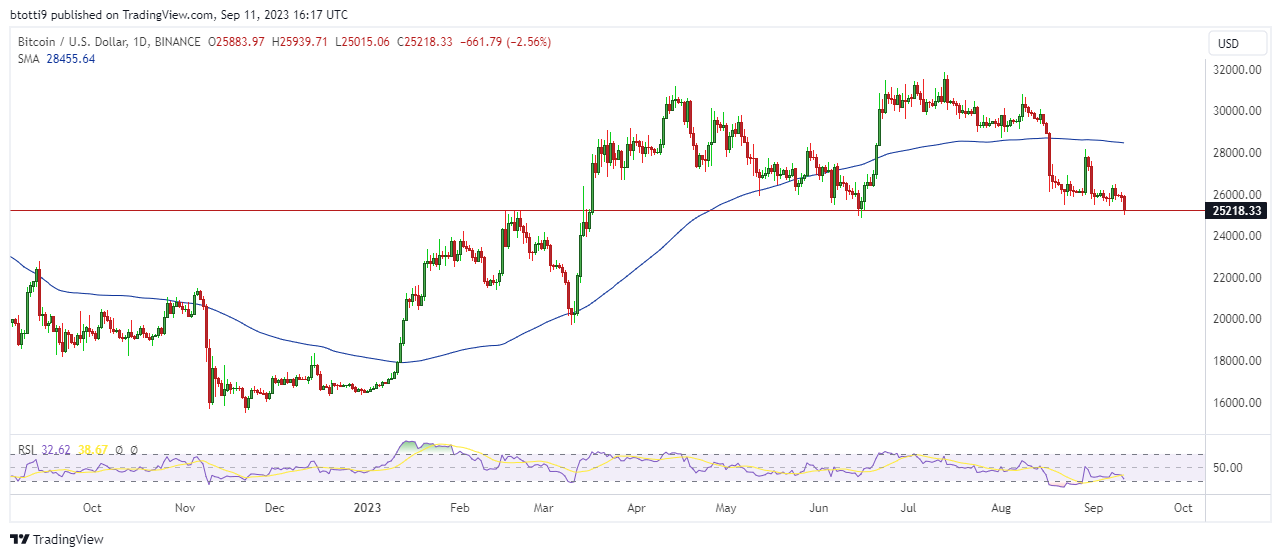
As covered earlier, rumours of a potential sell-off for Solana based on bankrupt crypto exchange FTX liquidation of millions of dollars’ worth of SOL had the broader market reacting lower. Bitcoin, which an analyst says could trigger a cascade of bloodbath with a dip to $25,200, traded to lows of $25,015 on Binance for its lowest level since mid-June.

Bitcoin price chart from TradingView

Ethereum slid further below $1,560 with a 3.7% decline, while BNB and XRP dumped 3% and 5% to touch key levels near $200 and $0.45 respectively. 

FTX reveals crypto portfolio

Crypto exchange FTX went bankrupt in 2022 – former CEO Sam Bankman-Fried is facing a criminal trial over the implosion that sent crypto into a downward spiral. As the debtors eye a reimbursement for victims, one of the latest topics around it is the potential dump of billions worth of tokens to the market.

FTX revealed just what assets it currently holds and their nominal value as of August 31. Notably, SOL accounts for the largest percentage at more than $1.16 billion. 

The exchange held Bitcoin, Ethereum and Aptos worth $560 million, $192 million and $137 million as well as $120 million and $119 million in USDT and XRP. More can be seen as below per this post from Wu Blockchain.

Per the FTX filing, the exchange has another 438 investment portfolios accounting for roughly $4.5 billion. These invested amounts have not been added to the $7 billion that was earlier announced. Some of the assets still being tallied include from Genesis, Yugalabs, and Paradigm.

Meanwhile, over 36,000 customer claims had reportedly been filed as of August 24, with total claims of $16 billion. 

With FTX seeking court approval to liquidate the assets and pay creditors, crypto analysts predict a potential market dump. The negative sentiment is what has driven SOL price sharply lower in the past 24 hours and things could get bloody if the anticipated sell-off happens on September 13.

The post Crypto slides as FTX reveals what assets it holds appeared first on CoinJournal.