
Norwegian Gambling Authority steps up oversight of online casinos

  • Norway’s online casino market faces increased scrutiny
  • Lotteritilsynet oversees banks to enforce a ban on transactions with illegal online casinos in Norway.
  • EGBA urges Norway to adopt a licensing model for online gambling, citing the need for diversity and player safety.

In a bid to further regulate the online casino market including the rapidly growing crypto gambling and reduce illegal gambling, the Norwegian gambling authority, Lotteritilsynet, has intensified its efforts to enforce existing regulations. 

The authority is closely monitoring nine banks in Norway to ensure compliance. It has also banned banks from processing illegal gambling transactions.

Online casino payment restrictions

The ban on payments to and from illegal gambling operators is a crucial regulatory tool aimed at reducing illegal gambling in Norway. 

Recent population surveys suggest that this prohibition has made it increasingly challenging for the public to engage with foreign-based gambling operators, helping fuel a boom in crypto being used in the payments sphere. This measure aligns with Norway’s commitment to fostering responsible gambling practices and protecting its citizens from the adverse consequences of excessive gambling.

Bank surveillance

Under Section 5 of Norway’s gambling act, payment transactions with unlicensed gambling operators are prohibited. Lotteritilsynet has the authority to instruct banks to reject transactions to and from specific accounts and companies involved with unlicensed gambling operators. Reports have it that the regulator has identified nine banks for scrutiny.

While the identity of the nine banks under scrutiny remains undisclosed, the move is part of Lotteritilsynet’s ongoing efforts to enforce the ban and curb problem gambling in the country.

Lotteritilsynet has requested detailed information from the nine banks regarding the steps they have taken to prevent transactions to and from specific companies and account numbers associated with unlicensed gambling operators. Additionally, the authority has asked for insights into the banks’ internal compliance routines.

The banks have been provided with a three-week deadline to furnish Lotteritilsynet with the required documentation and information. The regulatory body expects the banks to demonstrate effective compliance with its directives.

EGBA urge Norway to shift to a licensing model

While Norway maintains strict control over its gambling industry, including a state monopoly on online gambling, calls for reform have emerged. The European Gaming and Betting Association (EGBA) has urged Norway to shift from its current online gambling monopoly to a licensing model.

EGBA’s argument centres on the need to meet the growing demand for diverse online casino options within Norway. Currently, Norway’s online gambling market is limited, with Norsk Tipping covering sports wagering and online casino gaming, while Norsk Rikstoto focuses on horse racing. EGBA points out that neighbouring countries like Sweden and Finland have successfully transitioned to licensing models, providing players with more choices including crypto gambling, which offers anonymity among other benefits associated with the decentralized nature of cryptocurrencies.

EGBA emphasizes that such a transition would not only cater to player preferences but also enhance player safety by implementing clear regulatory frameworks and rules for companies to follow. Moreover, it could lead to increased tax revenue for the government and better regulation of domestic operators.

As Lotteritilsynet intensifies its oversight of payment transactions related to online gambling, the ongoing dialogue surrounding the regulatory framework of Norway’s gambling industry remains at the forefront. Whether the nation will heed the call for change and transition to a licensing model, as suggested by EGBA, is a topic that continues to evolve in the dynamic landscape of online casinos in Norway.

The post Norwegian Gambling Authority steps up oversight of online casinos appeared first on CoinJournal.
Polygon price prediction as Shiba Memu presale surges above $3.55M

  • Rising Polygon prices are attributed to adoption, utility, and partnerships.
  • Polygon’s Q3 innovations boost its position in the crypto market.
  • Shiba Memu’s presale success is driven by an autonomous marketing approach and AI technology.

In the world of cryptocurrency, exciting developments are constantly unfolding, and Polygon (MATIC) is no exception. While Polygon has been making waves in the crypto space, another token, Shiba Memu (SHMU), has been gathering attention with its presale surging above $3.55 million.

In this article, we’ll explore the recent developments in both Polygon and Shiba Memu, shedding light on what’s driving Polygon’s price surge and what the future may hold for both tokens.

Polygon’s impressive run

Polygon, renowned for its innovative “layer two” scaling solution built on the Ethereum blockchain, has been on an impressive run. It addresses the long-standing issues of slow transactions and high fees on the Ethereum network.

Polygon’s solution optimizes transaction speed and reduces fees, making it an attractive choice for developers and users alike.

Key developments in Q3 for Polygon

The third quarter of 2023 has been marked by several notable developments in the Polygon network.

Polygon ID Release 4

Polygon ID Release 4 was unveiled on July 20, offering tools to seamlessly integrate Polygon ID modules into developer projects.

Polygon ID, built on the iden3 protocol, focuses on decentralized identities using zero-knowledge proofs. This innovation has led to a thriving ecosystem with various projects and trusted networks.

Immutable zkEVM Testnet

In August, Polygon Labs and Immutable collaborated to introduce the Immutable zkEVM Testnet, a dedicated chain for gaming that combines zk-rollup technology with Ethereum Virtual Machine (EVM) compatibility.

This promises extensive scalability, reduced costs, and robust security, positioning it as a game-changer in the gaming sector.

Uptrip Loyalty Program

On August 31, the Polygon network welcomed Uptrip, a groundbreaking travel platform.

Uptrip rewards travellers with NFT trading cards for each flight, offering unique rewards such as business lounge vouchers and frequent traveller status unlocks upon completing collections.

This integration highlights Polygon’s versatility in supporting diverse applications.

Polyhedra Network’s Zk-Powered Bridge

In early September, Polygon Labs reported a significant development in collaboration with Polyhedra Network.

Polyhedra Network is working on a cross-chain bridge powered by zero-knowledge (ZK) technology, aiming to enhance interoperability between Polygon and other Layer-1 and Layer-2 networks.

Canto’s Migration to ZK L2

September 18 marked Canto’s migration to a zero-knowledge Layer 2 on Ethereum using Polygon’s Chain Development Kit (CDK). This move allowed Canto to focus on real-world assets while maintaining independence and modularity within the broader ecosystem of ZK Layer 2 networks.

Polygon’s CDK, being permissionless and open-source, provides the flexibility needed for projects like Canto to thrive.

Dragon Fruit Upgrade

The Polygon ZkEVM received its first upgrade, known as Dragon Fruit, on September 20.

This upgrade added support for the latest EVM opcode, solidifying Polygon zkEVM’s position as a pioneer in supporting PUSH0 in Ethereum L2 scaling. This enhancement is expected to contribute to Polygon’s growing popularity.

Why Polygon’s price is rising

Amid these developments, it’s essential to understand why Polygon’s price is experiencing an upward trajectory. The increase in Polygon’s adoption and utility, driven by its scaling solutions and partnerships, has been a key factor. As more projects and platforms integrate with Polygon, its ecosystem grows, making it more attractive to developers and users.

Furthermore, Polygon’s commitment to enhancing the developer experience, fostering interoperability with other networks, and addressing the pain points of the Ethereum network has solidified its position as a leading Layer 2 solution. The utility of Polygon in various sectors, from gaming to DeFi, has contributed to its rising demand, resulting in a positive impact on its price.

Shiba Memu presale surge

While Polygon has been busy with its innovative developments, another player has emerged in the crypto space. Shiba Memu (SHMU) has witnessed a remarkable surge in its presale, surpassing $3.55 million.

The Shiba Memu project prides itself on its self-sufficient marketing capabilities, driven by AI technology, making it a unique and attractive investment in the world of meme tokens.

Shiba Memu’s presale success can be attributed to its growing community, often referred to as the #MemuMafia. This community has been gaining relentless power, and the project’s relentless marketing efforts have played a significant role in its rapid rise.

The #MemuMafia’s support has contributed to the token’s popularity and the funds raised during the presale.

Unique selling proposition

Shiba Memu distinguishes itself by claiming to create its marketing strategies, write its PR, and promote itself in relevant forums and social networks autonomously. This unique approach eliminates the need for extensive human-led marketing efforts, potentially reducing costs and increasing efficiency.

Furthermore, Shiba Memu’s utilization of AI technology allows it to generate an abundance of content, monitor and analyze marketing performance, and engage with users directly through an AI dashboard. This level of automation and innovation has attracted investors looking for a novel and technologically advanced meme token.

Conclusion

The third quarter of 2023 has been a significant period for both Polygon and Shiba Memu. Polygon’s innovative developments and partnerships have fueled its price rise, while Shiba Memu’s presale surge showcases the growing interest in meme tokens with unique value propositions.

The crypto space continues to evolve, offering opportunities for innovation and investment, and both Polygon and Shiba Memu are riding this wave of progress.

The post Polygon price prediction as Shiba Memu presale surges above $3.55M appeared first on CoinJournal.

XRP rallies after major Ripple Labs legal wins

  • Ripple has secured approval in Singapore, paving the way for regional expansion.
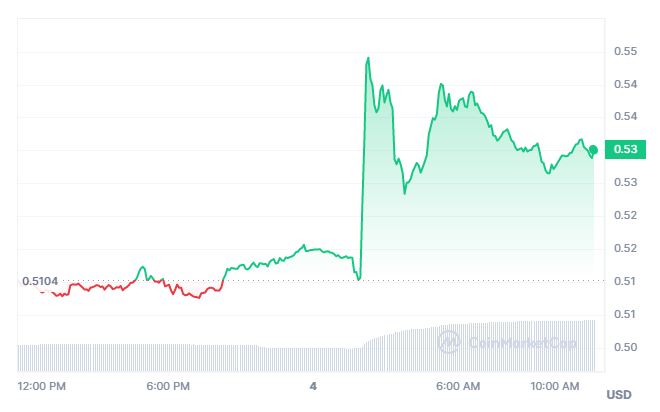
  • AA US Judge has also denied SEC’s appeal boosting XRP price by 4% to $0.53.
  • Ripple’s legal wins showcase its resilience and impact on the crypto market.

Ripple is trending today after its legal triumph in Singapore coupled with the denial of the SEC’s appeal. The two developments have led to a resurgence in XRP’s price.

The cryptocurrency community is closely monitoring these developments, which could have far-reaching implications for both Ripple and the broader cryptocurrency market.

As at the time of writing, the price of Ripple’s XRP token had gained over 4%.  It is currently trading at $0.53, marking a 5.05% increase over the past month and a 6.77% gain over the previous week.

XRP price chart


Ripple secures approval in Singapore

American blockchain payments firm Ripple Labs Inc. has scored a significant legal victory by obtaining full approval to operate as a digital payment token services provider in Singapore. 

The Monetary Authority of Singapore (MAS) granted the license, solidifying Ripple’s position in the cryptocurrency space. Just four months after receiving in-principle approval from the regulator, this development paves the way for Ripple’s local subsidiary, Ripple Markets APAC Pte Ltd, to expand its operations across the Asia Pacific region.

The regulatory clarity provided by MAS has played a pivotal role in Ripple’s success in Singapore. CEO Brad Garlinghouse expressed his enthusiasm for the move, emphasizing Ripple’s readiness to create crypto solutions that enhance utility in the financial industry. 

While the end-users stand to benefit, Ripple’s primary focus remains on businesses and financial institutions that can leverage its tailored products and services.

Ripple’s win against the US SEC

The ongoing legal battle between Ripple and the United States Securities and Exchange Commission (SEC) took an interesting turn as Judge Analisa Torres denied the SEC’s request for an early appeal. 

The decision is a significant setback for the SEC, as it sought to challenge two aspects of the judge’s summary judgment.

In essence, the judge’s ruling distinguishes between Ripple’s different transactions involving XRP. Institutional Sales were categorized as sales of securities, while Programmatic Sales and Other Distributions were not. 

The judge emphasized that Programmatic Buyers did not have the same expectation of Ripple generating profits on their behalf as Institutional Buyers did.

The post XRP rallies after major Ripple Labs legal wins appeared first on CoinJournal.

Binance to cease BUSD lending services by October 25

  • Binance is carrying out a phased termination of BUSD-related services.
  • BUSD withdrawals via various blockchain networks were suspended last month.
  • Binance is currently locked in a legal battle with the US Securities and Exchange Commission (SEC).

In a significant development within the cryptocurrency exchange sphere, Binance has officially announced the discontinuation of borrowing and lending services for its native stablecoin, Binance USD (BUSD).

The move is part of a phased termination of BUSD-related services, culminating in a complete cessation expected by February 2024.

Shutting down BUSD lending 

As per the announcement made on October 3, 2023, Binance is set to shut down BUSD borrowing and lending services by October 25, 2023. The exchange will close all outstanding BUSD loan and collateral positions by the end of the month.

Users who have been utilizing BUSD for lending purposes will now have to explore alternative stablecoins, such as Tether (USDT), Dai, TrueUSD (TUSD), and USD Coin (USDC), for their lending needs on the platform.

Previously, users enjoyed an estimated annual percentage yield of 3% when lending their BUSD on Binance. However, with this move, BUSD’s role within the Binance ecosystem is set to diminish significantly.

Phased termination of BUSD-related services

Today’s announcement follows Binance’s phased approach to discontinue BUSD-related services.

In the previous month, BUSD withdrawals via various blockchain networks, including BNB Chain, Avalanche, Polygon, Tron, and Optimism, were suspended. Notably, BUSD withdrawals remained available on the Ethereum network.

Although BUSD deposits were maintained across all blockchains, users are encouraged to transition their BUSD holdings into fiat or other cryptocurrencies before the looming 2024 deadline.

This decision to pause BUSD-related services is intertwined with Binance’s ongoing legal disputes with the US Securities and Exchange Commission (SEC).

In February 2023, Paxos, the issuer of the BUSD stablecoin, severed ties with Binance due to the legal uncertainties surrounding the cryptocurrency exchange. Paxos also declared its intention to halt redemptions from BUSD to underlying US cash and Treasuries in February 2024, temporarily pausing the minting of new BUSD tokens.

The post Binance to cease BUSD lending services by October 25 appeared first on CoinJournal.

Embattled crypto lender Celsius wants to start repaying customers by year-end

Key takeaways

  • Celsius is seeking court approval to start repaying customers in the coming weeks. 

  • The company will repay its creditors using Bitcoin and Ethereum and stock in the new company.

Celsius seeks to start repaying customers soon

Embattled crypto lender Celsius Network is seeking court approval to start repaying its customers by the end of the year. The company informed a judge during an October 2 heading for its reorganisation plan. 

Celsius’ legal counsel, Christopher Koenig, told the court that the new company, called NewCo, is set to emerge from the proceedings with $450 million in seed funding.

The cryptocurrency lender is now looking to partially repay its creditors using $2.03 billion in Bitcoin and Ethereum and stock in the new company. So far, NewCo has received backing from a consortium called Fahrenheit LLC. The consortium is set to manage the mining and staking business of the company. 

The judge, Martin Glenn, is currently considering the possibility of approving Celsius’s restructuring plan. However, the plan will need to be approved by security regulators in the US. 

While the majority of creditors have approved the reorganisation plan, some are not in favour of it. Celsius said,

“The Debtors arrive at Confirmation with a Plan that has the support of over 95% of voting Account Holders by both number and dollar amount.” 

Celsius could soon be resurrected after filing for bankruptcy

Celsius declared bankruptcy more than a year ago and has been under fire by security regulators. In July, the US Federal Trade Commission slapped Celsius Network with a $4.7B fine for squandering billions in user deposits. 

Its founder, Alex Mashinsky, is still in court after pleading not guilty to fraud charges filed against him by the US Department of Justice.

If the Celsius plan is approved, it would become one of the first failed crypto platforms from last year to be resurrected after filing for a Chapter 11 bankruptcy. 

The company halted withdrawals in June 2022 following the collapse of the Terra/Luna project, and investors have been waiting since then to access their funds. 

The post Embattled crypto lender Celsius wants to start repaying customers by year-end appeared first on CoinJournal.