
Crypto price prediction: Loom Network, ThorChain, Lido DAO (LDO)

Cryptocurrencies had another difficult week even as the US dollar index (DXY) and bond yields rally waned. Bitcoin dropped back to $26,000 while Ethereum slumped to the lowest level in months. There was no major news except the ongoing trial of Sam Bankman-Fried (SBF). This article looks at some of the top coins to watch like THORChain (RUNE), Loom Network (LOOM), and Lido DAO (LDO).

Loom Network price prediction

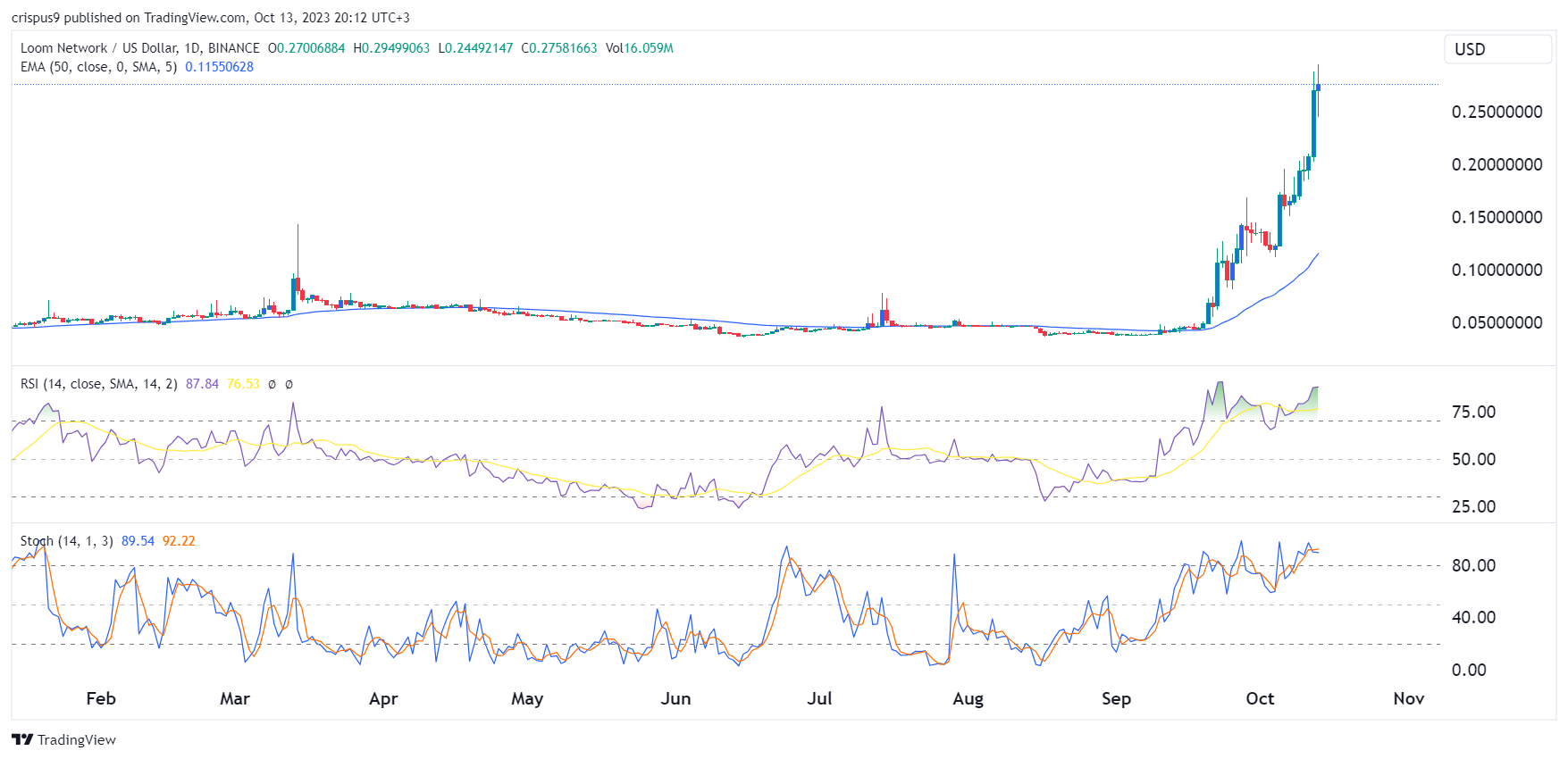
Loom Network price has defied gravity in the past few months. It surged to a high of $0.300, ~670% above the lowest level this month. It has become the best-performing cryptocurrency in the world. Along the way, the coin has jumped above the 50-day and 100-day moving averages (MA). 

At the same time, oscillators like the Relative Strength Index (RSI) and the Stochastic Oscillator have moved to the extremely overbought level. It has also jumped above the Ichimoku cloud. This surge happened after the coin was listed by the likes of Gate, LBANK, and Binance. 

I believe that the risk/reward ratio is not favourable for now based on the Wyckoff model. In other words, the token has moved to the markup stage, where demand is usually higher than supply. Therefore, it will now enter the distribution phase followed by a markdown. As such, the outlook is now bearish, with the next level to watch being at $0.15.
How to buy $LOOM

Bitvavo

The Bitvavo platform was launched in 2018, with the goal to bridge the gap between traditional currencies and digital assets. Bitvavo is making digital assets accessible to everyone, by offering transparent fees, a wide range of assets and an easy to use platform.

BKEX

BKEX is a centralized cryptocurrency exchange located in British Virgin Islands. There are 254 coins and 415 trading pairs on the exchange.

THORChain price forecast

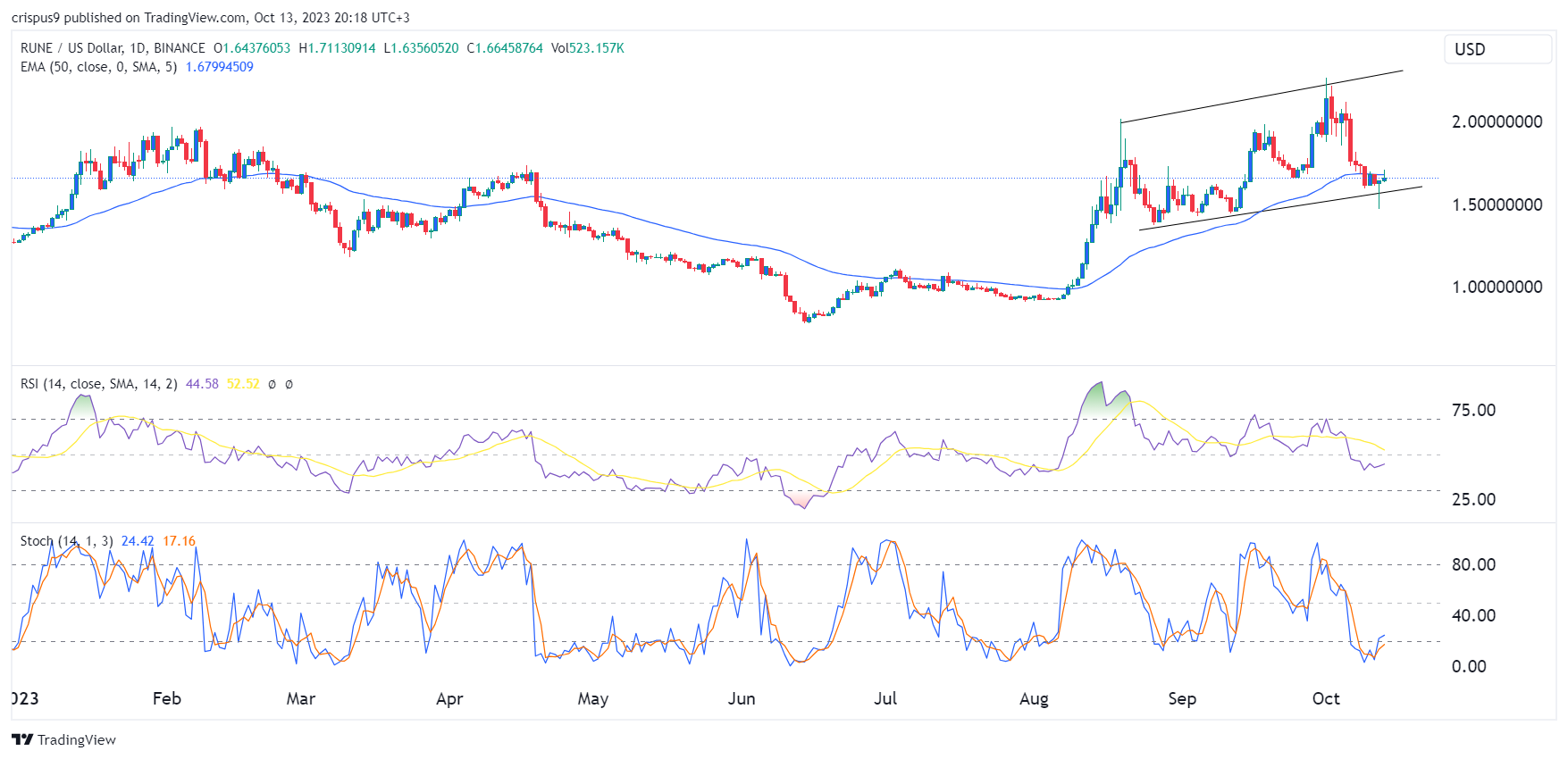
The daily chart shows that RUNE price surged to a high of $2.26 on October 1st. It has now pulled back as the recent momentum faded. This is a sign that it has entered the distribution phase of the Wyckoff model. It has also formed an ascending channel and is now at the lower side.

RUNE price has formed a bearish divergence pattern, which is usually a bearish sign. The Stochastic Oscillator has moved to the oversold level. Most importantly, it has formed a small hammer pattern. This pattern signals that the coin will continue rising as buyers target the resistance point at $2.0. This view will be invalid if it moves below the lower side of the hammer at $1.50.
How to buy RUNE

KuCoin

KuCoin is a global cryptocurrency exchange for numerous digital assets and cryptocurrencies. Launched in September 2017, KuCoin has grown into one of the most popular crypto exchanges and already has over 5 million registered users from 200+ countries and regions. According to Alexa traffic ranking, KuCoin’s monthly unique visit ranks the top 5 globally.

Lido DAO price prediction

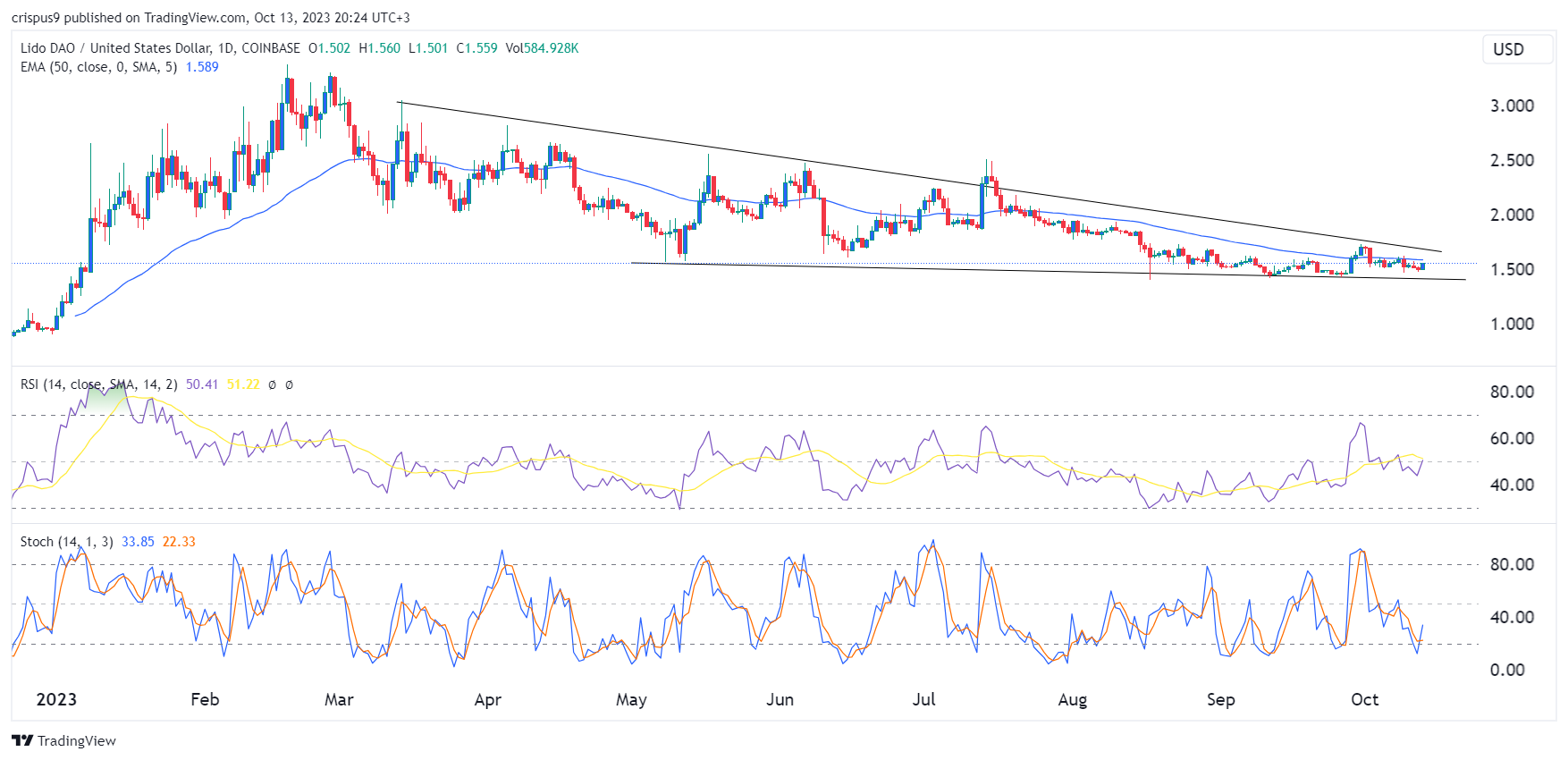
LDO price has been in a tight range amid a prolonged slow growth in the liquid staking industry. It has found a strong support at $1.41, which is the lower side of the descending triangle pattern. 

Lido DAO price is consolidating at the 50-day moving average while the Stochastic Oscillator has moved to the oversold point. Therefore, because of the descending triangle pattern, there is a likelihood that it will have a bearish breakout now that the triangle is nearing the confluence zone.
How to buy $LDO

The post Crypto price prediction: Loom Network, ThorChain, Lido DAO (LDO) appeared first on CoinJournal.
XLM price: could key Stellar news help stem bearish flip?

  • Stellar (XLM) price was changing hands around $0.10 on Friday, down 7% and 15% in the past 7 and 30 days respectively. 
  • The Stellar Development Foundation has teamed up with Certora to boost security for Soroban.

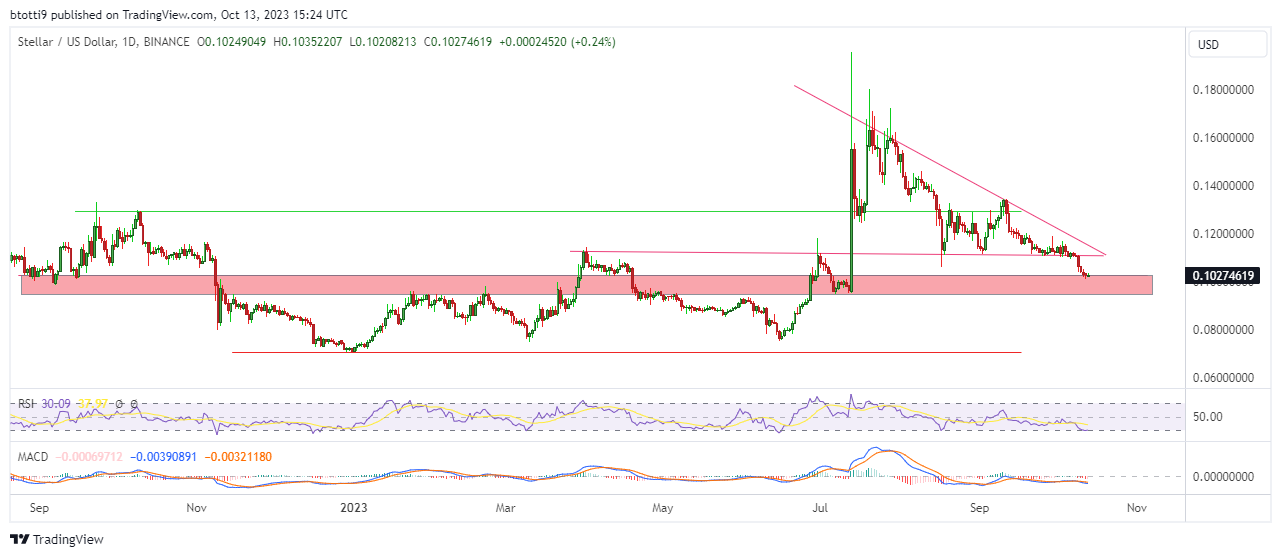
Stellar (XLM) price traded around $0.10 on Friday morning, positive by about 1.3% in the past 24 hours but -7% and -15% in the past seven and 30 days respectively. The downward trend that has held since the flip from highs of $0.20 on July 13 could now strengthen after XLM broke below the support line of a descending triangle pattern.

Stellar price gives up key support area

Today’s slight upside comes after Stellar news regarding its Soroban, a WebAssembly (WASM)-powered smart contracts platform. The Stellar Development Foundation has teamed up with smart contracts audit platform Certora to boost ecosystem security for Soroban. 

Stellar announced a testnet for the smart contracts platform in September. While the development coincided with a spike to above $0.12 for XLM, the overall picture since has been one of struggle for bulls.

As can be seen on the daily chart below, the XLM price has failed to decisively break above the downtrend resistance line of a descending triangle since July’s downward flip. The bearish outlook remains and could strengthen as bulls struggle to keep prices above $0.10.

Stellar price chart. Source: TradingView

While the $0.11 area is now the new supply zone, sellers taking control beneath this horizontal line has them eyeing the potential dip to $0.09 and even $0.07. The technical picture on the chart has both the daily RSI and MACD suggesting sellers hold the advantage.

Can bulls retake control?

XLM price will need to see a sustained push from current levels towards the descending trendline and possibly break higher to flip bullish.  If XLM breaks above $0.13, buyers might target the immediate term supply wall around $0.16.

The post XLM price: could key Stellar news help stem bearish flip? appeared first on CoinJournal.

Tether appoints Paolo Ardoino as new CEO

  • Tether says Paolo Ardoino will officially take up the CEO role from December 2023.
  • Ardoino will continue as Bitfinex CTO and chief strategy officer for Holepunch.
  • Meanwhile, exiting CEO Jean-Louis van der Velde, becomes an advisor and remains CEO of Bitfinex.

Tether news just in is that the company’s Chief Technology Officer Paolo Ardoino has been appointed as the new CEO, with the new role effective as from December 2023. Ardoino will continue as Bitfinex CTO and Chief Strategy Officer for Holepunch.

Meanwhile, current CEO, Jean-Louis van der Velde, will “transition to an advisory role for Tether while retaining his position as CEO of Bitfinex.”

New CEO to lead Tether into new growth chapter

Changes at the management level for the stablecoin issuer comes as the company looks to diversify into new verticals. One of the signals for this shift to a technology-focus approach was highlighted by the recent mega investment in Northern Data Group – with Tether eyeing dominance in the artificial intelligence space across Europe.

Commenting on Ardoino’s elevation to CEO, van der Velde said:

“Paolo is extremely well-suited to lead Tether into this exciting new era. I believe Tether is poised to continue its rapid growth, with a continued focus on emerging markets and transformative technology. I think I can speak for the entire company when I say that we eagerly anticipate Paolo’s leadership as he guides Tether toward a future where finance knows no bounds.”

In his remarks, Ardoino noted Tether’s commitment to transparency, security, and financial integration of digital assets – goals he will pursue as the new CEO. Notably, Ardoino has been the public face of Tether since 2017, with much of what’s communicated from the company’s leadership put to the public through him.

The post Tether appoints Paolo Ardoino as new CEO appeared first on CoinJournal.

Ethereum’s validator queue clears out amid staking demand decline

  • Ethereum validator queue at an all-time low.
  • Staking demand wanes as wait times plummet.
  • At press time, the entry queue for Ethereum only had 377 validators.

The Ethereum network’s validator queue once jam-packed with applicants eager to participate in the blockchain’s proof-of-stake system, has reached an all-time low. Data reveals that the queue has dwindled to just 598 validators, a stark contrast to the staggering peak of over 96,000 seen in early June.

This significant reduction in the validator queue marks a remarkable development in the Ethereum ecosystem, as it has not been this empty since the major “Shapella” upgrade in April, which finalized Ethereum’s transition to a fully functioning proof-of-stake network.

Staking demand declines

The shrinking validator queue is indicative of the diminishing staking demand on the Ethereum network. At its peak, individuals seeking to become validators faced a daunting 45-day wait, driven by pent-up demand to stake Ethereum’s native token, ETH.

However, as of Thursday, the expected waiting time to add a new validator to the network has plummeted to less than four hours according to data on Validator Queue. This swift decline reflects a change in the staking landscape following the Shapella upgrade, which allowed for the withdrawal of staked ETH for the first time, reducing the risk for investors.

The Shapella upgrade had initially sparked a surge in staking activity on the Ethereum network, with ETH staking growth described as “exceptionally strong” following Ethereum’s transition to proof-of-stake in September 2022. However, the initial fervour seems to have cooled in recent times.

The decline in staking demand has resulted in a decrease in staking rewards, which have fallen from 5%-6% earlier in the year to around 3.5%. This is partly due to lower network activity generating fees and an increasing number of stakers.

In comparison to other prominent proof-of-stake networks, Ethereum’s staking ratio, measuring the share of tokens staked relative to the total supply, has grown to over 22% since April. Nevertheless, it still lags behind competitors like Solana, Cardano, and Avalanche, with their staking ratios ranging from 53% to 69%.

The post Ethereum’s validator queue clears out amid staking demand decline appeared first on CoinJournal.

USDR liquidity crisis costs a trader 131,350 stablecoins

  • USDR suffered a liquidity crisis, revealing its illiquid assets.
  • A trader lost everything swapping USDR for USDC during the crisis.
  • An MEV bot profited $107,002 from the arbitrage opportunity.

The Real USD (USDR) stablecoin recently found itself in the eye of a storm, revealing the pitfalls of the DeFi space.

A liquidity crunch on October 11 led to a trader swapping 131,350 USDR for 0 USDC, incurring a complete loss. Here’s what transpired:

The USDR liquidity crunch

USDR, a real-estate-backed US dollar stablecoin, faced a liquidity crisis when users requested over 10 million stablecoins in redemptions.

Although it was advertised as 100% backed, a shocking revelation emerged: less than 15% of its $45 million in assets were backed by liquid TNGBL tokens, with the majority relying on illiquid tokenized real-estate assets.

The illiquidity of these real-estate assets stemmed from their tokenization under the ERC-721 standard. This unique standard made it nearly impossible to fractionalize these assets, creating a liquidity conundrum for investor redemptions. Furthermore, the underlying real estate properties could not be swiftly sold to meet withdrawal requests. Consequently, the USDR treasury was incapable of honouring these redemptions, resulting in a crisis of confidence among investors.

The costly DEX swap

During the USDR liquidity crisis, a trader attempted to withdraw their USDR holdings by executing a swap on the BNB Chain via the decentralized exchange (DEX) OpenOcean. The catch was the severe depegging of USDR, which had plummeted nearly 50% from its par value due to the liquidity crunch.

In a disastrous turn of events, the trader received a grand total of 0 USDC in return for their 131,350 USDR. This meant a complete and crippling loss on their initial investment. In the volatile world of DeFi, where slippage rates on DEXs can reach up to 100% during periods of poor liquidity, such incidents serve as a stark reminder of the risks at play.

The story took an interesting twist as a maximal extractable value (MEV) bot swooped in to seize an arbitrage opportunity. Recognizing the substantial price discrepancy, this automated trading algorithm profited handsomely, netting a staggering $107,002 in gains through a well-timed arbitrage trade.

The post USDR liquidity crisis costs a trader 131,350 stablecoins appeared first on CoinJournal.