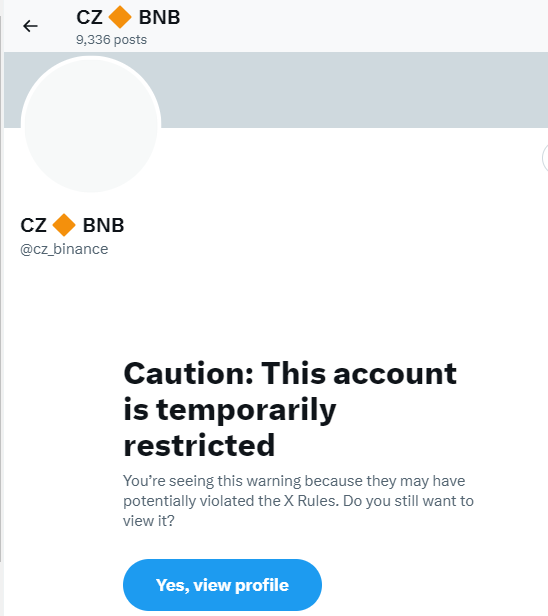
Ex-Binance CEO CZ’s X account restricted

  • X (formerly Twitter) has restricted the account of ex-Binance CEO Changpeng ‘CZ’ Zhao.
  • The Binance founder stepped down on Tuesday after pleading guilty to DOJ charges.

Binance founder and former CEO Changpeng ‘CZ’ Zhao’s X account has been restricted. While its not clear why the ex-Binance chief’s X (formely Twitter) is restricted, the move comes as a surprise to many.

On Thursday, US prosecutors wanted CZ prevented from leaving the US for the UAE, with allegations that he was a flight risk. This is after he pleaded guilty to money laundering charges and was released on a $175 million bond.

Binance will also pay a $4.3 billion penalty as settlement with the US Department of Justice (DOJ).

After he stepped down, CZ was replaced by Richard Teng, the former head of Abu Dhabi Global Market, UAE.

Update:

CZ’s account restriction was due to several name changes, which is what he noted in a comment as he urged against FUD.

The post Ex-Binance CEO CZ’s X account restricted appeared first on CoinJournal.

XRP and DOGE poised for significant upswings: analyst

  • Ripple’s XRP looks to be breaking from a descending channel, suggesting further upside momentum.
  • Dogecoin price is poised amid a notable surge in DOGE transactions.
  • Both coins traded lower this week as markets reacted to Binance news.

The Ripple token, the fifth-largest by market cap with over $33 billion, was trading near $0.61 at the time of writing. Meanwhile, Dogecoin (DOGE) has surged to highs of $0.075 and could break higher as on-chain activity swells.

Both XRP and DOGE saw a negative flip this week as cryptocurrencies dumped after news that former Binance CEO Changpeng Zhao was stepping down.

Analyst shares XRP and DOGE price outlook

While XRP failed to break the psychological barrier at $1 in July, crypto analyst Ali says a breakout from a descending parallel channel could see XRP/USD push to the $0.65 – $0.66 region.

Recent lawsuits by the SEC have listed several altcoins as securities – but not XRP has not been. In as much as there’s a likely battle over a settlement with the SEC in April next year, the previous wins against the regulator has the community buzzing on what next when the case that started in December 2020 finally recedes into the rear mirror.

As for DOGE, the analyst looks at a spike in large transactions amid institutional interest as pointers to a potential price spike.

The intraday gains stand at 3.5%, while the 24-hour trading volume is currently over $1.1 billion. It’s the fourth biggest volume in the period among non-stables, with Bitcoin, Ethereum and Solana – which has been flying in the market – ranking higher.

Dogecoin has seen a 24-hour trading volume of nearly $452 million. While the top meme coin lags some tokens in the $16 billion dog-meme market, its gains over the past month have cut yearly losses to just 5.5%.

Positive moves in the market could see DOGE/USD break above $0.1 going into next year. However, DOGE bulls have a steep hill to climb if they are to reclaim the all-time high of $0.73 reached in May 2021.

The post XRP and DOGE poised for significant upswings: analyst appeared first on CoinJournal.

Lido node operator to rotate keys after security firm flags vulnerability

  • InfStones, a Lido node operator, will rotate its validator keys followng a vulnerability disclosure by blockchain security firm dWallet Labs.
  • The vulnerability was acknowledged by Lido, which said its security team was working with the node operator to assess the scope and potential impact.

InfStones, a blockchain infrastructure provider and one of the key node operators for liquid staking protocol Lido Finance, will look to address a recent vulnerability issue by rotating its validator keys.

The platform is expected to take the security step by temporarily withdrawing its Ethereum validators from Lido. 

Why is InfStones taking this security measure?

InfStones’ move follows the discovery of a security threat connected to the open-source library Tailon in July, and which was disclosed by researchers at blockchain security platform dWallet Labs.

That chain of vulnerabilities at InfStones that put over $1 billion worth of assets at risk. The dWallet Labs team disclosed this to the Lido node operator to allow for remediation, Elad Ernst, cybersecurity researcher at dWallet Labs wrote on X.

Lido Finance acknowledged the vulnerability, noting the potential for an impact on 25 of InfStones servers.

“Lido contributors are now actively working with the Node Operator on investigating the incident to understand its full scope and potential impact,” the platform said in an update.

However, the protocol’s security team clarified that there had been no indication that keys had leaked or been compromised. The vulnerability was also unlikely to have impacted Lido Finance validators.

While InfStones notes that its keys have not been compromised, it has decided to transition to new keys. To continue with operations and to ensure stability of the liquid staking protocol, InfStone will redirect staked Ether (ETH) to Lido for re-staking.

Lido is the largest liquid staking platform on Ethereum, with more than $18 billion in total value locked (TVL) as of November 23

The post Lido node operator to rotate keys after security firm flags vulnerability appeared first on CoinJournal.

KPMG Canada partners with Chainalysis to tackle crypto frauds

  • The collaboration is aimed at combating digital asset fraud and enhancing anti-money laundering efforts.
  • The two will work to address the record-high $20.6B in global cryptocurrency-based illicit transactions.
  • They will provide advanced blockchain monitoring and governance.

In a strategic move to address the escalating threat of fraud and criminal activities in the digital assets sector, KPMG Canada has joined forces with blockchain analytics firm Chainalysis.

This partnership aims to bolster companies’ capabilities in adhering to evolving crypto regulations and advancing their anti-money laundering compliance programs.

Enhancing crypto security measures amid growing threats

The collaboration between the Canadian arm of KPMG and Chainalysis comes as the digital asset sector witnesses an increase in the sophistication of exploits and frauds.

The Chainalysis 2023 Crypto Crime Report revealed a record-high global cryptocurrency-based illicit transaction volume of $20.6 billion in the previous year. Notable incidents, such as wallet hacks and SIM swaps, have underscored the need for robust security measures within the crypto space.

KPMG Canada aims to leverage its extensive knowledge in cryptoasset financial crimes by providing advanced blockchain monitoring, support, governance, and risk management.

Chainalysis and KPMG Canada partnership

This collaboration will enable organizations to adopt a more comprehensive approach to mitigating fraud risks in crypto transactions. Jonathan Levin, Chainalysis co-founder and chief strategy officer, expressed confidence in the partnership, stating that combining KPMG’s expertise with Chainalysis’ industry-leading risk capabilities will contribute to a more effective defence against fraud in the crypto space.

KPMG Canada has been actively involved in the cryptocurrency sector, extending its footprint into the metaverse and making strategic additions to its balance sheet with bitcoin and ether. This move underscores the consulting giant’s commitment to staying ahead in a rapidly evolving digital landscape.

The collaboration between KPMG Canada and Chainalysis signifies a joint effort to navigate and address the complexities of financial crimes in the crypto sector, which continue to pose challenges to the security of digital assets.

The post KPMG Canada partners with Chainalysis to tackle crypto frauds appeared first on CoinJournal.

UK Finance Minister proposes a sandbox initiative for crypto regulations

  • UK Chancellor Jeremy Hunt has revealed plans for a cryptocurrency legislative initiative.
  • The government aims to pass legislation to officially establish the Digital Securities Sandbox (DSS).
  • The DSS will provide a controlled testing environment for crypto technologies and services.

In a move aimed at bolstering the digital asset sector, UK Chancellor of the Exchequer Jeremy Hunt announced a legislative proposal for a Digital Securities Sandbox (DSS) during the mini-budget announcement on Wednesday.

As part of the Autumn Statement, Chancellor Hunt outlined 110 measures for economic growth, including the introduction of the Digital Securities Sandbox.

The proposed Digital Securities Sandbox (DSS)

The proposed legislation aims to create a controlled testing environment for crypto technologies and services, facilitating the adoption of digital assets across financial markets.

The government plans to lay a statutory instrument to officially implement the DSS, in line with the Edinburgh Reform announcement to establish a Financial Market Infrastructure Sandbox in 2023. The DSS initiative is slated to commence in the first quarter of 2024.

In July, the UK government initiated a consultation on the DSS, which is run by the Bank of England and the Financial Conduct Authority. The objective is to strike a balance between fostering innovation and maintaining regulatory standards. Feedback from the industry has praised the emphasis on innovation without compromising on regulatory outcomes.

However, the DSS has some exclusions, notably unbacked cryptoassets, due to the absence of an established regulatory regime. The early activities in the DSS are expected to be focused on GBP-only assets, with the potential inclusion of non-GBP digital assets subject to a decision by the Bank of England.

Implications for the digital asset industry

The Digital Securities Sandbox represents a significant commitment by the UK government to provide a supportive environment for the growth of the digital asset sector. Industry experts, including Zodia Markets General Counsel Dina White, see this as a crucial step in the digitalization of financial instruments.

White notes that the DSS will enable firms to experiment with digital asset technology, establishing critical financial market infrastructure such as central securities depositories and trading venues. This move aligns with the broader trend of digitalization across financial instruments, paving the way for experimentation within an established industry.

The introduction of the Digital Securities Sandbox reflects the UK government’s proactive approach to integrating digital assets into the financial landscape. The controlled testing environment is expected to encourage innovation while ensuring regulatory oversight, contributing to the ongoing evolution of the digital asset sector in the UK.

The post UK Finance Minister proposes a sandbox initiative for crypto regulations appeared first on CoinJournal.