
Jellyverse secures $2 million seed round to build DeFi 3.0

  • DeFiChain-based Jellyverse raises $2 million from private investors to build its ecosystem.
  • The funding was secured in a seed funding round by Jelly Labs AG and Fintonomy LTD.
  • Jellyverse will feature protocols such as a DEX, staking protocol and stablecoin.

Jellyverse, a decentralised finance (DeFi) ecosystem built on the EVM-compatible layer-2 DeFiMetaChain (DMC), has secured a $2 million capital injection from private investors.

The seed round was raised by Jelly Labs AG and Fintonomy LTD, the two companies helping develop the Jellyverse. This DAO-governed ecosystem has JLY as the native token.

Jellyverse secures $2 million funding

According to details in a press release shared on Monday, Jelly Labs AG and Fintonomy LTD will utilise the financing to support the DeFi 3.0 platform’s development.

Specifically, the developers aim to advance DeFi adoption with integration of real-world assets and real-world price feeds. Initiated by the DeFiChain Accelerator core team, Jellyverse’s DeFi 3.0 products including decentralised portfolios, bonds, lending and staking are aimed at this goal.

“Jellyverse merges the pinnacle of past DeFi achievements with a fresh perspective. We present decentralised assets that pioneer a novel way to diversify your crypto portfolio, complemented by self-balancing multi-token pools,” Santiago Sabater, the co-initiator of Jellyverse, noted in a statement.

Jellyverse ecosystem to include a DEX, staking protocol and stablecoin

Jellyverse has several protocols under development. These include JellySwap, a decentralised exchange (DEX) built on Balancer; JellyStake,  a decentralised staking protocol; and jUSD, a stablecoin that allows users to borrow against DFI, dETH, the native Jellyverse token JLY as well as other cryptocurrencies.

The Jellyverse ecosystem will also feature jAssets and JellyBond. jAssets will be a protocol for crypto-backed user-generated tokens that will allow ecosystem participants to diversify their crypto portfolios via exposure to traditional financial markets. In this case, jAssets will reflect the prices of stocks, commodities and exchange-traded funds (ETFs), leveraging real-time price feeds.

JellyBond on the other hand is the protocol that bonds the stablecoin jUSD and jAssets, allowing users to earn yield on their tokens.

Jellyverse’s entry into the market could align with fresh momentum for the DeFi sector, which is showing resurgence amid bull market upside. The total value locked (TVL) was over $180 billion in November 2021 and fell to below $36 billion in mid-October this year.

According to DeFiLlama, the total TVL for all chains has risen to nearly $50 billion as the crypto market records a resurgence in prices.

The post Jellyverse secures $2 million seed round to build DeFi 3.0 appeared first on CoinJournal.
Standard Chartered Zodia integrates Ripple-owned Metaco’s crypto storage services

  • Zodia Custody, backed by Standard Chartered Bank, integrates Metaco’s crypto storage.
  • The move is aimed at enhancing global sub-custody services for cryptocurrencies.
  • The collaboration reflects the third generation of crypto custody, linking multiple custodians for secure and compliant management of digital assets.

In a strategic move to enhance global sub-custody services for cryptocurrencies, Zodia Custody, backed by Standard Chartered Bank, has integrated Metaco network’s crypto storage services.

This collaboration aims to redefine crypto custody and settlement processes, resembling traditional finance models. The move comes amid increasing demand for secure digital asset storage and reflects the evolution of the crypto industry.

Zodia Custody’s partnership with Metaco

Zodia Custody’s integration of Metaco network’s crypto storage services is designed to offer global sub-custody services for cryptocurrencies, enabling Metaco to store client funds securely and facilitate efficient fund management. CEO Julian Sawyer emphasizes the evolution of crypto custody into a third generation, where multiple custodians are interconnected.

This integration aligns with Zodia’s expansion, having recently extended its services in Hong Kong in response to rising institutional demand.

Metaco’s role and industry dynamics

Swiss-based firm Metaco, now under Ripple’s ownership following a $250 million acquisition earlier this year, leverages Ripple’s scale and market strength. The collaboration with Zodia Custody aims to accelerate reaching clients and providing advanced crypto storage solutions.

Notably, as the crypto industry grapples with trust and transparency issues, the integration of Metaco’s services into Zodia Custody signifies a crucial step in addressing these concerns. This move also aligns with broader industry trends, as evidenced by HSBC’s plans to launch a custody service in 2024, excluding cryptocurrencies, in partnership with Metaco.

The post Standard Chartered Zodia integrates Ripple-owned Metaco’s crypto storage services appeared first on CoinJournal.

ORDI hits new all-time high as Bitcoin breaks above $42k

  • ORDI (ORDI) price hit a new all-time high of $44.03 early Monday as Bitcoin touched $42,000.
  • The uptick in ORDI price comes amid rising total inscriptions on the Bitcoin network.
  • ORDI could trade high if BTC continues on a bullish trajectory.

As Bitcoin price rallied to above $42,000 early Monday, the BRC-20 token ORDI (ORDI) was hovering at $44, a new all-time high for the Bitcoin Ordinals token. 

This came amid a 35% surge in the 24 hours, an upside that saw ORDI extend its gains over the past week to over 111%. On December 4, the token’s value was more than 550% up.

ORDI spikes as Bitcoin hits $42k

ORDI’s massive price gains over the past few weeks have had a catalyst in the shape of Bitcoin’s rally. Over the weekend, BTC broke above the $40,000 level and like in the past several days, the upside reflected in the price of ORDI.

The token crossed the $24 hurdle on Saturday and after retesting the $33 area on December 3, extended higher to hit the all-time high of $44.03 early Monday. A look at the Bitcoin chart shows the benchmark cryptocurrency cross to its new year-do-date high price of $ 42,155 on Monday. Notably, BTC was traded at around $36,770 at the start of last week.

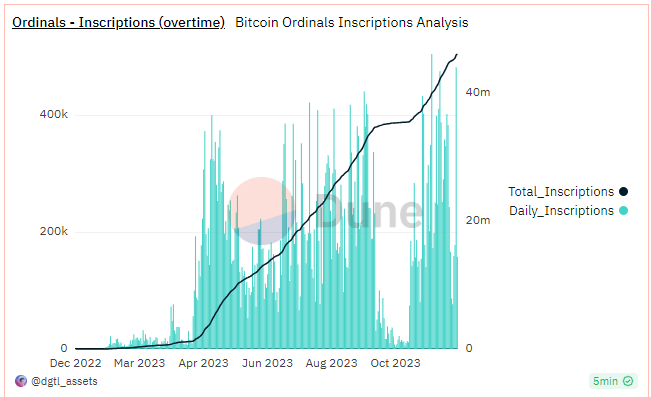
Analysts are bullish on Bitcoin going into next year, and with this outlook comes the possibility that ORDI could go on a vertical hike too. This forecast is informed largely by the increased pace of inscriptions within the Ordinals protocol.

ORDI makes up the largest share of these texts, images and such other features on Bitcoin, and as BTC rises, the BRC-20 token is likely to follow. This is the case with Bitcoin transactions fees rising, with data showing (in the above chart) that there have been over $46 million total inscriptions as of December 4, 2023.

While a retreat across the market could see ORDI’s price also decline, a return to the upward trajectory could well continue to track Bitcoin’s bullish outlook.

The post ORDI hits new all-time high as Bitcoin breaks above $42k appeared first on CoinJournal.

Crypto.com granted UK E-Money License by FCA

  • Crypto.com achieves FCA approval.
  • The license empowers crypto.com to introduce UK-localized e-money products.
  • The series of approvals underscores the exchange’s responsible innovation in the rapidly evolving cryptocurrency market.

Singapore-based cryptocurrency exchange, Crypto.com, has achieved a significant milestone by securing an Electronic Money Institution (EMI) license from the UK’s Financial Conduct Authority (FCA).

This move allows the exchange to introduce UK-localized e-money products, ensuring compliance with stringent FCA consumer protection standards.

Crypto.com, serving over 80 million users globally, continues its strategic expansion, emphasizing regulatory compliance in various jurisdictions.

Crypto.com’s E-Money License and UK expansion

Crypto.com’s recent authorization as an EMI by the FCA signifies a pivotal step in the exchange’s commitment to the UK market. The license empowers Crypto.com to offer a range of e-money products tailored for the UK audience, acting as a digital substitute for traditional fiat currency.

The UK license follows the exchange’s earlier registration as a cryptoasset business in August 2022, enabling the provision of diverse products and services to its UK clientele while complying with local regulatory standards. The CEO, Kris Marszalek, expressed the company’s dedication to the UK market and stressed the importance of collaborating with the FCA for responsible innovation in the crypto space.

Crypto.com’s global regulatory pursuit

Crypto.com’s pursuit of regulatory approvals extends beyond the UK. In November 2022, its Dubai branch secured a Virtual Asset Service Provider (VASP) license, enabling the exchange to offer services such as exchange, broker-dealer, management, investment, lending, and borrowing in Dubai. Earlier, in June 2023, the exchange finalised its registration in Singapore and registered as a VASP with the Bank of Spain, allowing it to offer compliant products and services in Spain, adhering to anti-money laundering directives and financial crime laws.

These regulatory milestones underscore Crypto.com’s dedication to compliance and user protection as it navigates the dynamic cryptocurrency market. The strategic acquisition of licenses across diverse jurisdictions reinforces the exchange’s position as a global player committed to regulatory standards and responsible innovation in the evolving crypto landscape.

The post Crypto.com granted UK E-Money License by FCA appeared first on CoinJournal.

Mantle launches liquid staking protocol on Ethereum Mainnet

  • Mantle’s liquid staking protocol (LSP) launched on the Ethereum blockchain.
  • The launched LSP is a non-custodial liquid staking protocol.
  • The Mantle liquid staking protocol is governed by its decentralized autonomous organization (DAO).

Decentralized autonomous organization Mantle has introduced a groundbreaking liquid staking protocol on the Ethereum mainnet. This move follows a successful deployment of a Layer 2 network and aims to provide users with a new method of participating in-network staking.

Mantle’s approach addresses concerns about the concentration of staked assets in major providers like Lido, Coinbase, and Binance, offering an alternative solution through their liquid staking derivative, Mantle-staked ether (mETH).

Mantle’s liquid staking protocol on Ethereum

The liquid staking protocol (LSP) launched by Mantle on the Ethereum mainnet is a non-custodial protocol that allows users to deposit ETH and engage in network staking via validator nodes while receiving Mantle-staked ether (mETH) as a token reflecting their stake.

Mantle’s LSP began its journey with the deployment of mainnet contracts in an exclusive alpha phase in October, subsequently transitioning to a permissionless phase to broaden access and participation. This innovative protocol is governed by the Mantle decentralized autonomous organization, emphasizing a community-driven approach to decision-making.

Addressing stake concentration with mETH adoption

One of the primary motivations behind Mantle’s liquid staking protocol is to tackle the concentration of ether stakes within major providers such as Lido, Coinbase, and Binance. According to Jordi Alexander, Chief Alchemist at Mantle, the concentration issue results from a feedback loop of increasing name recognition and use case.

To counter this, Mantle is focusing on the adoption of Mantle-staked ether (mETH) in the Liquid Staking and DeFi (LSDfi) ecosystem. The protocol aims to contribute to the solution by providing users with more options and enhancing capital efficiency to maintain sustainable yields. The Mantle DAO, empowered by the approval of governance proposal MIP-25 in August, has decided to stake ether from its treasury, adding to its existing $80 million in ETH staked with Lido Finance.

As a significant player in the crypto space, with assets totalling $470 million in ether and over $200 million in stablecoins, Mantle’s strategic approach to liquid staking marks a pivotal development in the ongoing evolution of decentralized finance on the Ethereum network.

The post Mantle launches liquid staking protocol on Ethereum Mainnet appeared first on CoinJournal.