
Pi Network to launch decentralised moderation feature on Fireside Forum

  • Pi Network has announced ‘Decentralized Moderation’ on Web3 social platform Fireside Forum.
  • The feature is geared towards incentivising better Web3 social interactions.
  • Fireside Forum was launched in June this year.

Pi Network has announced plans for the launch of a new feature dubbed “Decentralized Moderation” the Web3 social platform Fireside Forum.

Fireside Forum’s decentralised moderation feature

In a blog post on December 12, the Pi Network team said “Decentralized Moderation” is currently in the development phase. When it rolls out, it will bring decentralised social content moderation to users, incentivising them towards “meaningful and respectful online conversations.”

The aim is to foster a Web3 social experience where blockchain will be more than a layer of ownership. According to Pi, this is its vision for Fireside Forum, which launched in June 2023 and has seen steady user interaction.

“Through Decentralized Moderation, Fireside Forum aims to achieve a self-sustaining and transparent content ecosystem through cryptocurrency integration, allowing for diverse voices to be heard while keeping our behaviours accountable and respectful to others,” the platform wrote in the blog post.

Pi Network believes the new feature will not only empower users, but also help shape Fireside Forum’s evolution. This will include aspects such as content quality, accountability, and healthier online interactions.

Decentralized Moderation is expected to have tiered moderation levels, tokenomics and stakes in play and structured fair reward system.

The post Pi Network to launch decentralised moderation feature on Fireside Forum appeared first on CoinJournal.
Starknet allocates 10% of network fees to developers

  • Starknet to distribute 10% of network fees to developers in ‘Devonomics’ pilot.
  • dApps developers to receive 8% and core developers 2% of $1,600 ETH, or $3.5 million.
  • Starknet recently announced an upcoming airdrop.

Starknet Foundation and StarkWare, the developer of layer-2 Ethereum platform Starknet, has announced a pilot program that will incentivise developers via a $3.5 million total payout.

According to Starknet’s blog post on Tuesday, the pilot program is dubbed “Devonomics.” With it, early Starknet developers will receive 1,600 ETH accounting for 10% of all network fees.

Beneficiaries are those to have contributed to the platform’s activities and growth since its launch in November 2021 up to November 30, 2023. Developers are to be rewarded for operating and developing the Starknet network, as well as to empower them for governance decisions.

The program also seeks to incentivise developers to maintain and secure the blockchain platform through staking, Starkware noted.

8% to dApp developers and 2% to core developers

In particular, developers will have a share of over 1,600 ETH. Over 1,200 ETH, or 8% of the fees will be distributed to developers of decentralised applications (dApps).

Meanwhile, 300 ETH, or about 2%, will go to Core Developers, a group that includes devs that write code for provers, sequencers, full nodes, and long-term storage providers among others. While the initial distribution is in ETH, all future rewards will be in the native STRK token.

Starknet Foundation’s launch of Devonomics adds to several other initiatives aimed at empowering key network stakeholders.

Past initiatives include an early adopter grant (EAG) program, a 50 million early community member program (ECMP), developer partnerships (DPs) and grants to individual contributors.

Today’s announcement also comes a few days after Starknet confirmed plans for a potential 1.8 billion STRK airdrop.

The post Starknet allocates 10% of network fees to developers appeared first on CoinJournal.

INJ price hits new all-time high: Why is Injective surging?

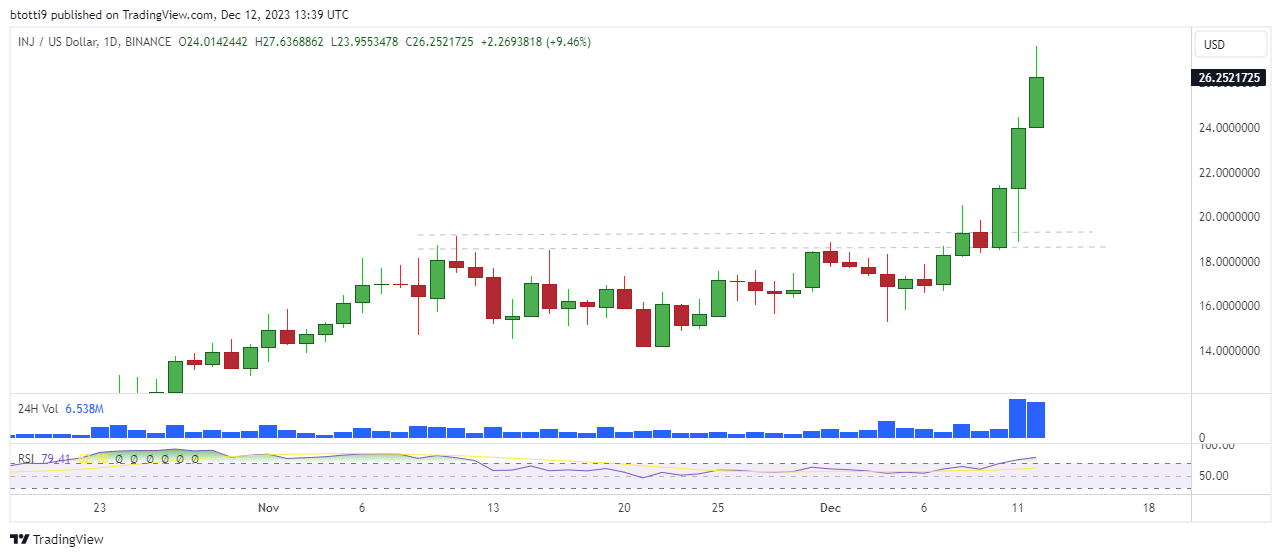
  • INJ soars to a new all-time high above $27, up 66% in two weeks and over $1,500% in the past year.
  • What’s driving the Injective price higher? Catalysts include upcoming network upgrade, weekly token burn and Helix DEX activity.

The injective (INJ) token is one of the standout performers in the past week, rising more than 60% as its price broke above $20. 

On December 12, the INJ price shot to highs of $27 across major crypto exchanges, touching a new all-time high as major altcoins looked to recoup losses seen on Monday.

As Injective looks for continued upside, one of the questions to ask is what has driven this token to its new ATH. Is this rally therefore likely to be sustainable, or will bears spoil the bulls’ Christmas party?

Why is Injective price surging?

The last 30 days have seen the price of Injective’s native token surge by more than 55%, while the steady upswing since the lows reached in December 2022 has included a parabolic rise of 1,570%. In recent weeks, positive ecosystem news have combined with the broader bullish sentiment to send INJ higher.

One of the catalysts this past few days has been Injective’s weekly token burn. The latest of these saw over $65,000 worth of INJ burned, permanently removing them from circulation.

Amid the burn auction, Injective has also witnessed a significant spike in total INJ staked. According to on-chain data, over $1 billion worth of the token has so far been staked.

This outlook has put pressure on Injective rising ahead of a recently announced upgrade dubbed Volan. According to the Injective team, this is going to be the largest mainnet upgrade in the layer-1 blockchain’s history.

Injective teased the Volan upgrade on November 30, and INJ price has skyrocketed more than 66% in the two weeks since. Network activity around Injective-based decentralized exchange (DEX) Helix has also contributed to the upward trajectory.

INJ price outlook

As INJ pares some of the intraday gains to trade around $26 at the time of writing, a bullish continuation could see buyer eye price beyond $30. A bearish flip amid broader market retreat could inform the potential slip to support in the $20-$18 range.

Injective INJ price chart. Source: TradingView


The post INJ price hits new all-time high: Why is Injective surging? appeared first on CoinJournal.

Horizen Labs, Offchain Labs propose APE-powered ApeChain on Arbitrum

  • Horizen Labs, Offchain Labs and Arbitrum Foundation have submitted an ApeCoin DAO proposal for ApeChain.
  • The platform targets the blockchain gaming ecosystem and will be built using Arbitrum’s technology.
  • ApeChain will utilise ApeCoin (APE) as the native gas token.

In a recent proposal, Horizen Labs, Offchain Labs and the Arbitrum Foundation outlined plans for an ApeChain platform, part of the broader vision to support growth for the ApeCoin ecosystem.

The price of ApeCoin (APE) was around $1.67 on Tuesday, down 0.2% in the past 24 hours. APE has struggled to mirror broader market gains in recent weeks and is up only 13% in the past 30 days.

ApeChain targeted for gaming ecosystem

 The ApeCoin DAO idea reveals that ApeChain will be developed using the Arbitrum technology with Horizen Labs spearheading the overall ecosystem growth. The ApeChain network will be an Orbit chain built using AnyTrust.

“We believe that leveraging Arbitrum’s market-leading technology will best position ApeChain to succeed as an independent governed chain in the Ethereum ecosystem,” the ApeCoin Improvement Proposal (AIP) reads in part.

Partners for the project will include a Data Availability Committee featuring Horizen Labs, Offchain Labs, Magic Eden, and Layer Zero among others. Yuga Labs, the Web3 startup that created Bored Ape Yacht Club (BAYC) and CryptoPunks, will also be approached to join the DAC.

According to the proposal, key benefits of developing ApeChain on Arbitrum will include the use of APE as the gas token. This could in turn see a native economy around APE grow to encompass staking and governance. Also, it could spark a new revenue stream for ApeCoin DAO, with increased traction in blockchain gaming due to low gas fees.

 “We’ve been excited to see ApeCoin DAO rally around the idea of a dedicated ApeChain, and agree that it would enhance the DAO’s value proposition. Our goal is to combine the strength of the APE brand with Arbitrum’s technology and cement ApeChain as the nexus of on-chain gaming,” Arbitrum said in a post on X.

Horizen Labs expects development of the ApeChain to commence in Q1, 2024, with onboarding of teams and formalization of the ApeChain governance structure. A testnet will also launch in the quarter, while the mainnet launch could be in Q2, 2024 if the proposal is adopted.

Meanwhile, the Arbitrum Foundation will offer grant funding for a Rollup-as-a-Service provider,  ApeChain Security Council and block explorer.

The post Horizen Labs, Offchain Labs propose APE-powered ApeChain on Arbitrum appeared first on CoinJournal.

The global metaverse gaming market set to surge 1085.92% by 2030

  • Metaverse gaming market is poised to surge from $14.2B in 2023 to $168.4.21B in 2030.
  • Driven by AR, VR, and blockchain, this technological revolution is reshaping the gaming experience.
  • The projected growth unleashes economic opportunities, with virtual assets, currencies, and services gaining real-world value.

The metaverse gaming market denotes a virtual space where players engage in real-time interactions, bridging the gap between physical and digital realms. Fueled by technological advancements such as augmented reality and blockchain, the metaverse in gaming has already transformed the landscape of interactive digital experiences. 

According to CoinJournal.net, the global metaverse gaming market is set to experience a significant change, with projections indicating a substantial leap from $14.2 billion in 2023 to a staggering $168.4 billion by 2030.

This astronomical growth represents a surge of 1085.92%, ushering in a new era for the digital gaming landscape.

Several factors contribute to the remarkable growth anticipated in the metaverse gaming market. First and foremost is the rapid advancement of technology, including augmented reality (AR) and virtual reality (VR). These technologies are creating immersive gaming experiences that go beyond traditional boundaries, enticing players into expansive virtual worlds.

The shift in consumer behavior is another significant driver of the metaverse’s expansion. Gamers are increasingly seeking more than just isolated gaming experiences; they crave interconnected universes where they can socialize, create, and explore. The metaverse offers an answer to these demands, providing a holistic environment where players can engage with a multitude of activities beyond gaming.

Apart from changing the gaming landscape, the metaverse is also presenting lucrative economic opportunities. Virtual economies within these digital realms allow for the creation and exchange of virtual assets, introducing new avenues for revenue generation. From virtual real estate to in-game currencies, the metaverse is becoming a thriving marketplace where users can buy, sell, and trade digital goods.

Max Coupland, the director of CoinJournal says: “This projected expansion of the global metaverse gaming market serves as a testament to the dynamic evolution of the gaming industry. As technology advances and consumer expectations undergo transformative shifts, the metaverse is poised to seamlessly integrate into the gaming experience. Developers, investors, and gamers should closely monitor this trend, recognizing its vast potential to shape the future of interactive entertainment. The metaverse is not merely a conceptual frontier; it is a rapidly unfolding reality that is redefining how we play, connect, and explore in the digital age.”

The post The global metaverse gaming market set to surge 1085.92% by 2030 appeared first on CoinJournal.