
TRON Exceeds Bitcoin in Daily Active Addresses

  • Surprisingly, TRON takes the top spot on the list of cryptocurrencies with the most active daily addresses, with 1,643,580.
  • It is followed by Bitcoin, which has 867,570 active addresses.
  • In third place is Litecoin with 754,272 active daily addresses.

Cryptocurrencies are always on the move, constantly changing and evolving. They’re often compared to the wild west of finance, breaking away from the rules of traditional markets. 

A new analysis by CoinJournal.net utilised the most recent data available to reveal the cryptocurrencies with the highest average of daily active addresses, either as a sender or receiver of the crypto in question. 

The snapshot from December 5, 2023 unveils an intriguing development—TRON outperformed Bitcoin in terms of worldwide daily user engagement.

Rank Cryptocurrency Active address count
1 TRON 1,643,580
2 Bitcoin 867,570
3 Litecoin 754,272
4 Ethereum 478,541
5 Stellar 109,897
6 Dogecoin 99,677
7 Bitcoin Cash 93,186
8 Cardano 45,483
9 USD Coin 33,920
10 Ripple 28,201
11 Ethereum Classic 15,472
12 Chainlink 5,021
13 Internet Computer 4,448
14 Dai 2,756
15 Wrapped Bitcoin 1,959


1. TRON (TRX)

At the forefront of blockchain activity on December 5, 2023, was TRON with an impressive 1,643,580 daily active addresses. The TRON network, known for its high throughput and decentralised applications, attracted a substantial user base actively engaging with TRX tokens.

2. Bitcoin (BTC)

Bitcoin, the pioneer of cryptocurrencies, maintained a robust presence with 867,570 daily active addresses. Despite its relatively lower throughput compared to some altcoins, Bitcoin’s widespread adoption and recognition ensured a substantial user base actively transacting on the network.

3. Litecoin (LTC)

Litecoin secured the third position with 754,272 daily active addresses. Known for its faster block generation time compared to Bitcoin, Litecoin’s user-friendly features and efficient transaction processing contributed to its significant presence in daily blockchain activity.

4. Ethereum (ETH)

Ethereum, the pioneer of smart contract functionality, boasted 478,541 daily active addresses. The Ethereum network’s versatility and wide range of decentralised applications facilitated a diverse set of users actively participating in transactions.

5. Stellar (XLM)

Stellar claimed the fifth spot with 109,897 daily active addresses. Focused on facilitating cross-border payments and bridging traditional finance with blockchain, Stellar attracted users seeking fast and low-cost transactions.

Max Coupland, the director of CoinJournal, comments, “The cryptocurrency landscape, characterised by its dynamic nature, has long been dominated by the legacy and influence of Bitcoin. However, TRON’s unexpected triumph signals a potential shift in user preferences and highlights the evolving demands within the crypto community. While Bitcoin continues to command a substantial user base and remains a symbol of decentralised finance, TRON’s surge suggests that users are increasingly seeking platforms that provide more than just a store of value.”


The post TRON Exceeds Bitcoin in Daily Active Addresses appeared first on CoinJournal.
Grayscale’s GBTC tops ETFs, Standard Chartered bullish on BTC, Meme Moguls trending in BTC ETF buzz

  • Standard Chartered forecasts $200K Bitcoin by late 2025, banking on ETF approval.
  • Grayscale’s GBTC outpaces 99% of ETFs, trading close to half a billion dollars.
  • Meme Moguls, a meme-backed stock market, enters the crypto space with presale buzz.

As the crypto world buzzes with anticipation over the potential approval of spot Bitcoin ETFs in the US, major players are making bold predictions. Standard Chartered forecasts a staggering $200,000 target for Bitcoin by late 2025, contingent on ETF approval.

Simultaneously, Grayscale’s Bitcoin Trust (GBTC) is making waves, outpacing the majority of ETFs in trading volume. Amidst this, a new player, Meme Moguls, is poised to capitalize on the ETF momentum.

Standard Chartered’s $200K Bitcoin projection with ETF approval

Standard Chartered, a banking giant, has made a striking projection for Bitcoin’s future. The multinational firm predicts a potential surge to nearly $200,000 by late 2025, riding on the approval and success of Bitcoin exchange-traded funds (ETFs) in the US. This optimistic forecast, shared on X by Entrepreneur and Bitcoin investor Lark Davis, is underpinned by the belief that spot Bitcoin ETFs could attract significant inflows, ranging from $50-100 billion in 2024.

The bank’s Head of Digital Assets, Geoff Kendrick, and Precious Metals Analyst Suki Cooper base this projection on the assumption that US-listed spot Bitcoin ETFs could hold a substantial amount of Bitcoin by the end of 2024, potentially multiplying its current price by 4.3 times. Kendrick and Cooper draw parallels with the growth trajectory of gold exchange-traded products, envisioning a more rapid ascent for Bitcoin given the expected faster development of the BTC ETF market.

Grayscale’s GBTC outpaces ETFs in trading volume

While Standard Chartered makes forward-looking predictions, Grayscale’s Bitcoin Trust (GBTC) has already demonstrated significant prowess.

According to industry expert Eric Balchunas, GBTC traded close to half a billion dollars on January 8, surpassing over 99% of the approximately 3,000 existing ETFs. Balchunas points out that if spot Bitcoin ETFs get approved, Grayscale will enter the market with substantial trading volume, giving it a significant advantage over its competitors.

Meme Moguls seizing the opportunities amid the ETF buzz

In the midst of the ETF buzz, a newcomer is entering the arena – Meme Moguls. This platform positions itself as the world’s first meme-backed stock market/exchange. As the crypto community eagerly awaits the potential approval of spot Bitcoin ETFs, Meme Moguls aims to capitalize on the growing interest in the cryptocurrency market.

The Meme Moguls ecosystem is powered by the Meme Moguls Governance Token ($MGLS), featuring diverse meme-inspired assets and engaging community-driven features like a casino, trading platform, fantasy trader, and a metaverse world named Mogul Land.

Meme Moguls is currently in the presale stage of its MGLS token, offering participants an opportunity to get involved in the world of meme trading and potentially become part of a groundbreaking utility-based memecoin. With a $10,000 giveaway at the end of each presale stage and ambitious plans to create 100 millionaires within the first three months of launch, Meme Moguls is setting high expectations.

In the presale’s current stage, participants can access $MGLS for $0.0027, with a total supply of 3 billion tokens. Analysts predict substantial growth for $MGLS, aligning with the overall bullish sentiment in the cryptocurrency market.

Conclusion

In this dynamic landscape, where traditional financial institutions make ambitious forecasts, established entities like Grayscale showcase real-time strength, and emerging platforms like Meme Moguls strive to carve their niche, the crypto market remains an ever-evolving space.

As the spotlight remains on the potential approval of spot Bitcoin ETFs, these developments mark significant steps in the maturation of the cryptocurrency ecosystem.

The post Grayscale’s GBTC tops ETFs, Standard Chartered bullish on BTC, Meme Moguls trending in BTC ETF buzz appeared first on CoinJournal.

Injective (INJ) eyes new all-time high as Bitcoin surges to $46k

  • Injective (INJ) price has surged 14% in the past 24 hours as bulls crossed above $40. 
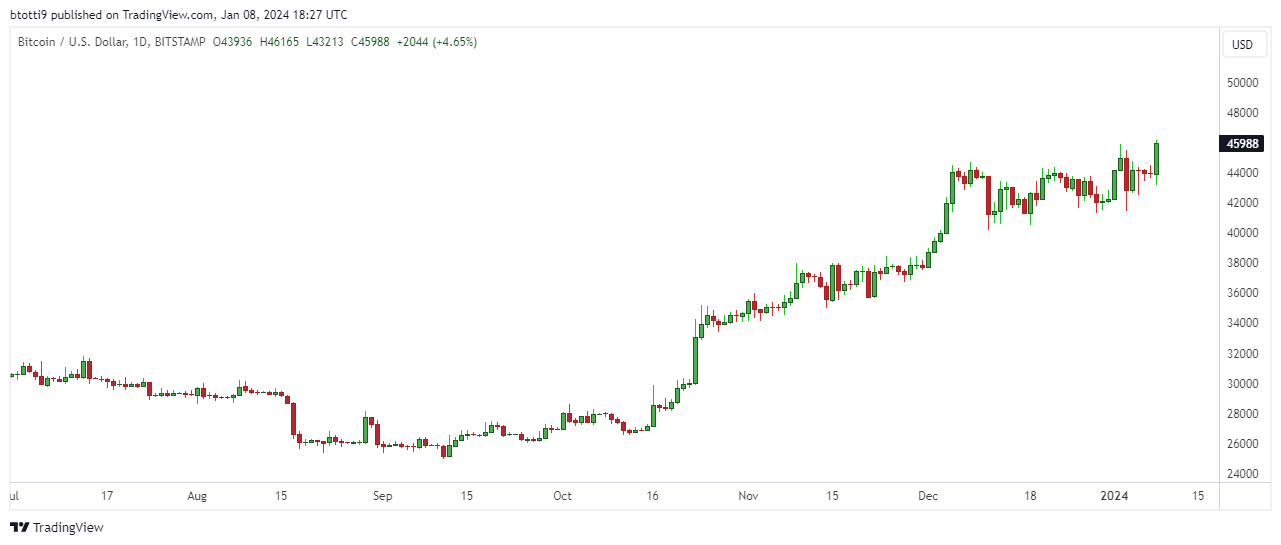
  • INJ is targeting a new all-time high above $44, with the gains coming amid a new upside for Bitcoin that saw BTC soar to $46k.

An infusion of fresh impetus has seen the price of Injective (INJ) rise sharply. As most altcoins looked to spark into life after Bitcoin rose above $45k, Injective’s native token was trading more than 14% up over the past 24 hours. Trading volume has jumped 61% in the same period to over $439 million.

Meanwhile, Bitcoin price was trading near the $46k level, up 4% in 24 hours. BTC reached highs of $46,165 on crypto exchange Bitstamp as Bitcoin ETF sentiment ramped up.

INJ price soars ahead of major token unlock

While the upside faces a hurdle near the all-time high of $44.57 reached on December 24, 2023, there’s a potential impactful event set for the next few days. 

According to data shared by tokenomics insights platform Token Unlocks, Injective is headed for its final token unlock.

The notable event will activate on January 21, 2024, with 3.66 million INJ worth about $152 million (at current prices) unlocked. This will see Injective’s total circulating supply bumped to the total supply of 100 million INJ. The unlocked coins will account for about 4.3% of the cryptocurrency’s circulating supply.

As the Injective ecosystem braces for the significant influx of tokens, traders are also likely to keep an eye on overall market sentiment. This is because there’s a broader bullish outlook as the industry anticipates the approval of spot Bitcoin ETFs by the US Securities and Exchange Commission (SEC).

Although price is likely to drop as the new supply injects downside pressure, INJ could benefit from a rallying market. Target price levels amid potential price discovery will include $100 in the short term. On the flipside, INJ could face a retest of primary support below $20.

At the time of writing, Injective changed hands around $42.21 – just over 5% off its ATH.

The post Injective (INJ) eyes new all-time high as Bitcoin surges to $46k appeared first on CoinJournal.

Bit24.cash faces backlash after reports of KYC data breach

  • Bit24.cash, an Iranian exchange, faces KYC data breach affecting 230K users.
  • Research uncovers misconfiguration, exposing passports, IDs, and credit cards.
  • Conflicting claims between Cybernews and Bit24.cash prompt user concerns.

Bit24.cash, a prominent Iranian cryptocurrency exchange, is under scrutiny following reports of a significant security breach.

Cybernews researchers uncovered a misconfiguration in the platform’s cloud storage system, leading to unauthorized access and exposing sensitive Know Your Customer (KYC) data of nearly 230,000 users. The incident raises concerns about user data protection in the cryptocurrency industry, as conflicting narratives emerge between the research findings and Bit24.cash’s official response.

Passports, IDs, and credit cards info compromised

The research by Cybernews exposed a misconfiguration in the exchange’s cloud storage system, providing unauthorized access to KYC data.

The compromised information includes passports, IDs, credit cards, and written consent to regulations for approximately 230,000 users. This breach underscores the vulnerability of user data and prompts users to question the safety of their personal information.

Conflicting claims and reassurances

In response to Cybernews’ allegations, Bit24.cash spokesperson and security engineer Hossein Amini refuted the claims, stating the report was inaccurate and misleading. Amini asserted that there was no evidence of a data breach or unauthorized access to user information.

Contrary to the research findings, Amini confidently declared the security and integrity of the MinIO instance and cloud storage containers, emphasizing their commitment to user security.

Ramin Moradi, the Bit24.cash CTO, also stated on X that Cybernews has not given any evidence on the security breach and as such he cannot I can’t confirm their claim.

Bit24.cash also stated that after “careful investigation, our technical team found the claims to be false and misleading.” They also went ahead to give a number of reasons through a thread of X (formerly Twitter) supporting their conclusion.

Impact on the Iranian crypto market

Bit24.cash, alongside other Iranian crypto exchanges, has been a significant contributor to the country’s crypto market. In 2022, these platforms accounted for 12% of all funds flowing to Iranian exchanges.

The reported security breach not only raises concerns for individual users but also highlights potential repercussions for the broader cryptocurrency ecosystem in Iran. Users are now urged to seek clarification from Bit24.cash support amid the conflicting narratives.

The post Bit24.cash faces backlash after reports of KYC data breach appeared first on CoinJournal.

BTC retests $45k as BlackRock, VanEck, Bitwise file low ETF fees

Monday has seen a flurry of final filings from issuers eyeing approval to list spot Bitcoin exchange-traded funds (ETFs). After BlackRock, VanEck and Ark/21Shares submitted their final changes with low fees, Bitwise intensified the “fee war” with a 0.24% fee rate.

This is after BlackRock set its fee at 0.30% and VanEck and Ark/21Shares at 0.25%. Last week, Fidelity had filed its amended S-1 to show a 0.39% fee. Today’s filing by Bitwise also highlighted a 6-month waiver that means it starts at 0.00%. Meanwhile, BlackRock has indicated a waiver to 0.20%.

Bloomberg ETF analyst James Seyffart shared the update below showing the state of play in terms of what different issuers are proposing.

Bitcoin price jumps as “fee war” erupts

Eric Balchunas, a senior ETF analyst at Bloomberg had earlier commented on the potential for the price war, or “ETF terrordome” intensifying ahead of approval. Are crypto exchanges going to lower their own fees in the wake of this move? 

The analyst suggests they may have to do it before it’s “too late.”

Balchunas also commented on Grayscale Investments’ fee rate that has dropped from 2% to 1.5%, noting the crypto firm’s considerably higher fee could see financial advisors pick the “sub 40 bps” rates offered by the traditional finance heavyweights.

Bitcoin price has jumped 1.5% in the past hour to trade above $45,000 as attention turns to the SEC. Most analysts say the go ahead for exchanges to list the ETFs could be given by Wednesday, January 11.

The nod, coming at the beginning of a year expected to be big for the bulls, could see BTC price surpass $50k in coming days. Predictions for this cycle is that Bitcoin could hit $100k or more.

The post BTC retests $45k as BlackRock, VanEck, Bitwise file low ETF fees appeared first on CoinJournal.