
Bitcoin ETF euphoria fades: BTC expected to slide to $40,000

  • Bitcoin (BTC) is expected to drop to as low as $40,000 despite hitting $49,000 post-SEC approval.
  • Crypto Fear and Greed Index drops to neutral after hitting October 2023 lows.
  • Investors seek clarity as Google searches spike 1,100%, questioning BTC’s fall.

In a rollercoaster week for the cryptocurrency market, the approval of spot Bitcoin ETFs in the US sent shockwaves through the industry. Bitcoin’s initial surge to $49,000 quickly turned into a decline, leaving market sentiment in a state of uncertainty.

As investors grapple with the aftermath, key indicators and market analyses offer insights into potential price movements and the impact of ETF approval on Bitcoin’s trajectory.

Bitcoin’s whirlwind

Bitcoin, the world’s largest cryptocurrency, experienced a momentous turn of events following the approval of spot Bitcoin ETFs by the SEC. The announcement triggered a rapid price surge, with BTC’s price reaching $49,000 within 24 hours. This surge was met with excitement, as industry players celebrated a significant step toward mainstream adoption.

However, the bullish rally was short-lived, as profit-taking sentiments among traders led to a substantial correction. Bitcoin tumbled to $41,500, wiping out the gains and prompting a shift in market sentiment. This sudden decline raised questions about the sustainability of the bullish momentum and the immediate implications of ETF approval.

Crypto Fear and Greed Index reflects changing sentiment

In the aftermath of the price turbulence, the Crypto Fear and Greed Index, a reliable gauge of market sentiment, took a notable hit. Dropping to its lowest level since October 2023, the index on January 15 stood at 52 out of 100, marking a shift to “neutral” sentiment. The decline in sentiment contrasts starkly with the earlier peak of “extreme greed” at 76, recorded during the anticipation of SEC’s approval.

Analysts suggest that the index’s plunge reflects the market’s response to the ETF approval, with the initial excitement giving way to a more cautious stance. The $BTC community, eager for mainstream adoption, is now grappling with uncertainties surrounding the performance of spot Bitcoin ETFs.

Lingering uncertainties

Despite the approval of spot Bitcoin ETFs being hailed as a groundbreaking development, the market response has been mixed. The surge in Google searches, with a 1,100% increase for “Why is Bitcoin falling?” underscores the growing need for clear and accurate information. Investors and enthusiasts alike are navigating uncertainties, with a lack of transparency about the assets underpinning these ETFs adding to the caution.

As Bitcoin hovers around $42,700, stability is sought amid conflicting data and speculative narratives.

However, the future of Bitcoin (BTC) remains uncertain, with market participants closely monitoring liquidity levels, ETF performance, and the broader impact on the cryptocurrency ecosystem.

The post Bitcoin ETF euphoria fades: BTC expected to slide to $40,000 appeared first on CoinJournal.
Poland to introduce crypto regulation bill in Q2: report

  • The new bill seeks to introduce a crypto regulatory framework that aligns with the EU’s MiCA.
  • Poland’s Financial Supervision Authority (KNF) will supervise cryptocurrencies and impose penalties where applicable.

Poland’s financial markets regulator plans to have a crypto regulatory framework in place by the end of the year, the Finance Magnates has reported.

According to the publication, which has cited details published in local media outlets, the Polish government is looking to introduce a crypto regulation bill that will facilitate this in Q2.

The move will see the Polish Financial Supervision Authority (KNF) empowered to surpervise the digital assets market in the country in line with European crypto regulatory guidelines. The EU adopte its Markets in Crypto Assets (MiCA) law in 2023 and is set to come into effect this year.

Poland’s pursuit of new crypto-related legislation is therefore down to the need to align local laws with the new EU rules. The new crypto bill is eyeing more clarity for KNF and the broader cryptocurrency industry, as well as proper investor protection.

If the new bill’s adopted into law, the Polish markets’ watchdog will have the authority to impose financial penalties against crypto companies.

The post Poland to introduce crypto regulation bill in Q2: report appeared first on CoinJournal.

Pullix hybrid exchange enters market as Google and Apple pull major exchanges from stores in India

  • Binance, OKX apps removed from Google, Apple stores due to PMLA non-compliance.
  • Indian traders flock to compliant platforms like WazirX, CoinSwitch Kuber, post-app removals.
  • Pullix’s PLX presale gathers steam fueled by its innovative trade-to-earn model.

In a significant turn of events, Google and Apple have removed major cryptocurrency exchanges from their app stores in India. This move follows heightened regulatory scrutiny by the Financial Intelligence Unit of India (FIU-Ind).

Meanwhile, Pullix, an emerging trading exchange, is making waves with its ongoing PLX token presale, offering unique features and a game-changing revenue-sharing mechanism.

Pullix: hybrid crypto trading platform

Pullix, an innovative hybrid trading exchange currently conducting the presale of its native token, PLX, is making waves in the cryptocurrency space as popular exchanges face the wrath of regulatory authorities.

Ushering in a new era of trading experiences. The PLX token stands out as the market’s first “Trade-to-Earn” cryptocurrency, allowing users to earn instant rewards for trading on the platform and completing challenges.

The PLX presale is generating significant interest, with analysts predicting a 580% rise in the presale and a potential 100x increase on launch. The presale is in its sixth stage and the price has risen considerably from the initial price of $0.04 to its current price of $0.08.

As the presale progresses, investors and traders are drawn to the PLX token’s unique revenue-sharing mechanism. Holders have the opportunity to profit from the daily revenue of the exchange, earning a fixed passive income by providing liquidity to automated market makers once the exchange launched later in January. This approach sets Pullix apart, offering a reliable source of income in the volatile crypto landscape.

India’s crypto clampdown: Google and Apple remove exchanges

The crypto landscape in India is undergoing a seismic shift as major exchanges face removal from both the Google Play Store and Apple App Store. Binance, OKX, KuCoin, and others have been blocked following notices from the FIU-Ind, stating that these exchanges are operating illegally without registering as reporting entities under the Prevention of Money Laundering Act (PMLA).

This regulatory action is part of a broader effort to bring offshore crypto exchanges into compliance with Indian regulations. The FIU-Ind’s notices, issued on December 28, 2023, highlighted concerns about money laundering activities on these platforms.

The Indian government has escalated its measures by urging the Ministry of Electronics and Information Technology to block the URLs of these exchanges, compelling them to register their services in India. The removal of these apps from app stores has impacted users’ access, marking a significant development in India’s stance on cryptocurrency trading.

Impact on Indian traders

India’s stringent regulatory environment, including a 30% capital gains tax and a 1% transaction levy, had prompted many Indian crypto traders to seek refuge on global platforms. However, the recent clampdown has resulted in a reverse trend.

With Google and Apple restricting access to major international exchanges, Indian traders are turning to domestic platforms like WazirX, CoinSwitch Kuber, and CoinDCX. These platforms, compliant with India’s anti-money laundering regulations, have witnessed a surge in registrations.

WazirX, for instance, reported a remarkable 250% surge in deposit inflows within four days of the FIU-Ind’s compliance notice to foreign exchanges. While this shift indicates a return to local platforms, it also leaves many Indian investors with assets stuck in the wallets of blocked foreign exchanges.

Conclusion

As India tightens its grip on cryptocurrency regulations, global exchanges are feeling the impact, leading to their removal from major app stores. The simultaneous rise of domestic platforms signals a shift in traders’ preferences, driven by regulatory compliance and the need for a secure trading environment.

Pullix’s PLX token presale adds an intriguing layer to the evolving crypto landscape, providing users with innovative opportunities for trading and earning in a market undergoing significant regulatory transformation.

The post Pullix hybrid exchange enters market as Google and Apple pull major exchanges from stores in India appeared first on CoinJournal.

Memecoin (MEME) price prediction as Memeinator’s MMTR token presale heats up

  • Memecoin’s cultural value clashes with Memeinator’s AI-driven strategy for meme supremacy.
  • Short-term dips forecasted for MEME, but long-term outlook signals growth potential.
  • Memeinator’s MMTR token enters the meme coin race, battling for the top spot.

In the ever-evolving world of cryptocurrency, two contenders are vying for the coveted title of the top meme coin—Memecoin (MEME) and Memeinator (MMTR).

Recent developments and price movements have set the stage for intense competition, with each project bringing its unique approach to the forefront. Let’s delve into the latest updates on Memecoin, explore its price predictions, and uncover the exciting details of Memeinator’s MMTR token presale.

Memecoin’s price movements: riding the waves

Memecoin (MEME) has boldly declared its lack of intrinsic value or financial promises, relying instead on the cultural phenomenon surrounding memes. Developed within the Memeland ecosystem by 9GAG, MEME stands out as a unique player in the cryptocurrency landscape.

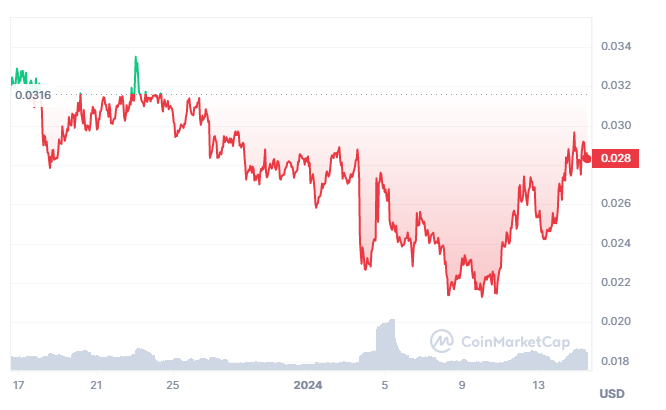
Recent days have seen MEME navigating the crypto seas with both bullish and bearish winds. Opening at $0.02705, bears initially had the upper hand, but bulls staged a comeback around $0.02100, stabilizing the market. The price found crucial support at $0.025, propelling MEME to a daily high of $0.02968.

Memecoin (MEME) price chart

MEME’s value, though unconventional, is culturally driven, reflecting the community’s interest and the significance of memes. Collections like “You the real MVP,” “The Potatoz,” and “The Captainz” serve as digital collectibles, contributing to the governance of the Memeland DAO.

Memecoin price prediction: short-term and long-term forecasts

In the short term, market analysts predict a slight dip in MEME’s value. However, despite the current bearish sentiment, the Fear & Greed Index registers 71 (Greed), indicating a dynamic market.

For the long term, analysts foresee memecoin (MEME) oscillating between a yearly low of $0.024312 and a high of $0.038052. DigitalCoinPrice anticipates volatility, with potential highs in the coming years, projecting a surge to $0.092991 in 2026 and $0.051937 in 2027.

Memeinator and the MMTR token presale                                               

In the competitive arena of meme coins, another coin, Memeinator, is also making headlines. According to the coin’s website, its mission is clear: to capture and destroy the weakest memes.

Powered by cutting-edge AI tech, Memeinator is on a relentless journey, eliminating unworthy projects and setting its sights on the top meme coin spot.

The Memeinator (MMTR) token, is currently in its presale stage. The presale allocates 62.5% to the community, 15% for marketing and CEX listings, and additional percentages for development, liquidity provision, and a competition pool. The presale is in its twelfth stage and the MMTR is currently going for $0.0186 and is expected to rise to $0.0197 in the next stage.

The project’s roadmap outlines phases like setting coordinates, unleashing the Memeinator, search and destroy, and ultimately achieving meme domination.

The unfolding meme coins battle

Both Memecoin and Memeinator are actively competing for the throne of the hottest meme coin. While Memecoin relies on its cultural significance and community-driven value, Memeinator brings forth its AI-powered Memeinator game and Memescanner, aiming for meme domination and eliminating threatening memes.

Memecoin’s cultural approach and Memeinator’s tech-fueled strategy showcase the diverse paths projects can take in this unique corner of the cryptocurrency market.

The post Memecoin (MEME) price prediction as Memeinator’s MMTR token presale heats up appeared first on CoinJournal.

Bitbot launches its presale this week: What should you know?

  • Bitbot (BITBOT) is a new Telegram trading app that launches its presale on January 17, 2024.
  • As traders eye opportunities, cryptocurrencies and Bitcoin ETFs are getting in the spotlight.
  • BITBOT holders will benefit from a unique revenue sharing model.

Cryptocurrency news headlines last week were predominantly about the roll out of spot Bitcoin ETFs. While focus is likely to continue hovering around the ETFs and the potential short term Bitcoin price outlook, this coming week could be big for traders amid the launch of Bitbot (BITBOT).

BlackRock holds 11,439 BTC amid ETF excitement

BlackRock’s IBIT Bitcoin ETF was one of the key drives of the inflows and trading volume for spot Bitcoin ETFs after their debut on January 11. Data shows the asset manager’s holdings rose to 11,439 BTC over the two days of trading.

Eric Balchunas, a senior ETF analyst at Bloomberg, also shared data showing Bitcoin ETFs saw more than $1.4 billion in new cash over the two days. With Grayscale’s GBTC’s recording outflows of about $579 million, the net inflows stood at over $819 million.

Meanwhile, BlackRock’s IBIT led the flows with $500 million as the cumulative trading volume hit $3.6 billion from 500,000 individual trades. If the analysis includes GBTC figures, individual trades reached 1.2 million, which the analyst says is an “impressive” feat.

The anticipation is that Bitcoin price will bounce amid further demand pressure. While the sharp BTC decline that followed Bitcoin ETF’s launch had traders scrambling, analysts believe the market will eventually embrace the long term impact of the ETFs’ approval.

Among tools that traders might want to tap into as the market matures is Bitbot.

What is Bitbot (BITBOT)?

Bitbot (BITBOT) is a new Telegram trading bot that’s billed the first non-custodial bot in the world, and is attracting huge attention.

One of the key aspects setting Bitbot apart from current Telegram bots is its focus on security and user privacy. Other than the advantage of access to institutional-graded trading tools, full custody of one’s assets is a major factor.

Retail traders eyeing this bot’s upcoming launch also see its robust security, enhanced by MPC custodial technology and backed by Knightsafe smart contract wallet, as a huge improvement on current offerings.

Bitbot’s Anti-MEV Bot and anti-rug features are also huge additions that will see the Telegram trading community avoid incidents such as those that hit Maestro and Unibot in 2023.

Bitbot presale goes live this week

Powering this platform is the native ERC-20 token BITBOT. This is the governance token and will also offer access to the trading bot’s bespoke wallet management and low gas options. 

BITBOT is also crucial in Bitbot’s revenue-sharing mechanism, offering holders an opportunity to earn a share of the revenue as the platform expands its utility across the trading ecosystem.

BITBOT has a total supply of 1 billion tokens, 30% of which is set for public presale starting on January 17, 2024.

Learn more about Bitbot’s upcoming launch here.

The post Bitbot launches its presale this week: What should you know? appeared first on CoinJournal.