
EOS Network Foundation implements major overhaul caps token supply at 2.1B

  • EOS Network Foundation caps token supply at 2.1 billion.
  • New economic model includes 4-year halvings and support for RAM market.
  • 950 million EOS tokens to be minted for ecosystem growth and rewards.

In a groundbreaking move, the EOS Network Foundation, under the leadership of CEO Yves La Rose, has approved a community proposal to cap the total supply of EOS tokens at 2.1 billion.

This decision marks a significant shift in the network’s tokenomics, aiming to stabilize and enhance the economic model of the EOS ecosystem.

Community approval and implementation

The proposal, which gained approval from at least 15 of the 21 EOS block producers, involves burning nearly 80% of the current total EOS token supply.

This drastic reduction is primarily sourced from future emissions, effectively decreasing the maximum supply from 10 billion to 2.1 billion tokens.

Yves La Rose confirmed the community’s consensus on the proposal through a post on X, emphasizing the foundation’s commitment to a fixed token supply and reduced inflation.

Currently, the circulating supply of EOS stands at 1.15 billion tokens, accounting for 54% of the newly established cap.

To support ongoing and future ecosystem growth, the proposal also includes minting an additional 950 million EOS tokens.

The minted tokens will be allocated to various ecosystem activities, such as rewarding stakers and block producers, ensuring continued incentivization and support for network participants.

Besides the trasition to a fixed token supply and reduction of the fully diluted valuation (FDV), La Rose highlighted several other key aspects of the proposal, including scheduled halvings every four years, and enhanced RAM market support.

In general, these changes aim to foster a more predictable and sustainable economic environment for the EOS network, positioning it for long-term success and stability.

EOS Network Foundation leadership transition

It is important to note that EOS was originally the creation of Block.one and the EOS token was introduced to investors through an initial coin offering (ICO) conducted between 2017 to 2018 raising $4 billion.

However, following some allegation of Block.one not reinvesting the funds raised during the ICO back in the EOS Network development, La Rose founded the EOS Network Foundation as a non-profit organization to support the EOS Network.

By capping the token supply and implementing a series of economic reforms, the EOS Network Foundation aims to create a more robust and investor-friendly ecosystem.

The planned changes are expected to be rolled out over the coming months, ushering in what La Rose describes as a “new era for EOS.”

The post EOS Network Foundation implements major overhaul caps token supply at 2.1B appeared first on CoinJournal.
Franklin Templeton proposes a 0.19% fee in its amended Spot Ethereum ETF S-1

  • Franklin Templeton files amended S-1 for spot Ethereum ETF with 0.19% fee.
  • SEC requires all spot Ethereum ETF issuers to file amended S-1 forms by Friday.
  • Franklin Templeton’s spot Bitcoin ETF also charges a 0.19% fee and currently manages $350M in assets.

Franklin Templeton has filed its amended S-1 form for spot Ethereum ETF following SEC’s directive that all spot Ethereum ETF issuers should send in their amended S-1 forms by Friday.

In the amended S-1, Franklin Templeton plans to charge a competitive 0.19% sponsor fee for the ETF, which is could be the lowest among its peers.

Franklin Templeton success with crypto ETFs

Franklin Templeton was among the eleven firms whose spot Bitcoin ETFs were approved by the SEC at the start of the year.

The firm’s foray into the Ethereum ETF space is buoyed by the success of its spot Bitcoin ETF, which currently manages approximately $350 million in assets. This strong performance of the Bitcoin ETF underscores the firm’s capability in managing cryptocurrency investment products and sets a promising precedent for its upcoming Ethereum ETF.

Its spot ether ETF application positions it among a growing number of financial institutions seeking to offer investors exposure to Ethereum, the second-largest cryptocurrency by market capitalization, without the need to directly purchase the digital asset.

Franklin Templeton’s aggressive crypto ETFs fee structure

Franklin Templeton’s proposed 0.19% fee mirrors the fee structure of its spot Bitcoin ETF (EZBC), which is also set at 0.19%, making it the lowest among similar financial products currently available.

Initially, Franklin Templeton did not charge any fee for investing in its spot Bitcoin ETF, a strategy likely designed to attract initial investors and build momentum.

Eric Balchunas, Bloomberg’s Senior ETF Analyst, commented on Franklin Templeton’s aggressive fee structure in a post on X saying, “The opening shot in the Eth ETF fee war has been fired from Franklin, 19bps.”

Balchunas’ comment highlights the competitive nature of the burgeoning Ethereum ETF market, where cost efficiency is a critical factor for attracting investors.

As firms rush against time to beat the Friday deadline, the stage is set for a new wave of Ethereum-based financial products to enter the market.

Although it may take a few weeks for these filings to become effective, the expectations that the ETFs could begin trading in a month’s time if not in a few weeks’ time.

The post Franklin Templeton proposes a 0.19% fee in its amended Spot Ethereum ETF S-1 appeared first on CoinJournal.

Uniswap delays protocol upgrade vote; UNI price falls 9%

  • The Uniswap Foundation announced a delay to an upgrade vote on the protocol’s fee mechanism.
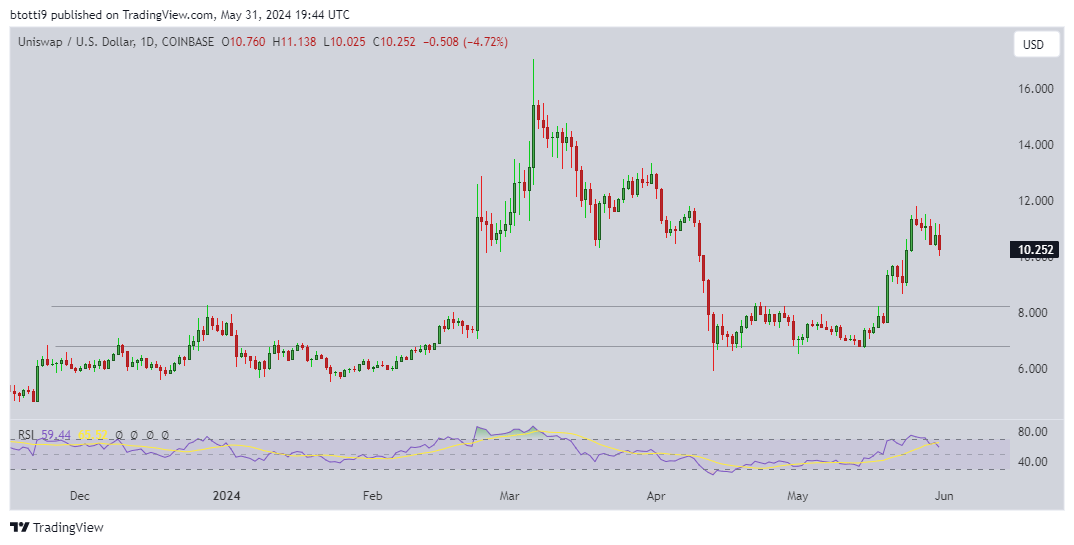
  • UNI price reacted lower, declining 9% to hit lows of $10.17.

The Uniswap Foundation has postponed the governance vote on a proposal aimed at activating a new fee mechanism for the protocol. This proposal would have initiated a fee switch for Uniswap, providing for rewards to UNI token holders who stake and delegate their tokens.

As the market reacted to the news, the price of UNI fell by nearly 9% to touch lows of $10.17 across major exchanges.

Uniswap postpones key upgrade vote

Uniswap announced the fee switch proposal last week, with an on-chain deployment and vote set for today, Friday. However, this will now not go ahead as planned as per a new update.

In an update today, the Uniswap Foundation stated that the delay relates to an issue a stakeholder raised following the proposal. This has necessitated “additional diligence” on the part of the Foundation.

“Due to the immutable nature and sensitivity of our proposed upgrade, we have made the difficult decision to postpone posting this vote. This was unexpected, and we apologize for the postponement. We will keep the community apprised of any material changes and will update you all once we feel more certain about future timeframes,” the Uniswap Foundation noted via its official X account.

UNI price

The UNI token traded to highs of $11.04 on Friday before the announcement saw the token’s value tumble.

UNI price has moved lower since hitting highs of $11.79 on May 26. The RSI on the daily chart suggests bears might yet target prices around the $10 level.

With Unswap price currently changing hands around $10.26, a breakdown below the psychological level could push it to support near $8.00.

As can be seen in the chart above, UNI price fluctuated within the $6.80-$8.22 range for several days before the breakout on May 20.

The post Uniswap delays protocol upgrade vote; UNI price falls 9% appeared first on CoinJournal.

New meme coin Piggy Bankster (PIGS) coming to Solana amidst the memecoin frenzy

  • The Solana meme coin frenzy welcomes Piggy Bankster (PIGS), a pig-themed token.
  • Piggy Bankster’s presale starts June 4th with 100M $PIGS tokens.
  • Solana’s ecosystem witnesses surge in activity amid increased meme coins activity.

Lately meme coins, most of which have launched on Solana blockchain, have emerged as powerful drivers of market activity and community engagement.

Leading the Solana-based meme coins frenzy are notable coins like Dogwifhat (WIF) and Bonk (BONK), which have captured the imaginations of investors and enthusiasts alike with staggering price increments.

Joining this dynamic landscape is Piggy Bankster (PIGS), a new meme coin entrant poised to leverage the success of other Solana-based coins. PIGS’ presale is scheduled to launch on June 4th, 2024.

Piggy Bankster (PIGS): the new Solana meme coin

Piggy Bankster brings a unique and intriguing narrative to the meme coin space that has been crowed by dog and frog-themed coins.

The pig gangster-themed coin is represented by a charismatic pig nicknamed Piggy Bankster who has clawed his way from the slums of Swine City to the pinnacle of the criminal underworld.

Piggy Bankster, always donning a pin-striped suit, is known for his ruthlessness, loyalty, and a fierce drive for power. His story is one of resilience and dominance, fitting perfectly into the meme coin culture that thrives on strong characters and engaging backstories.

The launch of Piggy Bankster is set against the backdrop of a booming meme coin market on the Solana blockchain.

Notably, the recent surge in popularity of Solana-based meme coins has driven substantial excitement and user activity on Solana, leading to increased network usage and a corresponding rise in the value of SOL, Solana’s native token.

Data from Dune Analytics highlights a rise in deployed transactions and revenue within the Solana ecosystem, correlating with the meme coin craze. Additionally, data on DeFi Llama shows a substantial increase in Solana’s Total Value Locked (TVL) throughout 2024, reflecting the platform’s expanding ecosystem and growing adoption.

However, this surge in activity is not just limited to meme coins. The broader Solana ecosystem has seen an influx of new projects, further enhancing the platform’s appeal. The recent integration of Solana into the multichain portfolio tracker Pulsar Finance simplifies asset management for users and underscores Solana’s growing importance in the Web3 landscape.

Piggy Bankster launch details and tokenomics

The Piggy Bankster ($PIG) presale launch is designed as a fair launch on the Solana network, ensuring that all participants have an equal opportunity to acquire the token from the outset.

The total supply of Piggy Bankster tokens is set at 100,000,000 $PIGS, with 100% of this supply being allocated to the liquidity pool. The initial liquidity is pegged at $12,000, establishing a starting price of $0.00012 per single PIGS token.

This strategic approach to the presale and liquidity provision aims to promote transparency and community involvement, key principles that resonate strongly within the cryptocurrency community.

Piggy Bankster’s persona is brought to life through memorable quotes that capture his ethos and appeal to the meme coin community. Statements like, “All I have in this world is my word and my snout. And I don’t break ‘em for nobody,” and “When you mess with the best, you get turned into bacon,” reflect the character’s tough and unapologetic nature.

For more information, you can visit the Piggy Bankster website, or follow the project on Twitter, or join the Telegram group for the latest updates.

The post New meme coin Piggy Bankster (PIGS) coming to Solana amidst the memecoin frenzy appeared first on CoinJournal.

JasmyCoin price prediction: could Bitbot outdo JASMY?

  • JasmyCoin (JASMY) has seen an impressive price rise driven by AI program launch, token lockup, and Apple speculation.
  • Analysts predict JasmyCoin price is posed for further gains and could hit $0.05 very soon.
  • Bitbot, an AI trading bot, is nearing end of its token presale with palpable anticipation for exchange listing.

JasmyCoin (JASMY) has recently captured the attention of investors with its meteoric rise in price. Surging by over 25% within the last 24 hours, by over 79% in the past month, and by over 577% in the past year, JASMY has demonstrated resilience and growth amidst the global crypto market’s recent crash.

However, as JasmyCoin rises, another cryptocurrency Bitbot (BITBOT) is also capturing the attention of investors as its presale comes to an end with exchange listing now in focus.

JasmyCoin price prediction

JasmyCoin’s recent price surge can be attributed to several key developments.

To start with the launch of the JANCTION AI program has attracted significant interest, positioning JasmyCoin as a pivotal player in the intersection of blockchain and artificial intelligence.

Additionally, the lockup of 100 million JasmyCoins has created buying pressure, reducing the circulating supply and boosting the price.

Analysts predict further price appreciation for JasmyCoin (JASMY), with expectations of potential breakout levels towards $0.05 and subsequently $0.10.

The recent surge in trading volume and market cap indicates growing investor confidence in JASMY’s future prospects.

Furthermore, speculation about a potential partnership with Apple regarding Japan’s “My Number” ID integration into iPhones is fueling excitement in the market as the general positive market dynamics, including rallies in Bitcoin (BTC) and Ethereum (ETH) prices adding to the bullish market sentiment for JASMY.

Bitbot: could it outperform JASMY once it gets listed?

Amid Jasmy’s spectacular rise, Bitbot, the world’s first AI Telegram Trading Bot, has emerged as another promising player in the crypto space.

Leveraging market data to provide actionable insights for trading decisions, Bitbot has garnered attention for its innovative approach to cryptocurrency trading.

In addition, the BITBOT token presale, which is quickly selling out and nearing its end, has also generated significant interest among investors.

The presale is in its last presale stage and it is quickly selling out as investors rush to get a stake of the Telegram bot token before the presale ends. Notably, the current presale price of BITBOT stands at $0.02 having risen significantly throughout the previous presale stages.

The presale has seen remarkable success, with enthusiastic participation from investors keen to secure their stake in this groundbreaking project. So far, the total amount raised has soared to an impressive $4,110,551, out of the target $4,324,000.

This overwhelming response underscores the confidence investors have in Bitbot’s vision and potential.

Looking ahead, the Bitbot roadmap outlines plans for further development, including the launch of the Bitbot native mobile app, cross-chain support, enhanced community features, and enhanced liquidity.

With the presale drawing to a close, anticipation mounts about the future trajectory of the BITBOT token, especially once it gets listed on bot centralized and decentralized trading platforms.

As investors weigh their options, the performance of Bitbot in comparison to JASMY remains an intriguing prospect.

With its advanced trading capabilities and strong community support, Bitbot has the potential to disrupt the cryptocurrency trading landscape and potentially outshine JasmyCoin in the future.

Conclusion

Both JasmyCoin and Bitbot represent exciting opportunities in the cryptocurrency market.

JasmyCoin’s recent price surge underscores its potential for further growth, driven by key developments and positive market dynamics.

On the other hand, Bitbot’s innovative approach to trading and upcoming roadmap milestones position it as a contender for outperforming JASMY in the long run.

Nevertheless, as investors navigate the dynamic crypto landscape, careful evaluation of the market is important for making informed investment decisions.

The post JasmyCoin price prediction: could Bitbot outdo JASMY? appeared first on CoinJournal.