
Sushi goes live on Bitcoin sidechain Rootstock

  • Sushi is now live on Bitcoin (BTC) sidechain Rootstock
  • Rootstock’s integration with the decentralised exchange (DEX) will expand DeFi on Bitcoin.
  • Users can now leverage Sushi’s advanced trading functionalities and other features while tapping into Bitcoin’s security and decentralisation.

SushiSwap, a decentralised exchange (DEX) deployed across over 30 blockchains, is now live on Rootstock, a pioneering Bitcoin (BTC) sidechain.

The Sushi team announced the integration with Rootstock, which seeks to bring decentralised finance (DeFi) to the Bitcoin ecosystem, on Thursday. 

SUSHI price rose slightly after the news, increasing by about 3% to reach $1.23.

Major news as Sushi integrates with Bitcoin sidechain Rootstock

Rootstock is the first EVM-compatible Bitcoin (BTC) sidechain, having launched in 2018 as the crypto industry experienced exponential growth across smart contracts projects.

With security enhanced via Bitcoin’s mining mechanism, Rootstock aims to expand the world of DeFi on Bitcoin through Ethereum-compatible smart contracts. The network provides for the critical features of high scalability, fast transactions and interoperability.

Sushi’s integration will allow SUSHI holders to trade and provide liquidity on the Bitcoin sidechain, with users able to tap into Bitcoin’s security and decentralisation.

The integration will allow for the expansion of SushiSwap’s trading functionalities to Rootstock’s DeFi ecosystem.

“This collaboration marks a significant expansion into the DeFi sector for Rootstock, enhancing its ecosystem with Sushi’s advanced trading functionalities. It also strengthens Sushi’s multi-chain expansion by adding Rootstock to the network, offering users diverse options for including Bitcoin in DeFi,” the Sushi team said in an announcement.

Sushi is therefore helping to bridge Bitcoin-Fi and DeFi, giving the community access to new opportunities that leverage BTC assets.

Some of the features Sushi brings to Rootstock are token swaps and liquidity provision. Users can leverage these via Sushi’s V2 and V3 Automated Market Maker (AMM), a DEX aggregator, and Route Processor 4 (RP4). The latter provides for efficiency and optimised trading.

Rootstock users can access DeFi protocols and other dApps using RBTC, a native token pegged 1:1 to BTC.

The post Sushi goes live on Bitcoin sidechain Rootstock appeared first on CoinJournal.
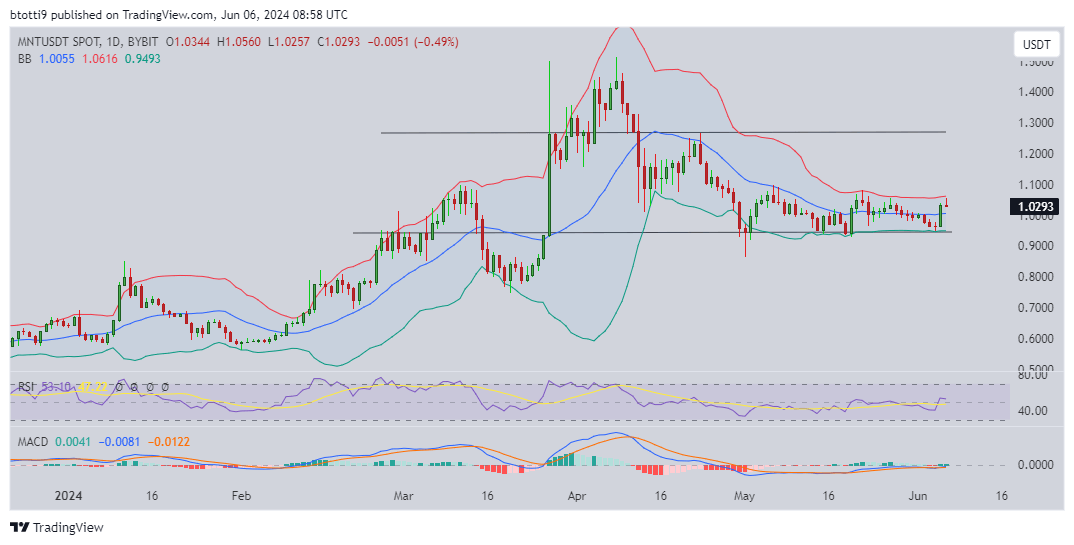
Mantle price outlook: Here’s why MNT is soaring

  • Mantle price rose 6% to above $1.04, with gains coming as Bitcoin (BTC) retested the $71k level.
  • MNT price had struggled to break out of a tight range.
  • Network developments and the overall crypto market outlook could help MNT price higher.

Mantle (MNT) price currently changes hands around $1.04 after jumping more than 6% in the past 24 hours alongside Bitcoin’s spike to above $71,000.

The cryptocurrency’s daily trading volume is up 110% to over $13o million in this period as Mantle trends among the best performers in the top 100 coins by market cap.

MNT price surges amid crypto bounce

Today’s gains for MNT price came as Bitcoin price surge to above $71k, with bulls taking advantage as spot BTC ETFs recorded an 11th consecutive trading day of net inflows.

Analysts are bullish on BTC, and projections for ETH amid spot Ethereum ETF approval could also contribute to MNT price going up.

Notably, MNT surged more than 40% in March, breaking above $1 as bullish momentum eventually pushed the token’s value to an all-time high above $1.50 in April.

While MNT benefitted from listing on South Korea’s largest crypto exchange Upbit, the parabolic rise that catapulted BTC to its ATH may also have fueled the upswing. The project’s introduction of the Mantle Rewards Station also added to the positive sentiment.

Mantle price – are bulls ready to run?

While MNT price has struggled since dipping below $1.40 in mid-April, it’s likely a new push in the SocialFi and gaming dApps space has Mantle poised for a fresh rally.

Mantle recently revealed it had deployed a $5 million ecosystem fund to support projects such as MetaCene, Blade Games, Co-Museum and Fingerlabs. The initiative has boosted the network’s protocols across lending, liquid staking, DEX, yield and RWA.

Data from DeFiLlama indicates the Total Value Locked (TVL) across these projects has nearly doubled in the past month. Per the details, Mantle TVL currently stands at around $463 million, up from approximately $252 million in early May.

MNT price on the daily chart is within a key range marked by the Bollinger bands. If bulls break higher, a decisive move above $1.10 may allow for a retest of the resistance line at $1.26.

The RSI and MACD indicators, however, suggest bears are not completely out of the picture. Primary support levels in case of a downward flip would include $0.94 and $0.78.

The post Mantle price outlook: Here’s why MNT is soaring appeared first on CoinJournal.

New Coinbase Smart Contract Wallet eliminates gas fees and recovery phrases

  • Coinbase has launched a Smart Contract Wallet with simpler onboarding and no gas fees.
  • The smart contract wallet supports Ethereum, BNB, Polygon, and others for seamless transactions.
  • Developers using the smart contract wallet can waive gas fees.

In a move to enhance user experience and streamline cryptocurrency transactions, Coinbase, one of the leading cryptocurrency exchanges, has unveiled its latest innovation: the Coinbase Smart Contract Wallet.

The groundbreaking smart wallet promises to revolutionize the way users interact with cryptocurrencies by eliminating gas fees and simplifying the onboarding process.

Key features of the Coinbase Smart Contract Wallet

Unlike traditional wallets that require users to manage complex recovery phrases and incur gas fees for transactions, the Coinbase Smart Contract Wallet offers a seamless and cost-effective solution.

One of the key features of the smart contract wallet is its simplified onboarding process. Users can create a new wallet and onboard onto a blockchain without the need to download additional apps or manage recovery phrases. Instead, the smart wallet integrates seamlessly with major applications and offers multiple authentication methods, including Face ID, fingerprint ID, and Yubikey.

Moreover, the smart wallet ensures self-custody, allowing users to have full control over their funds. Users can make payments directly from their Coinbase Wallet or Coinbase account, further enhancing convenience and accessibility.

Another notable aspect of the Coinbase Smart Contract Wallet is its integration with major blockchain networks.

At launch, the wallet will support a variety of networks, including Base, Ethereum, Optimism, Arbitrum, Polygon, Avalanche, BNB Chain, and Zora. This multi-chain support enables users to access a wide range of cryptocurrencies and decentralized applications (DApps) within a single platform.

Furthermore, Coinbase has introduced a unique feature that allows developers to waive gas fees by sponsoring transactions through a paymaster. This incentivizes developers to support the adoption of the smart wallet and contribute to a more seamless user experience.

The companion web app serves as the primary platform for users, offering comprehensive asset and identity management, as well as features such as buying, sending, swapping, NFTs, and transaction history.

Coinbase aims to provide users with a fluid and intuitive experience throughout their interactions with the smart wallet.

Loopring and Argent pioneered the smart contract wallets

Coinbase is not the first to launch a smart contract wallet. It is only building upon the growing trend of smart wallet technology in the cryptocurrency space.

The smart contract wallet technology was pioneered by companies like Loopring and Argent. The wallets offer enhanced security, usability, and cost-effectiveness compared to traditional wallet solutions.

The post New Coinbase Smart Contract Wallet eliminates gas fees and recovery phrases appeared first on CoinJournal.

Polygon Labs acquires Toposware to advance ZK research

  • Polygon Labs acquires Toposware to advance ZK research in blockchain.
  • Toposware brings expertise in ZK technology to Polygon’s ecosystem.
  • MATIC token sees positive market response following acquisition news.

Polygon Labs has announced its acquisition of Toposware to pioneer the next wave of zero-knowledge (ZK) technology.

The acquisition signifies a significant step forward in blockchain research and engineering, with a focus on pioneering the next wave of ZK innovation.

The acquisition seeks to foster practical ZK solutions

The objective behind this acquisition is clear: to leverage the expertise and talent of Toposware to push the entire ZK community forward. Polygon Labs, known for its contributions to ZK research over the years, seeks to further solidify its position as a leader in practical ZK solutions.

The integration of Toposware’s resources will span across various aspects of Polygon Labs’ ecosystem. This includes enhancements to AggLayer, Polygon zkEVM, and Polygon CDK, among others.

Notably, the acquisition also underscores Polygon Labs’ commitment to advancing zero-knowledge technology, a crucial element in the evolution of decentralized systems.

Toposware brings a wealth of knowledge and engineering prowess to the collaboration, complementing Polygon Labs’ existing capabilities. This synergy is expected to drive innovation and accelerate the development of practical ZK solutions, benefiting both developers and users within the blockchain ecosystem.

Polygon Labs’ strategic focus on ZK technology is underscored by recent developments, including insights into how Succinct’s SP1 will foster performant and cross-chain interoperability for AggLayer.

By leveraging leading ZK solutions such as Polygon Plonky 3, Polygon Labs aims to create a robust framework for decentralized applications, laying the groundwork for the future of blockchain technology.

With the acquisition of Toposware estimated to have cost approximately $1 billion, Polygon Labs solidifies its commitment to advancing zero-knowledge technology. This marks the third major deal in zero-knowledge technology for Polygon Labs, following previous acquisitions of Hermez (HEZ) and Mir in 2021.

On the sidelines, while there have been speculations regarding Polygon’s intentions to surpass Ethereum, Anurag Arjun, Co-Founder of Polygon, has downplayed such claims. Emphasizing Polygon’s initial motive to provide a scaling solution for Ethereum, Arjun clarified that the primary goal remains unchanged despite the ambitious strides in ZK research and development.

Polygon (MATIC) price reaction

The announcement of Toposware acquisition has not only garnered attention within the industry but has also had a positive impact on MATIC’s price, the native token of Polygon Network.

With a 2.31% increase in the last 24 hours, MATIC’s position as one of the best-emerging cryptocurrencies in 2024 has been further solidified.

Despite slight declines in value over the past 7 and 30 days, the overall trajectory remains positive, with notable growth in market capitalization and trading volume.

The post Polygon Labs acquires Toposware to advance ZK research appeared first on CoinJournal.

IOTA has launched its L2 EVM network focusing on real-world asset usage

  • IOTA launches layer 2 EVM network, integrating real-world assets and boosting DeFi.
  • The newly launched EVM network features smart contracts, cross-chain capabilities, and MEV protection.
  • IOTA token has seen a 3.23% increase to $0.2352 following the EVM network launch.

IOTA has launched its layer 2 Ethereum Virtual Machine (EVM) network focused on the integration and tokenization of real-world assets (RWAs).

Besides revolutionizing the IOTA ecosystem, the L2 EVM network offers robust functionalities tailored to meet the needs of both individual users and institutional investors.

Features of IOTA’s L2 EVM network

The new L2 EVM network introduces advanced features such as smart contracts, cross-chain capabilities, and parallel processing. These enhancements are designed to facilitate the seamless operation of decentralized financial (DeFi) applications and enable the efficient tokenization of physical assets.

A notable aspect of this network is its built-in protections against Maximal Extractable Value (MEV), a predatory practice where network validators manipulate transaction order to extract higher fees.

By preventing such activities, IOTA aims to create a more secure and equitable environment for all participants.

Dominik Schiener, co-founder of IOTA, in a Telegram message emphasized the network’s potential to bring vast amounts of real-world assets on-chain. Dominik said:

“We are positioning IOTA to bring the real world to Web3 and help to bring trillions of assets and institutional investors on-chain.”

Dominik’s ambition is supported by the establishment of the IOTA Ecosystem DLT Foundation, the first distributed ledger technology foundation registered under Abu Dhabi Global Market (ADGM) regulations.

This regulatory compliance ensures that IOTA is well-equipped to cater to the requirements of institutional investors, including features like on-chain KYC to identify investors and facilitate institutional DeFi trading pools.

Parallel processing is another key feature of the new L2 EVM network, enabling multiple transactions to be processed simultaneously. This approach significantly enhances the network’s scalability, reduces gas costs, and increases transaction speeds, addressing some of the most pressing challenges faced by blockchain networks today.

IOTA price reaction

Following the launch of the layer 2 EVM network, the IOTA token has experienced a notable uptick.

At press time, the IOTA token price was $0.2352, marking a 3.23% increase in the last 24 hours. The market capitalization stood at $773,040,069, reflecting a 3.27% rise. In addition, over the past 24 hours, the trading volume has surged by 25.71%, reaching $20,353,145.

However, the current price of is a far cry from its all-time high of $5.69, achieved in December 2017.

Despite the fluctuations, the recent developments and strategic focus on real-world asset usage points to a promising future for the token.

The post IOTA has launched its L2 EVM network focusing on real-world asset usage appeared first on CoinJournal.