
Less Than Three Months Left For STC Wallet Users To Redeem Their Tokens

The clock is ticking for Student Coin holders. The STC Wallet users have less than three months to redeem their tokens. The redemption process was launched on April 9 this year, with several stages scheduled for a total of five years.

The first and second deadlines for redeeming tokens within the STC wallet (automatically) and through centralized exchanges have already passed in June. The third stage, set to end on October 9, 2024, involves submitting a Redemption Request and requires direct contact with the Student Coin team. The final phase, which will continue until April 9, 2029, allows users to sell their tokens on-chain.

What is Student Coin, and why is it shutting down?

Student Coin was launched in 2019 by a group of students from Kozminski University, a Polish business school. The project’s primary purpose was to explore blockchain capabilities and inspire academia to embrace crypto technologies. The experiment proved a success and led to further initiatives, including creating the STC Wallet, launching the STC Academy, and, finally, establishing Coinpaper.com, currently one of the leading crypto news portals.

After a period of rapid growth and impressive valuations, the STC token faced a challenging environment. Economic turmoil, industry scandals, and regulatory uncertainty dampened its momentum. Despite navigating these stormy waters, the Student Coin team remained dedicated. They launched new initiatives, refined existing products, and prioritized user protection during major crypto collapses like Luna, UST, FTX, Genesis, and Celsius.

However, keeping the best interests of the community at heart, the Student Coin team has made the difficult decision to sunset the STC token and related projects, including the STC Terminal, STC University, and others.
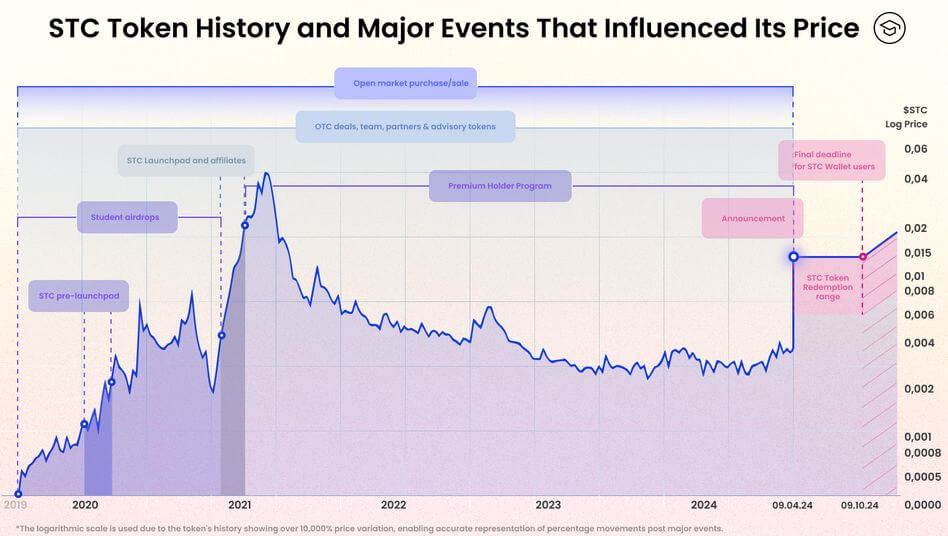
STC Token Price Chart, source: StudentCoin.org

After winding down the STC ecosystem, the team shifted its attention to developing new projects, with a special focus on Coinpaper. The crypto news outlet has been experiencing significant growth, with an impressive monthly user increase rate of nearly 19.75%, suggesting a bright future ahead.

How to stay informed about the STC redemption process?

Throughout the project, the STC team prioritized transparency and responsible approach to handling user funds. Users can stay informed about the developments of the redemption process by following the project’s website StudentCoin.org and Twitter. The team maintains direct contact with followers and posts frequent updates.

According to recent announcements, 82,86% of the STC total supply and 100% of the tokens held by the team have already been burned. Additionally, between May 30 and June 15, the tokens were delisted from KuCoin, ProBit Global, HitBTC, and all remaining centralized exchanges. The project also closed its Telegram chat.

The team has been continuously reminding users about deadlines for STC redemption stages and helping them navigate the process. The redemption prices range between $0.006 and $0.0137 per token and vary based on particular accounts’ purchase history and activity. This approach aims to reward loyal users, long-term holders, Premium Program members, and direct purchases via STC Wallet.

How can I redeem my STC tokens?

The manual STC Wallet Redemption via OTC Redemption request, available until October 9, 2024, requires undergoing KYC/KYB procedures and AML checks, as well as submitting documents that prove the source of funds and source of wealth. You can find more details at StudentCoin.org.

The last and longest-lasting redemption option, available until 9 April 2029, involves an on-chain operation and allows two approaches:

– Uniswap V3 to USDC transaction,

– on-chain burn procedure.

The Uniswap transaction is recommended for low STC volumes due to security reasons and possible liquidity limitations. It involves depositing tokens into a Metamask wallet and converting them to USDC through a relevant pool at Uniswap decentralized exchange.

As an alternative, recommended for larger amounts, you can use an on-chain burn procedure by simply sending all your STC tokens to the burn address https://etherscan.io/address/0x000000000000000000000000000000000000dead directly from your self-custody wallet. In return, you’ll receive an adequate value in USDC transferred to you by the STC team. You can read the full procedure at studentcoin.org.

The process is fully transparent, as all blockchain transactions are visible. Once the deadline has passed, all STC tokens will be burned anyway. The maximum waiting time for a refund in the case of an on-chain burn procedure is three months.

The post Less Than Three Months Left For STC Wallet Users To Redeem Their Tokens appeared first on CoinJournal.

Web3 Builders Invited to Apply for Nailwal Fellowship

The Nailwal Fellowship, an initiative founded by Sandeep Nailwal, co-founder of Polygon, has opened its application process for its 2024 cohort. The fellowship aims to support the brightest minds in the web3 space by providing them with financial support, mentorship, and comprehensive resources to explore innovative web3 ideas and develop new crypto projects or startups.

Sandeep Nailwal is an Indian entrepreneur, software developer, and blockchain expert, but he’s perhaps best known for co-founding Polygon in 2017, which was initially known as Matic Network.

Polygon, a Layer 2 scaling solution, has grown into one of the most influential platforms in the blockchain ecosystem, offering scalable and user-friendly solutions for decentralized applications. Nailwal’s leadership and vision have been instrumental in Polygon’s evolution, making it a cornerstone of the web3 landscape.

The Nailwal Fellowship Program

Nailwal launched the inaugural Nailwal Fellowship last year, when 8 fellows received $50,000 each as well as a wealth of technical support, mentorship and networking opportunities to help get their innovative ideas off the ground.

Last year’s winners of the inaugural fellowship were:

  • Adam Achebe: A Stanford Computer Science undergraduate focusing on liquidity challenges in the commodities industry.
  • Ananya Kandelwal: An Indian student creating new payment rails for global commerce.
  • Evgenii Danilenko: An Ethereum Foundation core developer working on advanced cross-chain infrastructure.
  • Joe Frazier: Former CTO of an NFT aggregator building new data indexing infrastructure.
  • J Paul Meyer: An ex-Goldman Sachs employee and Harvard graduate developing on-chain financial products.
  • Remi Gai: A repeat founder working on a new layer 1 solution using homomorphic encryption.
  • Shashank Yadav: An IIT Masters student and ML Engineer at Goldman Sachs creating a marketplace for AI data.
  • Tomas Taylor: An HBS graduate and former Dapper Labs employee developing an open platform for AI agents​

Applications now open

Applications for the 2024 cohort are now open, with a deadline of 22nd July 2024​.

This year’s fellowship will again offer each of the chosen fellows a $50,000 grant, technical resources and support, mentorship, and access to a network of industry leaders and investors through Symbolic Capital, a venture capital firm Nailwal co-founded.

This support is designed to allow fellows to dedicate six months entirely to their projects, fostering innovation in the web3 space.

With a strong commitment to diversity and inclusion, the fellowship is actively working to recruit more female applicants, addressing the gender imbalance in the web3 sector. By collaborating with organizations like SheFi and H.E.R. DAO, it aims to create a more inclusive environment for future cohorts​.

The post Web3 Builders Invited to Apply for Nailwal Fellowship appeared first on CoinJournal.

Poodlana: The new trendsetter meme coin set to launch on Solana

  • Poodlana is a new fashion-centric meme coin set to launch via presale on Solana.
  • The project’s token sale will launch on July 17, 2024
  • POODL listing on DEX will come immediately after the 30-day presale.

It’s been a year of new trends in the meme coins space, with new trends beyond the original dog-themed projects creating wave after wave of demand.

While political meme coins have exploded onto the scene in this election period, Poodlana (POODL) is the new trendsetter that brings a fresh breeze of fashion-centric attention to the cryptocurrency ecosystem.

Specifically, Poodlana is coming to Solana on July 17.

It’s a glitzy presale that will offer crypto enthusiasts and poodle lovers the early ticket to experience the haute couture of the crypto.

What’s Poodlana?

Poodlana is a new Solana meme coin that wants to bring the glamor of high-fashion to the crypto world.

It’s the meme coin world’s front-row seat in the unfolding era of luxury-blended crypto projects. This is the crypto for enthusiasts eyeing a chic meme coin that still embraces the ethos of community-driven growth.

The Shiba inu dog captured the imagination that drove Dogecoin, Shiba Inu and other top dog-themed meme coins to staggering heights.

Poodles are the other top dog breed in Asia and ranks among the top three in China, Japan, and Korea. These are three countries that don’t just love poodles; they are also trailblazers when it comes to meme coins. Notably, several projects have exploded in the Asian market before gaining traction across the globe.

One such meme coin is Chuan Pu. Dubbed the “Chinese Donald Trump coin”, Chuan Pu has raced to a 400x return for early investors. Biaoqing, another popular meme in the country, saw its market cap shoot up after it went viral in Asia.

Poodlana’s launch will likely see this type of growth or even more, particularly as poodles and high-fashion are a chic blend that radiates class and international appeal.

Poodlana’s presale approach

Innovative, transparent and tailor-made to benefit the community are descriptions very few presale projects can claim to be. But Poodlana does. Rather than have uncertain presale timelines and token listing dates, this project sets the ball rolling with a pacy 30-day token sale.

As noted above, the POODL presale goes live on July 17 and ends on August 16.

The 10-stage presale will see prices increase every 3 days, from $0.0200 in stage 1 to $0.0539 in the final stage. To make it easy for the community to participate, Poodlana will support buying with ETH, BNB, BASE, SOL, USDT and USDC. Users can also buy POODL via fiat/card payments.

Poodlana tokenomics

For tokenomics, the total supply will be 1 billion POODL tokens, 50% of which goes to the presale and the remaining split between marketing 15%, rewards 5%, partnerships 5%, treasury 10% and liquidity 15%.

100% of tokens will be unlocked on day one, and there will be no lock-ups or vesting periods. As the presale is time-defined, Poodlana will burn any unsold tokens.

According to the project team, token claims will open immediately after and Poodlana will debut on a decentralized exchange (DEX) within an hour of the presale close.

What this means is that crypto enthusiasts who join the POODL presale will know when it ends and when trading begins – no uncertainty of having to wait for token claims or listing news.

To learn more about Poodlana, visit their website.

The post Poodlana: The new trendsetter meme coin set to launch on Solana appeared first on CoinJournal.

Chainlink teams up with Fidelity and Sygnum to bring NAV data onchain

  • Chainlink partners with Fidelity and Sygnum to bring NAV data onchain for real-time access.
  • The collaboration enhances transparency and efficiency in NAV reporting using blockchain.
  • This initiative sets a new standard for asset management, highlighting DeFi’s potential.

In a groundbreaking move for the cryptocurrency and financial sectors, Chainlink has partnered with Fidelity International and Sygnum to bring Net Asset Value (NAV) data onchain.

This strategic collaboration aims to leverage Chainlink’s decentralized oracle technology to enhance the transparency and efficiency of NAV reporting, thereby setting a new standard for real-time data accessibility. It underscores the potential of blockchain to transform traditional financial systems and highlights Chainlink’s growing influence in the industry.

Bringing NAV data onchain for real-time updates

NAV is a critical financial metric that calculates the value of a fund’s assets minus its liabilities, divided by the number of shares outstanding.

Traditionally, NAV data is updated at the end of each trading day, which can delay accurate investment reflections.

The collaboration between Fidelity, Sygnum, and Chainlink aims to bringing NAV data onchain thus allowing for accurate real-time updates, offering a significant improvement over conventional methods. This will enhance transparency and efficiency for institutional investors.

Fidelity’s $6.9 billion Institutional Liquidity Fund will be the first to benefit from this innovative approach.

Sygnum’s clients will have access to this onchain data, aligning with Matter Labs’ strategy to move treasury reserves onchain while continuing to invest in high-quality debt securities.

By adopting blockchain technology, Fidelity and Sygnum demonstrate their commitment to innovation and their belief in the transformative potential of decentralized finance (DeFi).

Chainlink is setting a new standard in asset management

Chainlink’s co-founder, Sergey Nazarov, emphasized that tokenized funds offer far greater efficiency benefits compared to traditional methods. He predicts that this approach will eventually become the norm in the asset management industry.

The Depository Trust and Clearing Corporation (DTCC) has also recognized the potential of onchain NAV data.

In a recent industry pilot using Chainlink’s Cross-Chain Interoperability Protocol (CCIP), the DTCC explored extending its Mutual Fund Profile Service to include onchain NAV data. According to the pilot report, the pilot demonstrated that delivering structured data onchain could embed foundational data into numerous use cases, such as tokenized funds and smart contracts holding data for multiple funds.

The partnership between Chainlink, Fidelity, and Sygnum marks a significant advancement in the integration of blockchain technology with traditional financial systems.

By bringing NAV data onchain, this collaboration enhances transparency, efficiency, and data accuracy, potentially setting a new standard for the asset management industry and highlighting the transformative potential of decentralized finance.

The post Chainlink teams up with Fidelity and Sygnum to bring NAV data onchain appeared first on CoinJournal.

Paysafe Forecasts Annual Revenue of $1.7 Billion


Impressive growth forecast is driven in part by growing demand for paysafecard deposits on online casinos

In an impressive financial turnaround, Paysafe’s recent quarterly financial results offered an annual revenue forecast of $1.7 billion for the payment provider for 2024, partly fueled by the rising popularity of Paysafecard deposits with online casinos. 

Paysafe’s Q1 financial results revealed first quarter net income of $3.1 million, a marked improvement from the $3.8 million loss it reported in the first quarter of last year. Bruce Lowthers, the fintech company’s CEO, attributed the impressive year-on-year turnaround to Paysafe’s white-label wallet strategy, its expanded sales team, and its renewed focus on enabling casinos and iGaming sites to allow deposits via Paysafe, particularly in the USA.

The company’s revenue for the first quarter grew by 8% year-over-year, reaching $417.7 million, while its adjusted EBITDA stood at $111.9 million, reflecting a 4% increase. This growth is primarily driven by the expanded use of Paysafecard, which is becoming an increasingly popular payment method for online gambling sites.

Paysafe’s Merchant Solutions segment saw an 11% rise in revenue due to substantial growth in e-commerce and small to medium-sized businesses. The Digital Wallets segment also experienced growth, fueled by the gambling sector and enhanced product engagement.

Strategic Partnerships Expected to Fuel Paysafe’s Growth

Bruce Lowthers highlighted the success of Paysafe’s strategic initiatives, including the expansion of its sales team and a new white-label wallet strategy through a partnership with Xsolla. These initiatives have significantly contributed to the company’s robust performance and optimistic growth prospects.

Paysafe’s financial outlook for 2024, with expected revenue between $1.688 billion and $1.712 billion and an adjusted EBITDA ranging from $473 million to $488 million, underscores its confidence in its sustained growth. The company’s strategic focus on the iGaming sector and its collaboration with major payment networks like Visa are expected to further drive its financial success.

Online Casinos Projected to Record CAGR of 11.7%

Highlighting Paysafe’s opportunities for growth, market projections for the global online gambling sector indicate that it will reach an annual value of $153.57 billion by 2030, at a compound annual growth rate (CAGR) of 11.7% over the next six years. 

This growth is driven by several key factors, including the increasing availability of free-play versions of online casino games and the adoption of advanced digital payment options.

Free-play versions of online casino games have proven to be a major draw for new users. These versions allow players to experience games without financial risk, which helps build trust and familiarity with online gambling platforms. This model also generates revenue through advertisements integrated within these free-play environments​.

At the same time, the growing availability of digital payment options, including blockchain-based solutions and digital wallet solutions like Paysafe, are removing friction, making it easier for players to deposit and withdraw funds. 

A significant portion of iGaming, approximately 75%, is already funded through digital payment methods such as Paysafe and cryptocurrencies​. As much as 40% of these payments are made via cryptocurrencies, reflecting their growing acceptance and convenience in the online gambling space​.

The combination of these payment innovations and the user-friendly nature of online casinos is contributing to the sector’s rapid expansion. This trend presents substantial growth opportunities for payment providers like Paysafe, which are well-positioned to capitalize on the increasing demand for secure, efficient, and versatile payment solutions in the iGaming industry​.

As the online gambling market continues to evolve, Paysafe’s strategic focus on enhancing its digital wallet capabilities and expanding its presence in the iGaming sector will likely drive sustained growth. The company’s ability to adapt to market trends and meet the needs of modern online gamblers positions it as a key player in the future of digital payments for online casinos.


The post Paysafe Forecasts Annual Revenue of $1.7 Billion appeared first on CoinJournal.