
Morgan Stanley allows advisors to offer Bitcoin ETFs to clients

  • Morgan Stanley has become the first major Wall Street bank to allow its financial advisors to offer Bitcoin exchange-traded funds to its clients.
  • Over 15,000 of the bank’s financial advisors have the go ahead to pitch Bitcoin ETFs to eligible Morgan Stanley clients starting on Aug. 7, 2024.

According to a CNBC report on Friday, Morgan Stanley’s 15,000 financial advisors can, from Aug. 7, offer spot Bitcoin ETFs to the bank’s e clients. This sees the bank becomes the first Wall Street banking giant to take this step amid growing demand.

Per the reporting, the US-based wealth management giant has allowed two funds for pitching to its customers – BlackRock’s  iShares Bitcoin Trust (IBIT) and Fidelity’s Wise Origin Bitcoin Fund (FBTC).

However, while Morgan Stanley has allowed advisors to solicit these ETFs for clients, they will only be accessible to those who qualify. For instance, only clients whose net worth is $1.5 million or more, show an aggressive risk tolerance and want to invest in a speculative investment, will be eligible.

The bank will also allow these Bitcoin ETF investments in clients’ taxable brokerage accounts, and not their retirement accounts.

Spot Bitcoin ETFs market

IBIT and FTBC are among the 11 spot exchange-traded funds the US Securities and Exchange Commission approved for trading in January 2024. These spot ETFs allow investors to purchase and trade shares of products that track the market performance of the world’s largest digital asset Bitcoin.

Like other spot crypto ETFs, IBIT and FBTC offer an investment vehicle for those looking to gain exposure to Bitcoin via a structure that’s easily accessible and readily tradable.

US spot Bitcoin ETFs so far hold a total of $57.2 in net assets, while data shows cumulative net inflows were at $17.5 billion as of Friday, Aug. 2.

Per data by SoSoValue, the spot Bitcoin ETFs saw net outflows of over $237 million on Aug. 2, 2024, with over $104 million flowing out of Fidelity’s IBIT. Grayscale’s GBTC saw outflows of over $45.9 million.

On the other hand, BlackRock’s IBIT recorded inflows of $42.8 million. The Grayscale Bitcoin Mini Trust (BTC), which went live on the NYSE Arca this week, recorded over $9.8 million in inflows.

The post Morgan Stanley allows advisors to offer Bitcoin ETFs to clients appeared first on CoinJournal.
Bitcoin network difficulty reaches record high amid price volatility

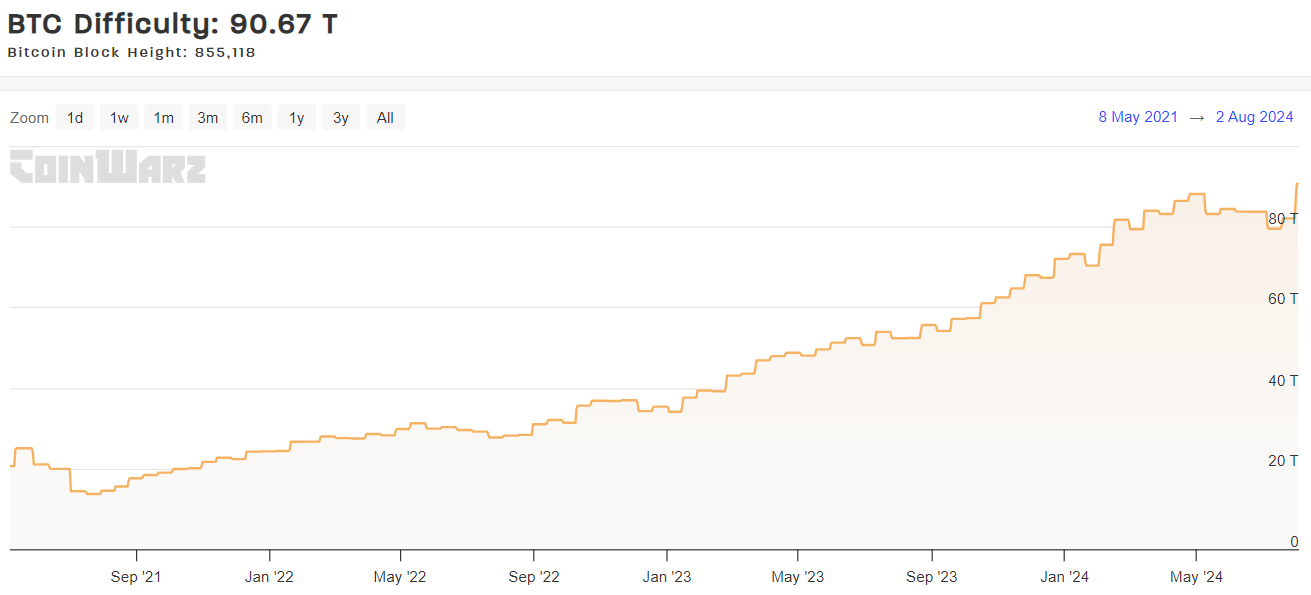
  • Bitcoin’s network difficulty hits a record high of 90.67 trillion as of August 2, 2024.
  • Bitcoin’s hash rate reached a record 677 EH/s on July 27th, boosting network security.
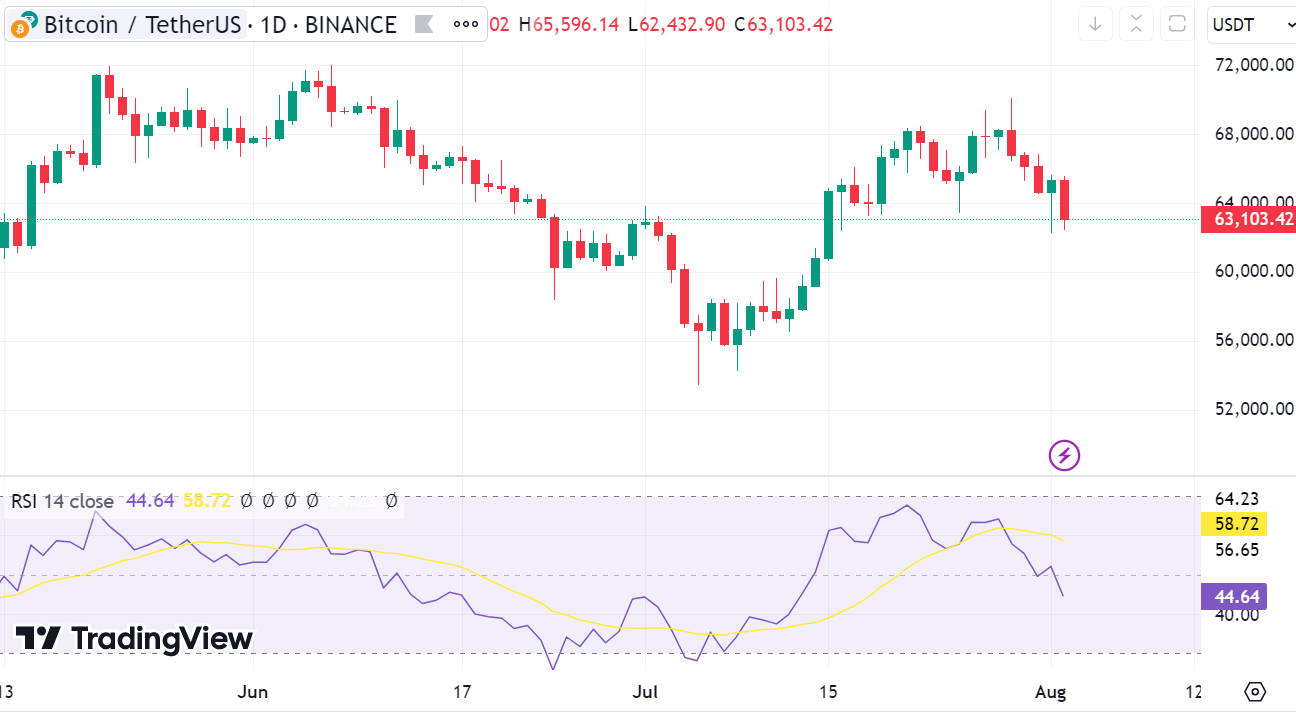
  • Bitcoin’s RSI at 44 suggests potentially oversold conditions; the price may test $58,000

Bitcoin has set a new record for network difficulty, reaching 90.67 trillion on August 2, 2024 according to data on CoinWarz.

This milestone represents a significant rebound following three months of declining difficulty, signalling renewed confidence among miners in the cryptocurrency’s network.

The increased difficulty implies that mining new Bitcoin blocks now requires more computational power, potentially driving up operational costs and influencing Bitcoin’s future supply and pricing dynamics.

Bitcoin’s hashrate also hit an all-time high

On July 27th, Bitcoin’s hashrate surged to a record 677 EH/s, reflecting a robust and secure network infrastructure. This peak suggests intensified competition among miners and strengthens the network’s resilience against potential security threats.

A high hashrate not only indicates increased mining activity but also has the potential to positively impact Bitcoin’s price by boosting investor confidence.

BTC price under increased bear pressure

Currently, Bitcoin is trading at $63,103.42, showing a 0.17% increase over the past 24 hours. The cryptocurrency has been fluctuating between $62,248 and $65,593, suggesting a mild recovery trajectory despite recent volatility.

If this trend continues, Bitcoin may avoid the $62,000 resistance level, potentially paving the way for new highs.

However, the Relative Strength Index (RSI) for Bitcoin is at 44.64, indicating that the cryptocurrency is approaching oversold conditions.

Bitcoin price

A declining RSI points to diminishing bullish momentum, and if bearish forces intensify, Bitcoin might test its next support level at $58,000. Further declines could follow if market pressure persists.

Overall, Bitcoin’s rising network difficulty and hashrate highlight a strengthened and competitive mining environment. These factors are essential for evaluating the network’s health and security as Bitcoin navigates through ongoing price volatility.

The post Bitcoin network difficulty reaches record high amid price volatility appeared first on CoinJournal.

Genesis Trading prepares to return $3B to customers, transfers 32,256 BTC

  • Genesis transferred $2.12B in BTC and $838M in ETH as part of bankruptcy restructuring.
  • Genesis will return $3B to creditors, covering 77% of customer claims.
  • Digital Currency Group will not receive any payout from Genesis’s bankruptcy plan.

Over the past three days, Genesis Trading has moved approximately 32,256 BTC, valued at around $2.12 billion, and 256,775 ETH, worth about $838 million, to various addresses.

This substantial transfer of assets is seen as part of the company’s efforts to manage creditor repayments under its ongoing financial restructuring plan.

Genesis Trading settlement plan has been approved

The turmoil for Genesis began in November 2022 with the collapse of the FTX crypto exchange, which severely impacted the firm’s derivatives business.

Genesis halted withdrawals and filed for Chapter 11 bankruptcy protection in January 2023 due to substantial losses linked to the FTX debacle and the failure of Three Arrows Capital.

At that time, the company owed over $3.5 billion to its top creditors.

Amidst this challenging backdrop, Genesis has recently reached a court-approved settlement plan, aimed at returning $3 billion to its customers. This plan will cover approximately 77% of the total value of customer claims.

In the immediate aftermath of Genesis’s bankruptcy filing, claims were trading at only 35% of their value on claim trading platforms. However, current trading prices for claims are significantly higher, with claims over $10 million trading between 97-110% of their value and smaller claims trading between 74-94%.

Digital Currency Group (DCG) to miss out on this settlement

Digital Currency Group (DCG), the parent company of Genesis, will not benefit from this settlement. The court has ruled that there is insufficient value in Genesis’s estate to provide DCG any recovery as an equity holder.

This decision was influenced by DCG’s failed attempt to cap customer claims at January 2023 cryptocurrency values, which would have allowed for full repayment to customers and potentially a recovery for DCG.

Additionally, DCG had assumed $1.1 billion of Genesis’s debt from the Three Arrows Capital collapse, but this obligation did not cover the losses.

The post Genesis Trading prepares to return $3B to customers, transfers 32,256 BTC appeared first on CoinJournal.

Hong Kong’s largest online broker Futu Securities launches Bitcoin and Ethereum trading

  • Futu Securities launches Bitcoin and Ethereum trading in Hong Kong with zero fees.
  • New users can receive incentives like Bitcoin or shares of Alibaba and Nvidia.
  • Futu seeks a crypto exchange license for PantherTrade amid Hong Kong’s crypto hurdles.

Futu Securities International, Hong Kong’s largest online broker, has introduced retail cryptocurrency trading in the city, marking a significant advancement in its financial services.

The brokerage firm, known for its extensive reach and innovative offerings, now allows residents to trade Bitcoin and Ethereum on its platform. This initiative comes after a partnership with HashKey Exchange, one of only two licensed cryptocurrency exchanges in Hong Kong.

Bonuses and waived crypto trading fees

The launch comes with enticing bonuses. New account holders who deposit HK$10,000 (approximately $1,280) for 60 days can receive either HK$600 worth of Bitcoin, a HK$400 supermarket voucher, or a share of Alibaba.

Those who deposit HK$80,000 are eligible for HK$1,000 in Bitcoin or a share of Nvidia, whose stock has surged by about 130% this year.

Additionally, Futu has waived commission fees for crypto trading starting August 1st, enhancing the appeal of their new service.

Futu looking for a crypto exchange license in Hong Kong

Futu is also pursuing a cryptocurrency exchange license for its new platform, PantherTrade, which currently operates under a ‘deemed to be licensed’ status.

PantherTrade is among 11 platforms in Hong Kong awaiting full approval from the Securities and Futures Commission (SFC).

Hong Kong crypto industry challenges

Despite these advancements, Hong Kong’s aspiration to become a global crypto hub faces hurdles. The city has experienced the exit of major global trading platforms and low trading volumes for crypto ETFs.

Increased fraudulent activities, such as a recent scam involving counterfeit currency, have further complicated the situation.

In response, Hong Kong authorities are enhancing their regulatory measures and law enforcement capabilities to address these issues and boost investor confidence.

As Futu Securities deepens its presence in the cryptocurrency market, the success of its initiative will depend on balancing innovation with stringent oversight to ensure a secure trading environment.

The post Hong Kong’s largest online broker Futu Securities launches Bitcoin and Ethereum trading appeared first on CoinJournal.

Top Microsoft Engineer Predicts Blockchain Vertical Upscale: Which Industries Might Lead the Charge?

  • Chris Li predicts blockchain will shift from horizontal to vertical scaling soon.
  • Vertical scaling could enhance efficiency in online casinos and improve user experience.
  • Advanced solutions like atomic swaps may replace wrapped assets, preserving decentralisation.

Chris Li, a former Microsoft engineer and the founder and CTO of Ava Protocol, has made a bold prediction for the future of blockchain technology. 

According to Li, the focus of blockchain development is set to shift from horizontal scaling towards vertical scaling within the next five years. This transition is anticipated to redefine how various industries utilise blockchain technology, particularly in terms of efficiency, user experience, and decentralisation.

Horizontal scaling solutions reach saturation

Horizontal scaling, which involves increasing the number of nodes or expanding network capacity, has been the primary method for improving blockchain performance. However, Li suggests that this approach has reached its limits. 

The saturation of horizontal scaling solutions, such as Ethereum’s layer-2 solutions and zk-rollups, indicates a pressing need for new strategies. 

Vertical scaling, on the other hand, aims to enhance the capabilities of individual transactions, making them faster and more cost-effective while maintaining decentralisation.

Online gaming set to benefit significantly from vertical scaling

One industry poised to benefit significantly from vertical scaling is online gaming, specifically online casinos.

The integration of blockchain technology in online casinos has already shown promise in terms of transparency, security, and fair play. 

Vertical scaling could further revolutionise this sector by enabling more complex transactions and interactions within gaming platforms. Enhanced smart wallets and multi-signature solutions could streamline the user experience, making it easier for players to manage their assets and engage in secure, instant transactions.

Li highlighted the limitations of wrapped digital assets, which, despite their utility in bridging assets across different blockchains, reintroduce centralisation risks and trust dependencies. 

For online casinos, this means that the current reliance on custodians for asset management could be replaced by more decentralised solutions such as atomic swaps and cross-chain bridges. 

These technologies promise to preserve the decentralised ethos of blockchain while enhancing functionality and security.

Balancing between security, scalability and decentralisation

Moreover, vertical scaling could address the blockchain trilemma — balancing security, scalability, and decentralisation. 

By allocating resources more efficiently and enhancing transaction capabilities, vertical scaling could provide industries like online casinos with robust, scalable solutions that do not compromise on security or decentralisation.

Vertical scaling offers a promising future, transforming how blockchain technology is applied across various sectors and paving the way for more efficient and user-friendly applications.

The post Top Microsoft Engineer Predicts Blockchain Vertical Upscale: Which Industries Might Lead the Charge? appeared first on CoinJournal.