
Ethereum falls below $2.6k as whales dump ETH

  • Ethereum is down more than 5% in the past 24 hours to trade below $2,600 as altcoins show weakness.
  • The top altcoin’s dip to lows of $2,560 on Tuesday however comes amid massive whale activity, most of which has happened in the last few hours.

Whales dump Ethereum

On August 27, 2024, Ethereum co-founder Vitalik Buterin sent 199.9 ETH worth over $517,000 to a multi-signature wallet. Details suggest a donation to ethos, a project that says its building an Ethereum mobile operating system.

While notable, this transfer pales in comparison to some of the largest whale movements seen in the past 24 hours.

Earlier in the day, Lookonchain pointed out a potential $49 million dump by a whale who had moved 19,000 ETH to Coinbase. The whale initially requested to transfer over 30,000 stETH – the staked ETH token, with this withdrawals amounting to over $78.67 million at the time.

Lookonchain has also highlighted another whale who has exchanged more than 4,591 stETH for 4,589 ETH, taking a 2.3 ETH loss just to have the tokens available immediately for sale. On-chain data shows the whale address has deposited 5,145 ETH tokens to Binance. This deposit and potential sale was worth over $13.3 million at the time of the transfer.

ETH whale dumps altcoin to avoid liquidation

But that’s not all. Two whales also sold 8,208 ETH worth over $21.5 million as the Ethereum price hovered at $2,630. According to on-chain analysis, the whales moved to dump their Ether for funds to repay debts on decentralized lending protocol Aave. The whales sold to “avoid being liquidated”, Lookonchain noted.

Whale dumping has also happened at a loss in the past 24 hours, with one large holder selling 5,088 ETH for $13.58 million. The whale made a loss of $3.66 million after having moved the coins off Binance in March and April this year, with the value of the holdings at around $17.24 million.

In total, whales have dumped over $96 million worth of ETH in the past 24 hours.

Ethereum price falls below $2.6k

The price of Ethereum rose to highs of $2,808 on August 24, riding a bullish flip that also saw Bitcoin (BTC) break above $64,900.
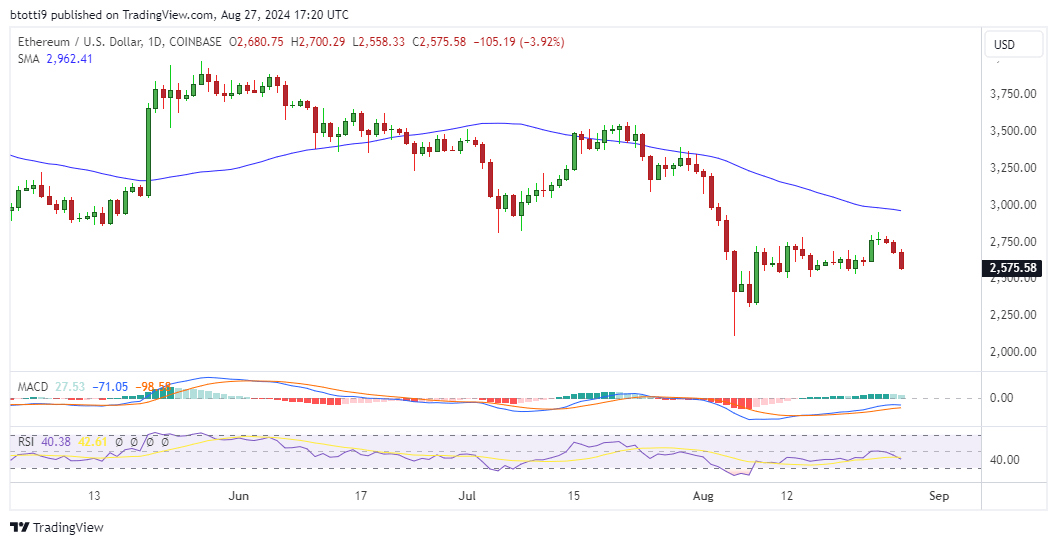
Ethereum price chart. Source: TradingView

However, ETH has seen a downturn that currently has price hovering below $2,600. Indeed, the leading cryptocurrency fell to lows of $2,558 on Coinbase, with the RSI and MACD on the daily chart suggesting bears have the upper hand.

The post Ethereum falls below $2.6k as whales dump ETH appeared first on CoinJournal.

Ondo Finance launches its permissionless yieldcoin USDY on Arbitrum

  • Ondo’s USDY yieldcoin is now live on Arbitrum, offering 5.35% APY for non-US investors.
  • USDY integrated with Camelot and Dolomite for trading, lending, and yield generation.
  • USDY represents 17% of Arbitrum DAO’s treasury, boosting RWA adoption on-chain.

Ondo Finance has launched its market-leading permissionless yieldcoin, USDY, on the Arbitrum blockchain, marking a significant expansion of real-world assets (RWAs) within the decentralized finance (DeFi) ecosystem.

USDY, a tokenized US Treasuries product, is now accessible on Arbitrum, one of the largest and most vibrant DeFi platforms, further cementing Ondo’s role in bridging traditional finance with blockchain technology.

USDY now integrated into key Arbitrum DeFi protocols

USDY offers a compelling 5.35% annual percentage yield (APY) and is specifically designed for non-US individual and institutional investors. It provides the stability of a dollar-denominated asset, combined with the yield potential of US Treasury Bills.

Following the integration, the USDY is now integrated into key Arbitrum DeFi protocols, including Camelot and Dolomite, enabling users to trade, lend, and earn yields in a secure, decentralized environment.

Arbitrum has quickly risen to prominence as a leading Layer 2 scaling solution for Ethereum, boasting over $15.5 billion in total value locked (TVL) and $4.5 billion in stablecoins. The integration of USDY into this ecosystem follows the Arbitrum DAO’s strategic decision to allocate 6 million ARB from its treasury into Ondo’s yieldcoin, making USDY a substantial 17% of the DAO’s total investment. It also comes on the heels of  Arbitrum DAO’s approval of a proposal to boost ARB performance and treasury security.

USDY holders on Arbitrum can benefit from trading on Camelot, the platform’s largest decentralized exchange, and lending on Dolomite, a major money market protocol. The token’s price is supported by primary and secondary market feeds from Pyth, enhancing its usability across various DeFi applications.

With USDY’s launch, Ondo Finance continues to drive the adoption of RWAs on-chain, offering global investors a robust, compliant, and yield-generating asset within Arbitrum’s rapidly growing DeFi landscape.

The post Ondo Finance launches its permissionless yieldcoin USDY on Arbitrum appeared first on CoinJournal.

Maker Protocol rebrands to Sky, Dai stablecoin rebranded to USDS

  • Maker Protocol rebrands to Sky, renaming Dai stablecoin as Sky Dollar (USDS).
  • MKR governance token upgraded to Sky (SKY) with a 1:24,000 conversion rate.
  • Maker SubDAOs rebranded as Sky Stars, with Spark as the first live subDAO.

In a significant move to make decentralized finance (DeFi) more accessible, the Maker Protocol has rebranded to Sky, unveiling a new identity for its stablecoin and governance token.

The Dai stablecoin, widely recognized as the largest decentralized stablecoin, has been renamed USDS. Alongside this, the governance token has been upgraded from Maker (MKR) to Sky (SKY), marking a pivotal moment in the evolution of DeFi.

Notably, the rebranding comes roughly three months after MakerDAO, the decentralized autonomous organization that oversaw the Maker Protocol, unveiled two new tokens – NewStable and NewGovToken.

A new chapter for Maker: introducing Sky and USDS

The rebranding of Maker Protocol, a pioneer in the DeFi space, reflects the protocol’s mission to simplify and broaden access to decentralized financial services.

With this shift, Maker has also introduced significant changes to its key assets. The Dai stablecoin, which has long been a cornerstone of the DeFi ecosystem, has been rebranded as USDS with the aim of making the stablecoin more relatable and accessible to a broader audience.

In tandem with the stablecoin rebranding, the governance token MKR has been replaced with the Sky (SKY) token. The upgrade from MKR to SKY is set at a conversion rate of 1:24,000, a move designed to increase the distribution and accessibility of the token.

According to Rune Christensen, co-founder of MakerDAO, this change is part of a broader effort to enhance user experience and drive the next wave of DeFi adoption.

Maker SubDAOs revamped to Sky Stars

As part of its comprehensive rebranding strategy, Maker has also revamped its SubDAOs, now known as Sky Stars. These decentralized, autonomous organizations will continue to operate independently, contributing to the broader Sky ecosystem with their unique business models.

Each Sky Star subDAO will have the autonomy to issue its own governance token, manage its treasury, and make independent decisions.

The first of these Sky Stars, Spark, has already gone live as a decentralized liquidity protocol. Spark offers users a 6% yield for depositing USDS while enabling borrowing at a 7% interest rate. This move positions Spark as a significant player in the DeFi lending space, currently ranked as the third-largest lending protocol with a total value locked (TVL) of $2.66 billion.

The rebranding of Maker to Sky, along with the introduction of USDS and SKY, marks a transformative step in the DeFi landscape, positioning the protocol for future growth and broader user engagement.

The post Maker Protocol rebrands to Sky, Dai stablecoin rebranded to USDS appeared first on CoinJournal.

Xapo Bank partners with Hilbert Group to launch $200m Bitcoin hedge fund

  • Xapo Bank and Hilbert Group will launch a Bitcoin-denominated hedge fund.
  • The BTC fund will receive an initial investment of $200 million from Xapo and other investors.

Xapo Bank is teaming up with Hilbert Group to launch a Bitcoin (BTC)-denominated hedge fund, according to a press release on Aug. 27.

In the announcement, Hilbert Group said the strategic partnership will involve its asset management arm Hilbert Capital and see an initial investment of over $200 million from Xapo as well as other investors.

“Over the last 12 months, we have developed a close and strategic partnership with Xapo Bank, a veteran in the Bitcoin space and a tier-one financial institution in the digital asset space,” Niclas Sandström, CEO of Hilbert Group, said.

He added, “Given the investment opportunity and the quality and experience of the team, we anticipate that the Fund will grow meaningfully over the next year.

Fund to offer exposure to Bitcoin

The newly-established BTC-denominated hedge fund will launch in September, Hilbert Group revealed in the press release. Corporates, businesses and professional investors will leverage the new fund to generate returns in bitcoin. The fund will offer institutional-grade credit arrangements that investors don’t get through direct market participation.

Notably, the BTC-denominated fund will have fees lower than the 2% and 20% Hilbert’s other hedge funds charge.

“We believe that offering the right products for participants in the space who are aiming not only for exposure to the Bitcoin price, but also structured ways to grow the Bitcoin value of those investments is a natural evolution of the asset class,” Joey Garcia, director of Xapo Bank commented.

Hilbert, founded in 2018, primarily focuses on asset management of algorithmic trading strategies.

The company also invests in blockchain and crypto related projects. Investments in the space include crypto data platform Coin360, blockchain-based self-service SaaS tool CapChap and HAYVN, a digital assets trading and custody platform.

Meanwhile, Xapo is the first Bitcoin-enabled bank that integrates fiat with crypto. It recently announced its entry into the UK.

The post Xapo Bank partners with Hilbert Group to launch $200m Bitcoin hedge fund appeared first on CoinJournal.

OKX adds support for new USDC spot trading pairs

  • OKX has introduced support for multiple USDC spot trading pairs
  • They include ZK, LITH, ZERO, ZRO, XNO, ONDO and LQTY

Crypto exchange OKX has announced spot trading support for multiple tokens against the stablecoin USDC.

According to an announcement, OKX has added USDC trading pairs for ZK, LITH, ZERO, ZRO, XNO, ONDO and LQTY among other tokens. Trading for these USDC pairs will begin on August 29, 2024, with tokens added between 6am and 8:30 am UTC.

“To support the growth of the USDC ecosystem and meet our users’ diverse trading needs, OKX is introducing the following USDC trading pairs in our spot trading between 6:00 am and 8:30 am UTC on August 29, 2024: CFG/USDC, XNO/USDC, LITH/USDC, ZK/USDC, LQTY/USDC, ZERO/USDC, ZRO/USDC, ONDO/USDC and G/USDC,” OKX notified its users.

ZKsync, Ondo and LayerZero are among the notable altcoin addition to the USDC spot trading market on OKX. Earlier this month, the exchange added USDC trading pairs for Basic Attention Token, Balancer, Moonriver, Ampleforth Governance, wrapped Bitcoin and Alchemix among others.

The exchange also recently added USDC, USDT, Bitcoin and Ethereum trading pairs against the Australian dollar (AUD).

USDC stablecoin

USDC is a US dollar-pegged stablecoin redeemable 1:1 for USD and has its reserves custody with leading financial institutions.

According to USDC issuer Circle, the stablecoin’s current circulating supply is $34.6 billion, while reserves stand at $34.8 billion.

In terms of reserves, there’s $4.2 billion in cash and $30.6 billion in the Circle Reserve Fund, a SEC-registered US government money market fund. The reserve fund’s portfolio includes short-dated US Treasuries, overnight US Treasury repurchase agreements as well as cash.

The post OKX adds support for new USDC spot trading pairs appeared first on CoinJournal.