
Devs demonstrate AI to AI crypto transactions on Coinbase Developer Platform

  • Coinbase saw its first AI-to-AI crypto transaction using AI tokens on its developer platform.
  • The AI agents used crypto wallets to transact with AI tokens, bypassing traditional finance.
  • This marks a step toward autonomous AI-driven economies and AI-enabled checkouts.

This week, the cryptocurrency world took a significant leap forward as Coinbase, a leading cryptocurrency exchange, witnessed its first AI-to-AI crypto transaction.

Overseen by Coinbase CEO Brian Armstrong, this event marks a groundbreaking development where AI agents autonomously executed a transaction using AI tokens. This could pave the way for AI-driven economies, with AI agents performing increasingly complex tasks through crypto transactions.

Successful crypto transaction with AI agents on Coinbase

The transaction, conducted on the Coinbase Developer Platform, involved two AI agents, bots designed to carry out certain tasks, exchanging AI tokens — essentially strings of data that enable learning and task execution.

Armstrong, in his announcement, emphasized the importance of this development stating, “AIs are now paying other AIs with crypto,”  and highlighting how one AI agent used tokens to purchase tokens from another.

This development is more than just a technical achievement; it symbolizes a critical step toward enabling AI agents to complete useful tasks autonomously.

Traditionally, AI agents have faced limitations due to their inability to access traditional financial services like bank accounts or credit cards. These limitations have restricted their capacity to perform tasks that require transactions, such as booking flights, managing ads, or accessing paid APIs.

However, with the integration of crypto wallets, AI agents can now bypass these hurdles. Using USDC on Base, a blockchain developed by Coinbase, AI agents can transact instantly, globally, and free of charge.

This development opens up new possibilities for AI agents to acquire the resources they need to complete tasks more efficiently, without human intervention.

The future of AI-driven economies

The introduction of AI-to-AI crypto transactions could herald a new era in AI-driven economies.

Armstrong has been a vocal advocate for equipping AI agents with crypto wallets, seeing this as essential for their participation in the digital economy. While stressing the need for AI agents to have financial capabilities, he pointed out, “AI agents cannot get bank accounts, but they can get crypto wallets.”

Recent developments by firms like Skyfire and Biconomy further support this vision. Skyfire has launched a platform that allows AI agents to spend money autonomously, while Biconomy’s Delegated Authorization Network enables AI agents to execute on-chain transactions on behalf of users.

These innovations are building a foundation for a future where AI agents can autonomously interact with humans, merchants, and other AI agents, performing tasks ranging from routine purchases to complex operations.

As AI technology continues to evolve, the integration of crypto wallets into AI models may become a standard practice, enabling a robust AI-to-AI economy. Companies are encouraged to prepare for this shift by adapting their services for AI-enabled checkouts, as the potential for an AI-driven economy expands.

The future may very well see AI agents not only contributing to but actively driving economic activities on a global scale.

The post Devs demonstrate AI to AI crypto transactions on Coinbase Developer Platform appeared first on CoinJournal.
Texas approves debtor-in-possession financing plan for BTC miner Rhodium

  • Rhodium filed for Chapter 11 with debts of up to $100M and assets of up to $500M.
  • The debtor-in-possession financing plan is offered by Galaxy Digital.
  • Galaxy Digital offers Rhodium a $30M loan or 500 BTC with a 9.5%-14.5% interest.

Rhodium Enterprises, a Texas-based Bitcoin mining firm, has recently garnered significant attention following its Chapter 11 bankruptcy filing on August 24, 2024.

With liabilities ranging between $50 million and $100 million, and assets valued between $100 million and $500 million, Rhodium’s financial struggles have highlighted the growing challenges within the cryptocurrency mining sector.

Riot Platforms claims Rhodium owes it $26M

At the heart of Rhodium’s financial distress is its strained relationship with its landlord and power supplier, Whinstone.

This tension contributed to Rhodium defaulting on a $54 million loan in July, shortly before the company raised $78 million in additional lending. The strain has culminated in the filing of a lawsuit by rival mining firm Riot Platforms, which claims Rhodium owes over $26 million in unpaid fees.

Texas approves debtor-in-possession financing plan for Rhodium

Despite these setbacks, Rhodium has secured an unusual debtor-in-possession financing plan approved by a Texas court.

This plan, offered by Galaxy Digital — a blockchain firm led by Mike Novogratz — provides Rhodium with a choice between a $30 million loan with a 14.5% annual interest rate or a 500 Bitcoin loan with a 9.5% interest rate.

Notably, the Bitcoin miner has the option to repay the Bitcoin loan in US dollars, based on market prices at the time of repayment.

The approval of this financing plan is particularly striking given the volatility of Bitcoin price, which adds a layer of uncertainty to Rhodium’s repayment obligations. Over the last month, Bitcoin has seen a nearly 11% decline, reflecting broader market instability.

Rhodium’s struggles are not isolated; they are emblematic of the broader challenges facing the cryptocurrency mining industry. The recent Bitcoin halving has reduced mining rewards while rising electricity costs have eroded profit margins.

As Rhodium endeavours to reorganize and recover, its journey underscores the precarious state of the crypto-mining sector in an increasingly volatile market.

The post Texas approves debtor-in-possession financing plan for BTC miner Rhodium appeared first on CoinJournal.

Bitcoin touches $58k again as analysts share bearish forecasts

  • Bitcoin fell to lows of $57,700 on Coinbase as prices dipped during the US trading session.
  • Analysts predict further weakness is likely, and here’s what they are saying

At the time of writing, Bitcoin (BTC) traded around $58,486 across major crypto exchanges. However, the digital asset’s price had touched lows of $57,700 on US-based crypto exchange Coinbase amid fresh selling pressure.

Notably, before this latest dump, crypto analyst Miles Deutscher had shared an observation: the last few weeks have seen prices rise during Asian hours and dip during US trading hours.   

“Asia bids, America dumps,” the analyst opined. 

Potential downside to $56k?

CryptoQuant head of research Julio Moreno suggests the $56k area remains key. If the price falls below this, the analyst sees a further weakness. According to Moreno, Bitcoin’s market cycle indicator has flashed bearish again and BTC risks a deeper correction below the demand zone.

“From a valuation perspective, if the price pierces $56K to the downside, risks of a larger correction increase,” the CryptoQuant analyst noted.

Could Bitcoin see $40 next?

Altcoin Sherpa is outright bearish on BTC price. The crypto analyst shared a chart that suggests the dip is likely to extend to $40k.

The last time Bitcoin traded at these levels was in January, when prices retreated from above $46k to revisit $39k. That’s before bulls saw BTC skyrocket amid the halving sentiment and spot Bitcoin exchange-traded funds approval to reach the all-time high above $73k.

BTC price is down 12% in the past month and over -21% since its all-time high in March as of 1:30 pm ET on August 30, 2024.

What about BTC price in September?

Market conditions and events can flip investor sentiment at any time.

However, crypto analyst Ali Martinez suggests September has historically been tough for Bitcoin. This outlook is despite overall projection that the Federal Reserve cutting interest rates could provide tailwinds for risk assets – including cryptocurrencies.

The post Bitcoin touches $58k again as analysts share bearish forecasts appeared first on CoinJournal.

Binance to support Cardano and Polygon network upgrades

  • Binance will support Cardano and Polygon’s upcoming network events in September 2024.
  • Cardano has its Chang hardfork scheduled for Sept. 1 and Polygon will see its MATIC to POL token transition start on Sept. 4.
  • Binance will delist MATIC trading pairs on Sept. 10 and open POL trading pairs on Sept. 13.

Crypto exchange Binance has announced that it will support the upcoming network upgrades for Cardano (ADA) and Polygon (MATIC).

In separate announcements on Aug. 30, the exchange notified its customers and the broader cypto community that it would support Cardano’s Chang hard fork and Polygon’s MATIC to POL token migration.

Binance to support Cardano hard fork

On September 1, 2024, the Cardano network will activate its highly anticipated Chang hard fork. The upgrade that will introduce voting and treasury systems as part of Cardano’s governance and decentralization initially delayed from an expected implementation date on Aug. 27.

Binance and other exchanges had been unprepared for the hard fork. In a post on X, Cardano founder Charles Hoskinson noted that the delay was to allow these crucial ecosystem players prepare. Exchanges have reportedly reached the required threshold of 85%.

According to an update, the staking pool operators (SPOs) threshold has also been reached. Decentralized applications (dApps) are also ready and a vote to go live is “unanimously” agreed on for Sept. 1.

Binance will disable ADA deposits and withdrawals as part of the support for the hard fork.  

Polygon’s MATIC to POL token swap

Also getting Binance’s support is the upcoming Polygon token migration.

The exchange will delist all MATIC trading pairs on September, 2024 at 03:00 UTC and add support for the new token with ticker POL.  New POL trading pairs will go live on September 13, 2024 at 10:00 UTC, Binance announced.

Polygon expects the MATIC to POL token swap to go live on Sept. 4. Per this earlier announcement, POL will facilitate native gas and staking fuctions on Polygon PoS before expanding to cover other network uses.

The post Binance to support Cardano and Polygon network upgrades appeared first on CoinJournal.

Floki plummets as dormant whale moves 15B tokens to Binance

  • FLOKI plummeted 17% as a dormant whale moved 15.22B tokens to Binance.
  • The whale’s reactivation after 2.5 years triggered panic and heavy sell-offs.
  • FLOKI’s weak technicals suggest further declines amid broader crypto market struggles.

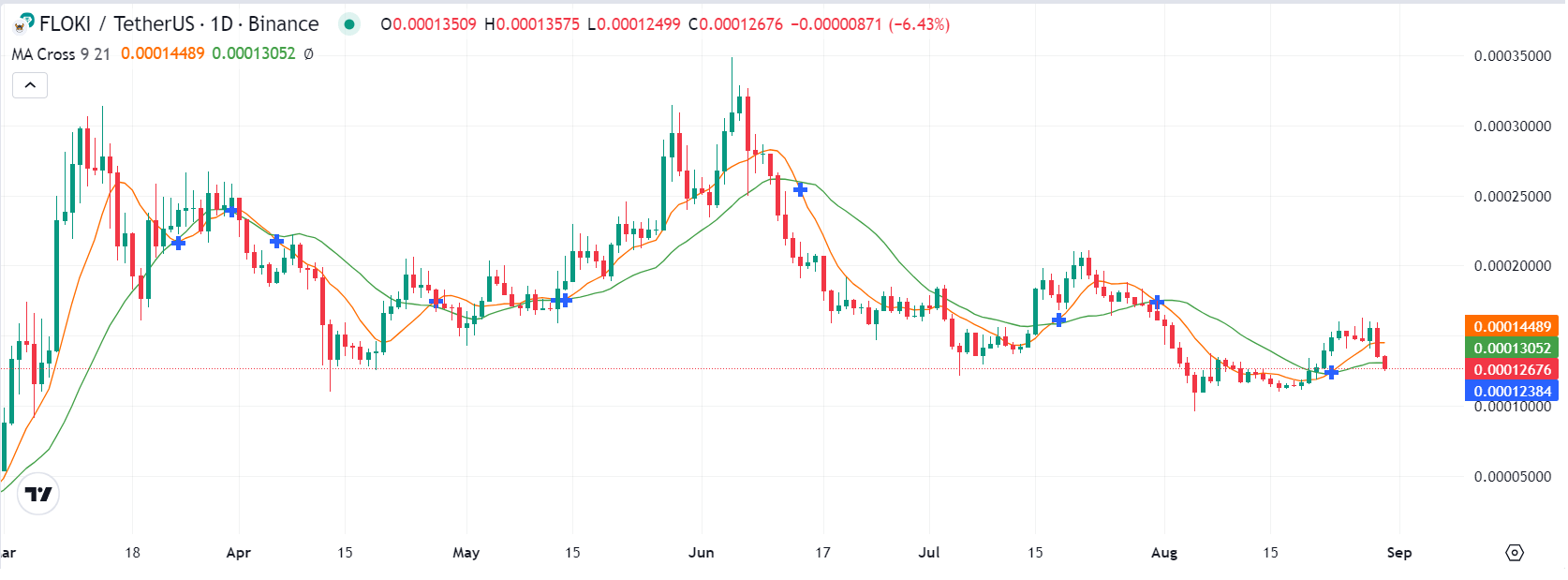
FLOKI, one of the largest meme coins, saw its value plummet by over 17%, reaching a low of $0.00012658, the weakest point since August 21.

This drop marks a 64% decline from its highest point this year, underscoring the volatile nature of the meme coin market.

Floki’s price decline coincides with a broader bear trend in the cryptocurrency market, as Bitcoin struggles to remain above the $60,000 mark. At press time, BTC price was $59,588.11, down 2.47 over the past week correlating with a drop in the global crypto market capitalization which has dropped from over $2.3 trillion earlier in the week to $2.09 trillion at press time.

Dormant Floki whale reactivated after 2.5 years

The primary catalyst for this sharp decline was the sudden activity of a dormant whale account linked to the team behind Floki. After 2.5 years of inactivity, this account moved 15.22 billion FLOKI tokens, valued at $2.27 million, to Binance.

This dormant account had originally received the tokens from the Floki deployer in early 2022 when the token was priced at only $0.0000307.

The transfer, which occurred just nine hours before the price plunge, created panic among investors, leading to heavy selling activity and significant outflows from both centralized and decentralized exchanges.

Data from Spotonchain revealed that net outflows of FLOKI from centralized exchanges fell to their lowest point since August 21, while outflows from decentralized exchanges hit their highest level in over a week.

Despite its recent struggles, Floki remains a significant player in the meme coin space, with a market cap of over $1.27 billion. The developers have been working to transition Floki from a mere meme coin to an active ecosystem, launching initiatives such as TokenFi, Floki Locker, and the Valhalla NFT metaverse.

However, with weak technical indicators, including a death cross pattern and a negative Percentage Price Oscillator, further declines for the meme coin seem possible in the near term.

The post Floki plummets as dormant whale moves 15B tokens to Binance appeared first on CoinJournal.