
0DOG and MATIC price prediction amid Polygon’s token swap

Bitcoin fell to lows of $56k again as crypto dumped amid a fresh surge in stocks.

Many altcoins are mirroring this dump, including Polygon and Bitcoin Dogs. Yet, as the market experiences new downside pressure at the start of a historically tough September, most experts are doubling down on a bounce for Bitcoin in coming months.

Is this the same outlook for Polygon price? What about the Bitcoin Dogs token?

What are analysts saying about Bitcoin (BTC)?

The latest outflows from spot Bitcoin exchange-traded funds – which recorded a net outflow of $288 million on Sept. 3 to hit a five-day streak – illustrate the robust challenge buyers face. But despite a difficult August and largely anticipated struggle in September, top analysts remain bullish on Bitcoin price long term.

In the short term, QCP Group analysts say a crucial indicator, the volatility momentum indicator, has triggered for both Bitcoin and Ethereum. According to a post on X, the crypto market is set for heightened volatility, with a potential momentum shift to the upside.

CryptoQuant analyst Crypto Dan suggests BTC could see a short term rebound if market sentiment flips positive amid the expected Federal Reserve interest rate cut in September. An opposite outcome would see the flagship cryptocurrency struggle through the remaining months of 2024.

Polygon price prediction as MATIC transitions to POL

Polygon has officially activated the MATIC to POL token migration, with POL the new native token for gas and staking on the main Polygon PoS chain.

The token migration is a 1:1 swap for MATIC to POL, which means the new token retains token supply metrics such as 10 billion total supply.

While this is a key network upgrade that has received support from major exchanges, the price reaction has been largely muted. After spiking to highs of $0.59 in August, price is down 18% in the past month to around $0.37.
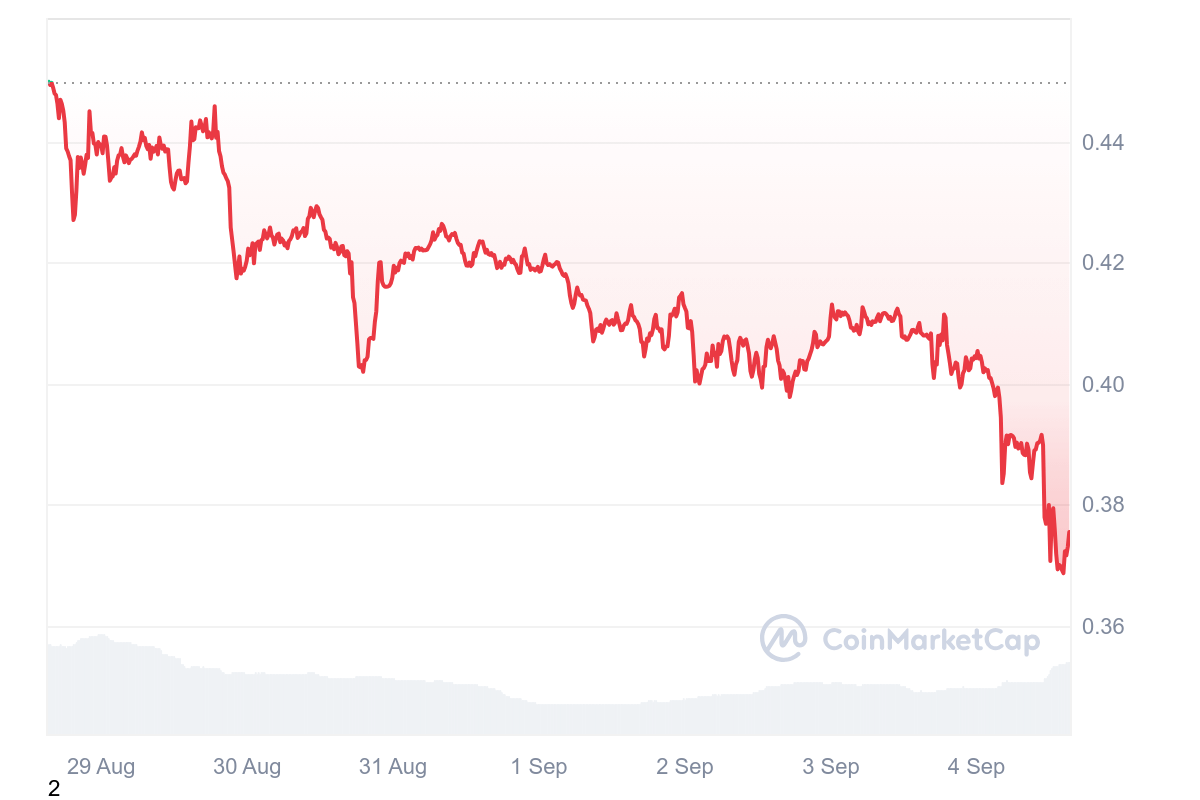
Polygon MATIC 7-day price chart

In late August, analysts at Santiment highlighted that despite MATIC price declines, on-chain activity suggested a potential reversal. With daily RSI and MACD indicators pointing to bears having an upper hand, Polygon price might have to reclaim $0.40 for bulls to come into the picture.

0DOG price prediction

Bitcoin Dogs (0DOG) is the project that delivered the first ICO on Bitcoin.

The 0DOG token has been listed on major crypto exchanges MEXC, Gate.io and DEX platform Uniswap. Despite retreating from the all-time high of $0.04934 reached on Aug. 22, 0DOG price has increased more than 85% from the all-time low of $0.0063 reached on Aug. 28.

While price has dipped 8% in the past 24 hours and volume is down 35%, the overall outlook is positive. 0DOG is one of the top five trending tokens on Gate.io.

As well as the exciting prospects of landing on other top tier exchanges – Binance could be a major move – there’s mounting enthusiasm around the Bitcoin Dogs game. The platform also targets the nascent Bitcoin ecosystem with an exclusive NFTs project.

Combined with multiple potential bullish catalysts for Bitcoin in 2024 and 2025, 0DOG price could reclaim its ATH and target $0.5 and the psychological $1 in coming months.

You can learn more about Bitcoin Dogs here.

The post 0DOG and MATIC price prediction amid Polygon’s token swap appeared first on CoinJournal.

Threshold community proposes merger to safeguard WBTC amid growing concerns

  • Threshold community proposes merging tBTC with WBTC.
  • The proposal is driven by concerns over WBTC’s stability due to Justin Sun’s involvement.
  • According to the proposal, BitGo will receive T tokens, becoming a major stakeholder in Threshold Network.

In a strategic move to protect the future of Wrapped Bitcoin (WBTC), a proposal dubbed “#saveWBTC – a merger with Threshold’s tBTC” has been put forward to merge the decentralized tBTC token of Threshold with BitGo’s WBTC.

The proposal, currently under discussion on Threshold’s forum page, comes in response to rising concerns within the crypto community regarding WBTC’s stability following BitGo’s partnership with Hong Kong-based BiT Global, a company partly owned by Justin Sun, founder of the Tron ecosystem.

Unease with Justin Sun’s involvement with WBTC

The partnership has raised alarms due to Sun’s controversial track record, with past incidents of misappropriating collateral. This unease has already led major DeFi protocols like MakerDAO to limit their exposure to WBTC, halt its use as collateral, and consider fully offboarding the asset.

Aave, another significant player in the DeFi space, is also closely monitoring the situation.

The Threshold, WBTC merger proposal

The merger proposal seeks to replace WBTC’s centralized custody and merchant-based mint and burn model with its decentralized and permissionless mint/redeem mechanism. This transition aims to ensure the safety and stability of the underlying collateral, reassuring users and protocols reliant on WBTC.

The plan involves granting Threshold’s DAO merchant privileges for WBTC while disabling tBTC minting, allowing existing tBTC holders to redeem WBTC at a 1:1 ratio.

As part of the proposal, BitGo would receive a grant of T tokens, making it the largest stakeholder in the Threshold Network.

The merger would be implemented in stages to ensure a seamless transition, with a fallback plan to offboard WBTC safely if the proposal is declined.

By combining WBTC’s established user base and liquidity with tBTC’s decentralized technology, Threshold aims to preserve WBTC’s role in the DeFi ecosystem, ensuring that the concerns over BiT Global’s involvement do not destabilize the broader market.

The post Threshold community proposes merger to safeguard WBTC amid growing concerns appeared first on CoinJournal.

SEC charges fund adviser Galois Capital over crypto custody failures

  • The SEC has charged investment adviser Galois Capital with crypto custody violations, including holding of investor assets on FTX.
  • Galois Capital has settled with the regulator and will pay $225,000 in civil penalty.

The US Securities and Exchange Commission has charged Florida-based investment adviser Galois Capital Management LLC over the company’s failure to properly custody client assets.

In an announcement on September 3, the SEC said the Galois Capital had failed to comply with crypto custody requirements and had violated the Advisers Act, including holding cryptocurrencies with the collapsed crypto exchange FTX. As a result, nearly half of the assets under management of a hedge fund Galois advised were lost when FTX imploded.

Galois Capital also misled investors

The SEC also notes that the firm misled its investors on redemption practices – particularly on “the notice period required for redemptions.”

“By failing to comply with Custody Rule provisions, Galois Capital exposed investors to risks that fund assets, including crypto assets, could be lost, misused, or misappropriated,” Corey Schuster, co-chief of the SEC Enforcement Division’s Asset Management Unit, said.

According to the SEC, Galois agreed to a settlement with the regulator and will pay $225,000 in civil penalties. The fine will be distributed to investors harmed during the collapse.

“Without admitting or denying the SEC’s findings, Galois Capital consented to the entry of an order requiring it to cease and desist from further violations of the Advisers Act, censuring it, and imposing the civil penalty,” the SEC wrote.

The SEC has in recent weeks charged Abra with offering unregistered securities and two brothers in relation to a $60 million Ponzi scheme.

NFT marketplace OpenSea also received a Wells Notice from the regulator.

The post SEC charges fund adviser Galois Capital over crypto custody failures appeared first on CoinJournal.

ZKsync developer Matter Labs lays off 16% of its workforce

  • Matter Labs has laid off 24 employees, over 16% of its workforce, amid market changes.
  • The company is shifting focus from general-purpose scaling to niche applications.
  • Despite layoffs, Matter Labs continues hiring for critical engineering and business roles.

Matter Labs, the company behind the Ethereum scaling network ZKsync, has announced the layoff of over 16% of its workforce, affecting 24 employees.

The announcement, made on September 3, 2024, by Matter Labs’ co-founder and CEO Alex Gluchowski, marks a significant shift for the company as it navigates the increasingly competitive landscape of Ethereum layer-2 scaling solutions.

Matter Labs restructuring amid market challenges

The layoffs come as Matter Labs re-evaluates its strategy in the face of changing market conditions and evolving business needs. It follows a large organizational planning exercise that revealed a mismatch between the company’s current talent and the needs of its future strategy.

According to Gluchowski, the decision to downsize was “the hardest change” he’s had to implement in the company’s six-year history.

In the layoff announcement, Gluchowski explained that the affected employees were notified of their termination and emphasized that the decision was not performance-related. He highlighted the necessity of aligning the company’s resources with its new strategic goals.

Despite the layoffs, Matter Labs is currently hiring for key roles in engineering, business development, and operations, underscoring its ongoing commitment to innovation and growth despite the reduction in staff.

Shifting focus from general-purpose to niche solutions

The layoffs are part of a broader strategic pivot for Matter Labs.

In June 2024, the company introduced the Elastic Chain, a new solution aimed at enhancing interoperability for the growing number of teams building custom chains on ZKsync. This launch has prompted Matter Labs to reconsider its positioning in the highly competitive Ethereum layer-2 ecosystem, which includes other major players like Coinbase’s Base, Polygon, Arbitrum, and Optimism.

Gluchowski indicated that Matter Labs might be moving away from its initial focus as a general-purpose Ethereum scaler. Instead, the company is exploring more niche and case-specific applications of its technology, a move designed to better meet the needs of its users and stay competitive in the crowded market.

As Matter Labs adjusts its course, the company’s commitment to innovation remains strong. The layoffs, while difficult, are a step towards aligning its workforce and resources with its evolving strategy in the Ethereum scaling space.

The post ZKsync developer Matter Labs lays off 16% of its workforce appeared first on CoinJournal.

Avalanche announces Avalanche9000, its largest upgrade since mainnet launch

  • Avalanche9000 upgrade will enhance subnet deployment on Avalanche, making L1 launches more feasible.
  • The upgrade will also Introduce customizable chains, speeding up project development and market entry.
  • The announcement has had no impact on the price of AVAX, which is down 2.22% amid a broader market decline.

Avalanche, a leading high-performance blockchain platform, has unveiled its most significant network upgrade since its mainnet debut in September 2020. The upgrade, named Avalanche9000, marks a pivotal moment in the evolution of the Avalanche ecosystem as it aims to further solidify its position within the crypto landscape.

Avalanche has gained recognition for its highly scalable and flexible blockchain architecture, which enables developers to build and deploy decentralized applications (dApps) on a fast, secure, and low-cost network.

As the platform continues to grow, the introduction of Avalanche9000 is poised to elevate its capabilities, driving greater adoption and innovation across the ecosystem according to a blog post by Avalanche.

Enhancing Avalnche’s scalability and flexibility

One of the key goals of Avalanche9000 is to accelerate the deployment of subnets, specialized Layer 1 chains (L1s) that operate within the Avalanche network. These subnets allow developers to create custom chains with specific rules on membership, tokenomics, and execution layers, offering a tailored and optimized experience for different use cases.

With Avalanche9000, the deployment of these subnets will become more economically feasible, enabling a broader range of developers and enterprises to launch their own L1s. The upgrade will also introduce customizable chains, reducing the time it takes for projects to go from concept to market.

By streamlining the development process, Avalanche9000 is set to empower innovators and entrepreneurs with the tools they need to quickly and efficiently build on the Avalanche platform.

Expanding the Avalanche ecosystem

In addition to technical enhancements, Avalanche9000 will be accompanied by the release of tools and documentation designed to assist users in launching their own L1s. The upgrade is also expected to include a variety of network changes based on community proposals, along with developer incentives and partnerships with key industry players.

Several major L1 launches are already lined up, including those by Deloitte, DeFi Kingdoms, Gunzilla Games, MapleStory, Shrapnel, and SK Planet. These projects highlight the growing interest in Avalanche as a platform for both enterprise and gaming applications, further establishing its reputation as a versatile and robust blockchain solution.

As the Avalanche9000 testnet is set to launch soon, the blockchain community eagerly anticipates the impact of this upgrade on the broader ecosystem. With its focus on scalability, flexibility, and ease of use, Avalanche9000 represents a significant step forward in the ongoing evolution of the Avalanche network.

The post Avalanche announces Avalanche9000, its largest upgrade since mainnet launch appeared first on CoinJournal.