
NYT: Trump reconsiders pro-crypto choices for Treasury Secretary, slows down his selection process

  • Trump is now considering Kevin Warsh and Marc Rowan for the US Treasury Secretary position
  • Howard Lutnick is reportedly frustrating Trump by spending too much time with him to get himself appointed
  • A person familiar with the situation between Lutnick and Scott Bessent as a “knife fight”

President-elect Donald Trump is allegedly reconsidering his options for US Treasury Secretary, pivoting away from pro-crypto choices.

Trump is now considering former Federal Reserve governor Kevin Warsh and Wall Street billionaire Marc Rowan, according to a report from the The New York Times. Trump is expected to invite the two to Mar-a-Lago, Trump’s Florida residence, this week following internal conflict over the role.

Trump had been expected to pick either pro-crypto candidates Howard Lutnick, the CEO of Cantor Fitzgerald or Scott Bessent, the founder of Key Square Capital Management, an investment firm, and a former money manager for George Soros.

Up until yesterday morning, Polymarket, a prediction market platform, had put Bessent at an 87% chance of getting the job. However, he’s now down to 16% with Warsh taking the lead at 44%.
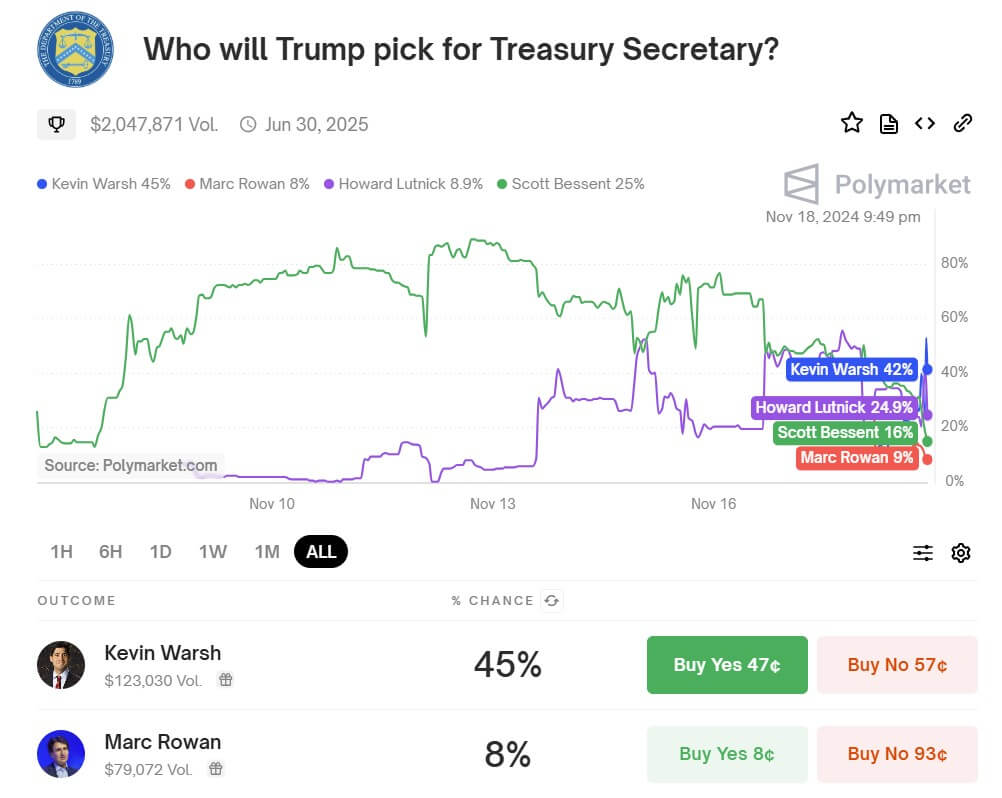
US Treasury Secretary ratings on Polymarket. Source: Polymarket

Getting frustrated

According to the New York Times, Trump has expressed frustration with Lutnick, claiming he’s been hanging around the president-elect too much to get himself appointed. A person familiar with the matter described the situation between Lutnick and Bessent as a “knife fight” with Lutnick as the “primary aggressor.”

Despite this, Elon Musk, CEO of Tesla, and an influential figure in Trump’s inner circle, took to X to endorse Lutnick, adding that “Bessent is a business-as-usual choice.”

“Business-as-usual is driving America bankrupt, so we need change one way or another,” Musk said. He added that Lutnick will “actually enact change.”

As a result of Trump’s second thoughts, he’s slowed down the selection process even though Bessent is still under consideration. Both Lutnick and Bessent are considerably more pro-crypto compared to Warsh and Rowan.

In an essay for the American Enterprise Institute, Warsh advocated for an American central bank digital currency (CBDC) despite concerns over consumer privacy. Rowan, on the other hand, said in a March interview he didn’t see the “value of an alternative currency” when discussing crypto.

The post NYT: Trump reconsiders pro-crypto choices for Treasury Secretary, slows down his selection process appeared first on CoinJournal.
Hedera Hashgraph, Catizen prices soar as traders eye Vantard

Cryptocurrencies were fairly mixed on Monday as Bitcoin remained stubbornly above the important support level at $90,000. Hedera Hashgraph (HBAR) token surged to a high of $0.1490, its highest level since April 24 and 256% above its lowest point this month. 

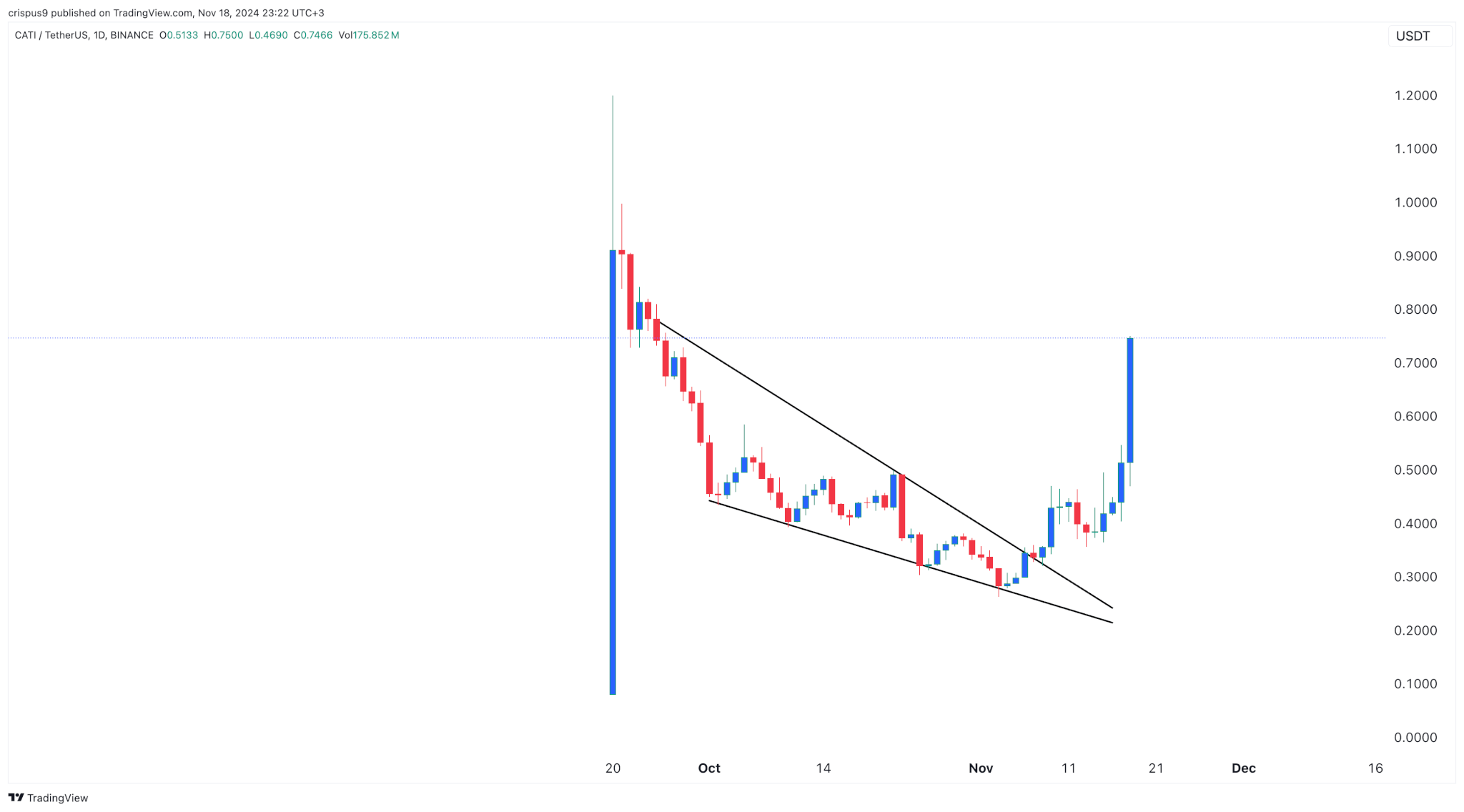
Similarly, Citizen (CATI), the popular Telegram game, jumped for four consecutive days, reaching a high of $0.70, its highest point since September. Notably, investors continued to eye Vantard, an upcoming cryptocurrency that seeks to create a meme coin index fund.

Why Hedera Hashgraph and Catizen soared

Hedera Hashgraph token surged after a leading company applied for a spot HBAR ETF in the United States. This application is taking advantage of the recent Donald Trump election, which will likely usher in a new era in the crypto industry. 

Unlike Joe Biden, Trump has comeout in support of the crypto industry since he has a skin the game. As such, there is a likelihood that the SEC will approve new crypto ETFs at a faster pace in the coming year.

Hedera Hashgraph is seen as an ideal candidate for an ETF because of its use case and the fact that it counts influential companies like Google, Mondelez, and IBM as members of its governance council. 

The main issue with Hedera is that it often has low volume and it has not attracted many developers in its ecosystem. As such, even if the ETF is approved, it is unclear whether it will gain popularity among institutional investors. 

Citizen, on the other hand, is a top player in the tap-to-earn ecosystem that has grown rapidly in the past few months. As shown below, its rebound was mostly because of technicals since it had formed a falling wedge pattern before its comeback. There is a likelihood that the token will surge to a record high of $1.2, which is about 60% above the current level.

Vantard token sale is accelerating

Meanwhile, investors have shifted their focus to Vantard, a popular crypto project that is in its token sale. Vantard has raised over $844,000 from investors, a trend that could continue as meme coins jump.

Vantard is based on the idea that meme coins do well over time. Recent data show that meme tokens like Dogecoin, Floki, and Dogwifhat have outperformed major cryptocurrencies like Bitcoin and Ethereum. 

Vantard’s strategy is to create a meme coin index fund that will track the biggest and most promising tokens in the industry. As such, instead of investing in all these coins, one can buy the VTARD token and gain exposure to some of the best coins. 

The developers hope that their tokens will thrive as Trump is set to simplify cryptocurrency laws while the Federal Reserve is expected to continue cutting interest rates through 2025. You cann learn more about Vantard here.

The post Hedera Hashgraph, Catizen prices soar as traders eye Vantard appeared first on CoinJournal.

MicroStrategy buys another $4.6 billion of Bitcoin

  • MicroStrategy has added 51,780 Bitcoin (BTC) to its holdings.
  • The company acquired the BTC for $4.6 billion, bringing total holdings to 331,200 BTC.
  • Metaplanet, the MicroStrategy of Asia, also announced plans to buy more Bitcoin on Nov. 18.

MicroStrategy, the world’s largest corporate holder of Bitcoin (BTC), has added to its impressive BTC haul with another major buy.

The company announced on Nov. 18 that it had acquired an additional 51,780 BTC worth $4.6 billion, with the latest purchase coming at an average price of $88,627 per bitcoin. It pushes MicroStrategy’s total BTC holdings to 331,200 BTC.

MicroStrategy BTC holdings hit 331, 200

MicroStrategy’s announcement comes a few days after the company founder Michael Saylor revealed the purchase of over $2 billion worth of BTC.

Overall, the publicly-listed company, whose stock MSTR has surged amid Bitcoin’s mega price spike, has acquired $16.5 billion worth of BTC. The average price of the buys is $49,874, putting the company billions of dollars in profit as the benchmark cryptocurrency trades near its all-time high.

“MicroStrategy has acquired 51,780 BTC for ~$4.6 billion at ~$88,627 per #bitcoin and has achieved BTC Yield of 20.4% QTD and 41.8% YTD. As of 11/17/2024, we hodl 331,200 $BTC acquired for ~$16.5 billion at ~$49,874 per bitcoin,” Michael Saylor posted on X.

As CoinJournal reported, the US-based firm has inspired several other platforms and entities to adopt a Bitcoin strategy.

One of these is Metaplanet, the Japan-based company listed on the Tokyo Stock Exchange. On Nov. 18, Metaplanet disclosed the issuance of over $11 million in bonds to buy Bitcoin. Metaplanet has become known as the “MicroStrategy of Asia.”

Elsewhere, the market continues to see a surge in interest in the crypto asset class. Bitcoin recently broke to a new all-time high above $93k. The BTC price has remained steady near the $90k level amid predictions that the digital asset’s value could run to $100k before the end of the year.

The post MicroStrategy buys another $4.6 billion of Bitcoin appeared first on CoinJournal.

Metaplanet to buy additional $11.7 million Bitcoin

  • Metaplanet to raise ¥1.75 billion (over $11.7) in bonds to buy Bitcoin (BTC).
  • The publicly-listed Japanese company has also unveiled a shareholder benefits program.

Metaplanet, a publicly-traded company listed in Japan, has announced plans to buy more Bitcoin (BTC) to add to its growing haul.

On Nov. 18, the Tokyo Stock Exchange listed Bitcoin Treasury Company announced it was looking to raise ¥1.75 billion in bonds to buy the flagship cryptocurrency.

The firm has issued one-year 0.36% bonds at ¥1.75 billion, approximately $11.7 million, and will use the proceeds to purchase more BTC. Currently, Metaplanet holds over 1,000 BTC.

Metaplanet is Japan’s MicroStrategy

Metaplanet’s board of directors resolved to issue the third series ordinary bonds during a meeting held on November 18, 2024, according to a regulatory disclosure. The bondholder will be EVO FUND, while the bonds will mature on November 17, 2025.

In Oct., Metaplanet announced it had adopted ‘BTC Yield’ as a key performance indicator. This followed the industry pioneer MicroStrategy whose strategy continues to inspire several other companies. On its part, MicroStrategy is eyeing $42 billion in capital over the next two-to-three years to buy Bitcoin.

Earlier this month, Michael Saylor revealed the US-based firm had acquired an addition 27,200 BTC for over $2 billion. Since the company started buying the scarce asset, it has hoarded 279,420 bitcoins purchased for over $11.9 billion.

Over the past year, MicroStrategy’s treasury operations have seen holders get 26.4% in BTC Yield – representing 157.5 BTC in daily accumulation. As Saylor recently noted, his company has achieved this “without the operational costs or capital investments typically associated with bitcoin mining.”

Metaplanet has announced a shareholder benefits program. According to the company, the program will offer exclusive perks and other added value offerings to shareholders. The firm is teaming up with VC Trade, Hotel Royal Oak Gotanda, The Bitcoin Conference, Bitcoin Magazine, and Webull Securities on this initiative.

The post Metaplanet to buy additional $11.7 million Bitcoin appeared first on CoinJournal.

Gary Gensler Preparing to Exit SEC Chairman Role?

  • Gary Gensler’s recent speech at the Annual Institute on Securities Regulation event indicates that he may expect to be out of office soon.
  • This follows a pattern of SEC Chairs resigning following a change in administration.

At the PLI’s 56th Annual Institute on Securities Regulation program, held on Nov. 14, Gary Gensler’s speech hinted at his nearing the end of his term as the SEC Chairman. This comes as speculation points to incoming President Donald Trump removing him from office.

Under Gary Gensler’s leadership, the SEC has adopted a regulation-by-enforcement model, which includes hazy regulations around cryptocurrency followed by enforcement actions against exchanges and protocols that default.

During his speech, Gensler referred to his job in the past tense as one of Trump’s campaign promises to the crypto industry was to fire Gary Gensler “on day one” of his presidential term.

Gensler’s crypto enforcement record

Gensler’s SEC has some notable cases against various crypto firms, the top being Ripple, Coinbase, Uniswap, and ConsenSys.

The agency’s multi-year lawsuit against Ripple Labs ended in a partial loss as a US Judge ruled XRP is not a security. However, this ruling only applies to XRP’s public sales, not its institution ones for which the company was fined $125 million.

Despite the partial victory, the ruling was counted as more of a loss for the SEC as it set a precedence for other cryptocurrencies with similar public sales being non-securities, a development that would unwind the SEC’s regulation by enforcement.

On the other hand, Gensler’s SEC has scored some victories in its pursuit of defaulting crypto exchanges as the agency won a case against Bittrex in August 2023. The exchange was fined $24 million for violating US securities laws and has since ceased its operations within the US due to regulatory uncertainties.

Gensler also pursued cases against crypto industry giants like Coinbase, Binance, ConsenSys, and even decentralised platforms like Uniswap; some of which are still ongoing.

Regulatory obscurity under Gensler

Obscure crypto regulations have characterized Gensler’s term. The SEC’s regulation-by-enforcement regime, which was predominant in 2023 but spilt over into 2024, created an uncertain regulatory environment that left exchanges in the dark about the rules surrounding crypto listings.

Exchanges like Coinbase demanded regulatory clarity and firms like ConsenSys sued the SEC for clarification on Ethereum’s status as a security after the agency served the blockchain infrastructure provider a Wells Notice for violating securities laws through its MetaMask product.

In an interview with CNBC in 2022, Gensler revealed that he believed most cryptocurrencies are securities and should be regulated as such. However, his agency failed to provide clear regulations for crypto companies and exchanges to follow. Instead, Gensler insisted that there’d been clarity for years.

While Gensler affirmed Bitcoin is not a security, the verdict was out for several other major cryptos, Ethereum in particular being a point of contention.

Coinbase has an active lawsuit against the SEC and is pushing for a court ruling to obtain crucial crypto policy documents regarding the SEC’s crypto regulations and its findings from investigations into Ethereum as a security.

The SEC is delaying the document release citing a three-year review period.

Meanwhile, Gary Gensler faces lawsuits from a coalition of 18 US States citing gross government overreach in his regulation of digital assets.

Whether or not Gensler approaches the end of his role as the SEC Chairman, the consensus seems to be that his approach to crypto regulation leaves much to be desired. As the SEC Commissioner, Mark Uyeda, said on Fox Business Morning in October 2024, “I think our policies and our approach over the last several years have been just really a disaster for the whole industry.”

The post Gary Gensler Preparing to Exit SEC Chairman Role? appeared first on CoinJournal.