
Bitcoin Pepe readies for a crypto revolution amidst a risk-off mood

Crypto majors have remained under pressure despite President Trump’s talks of a US crypto reserve. Amid the tariff jitters and economic uncertainties, the market is in a risk-off mood.

Nonetheless, savvy investors continue to look for opportunities beyond the majors. Bitcoin Pepe, the first meme ICO on Bitcoin’s network, is one of the projects on meme lovers’ radar. Its one-of-a-kind infrastructure and virality have positioned it for a crypto revolution with its early adopters earning heftily in the process.

Bitcoin price caught between risk-off mood and bull run optimism

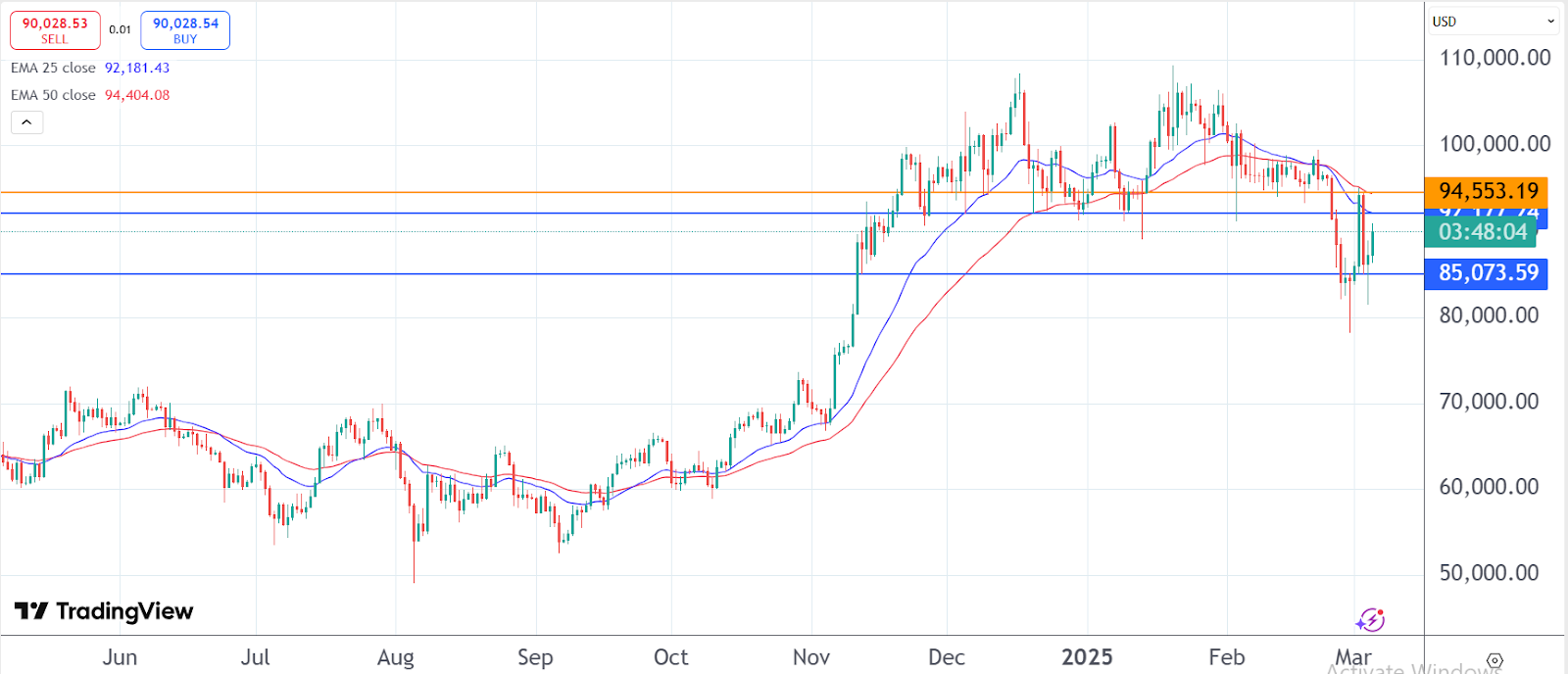
Bitcoin price is back above the crucial support zone of $85,000 after plunging below it in the previous session. However, the market remains noisy as extreme fear overshadows the highly anticipated bull run of 2025.

In the near term, the bulls will likely face resistance along the 25-day EMA at $92,177. That may yield range-bound trading with the major finding support at $85,073. Further rebounding will place the next target at $94.553. 
Bitcoin Pepe sets the stage for a crypto revolution

The meme culture has revolutionized the crypto market as savvy investors look for profitable opportunities in affordable projects with huge growth potential. The popularity of meme coins has boosted the market to a market cap of $59 billion according to CoinGecko.

It is no wonder Bitcoin Pepe, the first meme ICO on the Bitcoin network, has caught the industry by storm. About three weeks since the launch of its presale, the project has already sold out its first 5 stages. During that period, it has raised over $3.8 million. Besides, its token price has surged by 27.6% to the current $0.0268. 

Indeed, Bitcoin Pepe is designed in favor early adopters. By the end of the remaining 24 sessions, the token price will have cumulative gains of 311.4% at $0.0864.

This success is not just built on its virality; its infrastructure adds to the project’s growth potential. To begin with, it combines Solana’s speed with Bitcoin’s stability. Besides, the PEP-20 standard enables one to launch meme coins on Bitcoin. It is these factors that are set to sustain the project’s upward momentum before and after its listing in the year’s second quarter. Find out how to buy Bitcoin Pepe here.

Ripple price underperforms as talks of a crypto reserve underwhelms the market
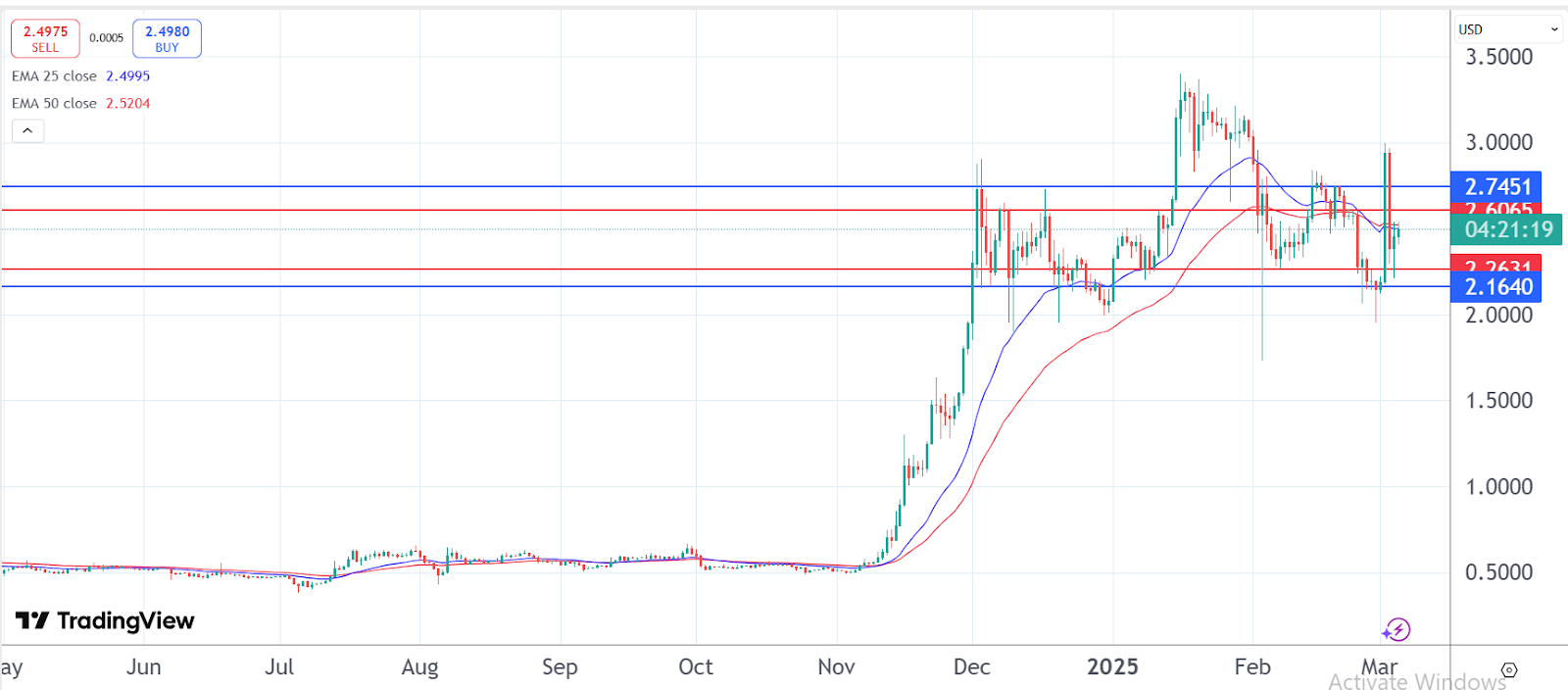
Ripple price extended its gains on Wednesday; erasing some of the losses recorded at the start of the week. Even so, it remains under pressure as investors maintain a risk-off mood with a crypto fear & greed index of 20. Optimism over a US crypto reserve as highlighted by President Trump appears to be fading. 

A look at its daily chart shows the altcoin’s price hovering around the 25 and 50-day EMAs. In the near term, the range between $2.2631 and $2.6065 will be worth watching. Further rebounding will likely have Ripple price find resistance at $2.7450. However, this thesis will be invalidated by a pullback past the lower support zone of $2.1640.


The post Bitcoin Pepe readies for a crypto revolution amidst a risk-off mood appeared first on CoinJournal.

Matrixport subsidiary Fly Wing receives Major Payment Institution License from MAS in Singapore

  • Fly Wing, a Matrixport subsidiary, has gotten an MPI License from MAS.
  • The license will bolster Fly Wing’s OTC crypto services in Singapore.
  • Matrixport aims to expand digital finance in the Asia-Pacific.

Fly Wing Technologies Pte Ltd (“Fly Wing”), a wholly owned subsidiary of Matrixport, the world’s leading and largest one-stop crypto financial services platform in Asia, today announced that it has been granted the Major Payment Institution (“MPI”) License by the Monetary Authority of Singapore (“MAS”).

With this license approval, Fly Wing will continue building its role as a trusted Over-the-Counter (“OTC”) desk in Singapore. This license follows the in-principle approval received in October, underscoring Fly Wing’s commitment to regulatory compliance and operational excellence.

John Ge, Co-founder and CEO of Matrixport, stated, “We are thrilled that Fly Wing has received its license from the MAS. This marks a significant step in our ongoing expansion across the Asia-Pacific region. We look forward to providing high-quality Digital Payment Token services to users in Singapore.”

Having received its license from the MAS, Fly Wing is well-positioned to build a strong foundation for its long-term growth, driving continuous innovation in the digital finance sector. Moving forward, Fly Wing will continue to offer innovative Digital Payment Token services securely and transparently and will continue to optimize blockchain-driven Digital Payment Token services, enabling seamless access for users entering the Web 3.0 industry.

About Fly Wing Technologies Pte Ltd

Founded in 2019, Fly Wing Technologies Pte. Ltd. (“Fly Wing”) is a wholly owned subsidiary of Matrixport, a leading digital asset financial services platform in Asia.

Fly Wing serves a diverse clientele, including crypto miners, trading firms, investment firms, and high-net-worth individuals from both crypto and traditional finance. The company engages in OTC services for customers to on- and off-ramp Digital Payment Tokens, facilitating over $100 million in monthly transactions and providing liquidity for major cryptocurrencies.

Fly Wing has received the MPI License from MAS to provide Digital Payment Token services for OTC trading in Singapore.

Fly Wing official website: https://www.flywing.com/

About Matrixport

Founded in 2019, Matrixport is the world’s leading all-in-one hub for crypto financial services. The platform is committed to providing every user with a personalized Super Account that integrates crypto trading, investment, loan, custody, RWA, research and more. With $6 billion in AUM (assets under management), Matrixport offers global users diverse crypto-financial solutions designed for optimal capital efficiency and sustainable returns.

As a Group and through its local subsidiaries, Matrixport has received the Trust or Company Service Provider / Money Lender Licenses in Hong Kong and the FINMA Asset Management License in Switzerland. The company operates as an Appointed Representative in the UK, is registered as an MSB in the US, and is a member of Switzerland’s FINMA SRO-VFQ.

Matrixport was recognized by CB Insights as one of the “50 Most Promising Blockchain Companies” and was featured in the Hurun “2024 Global Unicorn List.” Its subsidiary, Fly Wing, has received the MPI License from MAS in Singapore.

Matrixport official website: https://www.matrixport.com

The post Matrixport subsidiary Fly Wing receives Major Payment Institution License from MAS in Singapore appeared first on CoinJournal.

Bybit CEO confirms that $280M of the stolen $1.4B is no longer traceable

  • Bybit CEO has said that 20% of the $1.4 billion stolen from the exchange is untraceable
  • Hackers converted $1 billion in ETH to BTC via THORChain and spread it
  • So far, 11 bounty hunters have assisted in freezing $42 million of the stolen funds

In a stunning update, Bybit CEO Ben Zhou has revealed that $280 million of the $1.4 billion stolen from the cryptocurrency exchange in the February hack has vanished into untraceable channels.

The security breach, attributed to the North Korean hacking group Lazarus, saw approximately 500,000 Ether (ETH) pilfered from Bybit’s reserves. While the majority of the funds remains visible on the blockchain, Zhou’s announcement underscores the challenges facing investigators as they race against time to freeze the assets before the hackers fully cash out.

The attack exploited vulnerabilities in SafeWallet, a third-party wallet platform used by Bybit. Lazarus hackers compromised a developer’s device, injecting malicious code that allowed them to siphon off nearly $1.5 billion in ETH during a routine transfer.

Despite Bybit’s swift action to restore 1:1 backing of client assets within days, the hackers have been relentlessly moving the stolen funds across multiple platforms, complicating recovery efforts.

Hackers leveraged THORChain to fragment funds

A significant portion of the stolen Ether—417,348 ETH valued at around $1 billion—has been converted into Bitcoin (BTC) and scattered across 6,954 wallets, each holding an average of 1.71 BTC.

Zhou noted that 72% of the haul, or 361,255 ETH worth $900 million, was funneled through THORChain, a decentralized exchange known for its privacy features.

THORChain alone processed a record $4.66 billion in swaps in the week ending March 2, raking in over $5.5 million in fees from these illicit transactions. This fragmentation and conversion strategy has made tracking the funds increasingly difficult for blockchain forensic teams.

Meanwhile, 20% of the stolen assets—approximately 79,655 ETH—have “gone dark,” meaning they’ve been laundered through platforms like ExCH and rendered untraceable.

Zhou highlighted that an additional 40,233 ETH, worth $100 million, passed through OKX’s Web3 Proxy. Of this, 23,553 ETH ($65 million) remains untraceable without further cooperation from the OKX Wallet team, while 16,680 ETH is still within reach of investigators.

The CEO stressed that the next one to two weeks are pivotal as the hackers prepare to offload their haul via exchanges, over-the-counter (OTC) trading desks, and peer-to-peer (P2P) networks.

Bybit has enlisted bounty hunters amid freezing efforts

In a bid to thwart the hackers, Bybit has enlisted the help of bounty hunters and security firms.

Zhou reported that 11 parties—including prominent players like Mantle, Paraswap, and blockchain sleuth ZachXBT—have assisted in freezing $42 million, or 3% of the stolen funds.

So far, Bybit has paid out $2.178 million in USDT to these contributors as part of its recovery efforts, with more details available at Lazarusbounty.com. The exchange also partnered with Web3 security firm ZeroShadow on February 25 to enhance its blockchain forensics and maximize asset recovery.

Despite these efforts, the hackers show no signs of slowing down. Blockchain analytics firm Elliptic has identified over 11,000 wallets linked to the Lazarus group, suggesting a sprawling network designed to obscure their tracks.

Zhou indicated that an additional $65 million in ETH could be salvaged with OKX’s support, but time is running out as the attackers continue laundering operations through platforms like ExCH and OKX Web3 Proxy.

The post Bybit CEO confirms that $280M of the stolen $1.4B is no longer traceable appeared first on CoinJournal.

Bitcoin Pepe emerges as a possible go to altcoin as crypto market bleeds

  • The crypto market has crashed, losing $1.01 billion in liquidations.
  • Bitcoin (BTC) has plunged below $84k while altcoins like ETH and SOL have slumped 15-20%
  • Bitcoin Pepe’s presale offers a compelling alternative with the price set to rise from $0.0255 to $0.0268 in next presale stage.

The crypto market is reeling from a brutal wave of liquidations. Over $1 billion in leveraged positions have vanished in the last 24 hours, according to Coinglass data.

The liquidations have hit traders hard across major exchanges. Bitcoin alone accounted for $396.16 million in wiped-out positions. Ethereum saw $209.58 million evaporate, and Solana’s liquidations reached $70.55 million. Even meme coins weren’t spared—Dogecoin saw over $20 million in liquidations.

The crypto market erased gains made earlier this week

Bitcoin (BTC) has plummeted below $84,000 gain, shedding nearly 10% of its value in a single day. The tumble has reversed its rally past $95,000 earlier this week. It has hit an intraday low of $82,467.24 before stabilizing slightly above $83k.

Ethereum (ETH) followed suit, diving 15% to $2,089, while altcoins like Solana (SOL) and XRP cratered by 20% and 18%, respectively. Cardano (ADA) also plunged 25% to $0.7998 as a majority of the other altcoins bore the blunt of the bloodbath.

Meme coins were not spared either. Shiba Inu (SHIB) and Pepe Coin (PEPE) have dropped 13% and 18%, respectively, while Sonic (S) and Trump-backed tokens have shed 23% to 25,% respectively. It seems the high-risk corner of the market faced unrelenting exits as fear gripped traders.

Notably, the crypto market carnage mirrors a broader market slump, with the global crypto market cap tumbling 10% to $2.76 trillion.

What is causing the crypto market to drop?

Investors blame CME futures gaps and thinning liquidity for the sudden crypto market drop. Analysts point to liquidity gaps and leveraged bets gone wrong as the culprits.

Trump’s talk of a strategic crypto reserve couldn’t shield the market from broader economic tremors; the selloff has erased gains sparked by optimism over President Donald Trump’s pro-crypto moves.

Besides the liquidity gaps, economic factors are also to blame for the crypto crash. Trump’s new 25% tariffs on imports from Canada and Mexico have sparked trade tensions.

Canada and Mexico supply a third of US goods, and the tariffs threaten growth and stoke inflation fears.

Following the introduction of the tariffs, American stocks also tanked alongside crypto, with the Dow Jones falling 650 points. The VIX index also jumped to 22, signaling rising market panic.

Historically, cryptocurrencies falter when fear dominates, pushing investors to the sidelines.

Bitcoin Pepe emerges as a haven for crypto investors

Amid this chaos, Bitcoin Pepe stands out as a bold contender. Pitched as the “World’s Only Bitcoin Meme ICO,” blending Bitcoin’s durability with meme coin flair, the project aims to build a Meme Layer-2 for Bitcoin, promising instant transactions and ultra-low fees. Its PEP-20 standard lets users launch memecoins on Bitcoin’s blockchain.

Unlike the currently bleeding altcoins and memecoins, Bitcoin Pepe is currently in its presale stages, which are structured to ensure the price rises with each presale stage progression.

The presale is gaining traction despite the market rout. Currently in stage 5 of 30, the presale has raised $3,690,133. The current price sits at $0.0255 and is set to rise to $0.0268 in the next stage.

The project’s smart contract has already been audited by SolidProof, offering a glimmer of credibility in a sea of uncertainty.

Interested investors can connect wallets and buy in, betting on its vision of “Solana on Bitcoin” as a lifeline. The project’s whitepaper and roadmap pitch a future where meme coins thrive on the “only chain that will live forever.”

The post Bitcoin Pepe emerges as a possible go to altcoin as crypto market bleeds appeared first on CoinJournal.

Coinbase asks SEC for breakdown of cost of Gensler’s war on crypto

  • Coinbase goes after SEC for details on cost of war on crypto.
  • The exchange has filed a FOIA request asking for SEC’s documents during the leadership of former SEC chair Gary Gensler.

Coinbase has filed for a Freedom of Information Act (FOIA) request that seeks a detailed breakdown of what the US Securities and Exchange Commission (SEC) spend on its “war on crypto.”

Specifically, the crypto exchange’s FOIA wants it made public just how much the SEC splashed as part of its regulation by enforcement approach to crypto between April 2021 and January 2025.

Coinbase outlines what it seeks in a filing on Monday, March 3, 2025.

What else is Coinbase seeking via this FOIA request?

The exchange wants to know how much the SEC spent on investigations, lawsuits and enforcement unit employees. Per the request, the regulator should provide the costs involved as it pursued digital asset related cases, secondary transactions, and staking and lending providers.

“We know the previous SEC’s regulation-by-enforcement approach cost Americans innovation, global leadership, and jobs, but how much did it cost in taxpayer dollars? Today, Coinbase submitted a FOIA request asking the SEC to explain how much its war on crypto cost taxpayers,” Coinbase chief legal officer Paul Grewal noted.

He added:

“What do we hope to find out? How many investigations and enforcement actions were brought – and how much they cost; how many employees worked on these investigations/enforcement actions – and how much they cost; how many third-party contractors were used in these investigations/enforcement actions – and how much they cost,” the Coinbase CLO added in a post on X.

The request comes amid a recent spree of announcements regarding the SEC’s dropping of several crypto cases and investigations. It includes the regulator’s lawsuit against Coinbase and the crypto exchange Gemini.

SEC, under a new leadership following Gary Genser’s exit in January 2025, has also closed investigations against Opensea, Robinhood, Uniswap and MetaMask.

According to Grewal, the FOIA request is down to the need for transparency, with American taxpayers having the right to know. Coinbase believes the current SEC leadership will provide the information.

The post Coinbase asks SEC for breakdown of cost of Gensler’s war on crypto appeared first on CoinJournal.