
The future of payments? a16z bets on stablecoins to revolutionize money transfers

  • a16z says stablecoins are a “WhatsApp Moment” for money transfers.
  • Stablecoins eliminate historical gatekeepers in the payments industry.
  • Stablecoins offer a clean-slate alternative to costly and outdated systems.

Remember when making international calls or sending text messages across borders meant hefty fees?

Modern messaging apps like WhatsApp have made those costs a thing of the past.

Now, venture firm Andreessen Horowitz (a16z) believes stablecoins could revolutionize money transfers in a similar way, democratizing the payments industry by dismantling traditional gatekeepers and eliminating inefficiencies.

“Just as WhatsApp disrupted costly international phone calls, blockchain payments and stablecoins are transforming global money transfers,” the firm stated in a blog post published on Wednesday, laying out its vision for the future of money.

A new era for global payments

The current global payment infrastructure is a complex and often convoluted web, involving a multitude of intermediaries: points of sale, payment processors, acquiring banks, issuing banks, correspondent banks, foreign exchanges, and card networks.

This complex network not only creates friction but also adds significant costs and delays to international transactions.

a16z points out that remittance fees can reach as high as 10%, a burden reminiscent of the high costs associated with cross-border calls and texts before the advent of instant messaging apps.

Stablecoins on the blockchain

Enter blockchain and stablecoins – cryptocurrencies that are pegged to stable assets like the U.S. dollar, offering a more stable and predictable value.

“Stablecoins offer a clean-slate alternative. Instead of stitching together clunky, costly, and outdated systems, stablecoins flow seamlessly on top of global blockchains,” the blog post argues, emphasizing the potential for streamlined transactions.

“Already, stablecoins are slashing the cost of remittances: Sending $200 from the US to Columbia using traditional methods will cost you $12.13; with stablecoins, it costs $0.01,” a16z stated, highlighting the significant cost savings that can be achieved.

The transformative potential of stablecoins extends far beyond remittances.

They could also revolutionize business-to-business (B2B) payments on a massive scale.

a16z uses business transactions from Mexico to Vietnam as an example, noting that these transactions can take three to seven days to process and cost anywhere from $14 to $150 per $1000 transacted, often passing through as many as five intermediaries, each taking a cut.

The adoption of stablecoins could make such transactions nearly free and almost instantaneous, eliminating the delays and expenses associated with traditional methods.

Corporate adoption: SpaceX leads the way

Some forward-thinking corporations have already taken notice.

Elon Musk’s SpaceX, for example, is using stablecoins to manage its corporate treasuries, seeking to shield itself from foreign exchange (FX) volatility, demonstrating the practical applications of stablecoins in the business world.

These trends help explain why the total market capitalization of stablecoins has surpassed $200 billion, and the annualized transaction value of stablecoins in 2024 reached $15.6 trillion – figures that are roughly 119% and 200% that of Visa and Mastercard, respectively, underscoring the growing importance of stablecoins in the global economy.

However, the rise of stablecoins has not been without its challenges.

Regulatory bodies have scrutinized their use, creating significant hurdles for bridging traditional finance to stablecoins, according to a16z.

The landscape is now evolving, as policymakers are actively working to shape rules to recognize and regulate stablecoins in the US.

“A forthcoming bill clarifying this regulation could pave the way for even broader adoption and integration into the global financial system,” the blog post predicts.

As the financial landscape rapidly evolves and cryptocurrency adoption becomes more mainstream, stablecoins are poised to emerge as a transformative force, revolutionizing the future of money.

“Just as WhatsApp disrupted costly international phone calls, blockchain payments and stablecoins are transforming global money transfers,” concludes a16z, reiterating its bullish outlook on the future of stablecoins.

The post The future of payments? a16z bets on stablecoins to revolutionize money transfers appeared first on CoinJournal.
Ethereum plunges as Donald Trump’s trade war batters crypto markets

  • Ethereum leads fresh crypto selloff amid Trump’s trade war.
  • Trump’s insistence on tariffs dims hopes of avoiding a trade conflict.
  • Ethereum fell over 6% to its lowest level since March 2023.

Ethereum (ETH-USD), the second-largest cryptocurrency by market capitalization, spearheaded a renewed wave of selling across the digital asset landscape on Wednesday.

The downturn comes as US President Donald Trump doubled down on his trade war, insisting on enforcing 104% tariffs on numerous Chinese goods, further diminishing hopes that a prolonged and damaging trade conflict could be averted.

Ethereum tumbled more than 6% to reach its lowest intra-day level since March 2023 before partially recovering to trade at $1,432 as of 9:51 a.m. in Singapore.

Bitcoin (BTC-USD), the market’s bellwether cryptocurrency, also experienced a decline, dropping more than 3% before regaining some ground, underlining the broad-based nature of the market downturn.

Tariff uncertainty dampens sentiment: a broader market pullback

Trump and top administration officials signaled on Tuesday that the US was open to potential dealmaking that could reduce or eliminate the higher tariffs imposed on dozens of nations, creating a brief glimmer of optimism.

However, Asian stocks sank, and wider financial markets were once again roiled as the president intensified pressure on China.

This whiplash effect has left investors wary and contributed to the risk-off sentiment across asset classes.

“People have given up”: crypto recovery hopes fade

“It seems like people have given up on a major recovery in crypto in the first half of the year,” Sean McNulty, head of APAC derivatives at digital-asset prime brokerage FalconX, told Bloomberg, reflecting the growing pessimism among market participants.

McNulty noted a surge in put options activity, with investors buying downside protection for Ether and Solana overnight, signaling a defensive positioning.

He also added that the next key support level for Bitcoin is around $65,000, highlighting the potential for further price declines if the sell-off continues.

The post Ethereum plunges as Donald Trump’s trade war batters crypto markets appeared first on CoinJournal.

Shiba Inu, Ethereum prices waver as traders flock to this viral token

Economic uncertainties continue to keep buyers on the sidelines, causing most cryptos to record double-digit losses in recent months. While fear remains the key emotion within the crypto space, most tokens recorded a corrective rebound on Tuesday’s session as they strive to find their footing.

Even so, projects transforming the meme crypto space have maintained an upward momentum. Bitcoin Pepe, one such project has particularly captured the attention of enthusiasts looking to get the best from Bitcoin’s network and the meme culture. By building “Solana on Bitcoin” and developing the meme layer-2 solution on the unrivaled network, Bitcoin Pepe is “bringing the meme culture home”. 

Shiba Inu price records intraday rebounding as it finds its footing

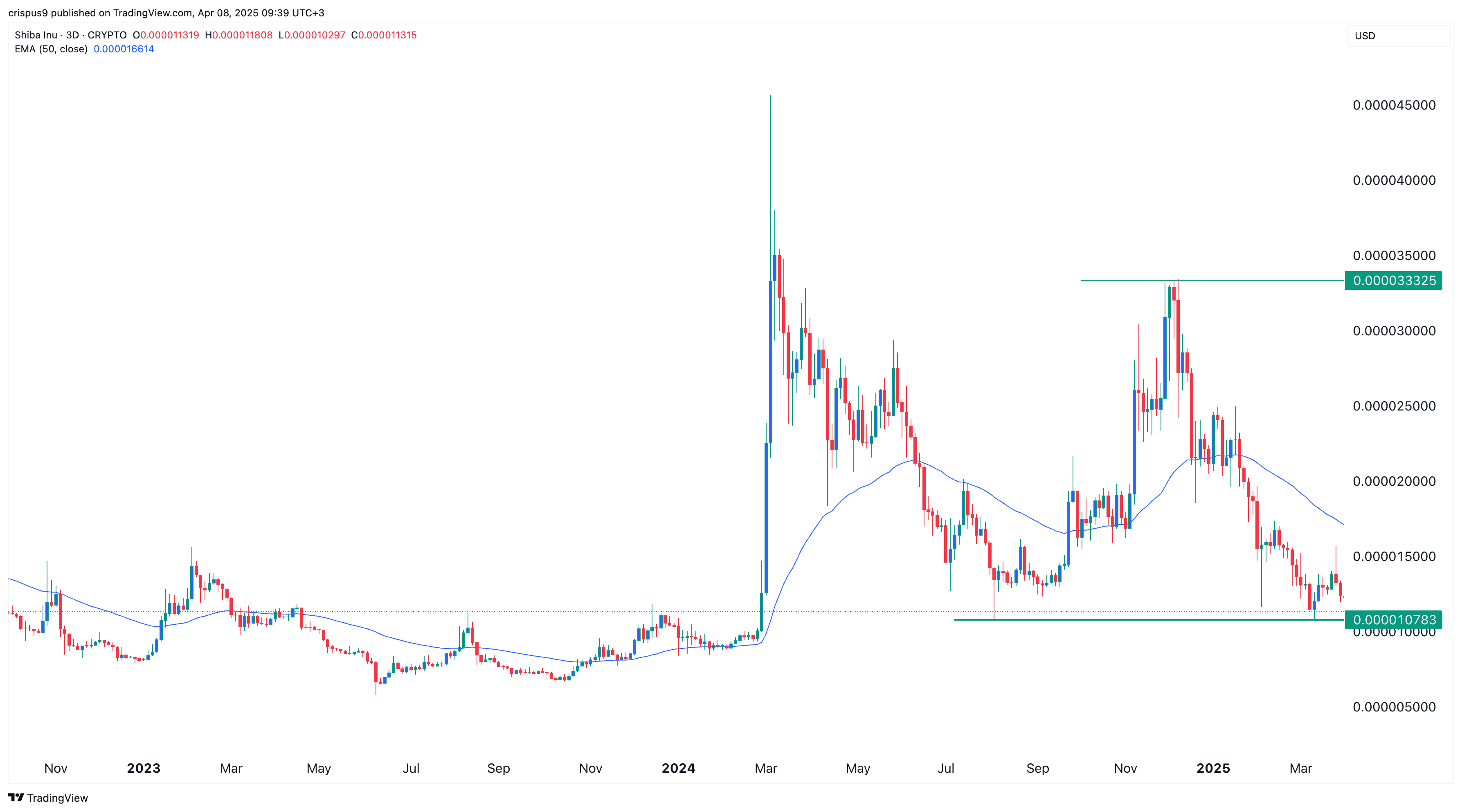
Amid the heightened tariff jitters, Shiba Inu extended its losses to trade at a 13-month low on Monday’s session. However, it held steady above the crucial support zone of $0.00001. 

A look at its daily price chart shows the top meme coin trading below the 20 and 50-day EMAs; an indication that it is not out of the woods yet. In fact, it has been on a downtrend since December 2024 when the two MAs formed a bearish death cross pattern.

In the near term, $0.00001 will likely remain a steady support level as Shiba Inu price finds its footing along Monday’s intraday low of $0.00001025. On the upside, the resistance level along the 20-day EMA at $0.00001241 will be worth watching. 

Shiba Inu Price
Shiba Inu Price

Bitcoin Pepe has enthusiasts sold on bringing meme crypto “home”

Bitcoin Pepe has been causing ripples across the meme crypto space and has over $6.2 million to show for it. In 8 weeks, it has already sold out 7 stages as meme lovers overwhelmingly embrace this revolutionary project. Its success is founded on its infrastructure and growth potential.

As the only Bitcoin meme ICO, Bitcoin Pepe is merging two ultra-popular worlds; the meme culture and the reliable Bitcoin network. Indeed, some enthusiasts have indicated that the project is “bringing meme crypto home”. 

With the meme layer-2 solution on the Bitcoin network, its holders get to enjoy BTC’s unrivaled security, Solana-style transaction speed, lower fees, and the overall meme culture. Besides, the new PEP-20 standard allows for one to launch a meme coin on the unrivaled Bitcoin network. 

It is this one-of-a-kind infrastructure that has meme enthusiasts flocking to purchase BPEP tokens before they hit the public shelves in Q2. With its value set to surge by up to 100X once it launches, the current price of $0.0295 is irresistible. 

So far, early adopters have locked in cumulative gains of 33.8% as the token price increases by about 5% with every stage. By the end of the 30 stages, holders will have their capital investment surge by up to 311.4%.  Hurry up and buy Bitcoin Pepe here.

Ethereum price set for corrective rebound amid the heightened selling pressure 

Ethereum Price Chart

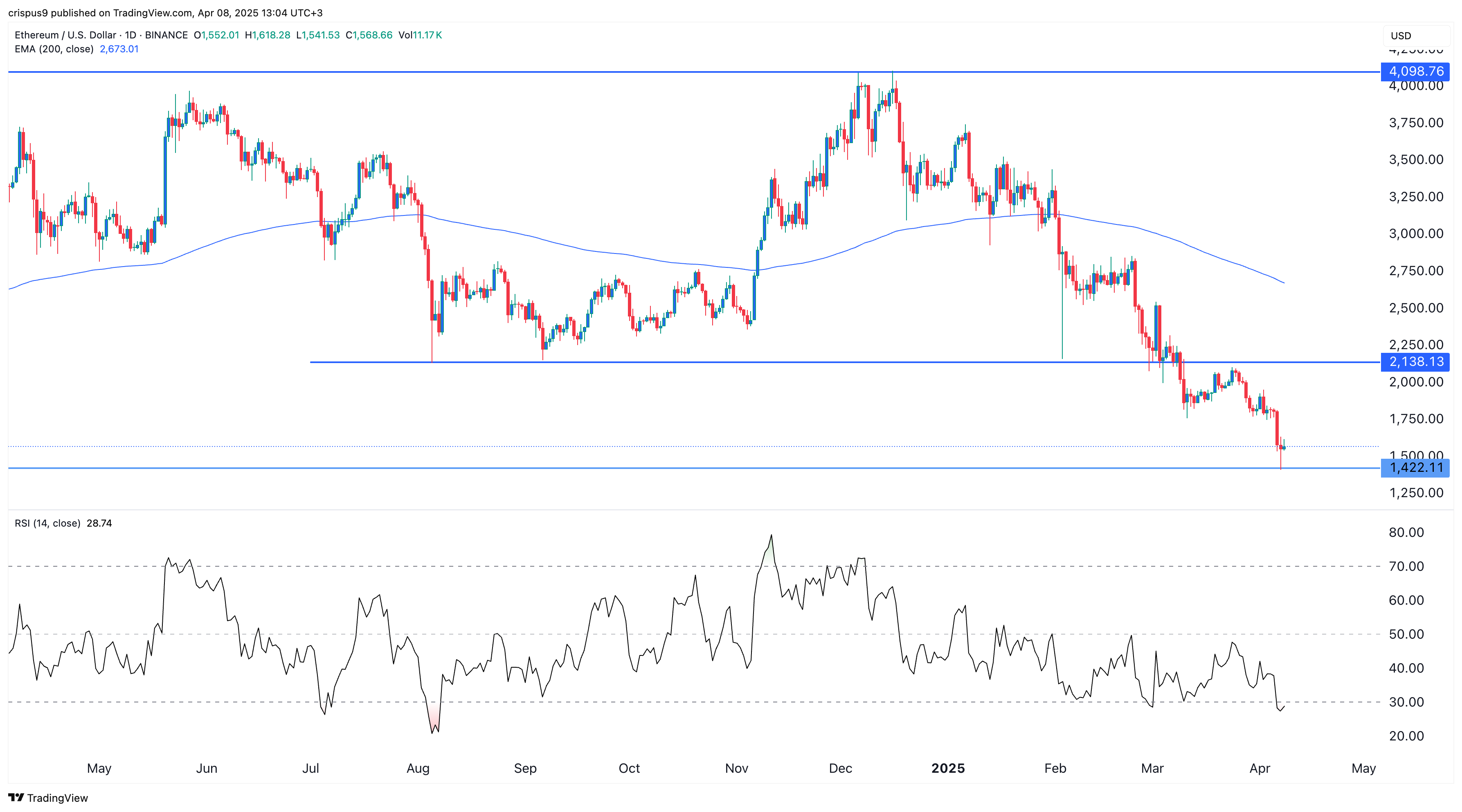
Ethereum price has plunged by over 50% since the beginning of the year with internal challenges and macroeconomic chaos being key bearish drivers. As fear remains the key emotion driving the crypto market, the altcoin continues to experience immense selling pressure.

As seen on its daily price chart, ETH is in the oversold territory with an RSI of 29. However, the indicator is facing upwards; signaling a corrective rebound after it hit two year low on Monday at $1,415. In the near term, the bulls will be keen on defending that support level. On the upside, $1,750 will be a resistance zone worth watching. 


The post Shiba Inu, Ethereum prices waver as traders flock to this viral token appeared first on CoinJournal.

XRP holds potential despite 16% plunge, expert urges caution

  • XRP drops 16% to $1.76 amid broader cryptocurrency market sell-off.
  • Expert Vincent Van Code links XRP’s past spike to US political optimism.
  • Van Code warns of a global financial reset and advises holding XRP positions.

XRP investors are facing a challenging moment as the digital currency has dropped 16% to $1.76 amid widespread selling across cryptocurrency markets.

The decline reflects broader turmoil, with major cryptocurrencies also taking a hit. Bitcoin values have plummeted more than 8% to $76,000.

The sell-off appears to be part of a larger crypto sector trend, leaving investors questioning their next moves.

Vincent Van Code, a well-known software engineer, has weighed in, expressing confidence in XRP despite the sharp price drop.

He attributes the decline to fear-driven market sentiment rather than any fundamental issues with the token itself.

XRP price spike tied to political optimism

Van Code suggests that XRP’s previous price surge, which saw it rise from $0.54 to $3.40, was largely driven by political optimism surrounding the new US administration’s pro-cryptocurrency policies.

This indicates that the token’s value has been heavily influenced by external political factors rather than solely technical advancements or adoption rates.

Despite the recent fall, Van Code maintains that nothing has fundamentally changed about XRP’s prospects.

He links the current market instability to spillover effects from traditional markets, noting reports of the US stock market losing approximately $6.5 trillion in value over two days last week due to global trade tensions.

This broader economic context, he argues, is amplifying the pressure on cryptocurrencies.

Expert warns of economic reset and market shorting

Van Code connects the ongoing volatility to what he describes as a “global financial reset,” suggesting that the US government’s actions are destabilizing multiple economies as part of a transformative process.

He warns that such sweeping changes often require the breakdown of existing structures before rebuilding, urging investors to brace for further turbulence.

Rather than viewing the decline as a reason to panic, Van Code sees it as potentially deliberate, with influential market players profiting by shorting the market ahead of the drop.

He predicts these investors will soon reverse their positions, potentially triggering a “miraculous” market bounce.

Drawing an analogy to swimming near whales in a stormy sea, he emphasizes the need for strategic patience.

Van Code advises XRP investors against closing their positions, asserting that a significant price recovery remains possible once market conditions stabilize.

The post XRP holds potential despite 16% plunge, expert urges caution appeared first on CoinJournal.

Flight to safety? Crypto funds see outflows as investors fret over tariffs

  • Crypto ETPs faced $240 million in outflows last week due to US tariffs.
  • Bitcoin ETPs were the hardest hit, with $207 million in withdrawals.
  • The US led the outflows, followed by Germany.

Global cryptocurrency exchange-traded products (ETPs) experienced a sharp reversal of fortune last week, with outflows totaling $240 million as investors grew wary of the potential economic impact of new US trade tariffs.

This marks a significant shift after two consecutive weeks of robust inflows, which had amounted to $870 million, according to a report in CoinMarketCap.

According to a CoinShares report, Bitcoin-related ETPs were the hardest hit, suffering withdrawals of $207 million, leaving the total assets under management at $132.6 billion – a modest 0.8% increase from the previous week.

The outflows were primarily concentrated in the United States, which saw $210 million withdrawn from its crypto funds.

Germany followed with $17.7 million in outflows, while Switzerland and Sweden also experienced net withdrawals.

In contrast, Canada and Brazil bucked the trend, with $4.8 million and $1.4 million, respectively, flowing into crypto funds.

Hong Kong and Australia also registered small inflows, offering a glimmer of optimism amid the broader market pullback.

Despite the recent setback, Bitcoin-related products still boast a year-to-date increase of $1.3 billion in investments.

However, the past week saw Bitcoin’s price plummet by more than 6%, largely due to tariff-related concerns and the pervasive economic uncertainty they sparked.

Beyond Bitcoin, other cryptocurrencies, including Ethereum, Solana, and Sui, also experienced significant outflows, as investor sentiment soured.

Ethereum saw $37.7 million withdrawn, while Solana and Sui experienced outflows of $1.8 million and $4.7 million, respectively.

On the other hand, smaller tokens like Toncoin enjoyed some positive movement, attracting $1.1 million in inflows.

Grayscale bleeds, BlackRock remains strong

Grayscale’s Bitcoin funds led the outflows, with $95 million in withdrawals last week.

This pushed Grayscale’s year-to-date outflows to a staggering $1.4 billion, the highest among all ETP providers, reflecting ongoing adjustments within the digital asset management landscape.

Conversely, BlackRock’s iShares ETFs, while experiencing $56 million in outflows last week, still boasted $3.2 billion in total inflows for the year, demonstrating their continued strength.

Other major players like ProShares and ARK Invest also saw continued inflows for the year, albeit in smaller amounts, with $398 million and $146 million, respectively.

While crypto ETPs experienced a downturn, the cryptocurrency equities market displayed greater resilience.

Blockchain stocks, including those of Coinbase, saw $8 million in inflows for the second consecutive week, suggesting investor confidence in the underlying infrastructure and businesses despite broader market anxieties.

Industry insiders, such as Marcin Kazmierczak from RedStone, suggest that the situation reflects wider market dynamics rather than a specific downturn in crypto assets.

The overall sentiment indicates that the crypto sector remains relatively robust, supported by continued institutional growth and the development of real-world applications.

Despite the notable outflows from global crypto funds last week, particularly those tied to Bitcoin, the enduring appeal of blockchain equities suggests that the market is far from collapsing.

The post Flight to safety? Crypto funds see outflows as investors fret over tariffs appeared first on CoinJournal.