Status (SNT) price surges as developer activity rises 35%

  • Status (SNT) price jumpd 38% in the past 24 hours.
  • Gains see the altcoin rank among best gainers today.
  • SNT broke to near $0.030 amid network growth, though potential for profit taking is high.

Status (SNT), the utility token powering the Status Network, has seen a remarkable price surge.

According to data from CoinMarketCap, SNT price is up 38% in the past 24 hours and over 60% in the past week. Its performance has overshadowed the plummeting MANTRA.

Having broken above resistance at $0.023, Status price jumped to near $0.030 before paring some of the gains.

Despite this, SNT ranks among the top gainers in the top 500 coins by market cap, behind Ardor (ARDR) and Fuel Network (FUEL). The altcoin traded around $0.028 with the daily volume spiking more than 1,200% to suggest massive market activity.

SNT development activity on the rise

Status has been making waves in the blockchain space, as evidenced by a 35% growth in development activity, a metric verified by Chain Broker.

According to the analyst, Status ranked among the top 10 projects for development activity growth in the past month. Its overall activity measure of +35% put SNT alongside heavyweights like Cosmos, and Solana.

The project’s consistent focus on its mission—delivering private messaging, crypto freedom, and true decentralization—has kept its development efforts robust. A recent update from the official Status account emphasized this commitment.

Status is a project dedicated to enhancing an open-source messaging platform and mobile interface for Ethereum-based decentralized applications, likely contributing to its recent price momentum.

Status price forecast: What next for SNT?

Traders might want to watch the broader market for overall sentiment, with Bitcoin futures suggesting a weakness as China reportedly sells its seized crypto.

If there’s a sharp retracement, wavering on the part of bulls will impact the rest of the market.

The crypto fear & greed index also points to caution.

Technical indicators provide an outlook for SNT’s price trajectory.

On the daily chart, the Relative Strength Index (RSI) stands at 61 and upslopping, signaling a potential flip into overbought territory.

Similarly, the Moving Average Convergence Divergence (MACD) reflects bullish momentum. The signal line is above the 50-period mark, while the positive histogram adds to this picture.

However, the recent 9.65% price increase could signal a potential reversal if bullish momentum builds.

SNT chart by TradingView

Derivatives data from CoinGlass highlights market dynamics, showing fluctuations in futures volume and open interest for SNT.

OI up 89% to over $7.4 million and rising trading activity in futures suggests growing speculative interest. This could amplify price volatility, with a jump in open interest continuing in the short term.

In this case buyers could push SNT price to $0.05. However, the market continues to seesaw and SNT’s price may have to rely on support near $0.018.

The post Status (SNT) price surges as developer activity rises 35% appeared first on CoinJournal.

Coinbase warns of renewed crypto winter as altcoin market cap plunges 41%

  • Bitcoin and COIN50 fall below 200-day moving averages.
  • Venture capital remains 60% below 2021 levels despite mild rebound.
  • Market may stabilise between mid and late Q2 2025, says Coinbase.

The risk of a renewed crypto winter is rising, Coinbase Research warned this week, as key technical and macroeconomic indicators suggest the digital asset market may be entering another prolonged downturn.

In a note published yesterday, Coinbase said Bitcoin has slipped below its 200-day moving average—a level widely seen as a bearish signal.

The COIN50 index, which tracks the top non-Bitcoin assets on the platform, has also fallen beneath its long-term support.

Adding to the market stress are surging global tariffs and prolonged fiscal tightening, both of which are weighing on investor sentiment and curbing inflows into crypto.

The situation echoes the 2022 crash, when over $2 trillion in market value was wiped out within 18 months.

Altcoins have been hit the hardest. Excluding Bitcoin, the total crypto market cap has dropped 41% since its December 2024 peak, falling to $950 billion.

That figure is lower than any level recorded between August 2021 and April 2022, a time when market turbulence was already high.

Altcoins fall 41%

According to Coinbase, the sustained drawdown in altcoins highlights the weakening appetite for riskier crypto investments.

Tokens outside the Bitcoin ecosystem have seen sharp sell-offs amid thin liquidity and a lack of new capital.

The COIN50 index now trades well below its 200-day average, signalling broad technical weakness across the sector.

Retail interest has also declined, while institutional flows remain limited. This suggests that the bullish momentum seen in late 2024 has largely dissipated.

Many smaller projects are underperforming, particularly those in niche segments such as decentralised AI, Web3 gaming, and tokenised real-world assets.

Funding stays low

Coinbase’s report also points to stagnation in venture capital. Although investment volumes have picked up modestly since late 2024, they remain 50% to 60% below the highs recorded during the 2021–2022 cycle.

This has left many early-stage startups without the runway to scale, pushing some to pause development or downsize operations.

The absence of fresh capital has slowed innovation across key verticals.

Many in the industry had expected decentralised finance, metaverse applications, and crypto crowdfunding models to lead the next bull cycle. Instead, these areas have stalled.

Macro weighs on sentiment

Coinbase cited external economic pressures as a major reason for the recent slump.

Tighter monetary policy, high interest rates, and the escalation of global tariffs have all eroded investor confidence.

David Duong, head of institutional research, said the investment environment has become “paralysed” as both traditional and crypto markets face liquidity stress.

These macro headwinds have discouraged speculation and limited the flow of capital into digital assets.

Traders have pulled back, focusing instead on safe-haven assets as geopolitical risk and inflation remain elevated.

Recovery may follow

Despite the gloom, Coinbase believes the market may find a bottom between mid and late Q2 of 2025.

A stabilisation in macro conditions—particularly a slowdown in inflation or an easing of interest rates—could help revive capital flows.

Coinbase warns of a potential crypto winter as altcoins drop 41% and Bitcoin breaks key support. Market cap falls to $950b, mirroring 2022’s downturn.

According to Duong, sentiment may reset quickly once market stress subsides, opening the door to a recovery in the second half of the year.

The report stops short of making bullish predictions but says tactical positioning may be useful in the current environment. Analysts suggest keeping a close eye on liquidity trends and macro data as potential signals of a shift in momentum.

The post Coinbase warns of renewed crypto winter as altcoin market cap plunges 41% appeared first on CoinJournal.

Pi Network price drops 10% to key level despite major network news

  • Pi Network price has dropped nearly 10% in the past 24 hours.
  • Traders are likely to watch the $0.65-$0.75 range for signs of a breakout or further weakness.
  • Pi Network’s focus on real-world adoption positions it for long-term growth.

Pi Network’s native token, PI, has experienced a sharp decline over the past 24 hours, falling to a critical support level despite significant ecosystem developments.

The price drop comes as major cryptocurrencies struggle to hold onto gains.

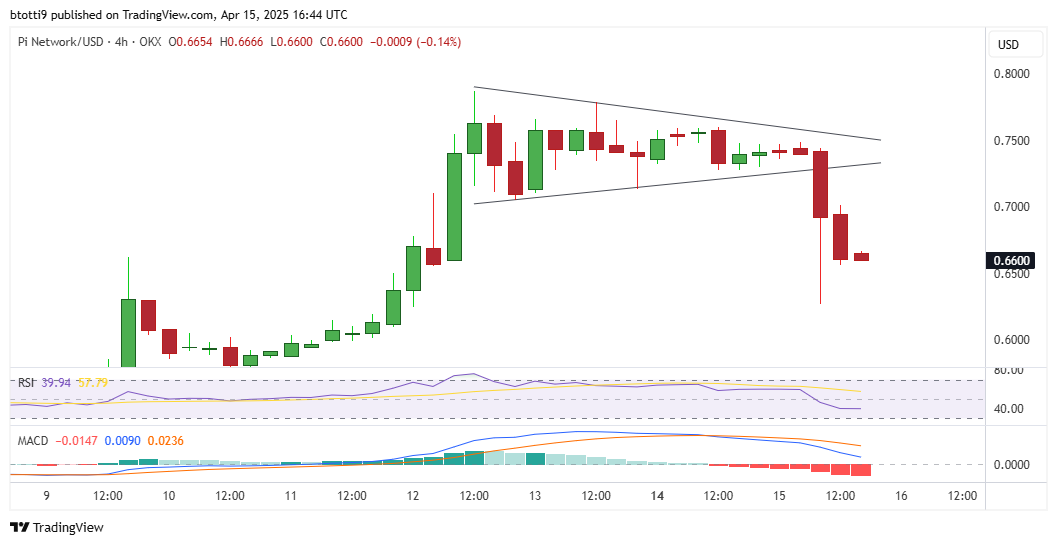
In the past 24 hours, PI price has dropped nearly 10% and cut weekly upside to about 14%, with the altcoin hovering near $0.66.

Despite the expansion of the Pi Ad Network to all ecosystem dApps, Pi Network’s price is under short-term bearish sentiment.

Tron and Cardano have also struggled, but what does this mean for the PI token?

Key Pi Network developments

In the past few days, Pi Network has posted notable network developments.

It includes a major Chainlink integration that marks a pivotal step for the cryptocurrency, which brings real-time, accurate data for decentralized applications.

For dApps, the collaboration means fresh potential for DeFi applications, prediction markets, and blockchain games, all of which could drive PI demand.

It’s the same outlook for DeFi protocols such as lending or staking platforms.

Meanwhile, the Pi Ad Network’s expansion to all ecosystem dApps introduces a new revenue stream for developers.

Advertisers must purchase PI to fund campaigns, while developers earn PI through user engagement.

Initially piloted with five apps in 2024, the Ad Network’s full rollout is expected to accelerate app development and token utility.

However, these fundamentals aside, PI’s price action reflects market hesitation.

PI price prediction

Since hitting highs near $3 in February, PI has been on a steady decline.

The token has shed significant value, with the current level about 77% of the all-time high.

A look at the four-hour chart reveals a symmetrical triangle pattern, a technical setup often signaling consolidation before a breakout.

Notably, this can go in either direction, and it’s downward for PI.

Pi Network chart by TradingView

The symmetrical triangle breakdown suggests sellers are capitalizing on uncertainty, possibly due to broader market conditions or profit-taking after earlier gains.

It’s what likely has bears in control, a scenario that could push PI price below key levels.

As can be seen above, the token is now testing support near $0.65. Other than the symmetrical triangle pattern, the relative strength index and the moving average convergence divergence give sellers an upper hand. The MACD indicates a recent bearish crossover, shifting short-term sentiment after a rejection around $0.75.

If bulls fail to hold above $0.65, PI could slide toward $0.50.

However, if bullish momentum builds, PI could break above $0.8 and rally toward $1.20 in the near term.

The post Pi Network price drops 10% to key level despite major network news appeared first on CoinJournal.

SEC delays call on Grayscale’s Ethereum ETF staking proposal

  • The SEC said it would defer its decision on the Grayscale ETFs until June 1.
  • A final ruling deadline is set for late October.
  • Ether’s market performance has lagged relative to peers in the current bull market.

The US Securities and Exchange Commission (SEC) has postponed its decision on whether to permit Ether staking within two of Grayscale’s Ethereum funds, further drawing out a process closely watched by crypto market participants and asset managers.

In a notice dated April 14, the SEC said it would defer its decision on the Grayscale Ethereum Trust ETF and the Grayscale Ethereum Mini Trust ETF until June 1.

A final ruling deadline is set for late October. The delay comes two months after the New York Stock Exchange filed a proposed rule change on Grayscale’s behalf.

It would allow Ether ETF investors to stake their holdings, locking up cryptocurrency to support the network’s operations in exchange for yield.

Staking yields have become an important feature for potential Ether ETF investors.

Coinbase currently offers an estimated 2.4% annual yield on staked Ether, while rates on Kraken range between 2% and 7%.

Ether ETFs have seen a comparatively modest uptake since their 2024 debut, with cumulative net inflows of $2.28 billion according to Sosovalue — a sharp contrast to Bitcoin ETFs, which have attracted over $35.4 billion in inflows.

The race for Ethereum staking

Grayscale is not alone in its pursuit. BlackRock’s 21Shares iShares Ethereum Trust also filed for staking permissions in February and awaits SEC approval.

The delay underscores persistent regulatory caution surrounding staking services in publicly traded products, even as other facets of crypto ETFs advance.

On April 9, the SEC approved options trading for multiple spot Ether ETFs, including those from BlackRock, Bitwise, and Grayscale.

The move allows these funds to offer derivatives exposure.

This feature broadens their appeal to institutional players but stops short of addressing the core issue of yield generation through staking.

Ether underperformance 

Ether’s market performance has lagged relative to peers in the current bull market.

As of April 14, the token remains below $2,000, well off its 52-week high of $4,112 and still shy of its November 2021 all-time high of $4,866.

This underperformance stands in contrast to other digital assets like XRP and Solana, both of which have posted stronger gains in the latest rally.

The muted demand for Ether ETFs compared to their Bitcoin counterparts, alongside Ether’s relatively weak price action, reflects investor hesitancy amid regulatory ambiguity and market volatility.

The SEC’s ongoing delays around staking approvals only reinforce that uncertainty for now.

The post SEC delays call on Grayscale’s Ethereum ETF staking proposal appeared first on CoinJournal.

Why Ethereum price may be on its way up after a disappointing quarter

  • Ethereum (ETH) price is showing recovery after falling to a low of $1,415.
  • Bullish patterns and DEX strength signal a potential ETH price rebound.
  • The upcoming Pectra update may drive ETH to $2,140.

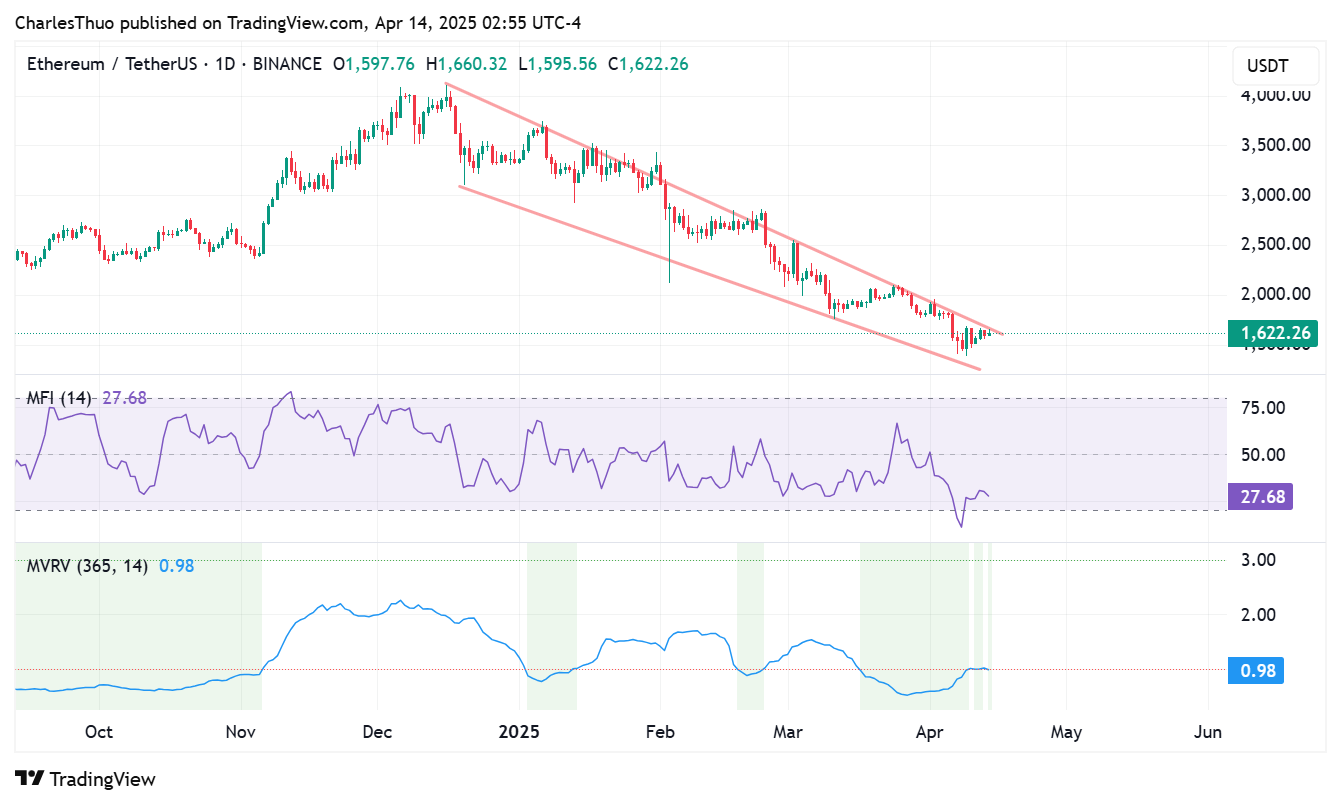
Ethereum (ETH), the second-largest cryptocurrency by market capitalization, has endured a tough quarter, with its price recently dipping to $1,415, reflecting a steep 61% drop from its December peak.

This significant decline has cast Ethereum as a notable underperformer in the crypto market, sparking unease among investors and analysts.

However, after hitting a low of $1,415, the price has shown signs of recovery, climbing to around $1,623.42, hinting at a potential shift in momentum.

What caused the ETH price to drop this low?

The downturn in Ethereum’s price stems partly from internal problems, with David Hoffman, co-founder of Bankless, calling out the community’s leadership for alienating users and builders.

Hoffman points to hostile attitudes, like shaming the staking platform Lido Finance and criticizing certain traders, which may have shaken confidence in the ecosystem.

Ethereum Co-founder Vitalik Buterin, in an April 12 post on Warpcast, also emphasized the need for a strong social philosophy in Ethereum’s application layer to guide developers in building decentralized apps that align with its core values, citing projects like Railgun and Farcaster as positive examples.

Ethereum Co-founder Vitalik Buterin emphasizing the need for a strong social philosophy in Ethereum’s application layer

Beyond internal strife, Ethereum’s Layer 1 infrastructure has struggled to keep pace with newer blockchains, adding pressure to its valuation.

External forces, such as market volatility triggered by President Trump’s tariff announcements, have also fueled sell-offs across cryptocurrencies, dragging Ethereum down further.

Technical analysis signals a price rebound for Ethereum (ETH)

Despite the rocky 2025 start, several factors suggest that Ethereum could be gearing up for a rebound, offering hope to those watching its trajectory.

Technical analysis, however, paints a more optimistic picture, as chart patterns signal a possible reversal in Ethereum’s fortunes.

A falling wedge pattern has emerged on both daily and weekly charts, nearing a confluence level that often precedes a bullish breakout.

A falling wedge pattern has formed on the D1 Ethereum chart
Ethereum price chart by TradingView

Should this pattern play out, Ethereum (ETH) could climb to $2,140, a 35% jump from its current price.

An inverse head-and-shoulders pattern, another bullish indicator, is also taking shape on the one-day chart, strengthening the case for an upward move in the near term.

The RSI indicator also recently rebounded from the oversold region, signaling that the token could be on a bullish rebound, which could last for a while.

The Market Value to Realized Value (MVRV) Z-score dipped to -0.832 before rebounding to around 0.98 at press time, indicating Ethereum is trading well below its historical average.

This metric implies that the cryptocurrency may be a bargain for investors, potentially sparking buying interest that could lift its price.

Historically, such undervaluation has often preceded periods of price appreciation, adding weight to the bullish outlook.

Ethereum-based DEXs outpacing rivals

Ethereum’s decentralized exchange (DEX) network continues to demonstrate resilience, providing another reason for optimism.

Despite competition from blockchains like Solana and Arbitrum, Ethereum’s DEXs processed over $17 billion in volume in the past week, outpacing rivals, according to data from DefiLlama.

This sustained activity highlights Ethereum’s ability to retain users and liquidity, even with higher fees, reinforcing its foundational strength.

Such robust performance suggests the network remains a cornerstone of the decentralized finance space, capable of weathering competitive pressures.

Valuation metrics further bolster the argument that Ethereum is primed for a recovery, as its current price appears undervalued.

The upcoming Ethereum Pectra update

Looking forward, the Pectra update, slated for May 7, 2025, promises to enhance Ethereum’s network, potentially reversing some of its recent setbacks.

This upgrade aims to tackle Layer 1 challenges, improving scalability and efficiency, which could restore faith among investors and developers.

A successful rollout might serve as a catalyst, driving Ethereum’s price higher as the market anticipates a more competitive blockchain.

Scheduled improvements like these signal Ethereum’s commitment to evolving, a factor that could reignite enthusiasm.

The combination of bullish technical patterns, a strong DEX ecosystem, undervaluation, and the promise of the Pectra update builds a solid case for recovery.

Investors would do well to keep an eye on resistance levels and sentiment shifts, yet the evidence points to Ethereum potentially rising from its disappointing quarter.

The post Why Ethereum price may be on its way up after a disappointing quarter appeared first on CoinJournal.