
Can MANTRA (OM) price rebound as RSI dips below 20?

  • The Mantra (OM) token has fallen below $0.40, with RSI at 17.18, signalling oversold conditions.
  • 300M OM tokens are scheduled for burning to curb supply, but price recovery remains elusive.
  • The Mantra team also plans governance reforms to restore trust, though volatility persists.

The Mantra protocol’s native token, OM, has plunged below $0.40, igniting speculation about a potential rebound as its Relative Strength Index (RSI) drops to an oversold level of 17.18.

This steep decline follows a dramatic crash in April 2025, erasing billions in market capitalisation and shaking investor confidence.

With technical indicators flashing extreme bearish signals and the MANTRA team implementing token burns and governance reforms, the question looms: can OM recover, or is further downside inevitable?

A catastrophic OM token crash and lingering fallout

On April 13, 2025, MANTRA’s OM token plummeted from $6.30 to $0.37 in mere hours.

The collapse slashed the project’s market capitalisation from $6 billion to under $700 million.

Attributed to forced liquidations during low-liquidity weekend trading, the crash sparked rumours of exchange involvement, which the team swiftly denied.

CEO John Mullin released on-chain data to counter claims of insider selling, confirming that team-held tokens remained locked.

In response to the crisis, MANTRA’s leadership took decisive action to curb selling pressure.

CEO John Mullin burned 150 million staked OM tokens from the team’s allocation on April 29, 2025.

An additional 150 million tokens from ecosystem partners are slated for destruction, totalling 300 million OM—roughly 16.5% of the total supply.

This significant reduction aims to tighten supply and bolster investor confidence.

However, the market has yet to respond, with OM lingering below key technical thresholds, suggesting scepticism persists.

Beyond token burns, MANTRA’s team is pursuing structural changes to rebuild trust.

Plans for decentralising validators and upgrading governance aim to enhance the protocol’s resilience and transparency.

These initiatives, while promising, require time to materialise and may not immediately impact price action.

Despite these efforts, investor trust remains fragile, with OM struggling to regain footing.

Market participants remain cautious, with volatility dominating OM’s short-term outlook.

The success of the introduced reforms could determine whether MANTRA regains its former stature or continues to falter.

Technical indicators show the OM token is in an oversold region

From a technical analysis point of view, MANTRA’s price now sits well below its 20-day EMA of $0.51 and 50-day EMA of $0.74, underscoring a pronounced bearish trend.

However, the daily Relative Strength Index (RSI), at 17.01, marks one of the lowest levels since the April crash, indicating extreme oversold conditions.

Historically, RSI readings below 20 often precede relief rallies, as buyers capitalise on perceived undervaluation.

In addition, the MACD has turned bullish with a crossover and the histogram moving above the zero line.

Mantra price chart
Mantra price chart by TradingView

If buying momentum emerges, OM could target the $0.42 resistance, with a break above $0.54 signalling stronger bullish confirmation.

Conversely, failure to hold the $0.37 support risks a slide to $0.30, potentially deepening panic selling.

Can Mantra price stage a comeback?

The convergence of an oversold RSI, significant token burns, and planned protocol upgrades creates a complex outlook for MANTRA.

While technical indicators hint at a possible relief bounce, sustained recovery hinges on restored investor confidence.

The $0.42–$0.54 price range will be critical for bulls to reclaim, while a drop below $0.37 could intensify bearish sentiment.

As MANTRA navigates this turbulent period, its ability to execute on promised reforms and stabilise price action will shape its path forward.

For now, traders watch closely, weighing the potential for a rebound against the risk of further declines.

The post Can MANTRA (OM) price rebound as RSI dips below 20? appeared first on CoinJournal.
Trump hints at China tariff cut: will Bitcoin price soar past $100K as trade tensions ease?

  • Trump acknowledged that the existing 145% US tariff on Chinese imports is ‘too high’.
  • Currently, the US and China are locked in a steep tariff battle.
  • Bitcoin and Ethereum have shown strong performance during periods of dovish monetary policy and reduced inflation.

US President Donald Trump has signaled a willingness to lower tariffs on Chinese goods.

The announcement comes amid escalating speculation about how such a policy shift could impact inflation, interest rates, and digital assets like Bitcoin and Ethereum.

Trump’s comments have already sparked renewed interest among crypto investors, who see a potential rally in the making.

Speaking in a recent CNBC interview, President Trump acknowledged that the existing 145% US tariff on Chinese imports is “too high” and has effectively crippled bilateral trade.

“At some point, I’m going to lower them,” he said, adding that China is eager to resume business with the United States.

Trump’s remarks suggest that trade talks between the two global powers could be back on the table, with hopes of a more balanced economic relationship.

Currently, the US and China are locked in a steep tariff battle, with Beijing retaliating by imposing a 125% duty on American goods.

These tit-for-tat tariffs have disrupted global supply chains and contributed to higher prices for consumer goods ranging from electronics to clothing.

Industry analysts believe that easing these levies could reduce inflationary pressure, thereby influencing the Federal Reserve’s monetary policy, particularly in holding back further interest rate hikes.

From a crypto market perspective, the implications are significant.

Historically, digital assets such as Bitcoin and Ethereum have shown strong performance during periods of dovish monetary policy and reduced inflation.

With tariff reduction on the horizon, crypto investors are betting on a resurgence in prices.

Bitcoin, for instance, recently dipped below $80,000 but has since bounced back, trading above $94,000 at press time.

Analysts predict that if sentiment continues to improve, Bitcoin could breach the $100,000 milestone, triggering a broader market rally.

Beyond Bitcoin, altcoins like Ethereum (ETH), Ripple (XRP), and Solana (SOL) also stand to gain from a more favorable economic environment.

Reduced trade tension often translates to increased risk appetite, driving more capital into speculative assets like cryptocurrencies.

Trump’s comments also hint at a broader economic recalibration.

Lower tariffs could ease operational costs for American businesses and improve consumer sentiment, factors that indirectly feed into the crypto economy by increasing liquidity and investor confidence.

While a final decision is yet to be made, the mere prospect of US–China trade normalization has already set the tone for a volatile yet potentially bullish phase in the crypto markets.

As always, traders are advised to keep a close eye on policy shifts that could influence macroeconomic indicators and, by extension, digital asset prices.

The post Trump hints at China tariff cut: will Bitcoin price soar past $100K as trade tensions ease? appeared first on CoinJournal.

Best coins to buy: NEAR and PepeX revive the AI narrative

As Bitcoin pursues $100K on enhanced optimism, crypto enthusiasts explore narratives that could fuel the upcoming broad-based rallies.

Let’s check why investors will watch NEAR and the viral PepeX in the coming sessions.

NEAR, “the Bitcoin of AI tokens,” eyes a potential breakout as a bullish structure aligns with optimistic chatter.

Meanwhile, PepeX’s advanced tokenization Launchpad grabs investor attention.

It has nearly $2 million in the ongoing presale.

NEAR hints at imminent breakouts

Near Protocol’s native coin exhibits a bullish price structure, suggesting potential upswings.

The token has secured solid grounds after months of subtle accumulations and consolidations.

Meanwhile, the expanding ecosystem and continued developments have kept the asset afloat.

Recently, Near Protocol expanded chain abstraction capabilities to Solana, TON, Aptos, Sui, and Stellar.

The announcement read:

 This update represents a crucial step in NEAR’s chain abstraction architecture, broadening interoperability across diverse blockchain ecosystems and fostering a more unified development experience. The addition of EdDSA support is particularly valuable for developers working with high-throughput chains like Solana, TON, Aptos, and Sui.

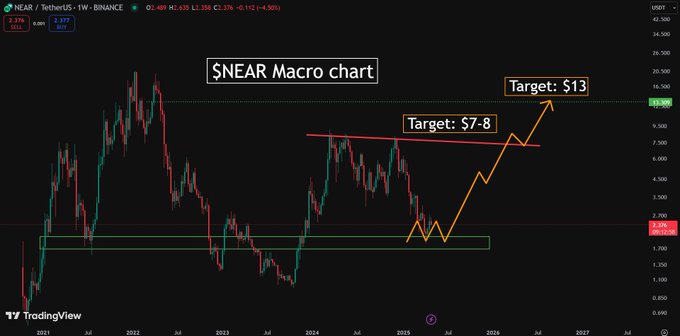
NEAR trades at $2.35, mirroring the prevailing broad market performance.

Meanwhile, a solid reversal setup on its price chart drives optimism.

The favorable candle formations and increasing buying volume after March’s lower low hint at upside trends.

Analyst Solberg Invest predicts surges to $13, translating to an over 80% uptick from NEAR’s current price.

Solberg Invest's NEAR chart on X


Besides price charts, NEAR boasts a solid foundation.

The $20 million AI fund project supports decentralized AI innovations.

Moreover, Near Protocol has Deutsche Telekom as its validator.

NEAR appears ready to shape decentralized technologies (in the long term) as it aims to integrate artificial intelligence tools into the blockchain infrastructure.

PepeX: AI tokenization and fair launches

Meme cryptocurrencies are shifting towards accrual innovation and utility, and PepeX appears at the center of this transformation.

With its AI-powered asset tokenization platform and focus on fair asset launches, PepeX looks to redefine a sector often attacked due to VC-centered tokenomics and insider trading deals.

The project distributes 95% of the available tokens to the public and only 5% to founders, which they might lose if PepeX fails.

The fair launch introduces transparency and legitimacy, which appear crucial in the growing cryptocurrency industry.

Moreover, PepeX’s AI-driven tool allows anyone to create and launch a token without technical expertise.

The project’s Whitepaper highlights:

PepeX is a neo-fair-launch platform where creativity and innovation are the only currencies that matter. Transparent, profitable for the community, and not a playground for insiders. No coding, no complex tokenomics – just pure creativity backed by real DeFi.

PepeX represents a movement toward decentralizing access to digital assets tools.

Imagine creating and launching your favorite token as simple as posting on social media sites.

Indeed, meme coins have done more in onboarding individuals into the cryptocurrency world than most specialized marketing campaigns.

PepeX leverages that while presenting genuine functionality.

PepeX trades at $0.0268, and analysts predict massive growth after its official launch.

You can visit here for more details about PepeX.

The post Best coins to buy: NEAR and PepeX revive the AI narrative appeared first on CoinJournal.

Bitcoin dominance rises, Solana prepares a surge as CartelFi surges

Bitcoin’s dominance is undeniable with CMC’s altcoin season index substantiating the Bitcoin season at a level of 21. However, meme coins are making a comeback and investors are on the lookout for fresh projects promising hefty returns from little investments. The attention is particularly on new entrants whose foundation is more than just a viral joke. 

One such meme crypto is CartelFi. It enables investors to earn passive income without compromising on the asset’s upside potential. 

What’s more, even before the highly anticipated launch in Q3, early adopters are already earning big during its presale. With every 3-day stage, CARTFI token price surges by 5%. By the end of the 90-days period, the project will have transformed several retail investors into crypto millionaires.    

Bitcoin price analysis: Neutral market sentiment creates hurdle on the path to $100,000

A surge in institutional demand bolstered the bitcoin price to a two-month high on Friday. However, it has since pulled back as investors remain concerned over US-China trade tensions and the persistent macroeconomic uncertainties. Compared to last week’s greed level of 63, the crypto fear & greed index is at a neutral zone of 53.

Data released by SoSoValue showed that only one out of the top 12 US BTC spot ETFs recorded daily net inflow on Friday. BlackRock’s IBIT recorded $674.91 million in the day’s net inflows while the other leading ETFs reported zero flows. 

In the immediate term, the bulls are keen on defending the support at $96,050. Success at bouncing off that support level will avail a chance to break the resistance at $97,797 with the next target being the psychologically crucial zone of $100,000. On the flip side, a further pullback would have the bears eyeing $92,745.


CartelFi rewards early adopters during the presale and beyond 

CartelFi hit the ground running, raising over $500,000 in the first 24 hours of its presale. Notably, it has maintained the upside momentum despite the external chaos that have impacted the broader crypto market. 

Less than 4 weeks into its launch, it has raised over $1.5 million. What started at a token price of $0.0251 is currently at $0.0408; rising by 5% every 72-hours stage.

In addition to the opportunity to earn hefty cumulative gains during the presale, the project’s attractiveness has been enhanced by its concept of yield farming. Under the current DeFi structure, meme coins “lie idle” in between rallies. To enjoy yields, an investor would have to sell some tokens; missing out on a potential rally.

CartelFi is solving this inefficiency by having an investor’s preferred meme coins work for them. Subsequently, one enjoys yields of upto 10,000% while still retaining the asset’s speculative upside. 

Additionally, CartelFi’s programmed scarcity enhances its attractiveness and growth potential. 100% of the fees generated by the platform once users deposit their meme coins are used to buy back and burn CARTFI tokens. This ensures that the total supply remains low; sustaining its upside momentum. Find out how to buy CartelFi here.

Solana price readies for a rally with a key bullish pattern underway

Solana price has been hovering around the crucial zone of $150 for over a week after rebounding from the 14-month low hit in early April. While the sentiment in the broader crypto market has improved, investors are still concerned about Trump’s aggressive tariffs and their impact on the economy. 

Even so, as meme coins make a comeback, Solana is set to benefit big from its positioning in the DeFi space. Subsequently, Solana price may continue to enjoy solid support at $140.

Indeed, this has become a point of convergence for the 25 and 50-day EMAs; signaling the formation of a bullish golden cross pattern. On the upside, $160 remains a resistance level worth watching. 

The post Bitcoin dominance rises, Solana prepares a surge as CartelFi surges appeared first on CoinJournal.

Tether plans new US dollar stablecoin as reserves near $120 billion amid Washington lobbying

  • Q1 2025 audit shows excess reserves down to $5.6 billion from $7 billion.
  • Tether’s reserves are managed by Cantor Fitzgerald, raising scrutiny over potential conflicts.
  • Competitor World Liberty Financial, backed by the Trump family, also plans to launch a stablecoin.

Tether, the world’s largest stablecoin issuer by market capitalisation, is preparing to launch a US-based stablecoin by the end of 2025 or early 2026.

The move marks a shift in the company’s strategy as it aims to align itself more closely with American regulatory frameworks.

While its international USDT token is already dominant in global crypto trading, the proposed dollar-pegged stablecoin will be designed to comply with domestic regulations in the United States.

Tether CEO Paolo Ardoino revealed the development during an interview at the Token2049 conference in Dubai.

He confirmed the company was awaiting the outcome of pending US legislation before finalising a launch timeline.

The push coincides with Tether’s broader attempt to reposition itself in the US as a compliant and cooperative player, following past controversies over its reserve disclosures and regulatory fines.

Lobbying efforts intensify in Washington

Tether’s domestic pivot comes as Ardoino increases his presence in Washington, DC.

His recent efforts include private meetings with lawmakers and a Capitol Hill lunch with Republican Senator Bill Hagerty, according to reports.

The company is now actively lobbying in support of proposed legislation like the GOP-backed GENIUS Act, which includes provisions that could benefit foreign issuers such as Tether if they agree to cooperate with US law enforcement.

Ardoino has also underscored Tether’s relationship with US agencies, stating that no other financial entity, traditional or crypto, matches its collaboration level with law enforcement.

While the company was once criticised for allegedly enabling criminal transactions, its new strategy focuses on transparency and legal compliance as a means of gaining regulatory approval.

Tether’s headquarters remain in El Salvador, but the company’s efforts to develop a domestically compliant stablecoin reflect its evolving approach to regulatory alignment.

It is positioning the new token as separate from its global USDT product, tailored to meet specific legal and financial rules within the US.

Cantor Fitzgerald link draws scrutiny

As part of its reserve management strategy, Tether holds billions in US Treasuries managed by Cantor Fitzgerald, a major Wall Street firm.

The firm’s Q1 2025 attestation report confirmed holdings of nearly $120 billion in Treasuries, though its excess reserves declined to $5.6 billion from over $7 billion in December 2024.

The Cantor connection has attracted attention due to the firm being led by the sons of US Commerce Secretary Howard Lutnick.

Ardoino addressed concerns around conflicts of interest, stating that proper “walls” are in place and that he does not communicate directly with the secretary.

He also emphasised Tether’s healthy capital position, noting $7 billion in excess equity and suggesting that traditional institutions should emulate its model.

In 2021, Tether paid $18.5 million to settle charges by the New York attorney general over misrepresentations about its reserves.

Since then, it has begun publishing routine attestation reports.

Ardoino insisted the company is now better capitalised than many traditional financial firms and prepared to withstand significant market shocks.

Domestic stablecoin market heats up

Tether’s expansion into the US stablecoin market comes amid increased political attention.

The Trump-backed World Liberty Financial recently announced plans to launch its dollar-backed token, adding to the competition for regulatory legitimacy and market share.

While stablecoins remain a hot topic in Washington, the GENIUS Act and other proposals could set the stage for clearer compliance pathways for issuers.

Tether’s ability to influence policy could prove crucial as it seeks to enter a space where scrutiny is likely to intensify in the run-up to the 2026 elections.

Tether’s move to issue a domestically regulated stablecoin is not only a technical milestone but also a political statement.

As regulatory conversations gain momentum in Washington, its future may depend less on market dominance and more on legal alignment with US financial policy.

The post Tether plans new US dollar stablecoin as reserves near $120 billion amid Washington lobbying appeared first on CoinJournal.