Bahamas have the world’s most advanced official digital currency, but is that a bad thing?

  • Bahamas lead countries worldwide on Central Bank issued cryptocurrencies, with their Sand Dollar
  • CBDCs present many advantages regarding efficiency of payments, speed and reduction of friction
  • However, some very real privacy concerns and questions surrounding government power also arise 

Centralised Issuance

The topic of Central Bank Digital Currencies (CBDCs) is one that is only beginning to break into mainstream consciousness.

While many crypto enthusiasts hope more countries will follow El Salvador’s lead and adopt Bitcoin as legal tender, stablecoins seemingly present as a less ambitious case for sovereign adoption, given they are immune to the volatility that plagues Bitcoin. Simply digital iterations of their fiat alternatives, the exchange rate is pegged one-to-one, and their value does not fluctuate.

But while there are small-time examples, such as the city of Lugano in Switzerland, where decentralised stablecoins such as Tether (USDT) can be used as legal tender, there are also a lot of governments working on their own, centralised stablecoins.

Countries

According to PwC, none are more advanced than the Bahamas, where the Central Bank issued a digital version of the Bahamian dollar in October 2020. Colloquially referred to as the Sand Dollar, it carries the exact same utility, legal status and authorisation as it’s conventional fiat alternative.

The advantages are many. Speed, efficiency and security of payments are the main ones, with an overall reduction in friction thanks to the blockchain. The Bahamas also hopes to leverage the publicity of the initiative, helping to place the nation as the crypto hub of the Caribbean.

The trackable nature of the blockchain will also help in restraining money laundering, counterfeit, fraud and all sorts of financial crimes. Additionally, the announcement cited the benefits that could be reaped in the loan market ,with the CBDC able to “provide an excellent record of income and spending, which can be used as supporting data for micro-loan applications”.

Disadvantages

However, not all consequences of CBDCs are positive. There are very real privacy concerns here, with the government theoretically able to track exactly what you spend, when you spend and who you spend it with. Accounts can also be frozen at will – think Tether who have frozen certain USDT in the past following hacks.

This raises all sorts of questions about a potential dystopian scenario, whereby increasingly sci-fi notions, such as social credit scores being leveraged automatically off payment activity, could be implemented by governments. Let’s say the government knew you spent $10 last night to gamble on the football, and this was automatically reflected in your credit score – or worse, your social score. It’s easy to let the mind wander to the power this would give more authoritarian governments.

Is absolute sovereign control over citzens’ finances a good thing? They already control the monetary environment regarding printing, inflation and interest rates, which is the reason so many give for turning to Bitcoin. With CBDCs, they could implement sanctions at will, have full visibility over your net worth, tax liabilities, spending habits and many other facets of your life, given how central money is to transacting in today’s world.

Conclusion

Right now, thankfully, these remain notions confined to Black Mirror plotlines. However, CBDCs do bring the potential for these scenarios closer, and open up the possibility of unfathomable power for a sovereign state. Absolute centralisation within cryptocurrency is a dangerous game, given the trackable nature of the blockchain and the digital wallet infrastructure attached to it.

Bahamas, thus far, are leading the charge. For this case specifically, all systems point towards this being merely a step towards efficiency, and an innovative tool to help build a wider crypto ecosystem for the Caribbean nation.

Still, with other governments – such as China – working on iterations of their own CBDCs, it’s valid to worry about the potential power these CBDCs could grant if leveraged in certain ways. This rings especially true for more authoritarian governments.

The post Bahamas have the world’s most advanced official digital currency, but is that a bad thing? appeared first on Coin Journal.

Bybit launches crypto options trading due to user demand

Bybit, a Singapore-based crypto exchange established in 2018, announced its extension into the crypto options trading in addition to its current product line of expiration and perpetual futures contracts.

This decision of developing a new options trading offering was highly influenced by the growing community demand, calling for a better tool for its users.

Once Bybit launches the crypto options trading, its users will be able to trade USDC options through a portfolio margin. Besides, the platform will come with a user-friendly interface and a fully integrated trading venue.

During the announcement release, Bybit Co-founder and CEO, Ben Zhou said:

“We are confident that our state-of-the-art offering will set the bar for the sector and normalize crypto options trading, just like what Robinhood did for stock options. We are also excited to bring with us to options trading the world-class liquidity and reliability our clients have come to associate with Bybit.” 

How the new feature works

The newly launched feature will not work any differently from the other traditional finance, however, it allows its users to project the future value of the asset in the United States dollar value as well as settle the trade using USDC.

Currently, Bybit has over two million registered users with a couple of partnerships with some of the prominent companies like Oracle Red Bull Racing, Astralis, Oracle Red Bull Racing Esports, esports NAVI, Alliance, and associations football teams Avispa Fukuoka and Borussia Dortmund, Virtus.pro, and Formula One racing team.

The post Bybit launches crypto options trading due to user demand appeared first on Coin Journal.

Cuban Central Bank to license Virtual Asset Providers

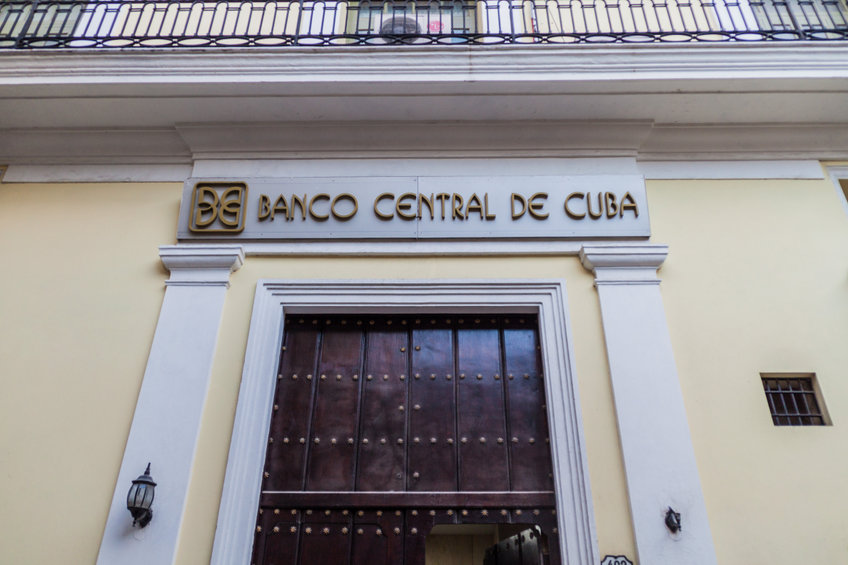
The Central Bank of Cuba (BCC) has announced that it will provide licenses to both Cuban and international virtual asset service providers, including organizations, individuals, or legal persons. This Spanish-language resolution was also published on Cuba’s official gazette.

However, the authorized licenses will be valid for one year upon which it might be extended for the second year.

The resolution noted that the providers will be able to work with only BCC-approved virtual assets.

‘’virtual assets do not contain digital representations of fiat currency, securities, and other financial assets extensively employed in traditional banking and financial systems, which other Central Bank of Cuba laws control.”

On Thursday, BCC recapped that the previous resolution enabled the bank to issue the licenses to the providers for the transaction of assets linked to exchange, collection, financial, or payment activities both at the national level and beyond.

Even though the government agencies would only use the virtual assets for transactions if only BCC permits them, the current resolution did not address the issue of how the Cuban government will tax the transaction of virtual assets.

However, the government stated that BCC will deny or grant the sought license within ninety working days after conferring with the Crypto Assets Group licensing.

Besides, the providers will only operate under BCC approval, The ministry of finance and prices approved by the Cuban Financial Reporting Standards will also require them to keep their accounting records on how they will be operating.

The post Cuban Central Bank to license Virtual Asset Providers appeared first on Coin Journal.

Brazil lawmakers pass bill seeking to regulate cryptocurrencies

Brazil’s senate passed the crypto bill on Tuesday, while the Central African Republic also took a similar step last week.

Brazil has become the latest country to pass a bill seeking the regulation of cryptocurrencies, joining a growing number of countries across the globe seeking to bring cryptocurrencies into financial regulatory frameworks.

The Senate reportedly passed the bill on Tuesday.

A crypto regulatory framework

The bill outlines the creation of a regulatory framework tailored for the crypto industry, with the government’s executive arm tasked with legislation.

The government also has the responsibility of constituting a new regulator for the crypto sector. If not, the bill provides for either the Securities and Exchange Commission or the central bank to be mandated to regulate it.

In attempts to attract crypto-focused businesses to the country, legislators included provisions that remove import levies on Bitcoin miners.

The bill now heads to the Chamber of Deputies, who, if they pass it, will send it to the president for accenting into law. This should happen before the end of 2022.

Central African Republic also eyeing crypto regulation

News of Brazil’s lawmakers passing a crypto bill on Wednesday comes a few days after it emerged their counterparts in the Central African Republic had also taken a similar step.

While the initial headlines had talked of CAR adopting Bitcoin as legal tender, the truth was that lawmakers had passed a bill seeking the creation of a regulatory framework on cryptocurrencies.

On Wednesday, a BNN Bloomberg report quoted the country’s Finance Minister Herve Ndoba as confirming the move. In comments made via a phone interview, Ndoba said the legislation seeks to make cryptocurrencies legal in the financial system.

But while the law would make use of crypto legal in the country, the Central African Republic wasn’t looking to make Bitcoin or any other cryptocurrency legal tender as El Salvador did.

El Salvador, whose President Nayib Bukele is a big Bitcoin proponent, remains the first and only country so far to adopt Bitcoin as legal tender.

The post Brazil lawmakers pass bill seeking to regulate cryptocurrencies appeared first on Coin Journal.

Should I Buy Gala? 3 Things To Consider

Gala Games Logo

The gaming industry has seen strong growth in the past few years. The industry is widely dominated by large companies like Microsoft and Take-Two Interactive. These firms generate billions of dollars every year through game purchases, subscriptions, and micro-transaction. Gala Games is a blockchain project that seeks to disrupt the gaming sector. In this article, we will look at the top thing to consider when buying the GALA token.

Gala Games is a decentralized gaming platform

Most games that are currently being played are centralized in nature. This means that the developers make all the decisions and all the money. They are also profit-oriented, meaning that their motivation is to make as much money as possible. As a result, most gamers hate their game providers. For example, EA Sports, the owner of the FIFA franchise is one of the most hated companies in the world.

Therefore Gala Games hopes to change this by creating a platform where developers build their games and let people play them mostly for free. The network is owned by its members who hold the GALA token. There are two main ways of buying the GALA token. First, one can buy it from a centralized exchange like Coinbase and Binance. Alternatively, you can own and run a node. By being a node operator, you will receive daily distributions from the network.

Gala Games users have already developed popular games. Some of the top games in the platform are Spider Tanks, The Walking Dead, Legends Reborn, Town Star, and Mirandus among others. Developers are continually building more games in the ecosystem.

The GALA coin is both used for governance in the Gala ecosystem and for making purchases in the ecosystem. It has a market cap of over $1.2 billion, making it the fourth-biggest gaming coin in the world after Axie Infinity,  Decentraland and Sandbox

Play-to-earn gaming is growing

Another thing you need to know is that the play-to-earn gaming industry is a large one and is growing rapidly. Analysts believe that the industry is actually in its infancy and that more developers and users will embrace the industry. This explains why cryptocurrencies like Axie Infinity, Decentraland, and Sandbox have achieved billions in valuations. 

A recent study estimated that the industry will be worth over $250 billion in 2024. That is a strong figure for an industry that was barely in its infancy a few months.

Gala is a leading player in NFTs

Finally, the Gala has become a leading player in the non-fungible token (NFT) industry. The idea behind this is a bit simple. Using its platform, people can mint their own NFTs and then sell them in their marketplace. Most of the NFTs in the ecosystem are of the existing games like TownStar and the Walking Dead. Transactions in this ecosystem are handled using the Gala token.

In 2022, the Gala Games platform will reduce some of the challenges in the ecosystem by launching its own product which is known as Gala Chain. The chain will become an integral part of the ecosystem by reducing the overall cost that people pay in the network. It will also make it easy for people to build their own games in the ecosystem.

Is Gala a good investment?

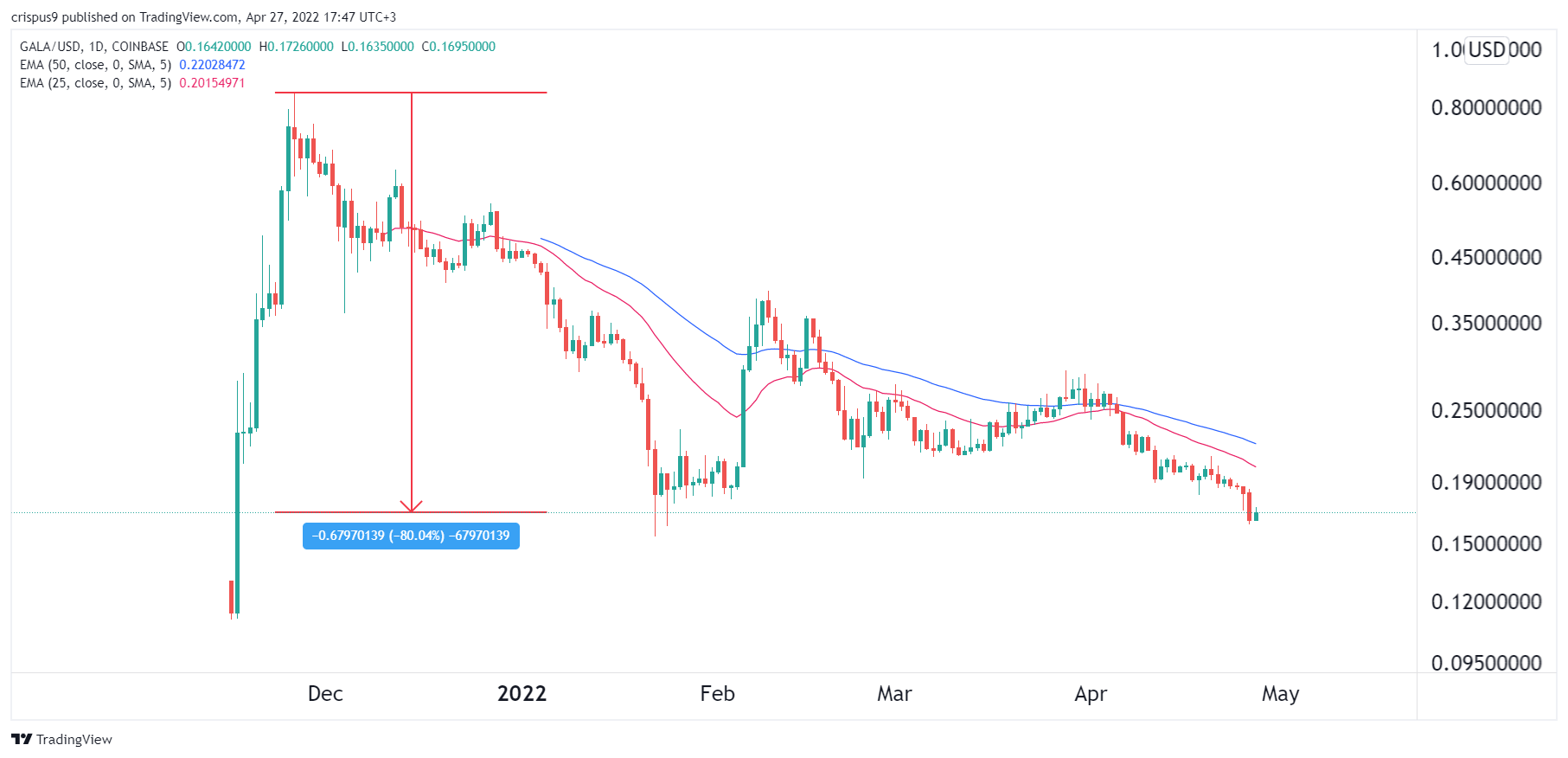
The Gala coin has been a bad investment in the past few months. Its price has dropped by over 80% from its all-time high. This has happened even though its overall ecosystem has grown rapidly this year. This performance is in line with other gaming tokens like Decentraland and Sandbox. In my view, I expect that the GALA price will continue rising in the coming years as the ecosystem growth continues.

The post Should I Buy Gala? 3 Things To Consider appeared first on Coin Journal.