
Binance Coin (BNB) exposed to further risks as the coin falls sharply in broader crypto sell-off

Binance Coin (BNB) has seen some steep losses over the last few days. However, although the coin is following the trend in the broader market, these losses have exposed BNB to significant downside risk that could lead to further serious declines. Here are some facts:

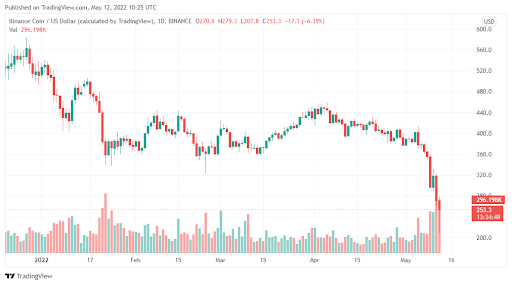
  • For most of 2022, BNB has found massive demand between $253 and $308

  • A 20% crash in the last 24 hours means that bulls have now lost that demand zone

  • If recovery doesn’t come soon, BNB will fall sharply again in the coming days
Data Source: Tradingview 

Where will BNB go next?

It was only recently that BNB was hovering well above $300. For most bulls, it was a time of consolidation, and there were hopes that the coin could stroll towards $400 in no time. But the crypto crash over the last few days has put so much pressure on BNB. The coin has lost 20% over the last 24 hours alone. 

But more importantly, BNB has also lost a crucial demand zone. You see, even with high volatility in the market, the coin was getting significant buyers between $308 and $253. The recent crash has pushed the price action outside this buy zone. 

Unless there is a recovery in the next 24 hours, BNB will come under selling pressure as bears take complete control. The coin will likely bottom at $222 or thereabout before any other bull run.

Are we seeing a serious BNB correction?

Losing nearly 40% in less than three days would be seen as a serious correction for any coin. But for BNB, the sharp fall has simply exposed it to further downside risk. For this reason, we don’t think the steep decline is over. 

In fact, based on sentiment in the market, it would be plausible to expect further BNB losses before the end of the week. We are therefore seeing a very serious correction with the coin.

The post Binance Coin (BNB) exposed to further risks as the coin falls sharply in broader crypto sell-off appeared first on Coin Journal.

Gala Games (GALA) crashes by nearly 40% after losing crucial support – Is recovery possible?

Gala Games Logo

Gala Games (GALA), one of the leading metaverse and blockchain gaming tokens, is currently in free fall. The coin follows the broader crypto market in decline, but its losses have been much worse than expected. Is there any chance of recovery? Here are the main facts:

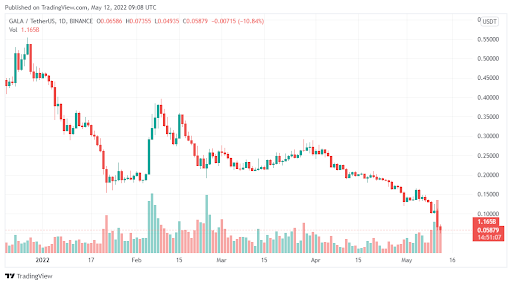
  • GALA has crashed by nearly 40% after losing its $0.07 support

  • The metaverse coin is essentially in free fall and could enter a bear market in the coming days

  • GALA is down nearly 65% from its monthly highs at the start of May

Data Source: Tradingview 

Can GALA recover after this bloodbath?

Recovery for GALA will of course come. But we do not see it happening anytime soon. Sentiment in the market is now very unpredictable. It appears many investors are cashing out on their crypto assets, with sustained losses hitting most coins. This is not a buyers’ market and as such, we expect GALA to drop further before any reversal. 

It will be very interesting though to see how the price action will play out once it dips below $0.05. After all, this has been a very psychologically important threshold for GALA bulls. At the moment, the metaverse coin is slightly above this price.

Based on trends in the market, it won’t be a surprise if it falls further. It is likely that the free-fall will continue before GALA bottoms at around $0.02.

How to profit from GALA right now?

This is not the best time to buy GALA. If you want to do it, it would be much better to wait for a week or thereabout. We expect the price to bottom way below $0.05. 

Once this happens, the coin will be trading at nearly a 100% discount from its May highs. That will be the most ideal dip to buy, especially if sentiment in the broader market improves.

The post Gala Games (GALA) crashes by nearly 40% after losing crucial support – Is recovery possible? appeared first on Coin Journal.

Dogecoin drops 15% after Anon Whales shift 250 million DOGE

Dogecoin (DOGE), the largest meme crypto, has dropped by more than 15% in the last 24 hours after Anon whales shifted 250 million DOGE with half of the amount going to Robinhood.

At the time of writing, DOGE was trading at $0.07903, down 15.51% after retracing from a daily high of $0.09932.

Half of the amount transferred to Robinhood

According to a tweet by @DogeWhaleAlert, an account that tracks big Dogecoin transfers, two transactions were carried out each exceeding 100 million, that is, 110,614,220, and 139,261,848 meme coins each worth $8,497,274 and $11,625,997 respectively. 

The second transaction of 139,261,848 Dogecoins was transferred to Robinhood, a popular US-based trading app that enables customers to invest in stocks and cryptos like Bitcoin, DOGE, Ethereum, Bitcoin Cash, Shiba Inu, Solana, and other popular coins.

Earlier this year, the service also started allowing customers to use local crypto wallets to deposit, store and withdraw digital currencies.

Yesterday, U.Today reported that Robinhood held 40,998,170,618 DOGE (worth $4,390,002,113) for its clients, which is approximately 30.90% of the DOGE circulating supply.

Recent DOGE activities

Following Terra UST dollar peg loss and the downtrend of Bitcoin, Dogecoin has also been trading sideways.

Currently, DOGE is 89.29% down from the all-time it had set last year, May 8, when it rallied to $0.7376 after Elon Musk, Tesla CEO and owner of SpaceX, called himself “The Dogefather” on Twitter and then debuted on Saturday Night Live (SNL).

However, Musk’s appearance on American TV resulted in a massive DOGE selloff but after three days dropped to $0.45.

The Tesla boss has been a major fan of DOGE and he has been mentioning the token a couple of times on his Twitter posts causing the token price to rally. However, as time went by his tweets’ effect started dimming and sometimes caused a short-term rally in the token price.

In January this year, Tesla Company started accepting Dogecoin payments for the selected merchandise in its online shops. But Musk commented on the move by saying that this was just an experiment and that he will see how it will go.

The post Dogecoin drops 15% after Anon Whales shift 250 million DOGE appeared first on Coin Journal.

Sam Bankman-Fried explains why UST crash was ‘predictable’

Sam Bankman-Fried, entrepreneur, founder and CEO of FTX crypto exchange, tweeted that the crash of Terra’s UST and LUNA was ‘predictable’, generating a Twitter thread that has since gone viral. He said:  

A good point someone brought up recently: ‘Stablecoin’ is used to mean multiple different things. Just as the outside view skeptics predicted, during a large market move a stablecoin blew out.  Just not the stablecoin they predicted. Which was predictable, if you knew the details. This isn’t a comment about good vs bad–it’s about how important it is to know the details! 

SBF’s take on algorithmic stablecoins before the crash

In a Bloomberg interview with Joe Weisenthal, co-host of the Odd Lots podcast, SBF was asked about his take on the rise of algorithmic, partially-backed stablecoins. Weisenthal inquired:

One of the most interesting phenomenon happening right now is the rise of Luna and UST. Luna has this Treasury Reserve consisting of a lot of Bitcoin, which seems a little dicey, but some people say any idea of an algorithmically-backed stablecoin is a perpetual motion machine – it’s only a matter of time before it fails. Do you believe there can be a truly decentralized stablecoin? What do you make of these projects?

SBF: 

I do have some sympathy to the perpetual motion machine crowd here. They can serve some useful purposes, but if you do zoom out, right, and you say, this is a stablecoin, backed by volatile assets, what’s gonna happen in a big market move. Right? Like, you know how this plays out.

The screenshot of this exchange, posted on Twitter, attracted all kinds of comments. Here is one seemingly reasonable suggestion:  

Has someone thought of minting a decentralized stablecoin backed by a basket of tokens tied to commodities and securities? If it were done right, it might be less volatile than a stablecoin backed by Bitcoin.

The post Sam Bankman-Fried explains why UST crash was ‘predictable’ appeared first on Coin Journal.

Tether to move over 1 billion USDT assets from Tron to Ethereum and Avalanche

After Terra’s UST stablecoin meltdown, there seems to be a storm within the stablecoin space with a second stablecoin and one of the most popular stablecoin, Tether (USDT) also losing its dollar peg. Following the recent developments, Tether has announced via a tweet that it shall coordinate a chain swap to move its USDT assets from the Tron blockchain to Ethereum and Avalanche blockchains.

In the announcement, Tether says that it plans to move one billion USDT assets from Tron to Ethereum and 20 million USDT assets from Tron to Avalanche. This will however not affect the total supply of the USDT stablecoins.

The announcement has come at a time when there is heightened fear arising from the recent TerraUSD stablecoin meltdown that has taken Terra (LUNA) coin down with it. Today, the price of USDT has shown some price fluctuations that have caused the stablecoin to even slip below $0.99 on many crypto exchanges.

USDT is the most traded stablecoin and investors are worried when it starts showing signs of struggle.

USDT is not like algorithmic stablecoins such as UST

In an interview, Tether’s CTO, Paolo Ardoino assured traders that the USDT stablecoin is not similar to algorithmic stablecoins like UST. He said:

“Tether has a Strong, conservative, and liquid portfolio that consists of cash & cash equivalents.” This includes treasury bills, money market funds, and commercial paper holdings.

Tether’s portfolio includes treasury bills, commercial paper holdings, and money market funds.

Ardoino also pointed out that while some are scared of the current stables hiccup, some traders are utilizing the opportunity by for example purchasing USDT below $1 and exchanging it for above $1 on Bitfinex and Tether’s official website.

The post Tether to move over 1 billion USDT assets from Tron to Ethereum and Avalanche appeared first on Coin Journal.