IDEX is exploding, up 56% in 24 hours: here’s where to buy IDEX

IDEX is soaring due to limited coin supply among other reasons. It ranked first in a chart released by the prominent Hoo Exchange on May 17 with a growth rate of 66.87%. 

The pledger uses the IDEX token and runs Idexd pledge software to operate the node. Pledgers earn 50% of the transaction fees charged by the network as a reward for their work. 

If you are attracted to unique features and want to learn how and where to buy IDEX, this guide is for you. 

Top places to buy IDEX now

Coinbase

Coinbase is one of the first places that made it easy to buy bitcoin and has since become a widely trusted exchange in the market.

Buy IDEX with Coinbase today

Swapzone

Swapzone is a crypto exchange aggregator that operates as a gateway between the cryptocurrency community and exchange services. Swapzone aims to provide a convenient interface, safe user flow, and crystal-clear data for users to find the best exchange rates among the whole cryptocurrency market.

Buy IDEX with Swapzone today

What is IDEX?

Idex is the first hybrid liquidity DEX that combines an order book model with an automated market maker. It blends the performance and features of a traditional order book model with the security and liquidity of an AMM. 

Idex takes an innovative approach to decentralized exchanges by combining an off-chain trading engine with on-chain trade settlement. 

This approach does away with failed trades and wasted money on gas fees, making the trading experience more pleasant and efficient. 

The instant trade execution prevents front-running or sandwich attacks and users can trade without waiting for previous trades to settle. More advanced order types and trading strategies can be executed since limit orders are possible. 

Should I buy IDEX today?

Considering how hard it is to come up with an accurate cryptocurrency prediction, you should never make any decisions affecting your finances before an in-depth market analysis. Don’t invest more than you can afford to lose. 

IDEX price prediction

IDEX broke $0.1 today, but will it continue to surge? Wallet Investor definitely thinks so. They predict it will be worth $0.63 in 5 years. 

An investment in this time will generate revenue of around +525%. If you invest $100 in it now, you could have $625 in 2027.

IDEX on social media

The post IDEX is exploding, up 56% in 24 hours: here’s where to buy IDEX appeared first on Coin Journal.


LimeWire inks major deal with Universal Music Group for music-based NFTs

LimeWire, the new NFTs marketplace that sprung from the discontinued popular music app of the early 2000s, has scored a huge deal with Universal Music Group (UMG).

The partnership with UMG, a world leader in the booming music and entertainment sector, adds to LimeWire’s steady return into the limelight.

Per a press announcement released on Tuesday, the deal with Universal Music allows the firm to offer its digital collectibles marketplace to several iconic record labels and revered artists.

UMG to license artists to LimeWire’s NFT marketplace

Labels that could tap into the LimeWire NFT marketplace to increase fan engagement via digital music NFTs and a Web3 experience include Interscope Records, Virgin Music, Republic Records, Def Jam Recordings, EMI, Capitol Records, and Motown Records.

Paul and Julian Zehetmayr, LimeWire co-CEOs, commenting on the collaboration, said that the partnership was a “true demonstration of the pace at which the music industry is embracing Web3.” 

“We’re thrilled to open up the LimeWire NFT ecosystem to Universal Music Group artists and fans and can’t wait to see the first creative projects being launched on the marketplace,” they added.

Going forward, the partnership will allow for access to the licenses the marketplace needs to partner with artists signed up with UMG, with the collaboration translating to original music-based NFT projects.

The NFT space continues to grow as mainstream players, including governments, embrace the technology that allows for the creation and securing of digital items on the blockchain.

Monetization opportunities mean the industry is a perfect fit for artists and others looking to revamp their revenue streams. LimeWire will provide that to the UMG artists.

The post LimeWire inks major deal with Universal Music Group for music-based NFTs appeared first on Coin Journal.
Bitcoin bottom not in yet, according to on-chain analysis

On-chain analysis is fascinating to me. Exclusive to the blockchain, it doesn’t exist outside of crypto. But in jumping on-chain, we can often get intriguing insights into market sentiment, and specific indicators have even been predictive of future price action.  

Of course, given Bitcoin’s short history of just over a decade, it’s not yet clear which indicators are merely coincidences and which carry actual value. But that’s part of the fun, no?

Percentage of Supply in Profit

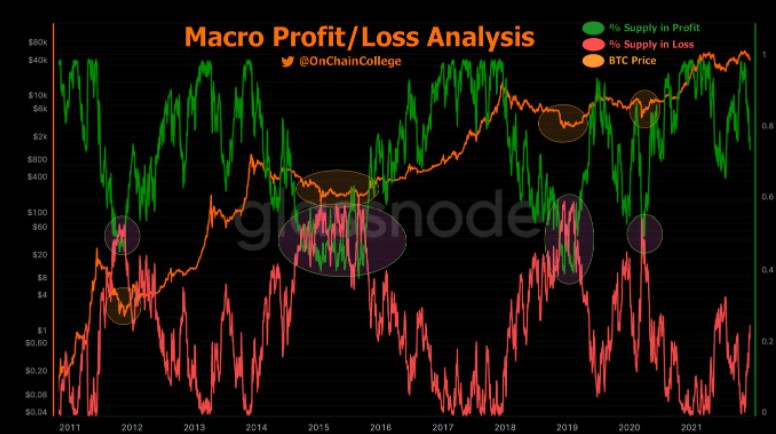
I came across an exciting indicator this week on Twitter, compiled by @OnChainCollege, who is a great follow if you’re into on-chain analysis. He looks at the percentage of Bitcoin supply in profit to gauge how overheated (or cooled off) the market is. Historically, this has signalled the start and end of the bear markets quite well for Bitcoin.

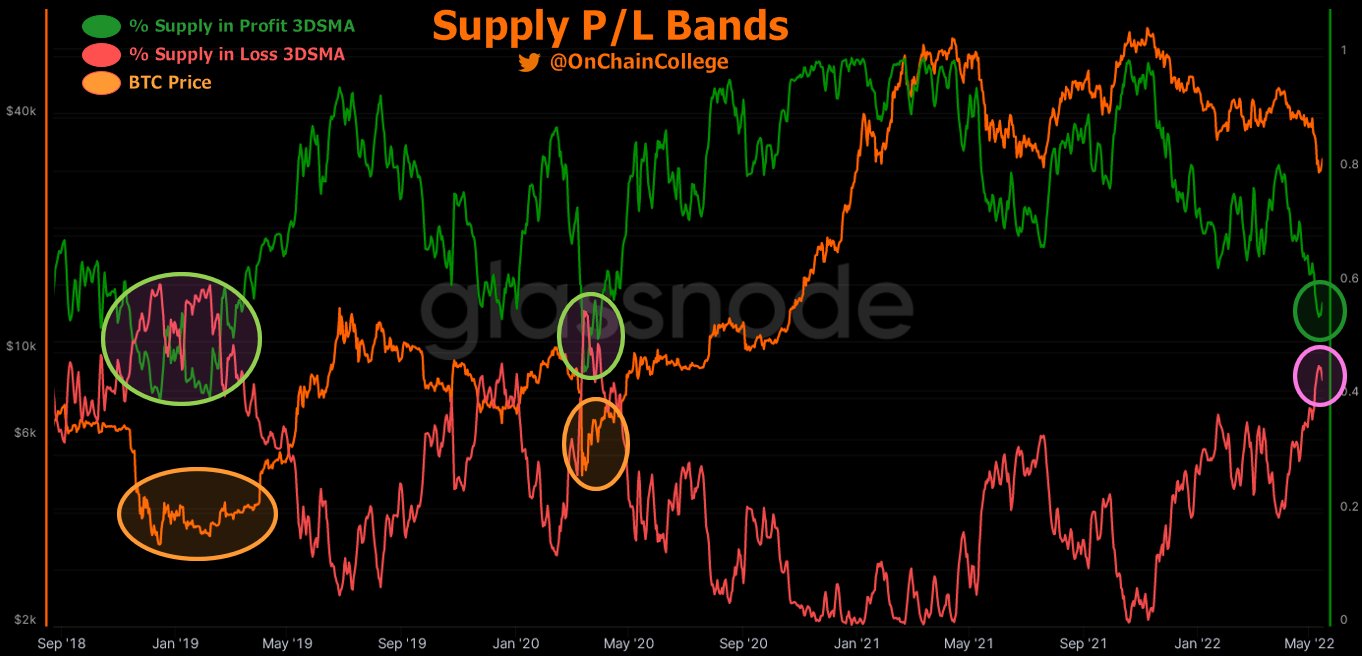
And these bands are very close to crossing at the moment.

To explain what the metric is, for those unaware, the percentage of supply in profit refers to the percentage of existing bitcoins where the current price is higher than the price at which those bitcoins were purchased. When the percentage of supply in profit rises above 50%, this is a top signal. When the percentage drops below 50%, this is a bottom signal. Or so the theory goes.

The graph below shows this, going back to 2011. Note that @OnChainCollege graphed it by placing the percentage of supply in loss (red) on the chart too, as well as the percentage of supply in profit (green). These two lines crossing would be the indicator.

Historical Accuracy

As you can see, this has crossed only four times previously. The most recent was March 2020, when the onset of COVID rattled the markets. In my view, this was the scariest time in crypto history – a true existential event (to be honest, it felt like it was an existential crisis for the world as a whole).

To play devil’s advocate, you could probably write this instance off as a black swan event, and overlook the impressive bounce that followed the crossover here – fine. But in looking at the other cases, the prediction ability holds in all three cases: 2019, 2014 and 2011.  

That’s all well and good. But what is the market saying now? Well, the percentage of supply in loss has not crossed the percentage in profit – yet. If the pattern holds, that means there may still be more pain to give before the bottom is in.

Caveats to On-Chain Analysis

Obviously, any on-chain analysis comes with the caveat that not only is the sample space small, but the data may be non-structural, with material changes to the landscape. Today, we are seeing rampant inflation, a hawkish Fed and a scary geopolitical climate. This has triggered the worst start to a year for stocks since 1939.

These macro headwinds mean that, for the first time in Bitcoin’s history, it is swimming upstream against serious and consistent bearish sentiment – April was the worst month for stocks since October 2008. Additionally, Bitcoin has almost nothing in common today with the niche Internet money it was back in 2011, or even 2014. Today, it takes its place amid bonafide asset classes, with institutional money pouring in and a seat at the macro table.

All this means that there is far from a guarantee that history repeats itself here, should these bands cross again. Nonetheless, it’s a fascinating trend to keep an eye on and a neat use of on-chain analysis from an analyst who is a personal favourite of mine. It will be fun to track going forward.

The post Bitcoin bottom not in yet, according to on-chain analysis appeared first on Coin Journal.

China returns as second-largest Bitcoin mining hub: report

Bitcoin mining has picked up again in China, a new report suggests.

According to a study by Cambridge University, Bitcoin mining activity in China has slowly surged to currently account for 21% of the total global hashrate.

The report released on Tuesday comes nearly a year after a massive Chinese crackdown on crypto mining and trading drove miners out of the country. As the exodus of miners found its way into the US and other countries, the overall hashrate securing the Bitcoin network from within China fell dramatically.

Per the report, miners have launched “covert mining operations”, the result of which is the uptick in the hashrate from virtually zero to nearly a quarter of global output.

“In China, following a sudden uptick in covert mining operations after the June 2021 government-mandated ban on Bitcoin mining, the country has re-emerged as a major mining hub,” the Cambridge Centre for Alternative Finance (CCAF) noted in its research report.

But while there’s a re-emergence of activity in the Chinese market, bringing it to second globally, the majority of computational power currently securing the Bitcoin network is in the United States.

Cheap electricity and favorable outlook across several jurisdictions mean 40% of hashrate is from US-based miners, a scenario likely to see the US top remain top of the list.

China’s 21.11% of global hashrate puts it ahead of Kazakhstan which accounts for 13.22%, Canada with 6.48%, and Russia with 4.66%.

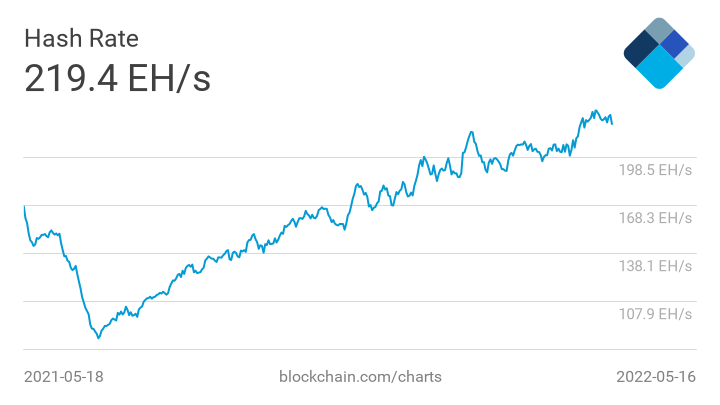
According to data from Blockchain.com, the Bitcoin hashrate has steadily risen since the lows reached in early July 2021. The 7-day average chart shows the total network hashrate stands at 219.4 EH/s (exahashes per second).

Bitcoin currently trades around $30,030 as bulls continue to battle massive bearish pressure. 

The post China returns as second-largest Bitcoin mining hub: report appeared first on Coin Journal.

Tron price prediction: USDD concerns remain

The Tron price has been a bit volatile in the past few days as worries about its newly launched USDD stablecoin that has a close resemblance to Terra USD. The coin is trading at $0.069, which is about 25% below the highest level last week. Its total market cap has declined to about $6.82 billion.

USDD concerns remain

The biggest story in the cryptocurrency this month was the collapse of Terra USD, the third-biggest stablecoin in the world. At its peak, it was the third-biggest stablecoin in the world after Tether and USD Coin.

Another big story was the launch of USDD Coin by Tron. USDD is a stablecoin that closely resembled Tron USD in that it is not backed by US dollars. Instead, it is an algorithmic stablecoin that automatically rebalances when it moves below or above $1. 

USDD has been one of the most successful stablecoin launches ever. In less than three weeks, its total market cap has jumped to over $310 million. This makes it one of the biggest stablecoins in the world and the 147th biggest coin globally.

Read more on how to buy Terra Luna.

The TRX price has declined because of worries of the USDD stablecoin. With algorithmic stablecoins like DEI, Neutrino, and Terra USD losing their peg, there are concerns that USDD also could do the same. For now, however, the coin’s peg has held relatively well and has ranged between $0.998 and $1.01.

Tron price has also declined because of the weak performance of its DeFi platform. Like all platforms, its total value locked has crashed hard in the past few days. It has dropped slightly to about $4.2 billion, making it the 4th biggest chains in the world.

Tron price prediction

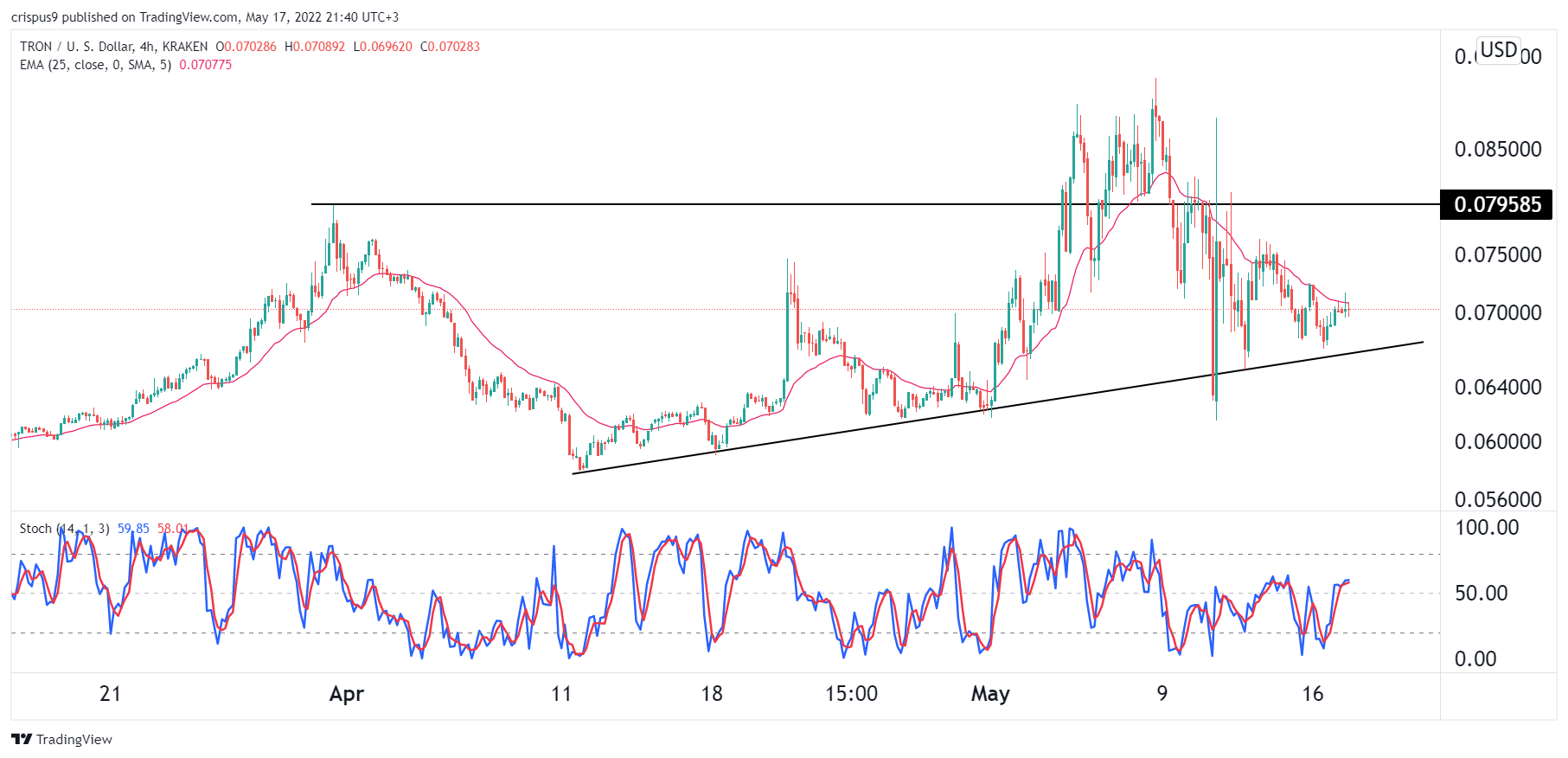
Turning to the four-hour chart, the TRX price jumped to a high of $0.092 as demand for the USDD coin rose. In the past few sessions, however, the coin has retreated sharply and moved below the 25-day and 50-day moving averages. The coin remains above the ascending trendline that is shown in black.

Tron’s Stochastic Oscillator has moved slightly above the neutral level at 50. Therefore, the outlook for the Tron price is a bit bearish, with the next key support level being at $0.065. A move above the resistance at $0.0072 will invalidate the bearish view.

The post Tron price prediction: USDD concerns remain appeared first on Coin Journal.