Jasmy Coin price prediction: Will ‘Japan’s Bitcoin’ Recover?

The Jasmy Coin price has lost its momentum in the past few weeks as concerns in the cryptocurrency industry continue. The token is trading at $0.01120, which is about 96% below its all-time high. Its performance has mirrored that of other large and small cryptocurrencies like Bitcoin and Dogecoin.

Jasmy loses momentum

Jasmy Coin is a relatively small blockchain project that was started by former senior executives at Sony, one of the biggest firms globally. It is popularly known as Japan’s Bitcoin.

Jasmy describes itself as a platform in the Internet of Things (IoT) space. Precisely, it helps companies and individuals manage their data well. The developers also hope to become leading players in the metaverse industry. They recently launched their metaverse fund that will fund developers in the space. 

Jasmy is still in its early days and has managed to make partnerships with some of the biggest companies in Japan. 

There are several reasons why the JASMY price has dropped sharply in the past few months. First, as you have seen in the crypto market, this decline has been across the board. This means that all coins, including giants like Bitcoin and Ethereum have all declined sharply. Historically, cryptocurrencies tend to be highly correlated.

Second, being a small coin that is not offered broadly, Jasmy has suffered because of liquidity challenges. In other words, people are afraid of buying the coin because they are unsure about its future. 

Further, there have been rising worries about monetary policy globally. The Ged has become one of the most hawkish central banks globally. Its officials have already committed to accelerating interest rate hikes in the coming months. Quantitative tightening is also on the table. Historically, risky assets like Jasmy coin tend to underperform in a period when the Fed is hiking interest rates.

Jasmy Coin price prediction

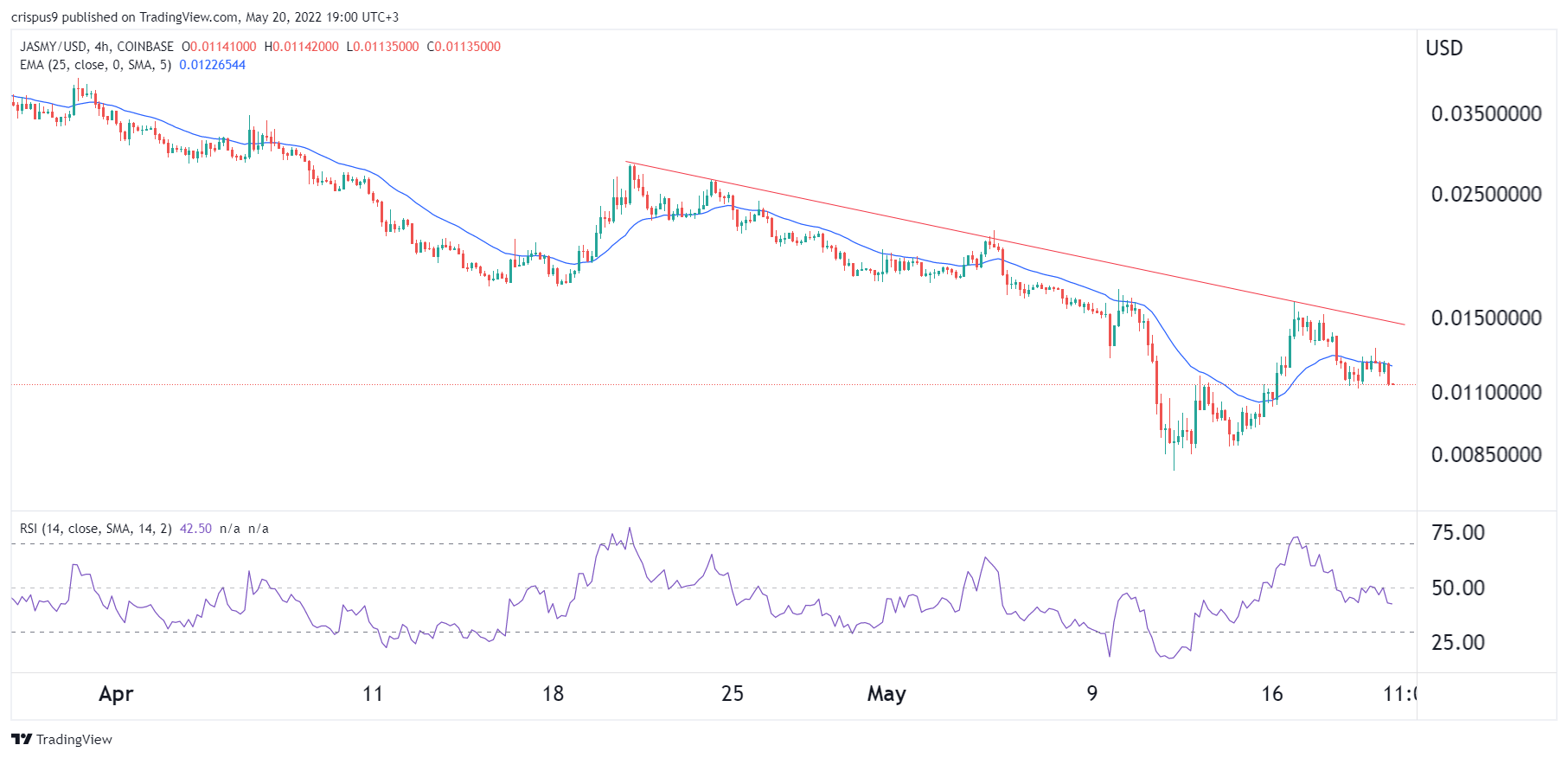
The four-hour chart shows that the Jasmy Coin price has been crawling back after falling to a record low last week. At the time, the coin fell to $0.0080. It then bounced back and reached a high of $0.015. The coin has remained below the declining trendline that is shown in red. It is also oscillating along the 25-period and 15-period moving averages. 

Therefore, the outlook for the Jasmy Coin is bearish as long as it is below the descending trendline. A move above this weeks high of $0.015 will signal that bulls have prevailed and will push it to $0.020.

The post Jasmy Coin price prediction: Will ‘Japan’s Bitcoin’ Recover? appeared first on Coin Journal.

Here is why Kyber Network Crystal is up by 24% today

The cryptocurrency market will end the week on a positive note after adding more than 2% to its value in the last 24 hours.

The broader crypto market has added more than 2% in the last 24 hours. At press time, the total cryptocurrency market cap stands above $1.26 trillion.

Bitcoin is trading above $30k again after spending the majority of this week below this threshold. Ether, the world’s second-largest cryptocurrency by market cap, is trading at $2,000 again after adding more than 2% over the past few hours.

KNC, the native token of the Kyber Network Crystal, is the best performer amongst the top 100 cryptocurrencies by market cap. Over the last 24 hours, KNC has added more than 24% to its value.

The primary catalyst behind this ongoing rally is the launch of the KyberSwap referral campaign. The Kyber Network team announced via Twitter on Friday that it would be giving away $2,000 in KNC tokens to the lucky winners.

The team said ten random lucky winners would walk away with $200 in $KNC rewards.

Key levels to watch

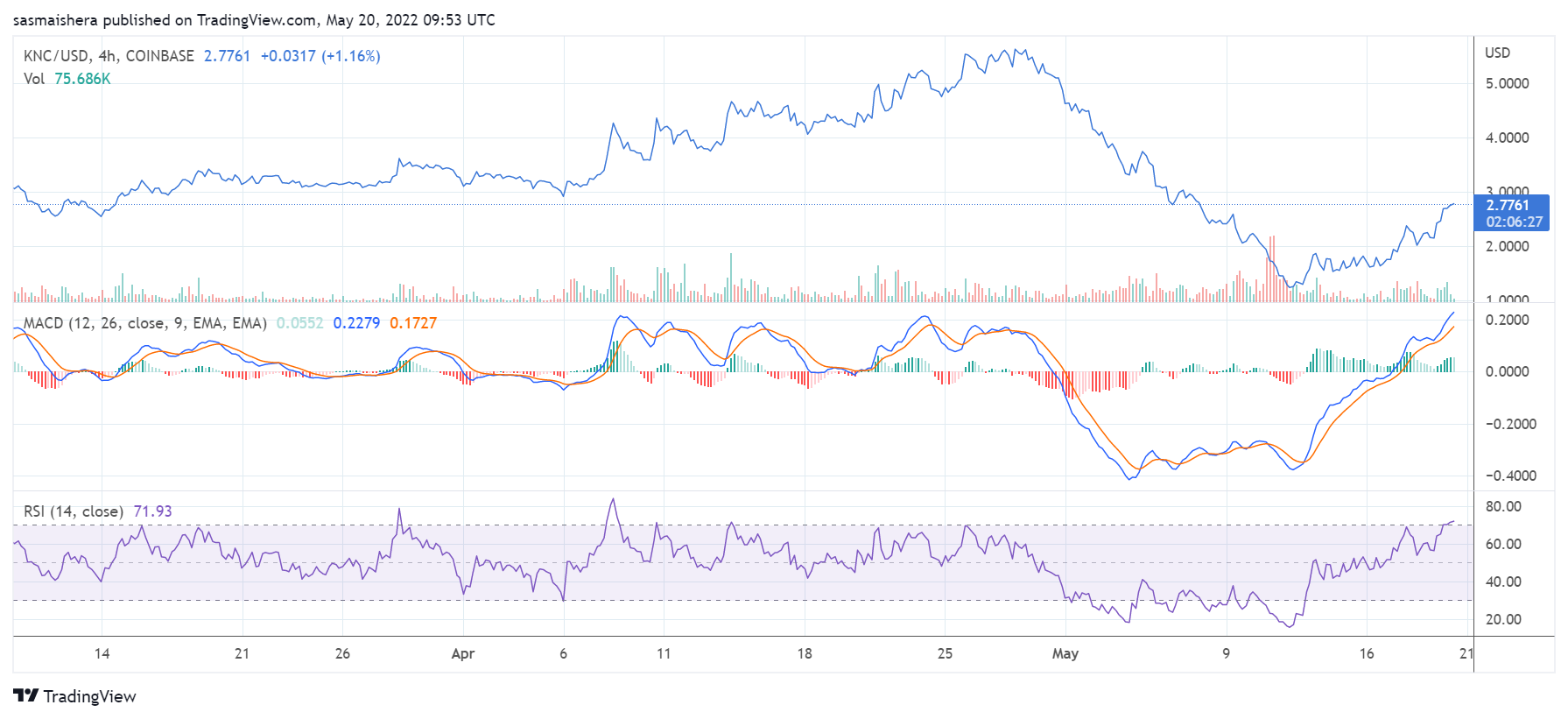
The KNC/USD 4-hour chart is currently the most bullish amongst the top 100 cryptocurrencies by market cap. The technical indicators show that the coin has outperformed many other coins today.

The MACD line is above the neutral zone, indicating a positive momentum. The 14-day relative strength index of 71 shows that KNC could soon enter the overbought region.

At press time, KNC is trading at $2.779 per coin. If the rally continues, KNC could surge past the first major resistance level at $3.13 before the end of the day. In the event of extended positive performance, KNC could trade above the $3.5 resistance level for the first time in three weeks. 

The post Here is why Kyber Network Crystal is up by 24% today appeared first on Coin Journal.

Highlights May 20: Major cryptos in the green, KNC outperforms the rest

The crypto market as a whole is bullish with most top 100 coins in the green at the time of writing. 

Top cryptos

Bitcoin didn’t have much to be happy about on Thursday. The largest cryptocurrency was fighting to remain above $30,000, way below where it was trading less than a month ago.

The flagship cryptocurrency is doing well today, as are other major altcoins. It was recently changing hands at around $30,200, up almost 4% over the past 24 hours. The increase is mirrored by Ethereum, which rose a little more than 3.5% today.

Most other cryptos registered gains as buyers continue to opt for market cap leaders over smaller, riskier ones. Solana, XRP, Cardano, and Polygon have all registered gains. 

Top movers

Outside the top 20, the tendency was similarly bullish, with most coins adding 3-8% to their value. Notable standouts include Cosmos and Kadena, both up 12%, the latter reversing recent losses.

Cosmos just announced a $GNOT airdrop for holders or stakers of its native token ATOM. GNOT is the native coin of GNO Land, a platform for interoperable concurrent smart contracts that scale.

In what looks like market support for privacy coins, Monero and zCash have each added 11% to their value. 

Zilliqa is rallying, up 10% and counting after making an important announcement yesterday. The ecosystem launched a Web3 Alliance, which will identify promising cross-vertical projects and arrange introductions that lead to an investment.

Kyber Network Crystal‘s KNC token is easily the biggest winner of the day and the week with gains of 27% resp. 78%. It announced an exciting giveaway today and enjoys the overall trust of investors. 

On the losing side, Curve DAO Token and Convex Finance both dropped, by 11% resp. 4%. Convex Finance is a DeFi protocol that allows Curve liquidity providers to earn a share of trading fees on Curve without staking liquidity there. 

TerraUSD’s losses are tapering off. Today, it’s only down by 7%. Its losses for the week stood at 49% at the time of writing.   

Trending

The biggest winner today is Neko Coin (NEKOS), a community-focused, decentralized cryptocurrency with instant rewards for holders. All fees go back into the ecosystem. 

Neko Coin focuses on supporting charities to help stray cats find shelter and care. The token has gained 1,950% today.  

The post Highlights May 20: Major cryptos in the green, KNC outperforms the rest appeared first on Coin Journal.

NFT traders increasingly flocking to Solana

  • Solana NFTs saw $295 million in volume during April
  • Integration with OpenSea has boosted entire ecosystem
  • Near-zero gas fees and low barriers to entry mean new NFT traders increasingly flocking to Solana
  • Not Okay Bears derivative on Ethereum highlights how far Solana has come


NFTs exploded onto the scene in 2021, with $17 billion in sales throughout the year. So far this year, despite the extreme risk-off environment with assets red across the board, this report from Chainalysis shows that volume in the NFT space is stabilising.

With every long-term indicator pointing towards longevity in the space, I thought it would be interesting to assess where these sales are taking place, and whether Ethereum still remains king.

One trend jumped out pretty swiftly – the growth of Solana.

OpenSea

In the short history of NFTs, the vast majority of volume has occurred on Ethereum, mostly on OpenSea, the marketplace built originally for Ethereum. That is beginning to change, however. OpenSea recently integrated with Solana, a watershed moment for Solana NFT collections that to date had been limited to marketplaces exclusively for Solana collections, such as Magic Eden and Solanart.

In another poignant moment, a derivative collection called Not Okay Bears was removed yesterday from OpenSea, after complaints from Okay Bears collectors. Traditionally, it has been the other way around – knock-off collections launching on Solana, but a high-profile imitation on Ethereum feels like a seminal moment for Solana.  

Sticking with Okay Bears, they are currently the hottest collection on Solana, trading at a floor price of 222 SOL ($11,500) and with a stout volume of 1.5 million SOL ($77 million) over the last month – and that’s on Magic Eden alone. On OpenSea, they have done almost an identical amount of volume in the last month, placing seventh on the leaderboard – with only six collections from Ethereum above them.

Okay Bears floor price and volume (in SOL) has been on an upward trend all month

Bored Ape Solana Club

Staying within the sphere of derivatives, another poignant case is that of Bored Ape Solana Club (BASC)– the Solana version of Bored Ape Yacht Club (BAYC) on Ethereum. This is different from the Not Okay Bears situation in that the derivative collection here is more of a homage than a knock-off. BASC even became verified on OpenSea, seeing volume and floor price rocket shortly afterwards.

Last month, following the chaos of the Otherside launch from Yuga Labs, the creator of BAYC, I wrote here about how exclusive the Ethereum NFT world had become. It felt like a Bored Ape 1% Club, as sky-high prices and onerous gas fees priced ordinary investors out from getting involved.

The concentration of wealth in the NFT space was getting worryingly high, while the centralisation of the space was a real concern – Yuga Labs have the top three collections on OpenSea and also own the IP rights to CryptoPunks, not to mention their tweets last month that they want to start their own blockchain.  

Solana gives the ordinary investor access to the NFT world, tearing down barriers to entry with its basement-low gas fees and easy-to-use interface. For fun, I even bought the below Ape from the BASC to quell my dissatisfaction from the Yuga Lab fallout. The fees I paid were a fraction of a cent, and the entire process couldn’t have contrasted more with the ultra-exclusive BAYC counterparts on Ethereum.

 

Instagram and Coinbase

This week also brought the news that Meta-owned Instagram is to test a feature allowing users to display NFTs as their profile pictures. Meta confirmed that while the initial test launch is limited to Ethereum and Polygon, Solana is to be added at a later date. Coinbase also announced their intention to expand to Solana once their Ethereum NFT ecosystem is up and running.

Growth

This access for the little guy that Solana offers is starting to catch on. More and more new investors are choosing Solana rather than Ethereum for their first foray into NFTs, for the same reasons I went to Solana to purchase my above Ape. There were 9.2 million transactions on Magic Eden vs 1.67 million on OpenSea over the past month, according to this report.

It should be caveated, however, that this chasm in transactions is skewed largely due to bot activity. However, the growth trends are clear – Solana is expanding at a rapid pace, with floor prices of the main collections increasing over the last month, in contrast to what is happening on Ethereum.

Perhaps more accurate than transaction count is volume, and according to DappRadar, the Solana NFT market jumped 91% in April, with volume of $295 million. Looking back over the last 30 days from today, the meltdown has reduced the dollar volume, but the SOL volume is up significantly. Indeed, when considering the pullback in the wider market, the fact that volume over the last 30 days across the top 14 marketplaces is $274 million (at the current SOL price of $52) is an extremely bullish sign.

The below graph shows the bulk of this volume has been taking place on Magic Eden and OpenSea.

Conclusion

In conclusion, it’s been a massively bullish period for Solana NFTs. While the crypto market has been a bloodbath – and the Solana token has not been spared – the long-term trajectory for the ecosystem remains upward.

Ethereum quite simply cannot compete with the almost-zero barriers to entry that Solana offers to NFT investors. Flipping NFTs, playing around with different collections and buying on a whim is all possible on Solana, with fees a fraction of cent per transaction. This is simply not viable on ETH, exacerbated by the dominance of the top collections, which layer in huge prices on top of the onerous gas fees.

Then again, unless you’re spending a lot on a very expensive NFT, Ethereum is not feasible to use given you lose so much on gas – meaning it continues to solidify itself as a blockchain for the elites, when it comes to NFTs at least. For the ordinary investor looking to invest amounts that are very much in the non-life-changing numbers, then Solana simply makes more sense.

The market is starting to realise this.

The post NFT traders increasingly flocking to Solana appeared first on Coin Journal.

Ripple commits $100M towards scaling climate-focused innovation

Ripple has announced it has committed $100 million in funding towards blockchain innovation meant to scale carbon removal.

The funding, which will go into companies in carbon markets, is also earmarked for climate-focused fintech startups, Ripple said on Thursday.

According to the press release, the funds will also go into Ripple’s portfolio of programs targeted at helping it become net zero by 2030. Apart from that, Ripple will use the funds to support efforts in carbon credit tokenization as non-fungible tokens (NFTs).

This, the company noted, will occur on the XRP Ledger (XRPL), with blockchain technology helping to ensure the authenticity of carbon credit NFTs.

A ‘call to action’ on climate change

Brad Garlinghouse, the CEO of Ripple noted that the funding is the company’s “direct response to the global call to action” on climate change. He said that companies are being encouraged to deploy resources, and even talent as part of the global response to curbing emissions.

“While reducing emissions and transitioning to a low-carbon future are paramount, carbon markets are also an important tool for meeting climate goals. Blockchain and crypto can play a catalytic role in allowing carbon markets to reach their full potential, bringing more liquidity and traceability to a fragmented, complex market,” Garlinghouse added.

According to the Ripple chief, the $100 million commitment is one more step towards ensuring rising global temperatures are limited below 1.5 degrees Celsius.

Ripple has partnered with several companies within the carbon markets to help achieves its goals, including carbon mineralization firm CarbonCure Technologies, UN-backed tokenization startup Xange.com and carbon offsetting firm Invert.

The company is also collaborating with Energy Web Foundation, the Alliance for Innovative Regulation, and Rocky Mountain Institute. 

The post Ripple commits $100M towards scaling climate-focused innovation appeared first on Coin Journal.