It’s still rough out there, people.
When looking at crypto specifically, the nuke of UST and Luna sent panic through the crypto markets like never before. One of the most intriguing – and downright terrifying – effects of this meltdown was the de-pegging of Tether. I’ve been putting off a deep dive on Tether for a while because I feel it’s the cryptocurrency equivalent of “Happy” by Pharrell – overplayed so much I get a headache every time I hear it.
But last week’s events, when Tether got in on this de-pegging trend that is suddenly very popular with cryptocurrencies, persuaded me that it was about time to write up a deep dive.
De-Pegging
You know it’s a bad time in the markets when your Spellcheck is now accepting “de-pegging” as a word. But that’s what we got, as Tether dipped below 95 cents in the aftermath of the UST blow-up (May 12th). A tidal wave of selling was sparked by investors worrying that Tether did not have sufficient reserves to withstand a run-on-the-bank, following the collapse of Terra’s UST.
Thankfully for the ecosystem at large, the market stabilised and the price has rebounded. However, even as I write this 11 days later, the peg has not been fully restored, currently trading at $0.999. Last time I checked, that wasn’t equal to $1.
Were Tether to go under, it would undoubtedly cause mass contagion throughout the markets – it is still comfortably the highest liquidity pair in the market. And absolutely vital to so much of what happens in the space. Since the start of May, a staggering $10 billion in Tether has been redeemed. Looking at the constant growth of USDT’s market cap historically, it’s clear to see that this latest episode has spooked investors more than ever before.
If you ask me, Tether does have the reserves to back up its $73 billion market cap. But whether they do or not is only part of the issue – the crux of the problem is how this is even a question to begin with.
We’ve Seen this Movie Before
Akin to seeing the daily numbers of coronavirus cases on the news two years into the pandemic, I’m sick of talking about Tether and the reserve situation.
Beyond that, it’s harmful to the industry at large, and this is coming from somebody who was never among the Tether sceptics.
How difficult is it to simply clear all this up and publish frequent and coherent balance sheet updates? Tether currently does this once a quarter, but they fall well short of the standards that should be maintained for a $73 billion company.
The most recent report from March 31st outlines $82.425 billion in assets and $82.262 billion in liabilities. This implies equity of $162 million, or to use the more colloquial term in this context, overcollaterisation of $162 million. Fine – seems acceptable.
But now let’s do some maths. This $162 million constitutes 0.2% of the assets. So, if the assets decline by 0.2%, Tether is by definition undercollaterised. Not so fine – and unacceptable. An undercollaterised stablecoin, what could go wrong?
Constitution of Reserves
You may contest that all the assets are contained in commercial paper, T-Bills and other secure investments, but that’s not true. The same report outlines $5 billion in “other investments (including digital tokens)”. The $162 million of overcollaterisation that Tether currently has corresponds to 3.3% of this $5 billion amount. If you’re a cryptocurrency investor, you don’t need me to explain how volatile your friendly neighbourhood digital tokens can be. Can you imagine digital tokens falling 3.3% since March 31st and rendering Tether undercollaterised? I’m betting you can.
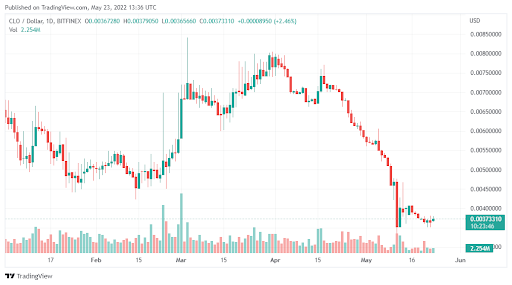
I dug into this report next, showing that Celsius tokens were one of Tether’s investments, at $62.8 million to be exact. Celsius Network is a lending platform, where depositors can earn additional yield on their assets (BTC, ETH etc) if they agree to earn their interest in Celsius tokens. How about we take a look at the Celsius token since October 2021, when Tether invested over $50 million into their Series B?
That’s a cool 87% decline. Ouch.
Again – the numbers for assets and liabilities above are from March 31st 2022. Since then, crypto has been heavily red, so who knows what the numbers are like now. But with Tether’s lack of transparency and balance sheet gymnastics, it’s not difficult to imagine the upcoming balance sheet update will paint the picture in a rosier light than what it actually is.
Accounting
Tether do claim that they recognise impairments but not gains on their balance sheet, and that this factors into the thin equity slice of $162 million above, which is therefore conservative. But that’s really difficult to verify with the lack of transparent reporting. Besides, you could also play devil’s advocate here and say that if the accounts record the lesser of cost or impaired value, that implies Tether have invested substantially more into these “other investments (including digital tokens)” than the $5 billion number currently on their “balance sheet”(inverted commas pointedly added there). And if they’re underwater here, who knows where that funding came from and what the health of the overall organisation is like?
Again, while the answers to these questions are vitally important, my main point of contention is that they require asking to begin with. Here I am digging through the balance sheet, pulling up various reports from months ago and trying to put together the pieces so I can see the entire jigsaw puzzle. But this is a $73 billion stablecoin central to the health of the cryptocurrency system. It simply should not be this opaque; the jigsaw should be clear for everybody to see.
Even if everything goes swimmingly and you have full confidence in these “balance sheet” reports, let us not forget that the company has a murky history. They originally claimed its reserves were backed one-to-one by the US dollar before the New York Attorney General’s investigation uncovered this as a lie. And I don’t use that word lightly. This is what caused them to change their rhetoric from “fully backed by the US dollar” to fully backed by “Tether reserves”. Additionally, these balance sheet updates are only published in the first place to satisfy the requirement, a fallout of that same investigation. Otherwise, we would be even more in the dark than we currently are.
The Benefits
All this takes me to why I believe the $10 billion in redemptions over the last month is a good thing. The smaller Tether becomes, the less its influence on the industry and the less the contagion effect would be in the doomsday scenario of a meltdown (I’m purely looking at hypotheticals here). The sooner the industry can move on from these tedious, repetitive and boring questions about Tether’s reserves, the better.
As I said, I don’t believe we are close to a collapse in USDT. I would never have considered myself a sceptic of Tether, akin to how a lot of people are constantly campaigning against it, and have been doing so for years. Yet, with recent admissions from the company as well as the really shoddy efforts on the balance sheet reporting, I am finding myself increasingly put off by USDT.
I avoid USDT whenever I can, in favour of more reputable stables. Because it comes down to simply question – why wouldn’t I? There is no inherent advantage to holding Tether aside from how ubiquitous it is, and other stables are now catching up. There is, however, enormous downside risk, however unlikely you believe that to be. And even if you don’t buy into the fact that it could all meltdown, a de-pegging like this month’s should be enough to persuade you to hold a more stable stablecoin (in writing that phrase, I am beginning to understand how some people make fun of cryptocurrency). Hopefully, the industry will do the same, because whether you are a believer or not, this repeated narrative that simply won’t go away is harmful to everyone involved.
Conclusion
This was an $83 billion stablecoin last month. Now it’s a $73 billion stablecoin. Hopefully, its popularity will continue to wane, and more reputable and transparent stables will gain market share organically. USDT has been a scourge on the industry for a while, which is why I smile when each dollar of USDT gets redeemed.
I’ll close off with the below quote from Tether CTO Paolo Ardoino, who had the following to say last week about Tether’s 100% record of honouring all these redemptions over the last month:
“This latest attestation further highlights that Tether is fully backed and that the composition of its reserves is strong, conservative, and liquid”.
But Paolo, is the fact that this statement needs to be made at all not indicative of the problem here? Tether was founded 8 years ago in 2014. It’s grown to a place where it is now worth $73 billion and powering a large part of the industry. And the CTO is still required to release statements arguing that redeeming 15% of the “fully backed” asset proves how safe it is?
That’s like me calling my Mum and saying, “Hey Mum, you’d be proud of me. I didn’t do heroin today!”. I’m really not sure it’s that great an achievement, no?
The post I’m sick of talking about Tether, but here’s an article about Tether appeared first on Coin Journal.




 Data Source: TradingView
 Data Source: TradingView