What’s happening with Waves’ rollercoaster 2022 price action?

Rollercoaster is a term frequently used in cryptocurrency. It’s certainly the first bit of vocabulary that comes to mind when looking at the Waves chart. The coin gained 240% in March 2022, yet has given back all those gains and more, and now trades 70% below where it opened on New Year’s Day.

It’s currently ranked 81st on CoinMarketCap. Back in 2017, it was in the top 20, before competitors such as Solana, Matic and Polkadot surged onto the scene.

So what’s going on here?

First, what is Waves?

A multi-purpose blockchain capable of supporting various decentralised applications and smart contracts, Waves’ summary reads as an alternative to Ethereum, really. Most popularly, it grants users the ability to create and trade custom crypto tokens at ease. No extensive smart contracts are needed, rather the currencies can be run via scripts off user accounts built on the Waves blockchain.

Why the crazy price action?

The chart below, plotting the market cap of WAVES since the start of the year, requires only a glance to realise how unusual the price action here has been.

The March boom was caused by a few variables. Anticipation over the Waves 2.0 upgrade. The announcement of a $150 million fund to boost applications and protocols running on its blockchain. Additionally, the below tweet re-affirming Waves’ founder Sasha Ivanov as Ukrainian seemed to also provide some impetus.

But why the staggering fall since, down 93% from the peak? The most concerning was analysis circulating on Twitter that the team were involved in manipulating the price of its native token through its own DeFi lending protocol Vires.finance. It is important to note that Ivanov dismissed these as false, instead laying the blame on Alameda for manipulating price while simultaneously launching a hostile media campaign to induce panic selling in the markets.

USDN De-Pegging

Either way, the debate quelled enthusiasm for the token, which was reflected in the price. That all got worse when, and stop me if this sounds familiar, a stablecoin started de-pegging. USDN is the coin in question, and works similarly to Waves as UST did to Luna.

Measures by Ivanov to fight back against a de-pegging event were controversial – reducing liquidation thresholds, limiting borrowing and instilling max APRs. Amid the furore, the Waves token has continued to fall, however, while the liquidity in the Vires.finance protocol has done the same.

Now, the team has released a proposal to revamp the approach and recover faith in USDN following the de-pegging, down to as low as 75 cents last month, and still trading below 97 cents at the time of writing.

Revamp

USDN is currently backed by roughly 40 million WAVES which are leased to two generating nodes. Half of the generated WAVES leasing profit is sent as rewards to USDN stakers and the other 50% gets sent to the smart contract to increase the USDN reserves.

The team is striving to decentralise and solidify the peg control mechanism, and therefore seeking crypto investors and community members “who are willing to run their own nodes for the needs of Neutrino to improve the reliability of the system and make their own interest”.

  • The addition of participants will be gradual and on a one-by-one basis.
  • Maximum participants cannot exceed 80.
  • To begin, each participating node will get 1 million WAVES in leasing, with this amount changing in the future with the possibility of additional participants.
  • Participants will be combined in groups of 10 addresses to simplify the management of the leased amounts.

Phase two of the program will provide the community the chance to govern the decentralisation through voting.

Conclusion

Whether this will re-instil confidence among the community following the de-pegging remains to be seen. The meltdown of the UST stablecoin obviously sent shockwaves through the entire space, but with USDN possessing so many parallels, the pain was more pronounced here than elsewhere.  On the bright side, the Waves team recognised there was action required and is now acting accordingly. If they can learn from Terra’s errors and make the necessary adjustments, there could be a rebound. If not, all bets are off. 

It will be an interesting one to follow.

The post What’s happening with Waves’ rollercoaster 2022 price action? appeared first on CoinJournal.


Terra 2.0 launch delayed to 28 May as major exchanges announce LUNA airdrop support

Terra 2.0 will now launch its mainnet on 28 May 2022, the team behind the blockchain has announced.

While the announcement made via its official Twitter account did not specify the reasons for the delay, it expects the chain’s version two to go live at 6:00 AM UTC (tomorrow 28 May).

“Block 1 of the new chain will be produced following a supermajority of interconnected validators running simultaneously,” the team shared in the thread. 

As for what the community should look forward to, Terra says:

Top crypto exchanges announce LUNA aidrop support

Weeks after a brutal crash of the TerraUSD (UST) stablecoin and the LUNA token, the Terra team is getting ready for reincarnation. This time, there will be no UST.

And despite the controversy, criticism and anger around Terra’s collapse, and opposition to forking the blockchain, a governance vote initiated on May 18 was passed to give way to the new chain.

An airdrop for LUNA, the native token of the new chain will also take place at the genesis block. Binance, KuCoin, and FTX, all support the airdrop.

Other major crypto exchanges to announce support include Bitfinex, ByBit, Huobi, Bitrue, LBank Crypto.com, HitBTC, and Gate

Also expected is the migration of dApps built on what is set to be the old chain Terra Classic (LUNC). However, individual projects will choose when to do so, according to today’s communication.

The post Terra 2.0 launch delayed to 28 May as major exchanges announce LUNA airdrop support appeared first on CoinJournal.

Binance NFT Marketplace launches “Rh!noX by BinaryX” NFT Collection

Binance NFT Marketplace has announced via a tweet the launch of “Rh!noX by BinaryX” NFT Collection on its Marketplace. The newly launched Collection will be available as a feature in the subscription mechanism.

BinaryX powers CyberArena and CyberDragon, a famous Play-to-Earn game on Binance Smart Chain (BSC). Players can create equipment and characters which are all NFTs. Players can also earn daily rewards and revenues as they have fun.

“Rh!noX by BinaryX” NFT Collection features

“Rh!noX by BinaryX” contains some exclusive NFT avatars with numerous accessories like different backdrops and facial traits. A single NFT costs 7 BNX. 

In addition, “Rh!noX by BinaryX” NFTs provide holders with different privileges and rights on platforms according to their credit ratings.

The future of Binance Smart Chain

In the future, BSC developments will be using NFT items as soulbound certifications and status symbols. NFT avatars can be used to identify key GamFi, DeFi, or Web3 participants and architects.

During the active period of “Rh!noX by BinaryX” NFT Collection, the Binance NFT marketplace will allocate 100 BNX tokens to all top 20 users.

Every account can only purchase 1 “Rh!noX by BinaryX” NFT during the token first sale. After the allocation, the users can sell their NFT on the secondary market. However, the users have to complete the KYC before they start trading their NFTs on Binance’s secondary market.

Users are also awarded BNX token voucher which they can redeem by logging into the account and selecting ‘’Reward Center’’ in the ‘’Account’’. The voucher has a 30-day expiry date for the allocation.

Binance has all the rights to disqualify users who portray malicious activities or those who register numerous accounts to trick the system.

The post Binance NFT Marketplace launches “Rh!noX by BinaryX” NFT Collection appeared first on CoinJournal.

TRX: Tron price has rebounded but USDD is a major risk

Tron has had a spectacular month in May even as other cryptocurrencies have pulled back and others crashed. The TRX token is trading at $0.081, which is about 30% above the lowest level this month. As a result, its total market cap has risen to about $7.6 billion, making it the 13th biggest coin in the world.

Tron’s successes in May

Tron has seen its ecosystem grow rapidly in May. A good way to look at this is to view the performance of its DeFi ecosystem. According to DeFi Llama, Tron’s total value locked has jumped to more than $5.6 billion. 

This growth has made it the third-biggest player in the industry after Ethereum and BNB. The most successful projects in its ecosystem are JustLend, JustStables, and SunSwap. As such, investors now believe that the ecosystem will continue growing in the future.

The other reason why the Tron price has done well this month has been its newly launched stablecoin known as USDD. According to CoinGecko, the USDD token moved from zero to over $576 million. This makes it the 89th biggest coin in the world.

Still, USDD poses the biggest risk to Tron’s ecosystem. Like TerraUSD, USDD is an algorithmic stablecoin that looks like a UST clone. It is not backed by any real assets like the US dollar. Instead, its stability is based on algorithmic rebalancing.

As a result, USDD faces the same risks that UST and Neutrino faced before. In other words, since there are no assets backing the stablecoin, if it crashes, holders will lose all their tokens. 

Tron price prediction

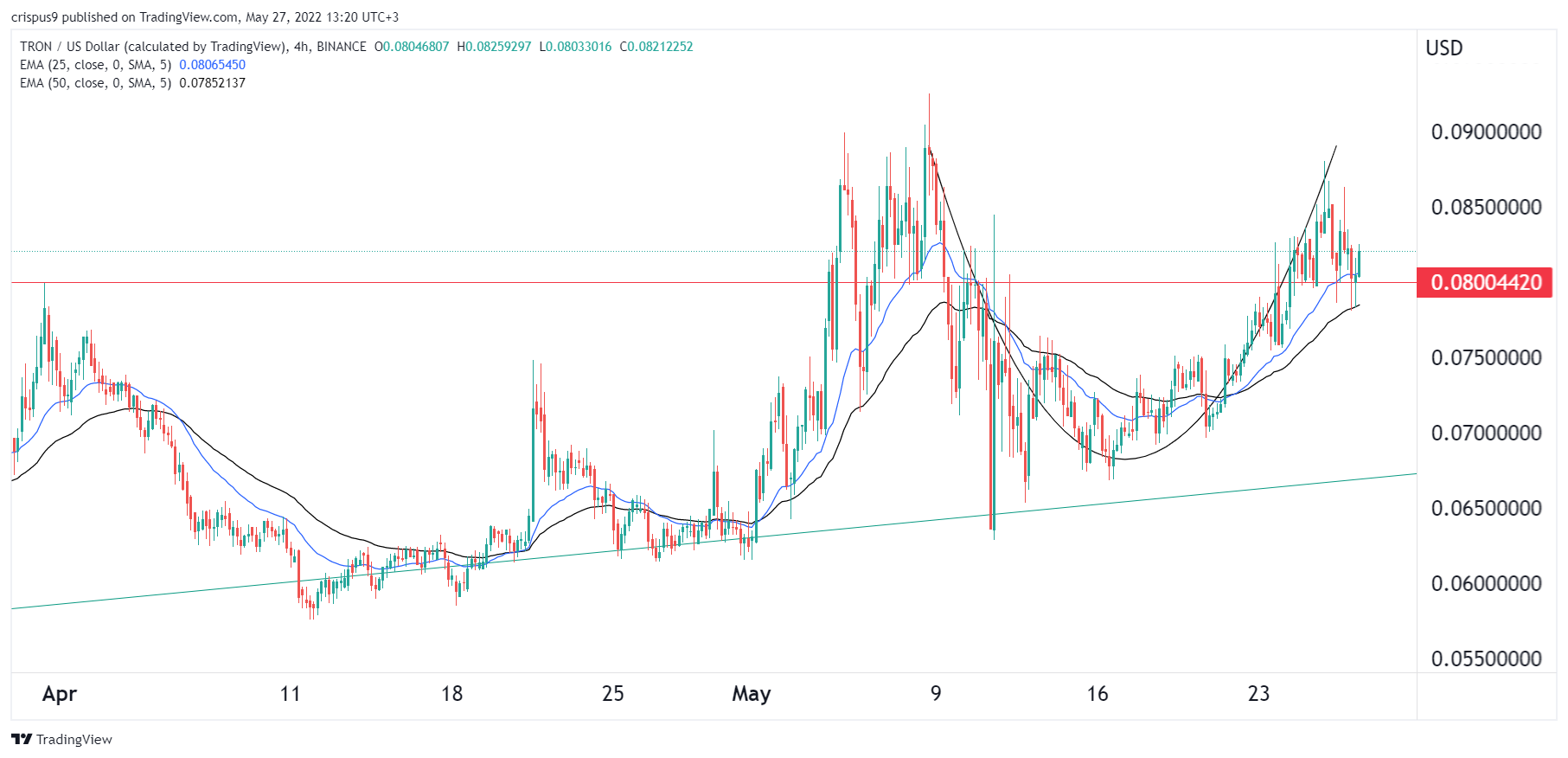
Turning to the four-hour chart, we see that the TRX price has been in a strong bullish trend lately. This rebound has been supported by the 25-day and 50-day moving averages. It has also retested the important support level at $0.0800, which was the highest level on March 31st. 

A closer look shows that the coin is forming a cup and handle pattern, which is usually a sign of a bullish continuation. Therefore, there is a likelihood that the coin will keep rising as bulls target the key resistance level at $0.09, which is the upper side of the cup.

The post TRX: Tron price has rebounded but USDD is a major risk appeared first on CoinJournal.

Highlights May 27: Investors show preference for Bitcoin at expense of altcoins

The crypto market as a whole is bearish with most top 100 coins in the red at the time of writing. Bitcoin fell slightly, altcoins did worse even though stocks rose. 

Top cryptos

Bitcoin was recently trading at around $29,000, generally unchanged over the previous 24 hours. Ether lost around 8% over the same period and was trading below $1,800. 

Most top 10 altcoins were in the red. Solana is the biggest loser, down by around 10%. Investors show preference for Bitcoin, considered the least risky of all digital assets, amid ongoing worries about an economic downturn and high inflation. 

Relative to other coins, Bitcoin saw a spike in its market cap. XRP and Tron are the only top 20 coins in the green, up by around 2% resp. 1%. 

Top movers

Outside the top 20, the tendency was bearish, with most coins losing 3-8% of their value. Notable standouts include Elrond with a loss of 15%, THORChain with 14%, Loopring 10%, Gala 9%, and Waves 12%. 

The biggest loser, however, is STEPN, down 22%. STEPN is in freefall for three reasons: it was banned in China, a massive NFT selloff is resulting in lower prices, and the crypto market is weak overall. 

UST’s descent continues. It’s currently trading for 4 cents and has lost 52% of its value today.  

On the other end, Decred added 2% and Ethereum Classic gained 3%, continuing its upward trajectory seen in the last few days. Tron’s stablecoin USDD is rapidly rising in the market cap ranking.  

Trending

The biggest winner today is Topchain, which aims to become the world’s leading gaming brand, transforming the industry to create a global decentralized gaming ecosystem. Its token TOPC has added 225% to its value today.  

The post Highlights May 27: Investors show preference for Bitcoin at expense of altcoins appeared first on CoinJournal.