Shiba Inu’s 55% rally could lose steam as it faces a major resistance zone

Shiba Inu Coin

As the crypto market roars back modestly, Shiba Inu has been posting massive gains. Over the past three days alone, the coin is up nearly 55%. However, it looks like this upward momentum is about to face its biggest test yet. SHIB is now facing a major resistance zone. Will it manage to keep going? Here are some takeaways:

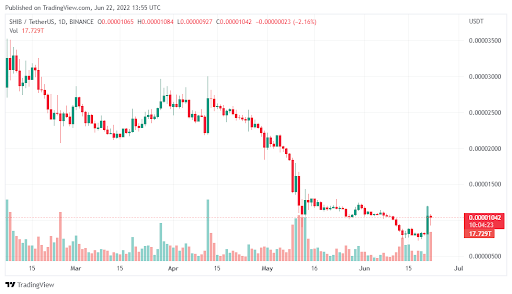
  • SHIB faces major resistance at the $0.0000104 mark

  • A rejection at this price could trigger a decisive pullback

  • SHIB however appears to have enough momentum to overcome

Data Source: TradingView 

How long will SHIB rally?

After gaining 14% over the last 24 hours, SHIB is now outperforming the market. The coin has also reported gains on its fourth straight day. This renewed momentum comes against the backdrop of growing uncertainty in investor sentiment around meme coins. But despite this, SHIB now faces its biggest hurdle as it tries to overcome the $0.0000104 resistance. 

If the coin fails to clear this price, we are likely to see at least a 17% pullback. SHIB will then consolidate and try again. However, we believe that there is enough momentum for SHIB to in fact rise above this mark. 

The coin has rallied in the past 24 hours and is getting closer and closer to $0.0000104. Once the barrier is breached, SHIB could run further by another 25% before any breakdown. This will represent one of the sharpest rebounds in the market in June.

Why is SHIB surging?

As noted above, SHIB is outperforming the entire market during this small recovery phase. It seems though that much of these gains have come as SHIB’s demand among whales grows further. 

We are also seeing some slight improvements in sentiment across the market. As such, trade volume for the meme coin has shot up slightly. If these conditions hold in the near term, SHIB will likely keep rising.

The post Shiba Inu’s 55% rally could lose steam as it faces a major resistance zone appeared first on CoinJournal.

Nexo and Citigroup are in talks for strategic opportunities in crypto lending

Nexo has today announced that it is spearheading talks with Citigroup as it seeks consolidation of the crypto lending space. Citigroup is poised to take the role of a financial advisor.

Through this new relationship with Citigroup and the extensive expertise of its investment arm, Nexo Ventures, Nexo has both the liquidity and the market know-how to lead a successful consolidation in the crypto lending sector.

The crypto lending sector in particular has proved to be in dire need of liquidity amid the ongoing turbulence within the crypto space. A number of crypto lenders like Celsius have been faced with the risk of insolvency as crypto prices nosedived over the past few weeks.

Since the cryptocurrency industry has no central body similar to the Federal Reserve that acts as a last resort for financial institutions at the risk of insolvency, mass consolidation of the crypto industry through mergers and acquisitions (M&A) becomes the way of least resistance for the remaining solvent players.

Stability for companies facing insolvency

Nexo has been doing a lot of acquisitions in the recent past with the main aim being to “instill stability in the companies facing insolvency and, more importantly, to protect retail and other investors who would otherwise be most adversely affected by the failure of multiple crypto lenders” to refund their deposits when requested to do so.

According to Nexo’s co-founder and Managing Partner, Antoni Trenchev:

“We have been approached by multiple Wall Street banks and decided to officially explore the opportunities for acquisition to help stabilize our nascent industry. At Nexo, we have long advocated for the implementation of prudent practices and sustainable business models in our industry, as a result of which the company has amassed a war chest of funds to be used in such aid deals.”

Nexo has been looking for crypto firms that have been adversely affected by the recent crypto market conditions and Citigroup could be a great partner, especially as a fanatical advisor.

The post Nexo and Citigroup are in talks for strategic opportunities in crypto lending appeared first on CoinJournal.

Analysis: Who is losing more in the current market – retail, or institutions?

Bitcoin has lost more than 70% of its value since hitting an all-time high of $69,000 in November 2021.

Largely, the crypto market’s sell-off since last November has all types of investors down on their positions.

Bitcoin is down to around $20,000 today, having recovered from lows below the 2017 cycle peak. Losses have been widespread as the market crashed.

But which group of investors between retail and institutional has seen more losses?

Analyst on who is losing more

Marcus Sotiriou, an analyst at digital asset broker GlobalBlock, says all wallet cohorts – whether whales or shrimps – have seen “some degree” of loss.

By whales, the analyst is referring to that group of Bitcoin wallets with 1000 or more BTC. Shrimps are generally retail wallets and hold lower amounts of BTC.

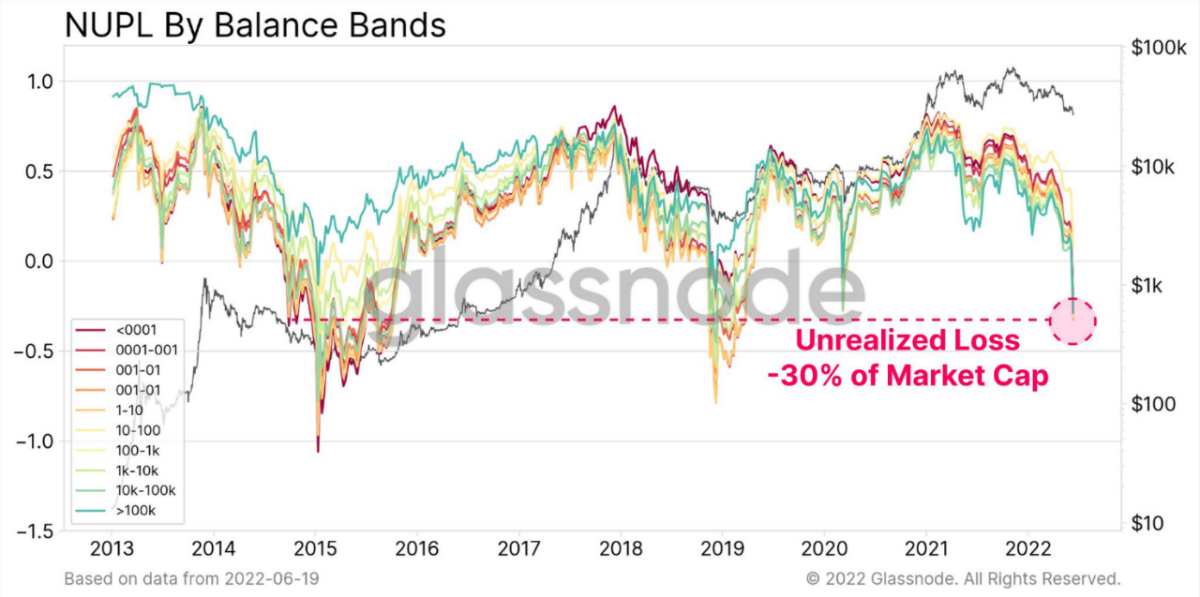
Going by analytics firm Glassnode’s recent data on Bitcoin wallet profit/loss outlook, it is clear that nearly all holder cohorts have hit huge unrealized losses. According to the firm, this sell-off has been more painful than that of March 2020.

Data, however, suggests the wallet cohort with the least profitability is that which holds 1-100 $BTC.

Glassnode chart showing unrealized loss hit 30% of market cap

Institutions are vulnerable

When Bitcoin rallied to highs of $69,000 in November, with the rest of the market joining in amid a bull market buoyed by institutional activity, the total crypto market cap rose to over $3 trillion. 

Since then, it has steadily shrunk, with last week’s sell-off pushing the global crypto market cap below $1 trillion.

Major institutional holders like MicroStrategy and Tesla are significantly down on their holdings’ value since adding BTC to their balance sheets. The two companies have not sold their Bitcoin, but Sotiriou, in emailed comments shared with CoinJournal, says there’s evidence of institutions being vulnerable in this market.

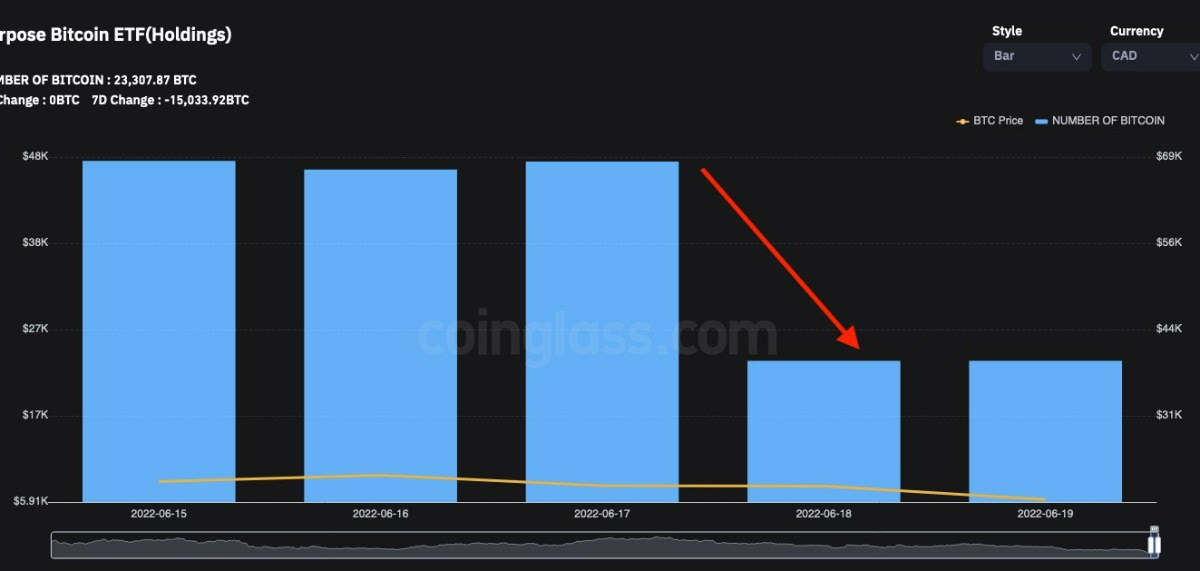
He points to Canada’s Purpose ETF, the first ever actively managed crypto exchange-traded fund. Data from the firm shows the firm sold 24,500 BTC on 18 June, 2022. This happened as the flagship cryptocurrency’s price plummeted to lows of $17,600.

Purpose ETF chart shared by Marcus Sotiriou

 Why is this the case? Well, Sotiriou also points to another issue – the blot that largely is the fault of top crypto lenders. 

These firms, the analyst said, rode the bull market and became too generous. Over-leveraging among borrowers meant too much debt and as markets plummet, forced selling of Bitcoin and Ethereum has ensued.

Too many institutions could therefore have too much exposure to some of the failing crypto lenders and hedge funds, with more selling likely.

The post Analysis: Who is losing more in the current market – retail, or institutions? appeared first on CoinJournal.

Analysis: How KuCoin stands out compared to its broker peers

  • KuCoin Token (KCS) is the native token of the KuCoin Community Chain (KCC)

  • KCS offers holders trading discounts, the opportunity for daily passive income and other bonuses

  • KuCoin repurchases and burns KCS monthly with 10% of its revenue

  • There is nearly $50 million of TVL on KCC, with many DApps emerging

What is KCS?

KCS is a utility token native to the KuCoin platform. Launched in 2017, KCS carries various utility for hodlers. Firstly, a trader using the token to gas fees will enjoy a 20% discount. A user who holds more KCS will also receive more benefits, while bonuses are available which are anchored to both holdings and the trading volume of the wider KuCoin exchange.

KCS is essentially a bet on the KuCoin exchange. If the KuCoin exchange grows, KCS is likely to spike, too.  KuCoin is the third biggest exchange according to CoinMarketCap. Over 8 million users in 207 countries and jurisdictions across the globe access KuCoin services, including hundreds of digital assets and cryptocurrencies.

The range of products offered is vast, including Spot trading, Margin trading, P2P fiat trading, Futures trading, Staking and Lending. KuCoin also announced a $20 million Round A funding in November 2018, with participation from IDG Capital and Matrix Partners.  

KuCoin also repurchases KCS from the secondary market monthly with 10% of the platform’s revenue. This purchased KCS will be burned, deflating supply. KuCoin has already completed 27 burns.

Finally, to provide better support for the development of the KCS ecosystem, the EIP-1559 and the KCC fee mechanism of base fee + priority fee will be introduced into the KCS Deflation Mechanism. This will cause the basic fuel fee to adjust dynamically according to the congestion of the KCC network.

KCS is listed in several places, including Kucoin, MXC, Poloniex, Probit, AscendEX (formerly Bitmax).

Spotlight & Burningdrop

By holding KCS, investors gain the right to participate in token sales the token sale on KuCoin Spotlight, which is the token launch platform on KuCoin.

KuCoin Spotlight has launched over 20 projects, with highlights including CWAR and HOTCROSS.  

Secondly, BurningDrop is a fair token distribution platform that has supported the token distribution of a wide range of blockchain start-ups, which KCS holders can participate in. Through locking or designating crypto assets, users can increase their computing power for additional token distribution.

KuCoin Community Chain

The KCS token is the fuel on which the KuCoin Community Chain runs. KCC runs via a Staked Authority (PoSA) consensus mechanism, displaying stout performance, high throughput, low transaction costs, low latency and strong security and stability. Additionally, the PoSA helps keep block confirmation duration to 3 seconds.

The on-chain TVL currently amounts to about $50 million, and the number of wallet addresses is over 300,000. 

KCC focuses on the following areas:

  • Building a basic toolchain for the blockchain

  • Connecting the centralised and the decentralised

  • Building a global open developer platform

  • Building a decentralized autonomous community

  • Building cross-chain interoperability protocols

  • Expanding the capacity to manage the added load

DeFi, NFTs, Web3 projects, and gaming are also target areas for the KuCoin ecosystem.  

KCS Management Foundation

The KCS Management Foundation is responsible for the development, decision-making, investment, and application of KCS and is currently working on the research and development of various centralised and decentralised applications.

In the future, the KCS ecosystem – comprising the KuCoin core team, the KCC GoDAO Foundation, investment institutions, angel investors, and representatives of the KCS Holder Community – will establish more efficient, autonomous and community-based protocols and tools and will gradually remove power from the KCS Management Foundation.

Eventually, the GoDAO community will take over management completely.

Other KCS Use Cases & The Future

KCS can also be used to purchase a wide variety of goods and services online and offline. Fields containing merchants and digital payment providers that support this token include online shopping, hotel reservations and online games. 

For KCS to achieve its goal, it has to work together with KuCoin Exchange and KCC to develop a payment system that can serve its users across the world. This payment system should connect all projects with the KCS ecosystem. It should also be involved in myriad transactions such as derivatives trading, new coin launches, stablecoins, lending, NFT transactions, and the KCC ecosystem’s transactions.

The post Analysis: How KuCoin stands out compared to its broker peers appeared first on CoinJournal.

Pacific Medical Health Group starts accepting Bitcoin payments

Pacific Medical Health Group led by Dr. Michael Omidi, a primary physician, has announced that it will start accepting Bitcoin payments. 

Early in May, the Pacific Medical Health Group had stated that it will start accepting crypto payments for its products.

Pacific Medical’s move to accept Bitcoin and other cryptocurrency payment methods comes at a time when a majority of organizations are trying to introduce the same. 

Actually, important to note that the original plan of developing these cryptos was to serve as payment tools, where they were created to push fiat currencies, credit cards, and checks to the other side. However, because of the volatility of crypto prices, it has been a challenging and relatively slow journey to achieve that.

Crypto volatility impact on payments

Since it’s hard to predict when Bitcoin and the entire crypto market will experience gains or losses, many companies and stores have been hesitant to accept the crypto payment methods.

For example, if a person buys a product worth $100 with Bitcoin and then the store or the company fails to trade the BTC into fiat immediately and in a few hours the price of BTC drops to $80, the store will incur a loss.

Cryptocurrencies are the next phase of technology

During an interview, Dr. Omidi said that the crypto markets are gaining traction daily and he is seeking to educate people on how they can utilize digital currencies as well as using them as a mode of payment.

He noted:

‘’We wish to accommodate patients that wish to use cryptocurrency on items besides investments or stocks, which is becoming standard to many businesses in the future… Cryptocurrency and blockchain backbone is the next phase of technology and will be a huge part of how businesses will be utilizing in the future.’’

However, their decision comes when companies like continental Diamond, a prominent American jewelry company, announced that will allow their customers to pay using Bitcoin and other related altcoins to pay for the jewelry.

The post Pacific Medical Health Group starts accepting Bitcoin payments appeared first on CoinJournal.