Should you buy Compound’s token after doubling its value in June?

  • Compound token doubled in value this month.

  • The token met resistance at $56.

  • COMP is currently bearish but has a reference bottom at $27.

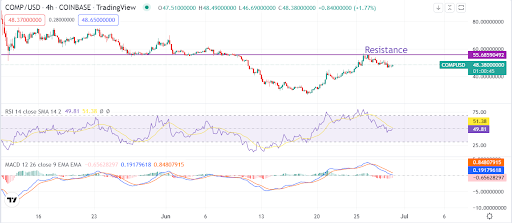
Compound token COMP/USD is a top gainer cryptocurrency this month. It traded at a low of $27 in mid-June before climbing to a high of $56 on June 26. The gain doubled in less than two weeks. Comp is now retreating and is trading at $48. We believe COMP/USD is showing promising signs of recovery, and investors should take note. 

Compound claims to be an algorithmic and autonomous interest rate protocol for developers. The DeFi protocol also rewards users for depositing their tokens in supported liquidity pools. The network achieves this by matching borrowers and lenders while rewarding the liquidity providers. It then makes sense that Compound has a space in the decentralization of finance. 

Crypto volatilities and the nascent industry of DeFi have slowed the uptake of networks like Compound. The network’s token COMP has been subdued as it trades significantly lower from its all-time high. However, COMP bottomed at $27, and investors should be keen to catch another bottom. 

COMP is retracing after hitting a resistance

Source – TradingView

Technically, COMP’S established resistance is at $56. The price is retracing after hitting the level. The MACD confirms a developing bearish momentum. The MACD line crossed below the moving average. The price of $56 also coincided with overbought conditions as the RSI touched 78. However, we believe COMP is unlikely to fall below $27, which is the overbought level. Investors should be keen to buy lower from the current retracement above $27. Long-term COMP recovery will be experienced if it breaks above the strong resistance of $56.

Concluding thoughts

COMP has doubled in value in July. The cryptocurrency is retracing after meeting resistance at $56. We expect the current weakness to continue until the token finds support. Investors should be keen to buy lower but above $27.

The post Should you buy Compound’s token after doubling its value in June? appeared first on CoinJournal.

New referendum-led governance structure proposed for Polkadot

Polkadot, the eleventh biggest cryptocurrency with a market cap of over $7 billion, might be getting a revamp of the entire governance system.

Gov2

The proposal, which is known as Gov2 while in development, can be summarised overall as striving to increase both the decentralisation and decision-making efficiency of the network. In order to do this, referenda will be the only first-class decision-making mechanism. It will contrast with the current form of governance in that many decisions can be happening simultaneously.

With the system that has been in place for the last few years, a technocratic committee has managed issues such as timelines; an approval-voted, elected executive “government” has managed parameters, admin and spending proposals; for everything else, a general voting system has been in place, with long-term stakeholders rewarded with increased influence.

Current drawbacks

This current system has served to limit the number of decisions occurring at once, given the single “all or nothing” referendum model — that is to say, all referenda carry the maximum amount of power. Partly due to this, there can only be one referendum voted at a time and these votes last multiple weeks by default. Additionally, the elected executive is a centralised body and also not anonymous, hence can be pressured one way or another. 

However, the current system also offers features that won’t be changed here. For example, 50% of the total stake in the system should, if they have sufficient strength of conviction in their opinion, be able ultimately to command the system’s future. There will also be a greater weight assigned to those who are willing to lock their tokens into the system for longer. 

Referendum mechanism

Let’s take a look into how a referendum works, given the new network could be running off these soon. 

When a referendum is initially created, it is immediately votable by anyone in the community. However, it is not in a state where it can end, or otherwise have its votes counted, be approved and summarily enacted. Instead, referenda must fulfil a number of criteria before they are moved into a state known as Deciding. Until they are in this state, they remain undecided.

The criteria which need to be met are threefold: Firstly, all referenda have a lead-in period. This is an amount of time which must have elapsed after the proposal before deciding can begin, providing a notice period which mitigates the possibility of “decision sniping”, where an attacker controlling a substantial amount of voting power might seek to have a proposal passed soon after proposing it, not allowing the overall voting population time to consider and vote.

Secondly, there must be room for the decision. All tracks have their own limit on the number of referenda which can be decided simultaneously. The more potent the Origins allowed on the track, then the lower this limit.

Finally, a Decision Deposit must be paid to mitigate against spamming or bloating the system.

Proposals which are not approved after 28 days are considered rejected by default. At this point, the Decision Deposit can be refunded.

Cancellation

Of course, there are issues whereby a proposal being voted on is revealed to contain a problem. In Gov2, there is a special operation for intervening in this way known as Cancelation. This operation immediately rejects an ongoing referendum regardless of its status. 

Cancellation is itself a governance operation which must be voted upon by the network in order to execute. This poses a possible problem of timeline, and in order to be useful, getting a cancellation proposal passed must be significantly faster than any possible target proposal passed. As such, cancellation comes with its own Origin and track, which has a low lead-time and approval/support curves with slightly sharper reductions in their thresholds for passing.

It’s a neat way to balance the fear of centralisation with the realities of efficiency. 

Final Thoughts

Of course, this is all only a proposal. Nonetheless, there are some very interesting aspects to Gov2 and it will be intriguing to see how it ends up. Bear markets are both a time to build and a time to improve existing infrastructure, so it’s promising to see proposals such as these, whether it ends up passing or not.  

Gov2 is set to launch on Kusama imminently, following final professional audit of its code. Following a test period on Kusama, a proposal will then be made for the Polkadot network to vote on.


The post New referendum-led governance structure proposed for Polkadot appeared first on CoinJournal.


Cardano ecosystem builder AdaSwap launches public testnet

Adaswap, a Gal Gadot-backed decentralized exchange (DEX) platform on the Cardano network, has launched its public testnet.

A press release shared with CoinJournal stated that the Adaswap DEX, also backed by Shima Capital, was going live today 29 June 2022.

According to the platform’s team, the testnet launch makes the project among the very first to tap into the capabilities of the Ethereum Virtual Machine (EVM). 

The project  went live on the Milkomeda Network.

Tapping into blockchain interoperability

With the testnet launch via Milkomeda Network, Adaswap is looking to tap into the benefits of a layer-2 protocol with over $36 million in TVL. 

The team notes that among the key benefits for builders will be the ability to deliver EVM capabilities to non-EVM compatible blockchains.

This, they added via the announcement, enables the extension of Cardano’s ecosystem to projects that seek to build advanced products and services. 

AdaSwap CEO Itai Levi said:

“Deploying on Milkomeda has allowed Adaswap to deploy at a rapid pace and bring lightning-fast usability to our DEX for Cardano native assets. We can’t wait for our community to explore these new opportunities and bring a new wave of liquidity to the Cardano DeFi ecosystem. We’re also looking forward to the blockchain interoperability benefits that Milkomeda will offer.“

Adaswap has been building towards the launch of its testnet over the past month, with the team noting in early June that they were focused on delivering this milestone despite the tough market conditions.

Earlier in May, Adaswap announced the NFT marketplace ADANFT, which was launched in collaboration with globally renowned artist Jonathan Paul, aka Desire Obtain Cherish.

The post Cardano ecosystem builder AdaSwap launches public testnet appeared first on CoinJournal.

Major advocate of Bitcoin Cash accused of default: BCH price sinks 7%

Bitcoin Cash (BCH) today dropped to a low of $102.08 following reports that a major advocate of the blockchain had been accused of default.

Roger Ver, the former CEO of Bitcoin.com and a big advocate for Bitcoin Cash, was on Wednesday accused of owing $47 million to crypto exchange CoinFlex.

Coinflex CEO Mark Lamb disclosed a written agreement between the exchange and Roger Ver that obligates the Ver to guarantee any negative equity.

Lamb indicated that they have already written notice of default to Roger Ver for defaulting on the agreement.

In a subsequent tweet thread, Lamb went ahead to clarify that the debt in question pertains to Ver’s account.

But in a rejoinder, Roger Vertook to Twitter to deny Lamb’s claims of owing any debt and rather accused CoinFlex of owing him a substantial amount of money and revealed that he was seeking the return of his funds.

Roger Ver’s relations with Bitcoin Cash

Roger Ver has been the biggest promoter of Bitcoin Cash since it hard forked from Bitcoin.

The main reason Ver supports Bitcoin Cash is that he believes that Bitcoin should be a peer-to-peer transaction system instead of just being a store of value like it currently is.

The position or trade-in question is a leveraged 600-800K BCH long that Roger Ver holds on CoinFlex exchange.

The post Major advocate of Bitcoin Cash accused of default: BCH price sinks 7% appeared first on CoinJournal.

Here’s why Terra Luna Classic (LUNC) and USTC are suddenly rising

Terra Luna Classic (LUNC) has gained 44% today and over 110% over the past seven days while TerraClassicUSD (USTC) has gained over 140% today and over 780% in the past seven days.

Both TerraClassic (LUNC) and TerraClassicUSD (USTC) had almost been forgotten by the greater crypto community over the past two months following the unfortunate Terra (LUNA) debacle that started with the de-pegging of the TerraUSD (USDT) stablecoin.

But the recent price hikes have brought the two cryptocurrencies back to the limelight.

According to CoinMarketCap, the number of LUNC holders has started to increase with the rising price and the same case applies to the USTC stablecoin holders. Between June 26 and today, the number of LUNC holders rose by about1.41%.

Why is USTC and LUNC price rallying?

One of the main contributors to the sudden rise of LUNC price and consequently that of the USTC stablecoin is the recent announcement by a metaverse venture called StarShip that it shall incorporate LUNC into its ecosystem. LUNC will be one of the payment methods in StarShip.

In addition, StarShip will also burn 1.2% of the total amount of LUNC that it will receive as payment.

A press release by StarShip read:

“LUNC will be implemented into the StarShip ecosystem as one form of payment within StarShip Universe, burning 1.2% of all LUNC received for these payments.”

StarShip is one of the biggest metaverses to be created and it recently released footage showcasing its gameplay. The MetaUniverse features 32,000 square kilometers of buildable area and is powered by the new Unreal 5 engine.

The crypto community welcomes the practical use case for LUNC and the partnership between StarShip and Luna reinforces each ecosystem.

The post Here’s why Terra Luna Classic (LUNC) and USTC are suddenly rising appeared first on CoinJournal.