
Tezos co-founder says Celsius going bankrupt was inevitable

Tezos co-founder Kathleen Breitman says the eventual filing for bankruptcy by embattled crypto lender Celsius Network is not surprising at all.

Breitman, commenting on the unfortunate turmoil that’s threatening to suck any pending warmth from an already cold crypto winter, said the lender’s trajectory towards trouble was inevitable.

The die was cast for Celsius

According to the Tezos co-founder, a suspect business model, underpinned by the massive yield offered to investors and the crypto price crash spelled bleakness for the likes of Celsius.

So when crypto hedge fund Three Arrows Capital collapsed and filed for bankruptcy, followed by crypto brokerage Voyager Digital, the die was cast for Celsius.

The lender, which paused customer withdrawals in early June, indicated in its filing that total liabilities stand at $5.5 billion, with over $4.7 billion owed to users. However, the total assets are about $4.3 billion to leave a $1.2 billion hole in the balance sheet.

Before the bankruptcy filing, Celsius had been hit by a class action lawsuit brought by a former employee. The lawsuit alleged that the crypto lender had, among other things, disregarded risk management practices and even manipulated the market by artificially inflating the price CEL, its native token.

Before hitting the wall, the lawsuit alleges Celsius had operated more like a Ponzi scheme, using new customer deposits to sustain withdrawals.

These are the events that paint a picture of a company doomed to fail.

“For those of us who’ve been in this industry for quite some time, it’s completely unsurprising that something like Celsius would go bankrupt,” she told Bloomberg Technology.

She added that this outcome was likely “because economics does have laws that transcend the word blockchain.” The unfolding, she explained, is a “shakeout” of what wouldn’t just work – especially for businesses that staked their future on “the theory that numbers will always go up.”

The post Tezos co-founder says Celsius going bankrupt was inevitable appeared first on CoinJournal.

Lido price prediction: Here’s why the LDO token is rising

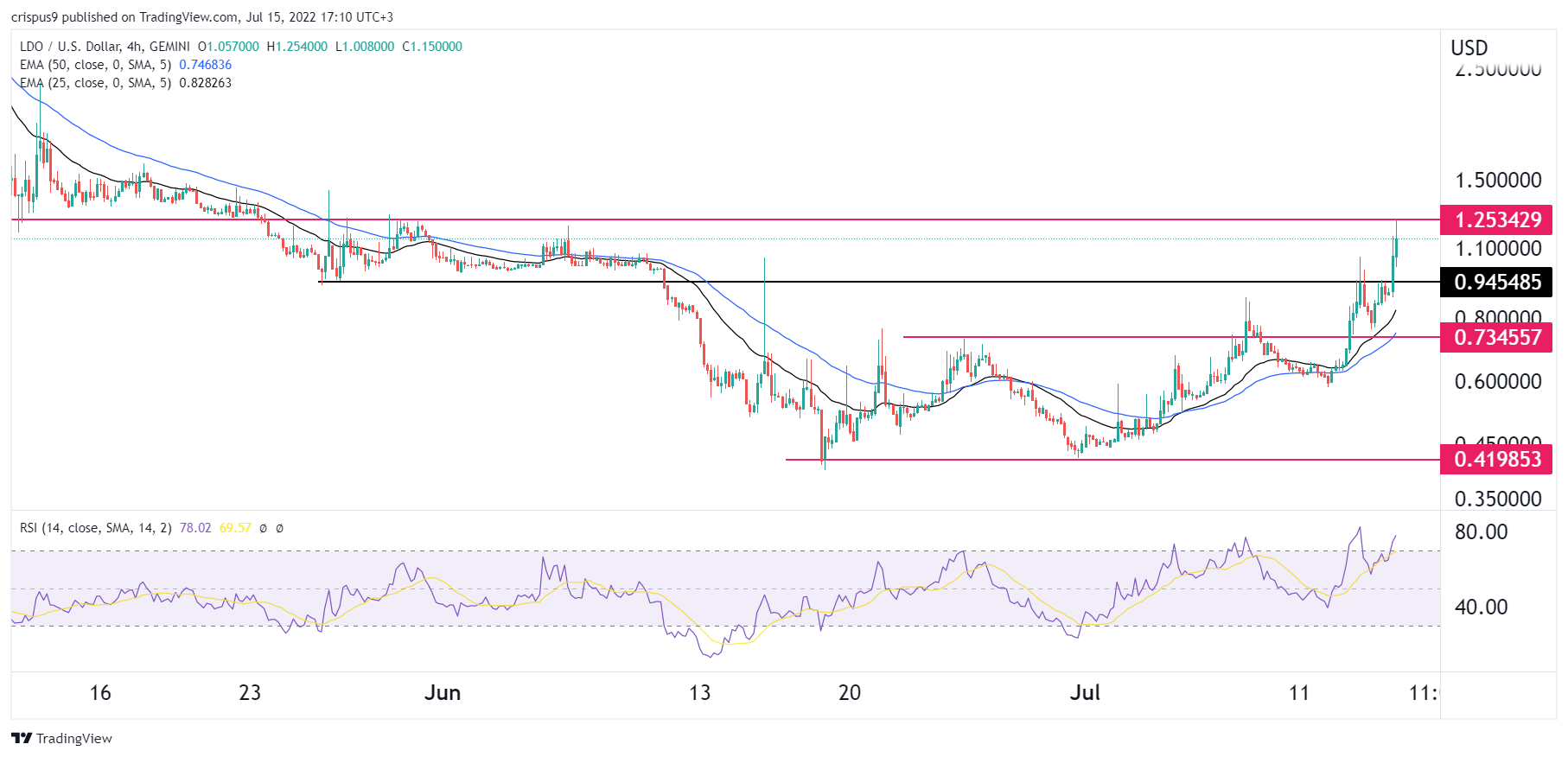
Lido price continued its recovery trend as blue-chip DeFi tokens continued surged. The LDO token rose to a high of $1.2534, which was the highest point on May 26th. It has risen by almost 200% from its lowest level this year.

DeFi blue-chips jump

Lido is a leading player in the decentralized finance (DeFi) industry. It is a platform that provides liquidity solutions for staked assets. One of the best-known staked assets that in Lido is sETH, which is pegged to Ethereum’s Beacon Chain.

According to its website, Lido has over $5.2 billion worth of staked assets in its ecosystem. Most of these assets are linked to its Ethereum platform. The other popular assets are Kusama, Polkadot, Polygon, and Solana. 

Lido is the fourth biggest DeFi platform in the world with a total value locked (TVL) of more than $5.2 billion. The three biggest ones are Maker, Aave, and Curve Finance.

Lido price is rising as investors buy the dip in blue-chip DeFi tokens. Indeed, these tokens have become the best-performing in the industry. They include coins like COMP, AAVE, CRV, and UNI.

It is unclear why these coins have surged recently. A likely reason is that investors believe that the tokens will become dominant players in the financial industry. For example, while many dot com companies went bankrupt during the last dip, many others like Google and Cisco thrived. 

Another reason is that investors believe that DeFi platforms will be more popular than centralized platforms. That’s because recently, many well-known brands in the industry like Celsius, Voyager, and Vauld have gone out of business. 

DeFi platforms are usually more transparent since they are usually built using open source technology. Further, LDO price has risen because Staked Ether seems to be regaining its peg.

Lido price prediction

The four-hour chart shows that the LDO price has been in a strong bullish trend in the past few weeks. The coin has managed to move from a low of $0.4198 in June to the current $1.2534. It has risen above the 25-day and 50-day moving averages. It has also risen above the key resistance levels at $0.9454 and $0.7345. 

Therefore, it seems like there is a bullish momentum, meaning that the coin will keep rising as bulls target the key resistance at $1.50. This view is in line with my previous LDO price.

The post Lido price prediction: Here’s why the LDO token is rising appeared first on CoinJournal.

Open DeFi Notification Protocol integration a big relief for Alpaca Finance users

At the start of this year, Alpaca Finance integrated the Notification Protocol and the integration has been of great help to DeFi users especially those that use Alpaca Finance.

Alpaca users are now able to set up “position health” notifications that give an alert when the safety buffer of leveraged positions drops below the specified threshold. This way users can monitor their leveraged positions 24/7 without worrying about missing out on any notification.

Depending on the issued alert, users are able to take immediate action like adding collateral to mitigate liquidation in case of a low safety buffer alert.

What is Open DeFi Notifications Protocol?

Open DeFi Notification Protocol is a community-led initiative that was developed by defi.org. It provides users with free decentralized mobile notifications of any on-chain events that happen. The protocol is powered by the Orbs Network.

The Defi Notification Protocol is fully open meaning anyone can contribute new notifications. One only needs to implement a simple JavaScript web3 class that is responsible for extracting the notification from the data on the chain.

The protocol has an app called Open DeFi Notification Protocol App that is available on both Google Play and Apple AppStore.

What is Alpaca Finance?

Alpaca Finance is the largest lending protocol for leveraged yield farming (LYF) on Binance Smart Chain (BSC). It has a total value locked (TVL) of $ 800 million.

Alpaca borrowers are able to take under collateralized loans for leveraged yield farming positions. The loans enable users to increase their asset base and ultimately their yields.

However, opening a leveraged yield farming position comes with certain risks especially the risk of liquidation. Therefore, borrowers have to find a way of ensuring that they do not cross the liquidation threshold that triggers an automatic liquidation where all positions are closed to repay the debt.

Need for real-time notifications for LYF positions

Alpaca calculates the safety buffer of the entered positions for customers and displays how close the positions are to potential liquidation. However, displaying it does not help much since you may not be available to see the dashboard all the time.

That is where the Open DeFi Notification Protocol integration comes in. Through the integration, Alpaca Finance users can now get real-time notifications not only of real-time on-chain events but also in relation to the calculated safety buffer.

After the integration, Alpaca has also created a notification widget on their Portfolio page user interface to allow users to set alerts seamlessly.

In a nutshell, real-time notifications for DeFi users are a must especially when money is at stake and there is a likelihood of liquidation. With the Open DeFi Notification protocol integration on Alpaca Finance, DeFi users are assured of never missing any crucial alert.

The post Open DeFi Notification Protocol integration a big relief for Alpaca Finance users appeared first on CoinJournal.

BNB Chain launches dApp platform with anti-scam alarm

BNB Chain’s dApp platform DappBay will help users assess projects before investing in them.

BNB Chain on Thursday announced the launch of a new decentralised applications (dApps) platform, designed to offer a scam alert to users as they look to invest in the DeFi and Web3 ecosystem.

The new tool is available at BNB Chain’s DappBay, a dApp hub that features a built-in risk assessment system dubbed Red Alarm.

An anti-scam feature 

Red Alarm is an anti-scam feature that provides for an innovative scanning tool which users can leverage to easily navigate through new projects. 

With it, a user can spot potentially high risk projects and use the given details to make informed decisions, thereby keep off what could turn out to be a rug pull or scam

To assess new projects for any possible red flags, a user will need to enter the contract address of the given project. The BNB Chain community can then use the assessment details to rank newly launched projects in DeFi, NFTs and GameFi, Gwendolyn Regina, Investment Director at BNB Chain said in a statement.

“Most importantly, the Red Alarm feature helps users in staying one step ahead of scammers; the system warns in real time of potential risks associated with the projects, allowing the community to make informed investment decisions,” she added.

The Red Alarm page shows one of the new DeFi projects to have “significant risk”, noting that the “contract contains logical or programming backdoors that are able to drain users’ funds.”

DappBay will not only benefit BNB Chain users, but also the broader blockchain community.

The post BNB Chain launches dApp platform with anti-scam alarm appeared first on CoinJournal.

Coinbase ‘grew a ton in 2021’, and is still adjusting, CEO says

  • Coinbase added to its headcount by 200% year-over-year as crypto saw massive growth.

  • The risks of that is what informed the decision to thin out the employee numbers in June.

  • Now the focus on “driving efficiency” with scaling in mind to better serve customers.

Coinbase is looking at ways to ensure efficiency at all of its operations during these lean crypto times, Brian Armstrong, the CEO of the top crypto exchange said in a blog post.

Commenting on the company’s massive employee growth over the past eighteen months, Armstrong noted that it was a “ton” of growth. However, even as they adjust to that, it’s time to focus on “driving more efficiency.”

According to the Coinbase boss, unchecked workforce growth may see a company slow down and become less efficient. 

When this happens, most largely to massive scaling, getting off the wrong turn often eats up “more dollars, more people and more time” just to get things going. In the meantime;

“Coordination headwinds increase, vetocracies emerge, risk tolerance fades, and teams become inwardly focused instead of staying focused on their customers,” he added, pointing to the risks of unchecked headcount growth.

What great companies do

Armstrong, whose company is among those to lay off employees amid the crypto winter, said that the outcome (layoffs) was what any great company would do.

“Every great company, from Amazon to Meta to Tesla, found ways to retain their founding energy in conjunction with appropriate controls, even as they scaled to be much larger than Coinbase is today,” he wrote.

He explained that in most cases, the so-called great companies always find ways to “maintain their insurgent mindset,” doing so to avoid careening into complacency and turning into an “irrelevant” at a later date.

“That’s why we’re focusing on driving more efficiency at Coinbase. After 18 months of ~200% y/y employee growth, many of our internal tools and organizing principles have started to strain or break. So we’ve been digging in to identify the set of changes we need to make to help us succeed at this new scale,” he added.

One of the steps towards achieving this was to cut their headcount as was done in June. 

The exchange will also continue to find novel ways to add more efficiency to its services, with the objective being to return to that “mindset and approach” by which the company saw much success.

The post Coinbase ‘grew a ton in 2021’, and is still adjusting, CEO says appeared first on CoinJournal.