Watch these levels as XRP fails at resistance that has been holding price

  • XRP corrects 5% after a week of gains

  • Ripple continues to enjoy positive developments on the case with SEC

  • XRP could continue to correct until it finds support at $0.33

Ripple’s XRP/USD is recovering, but sustainable gains depend on a key resistance. As of press time, XRP was down 5% in 24 hours as bulls failed to inspire a breakout of $38. The token fell alongside other cryptocurrencies. The decline can be said to be a correction after the market was bullish for a week. 

Revising the SEC case, Ripple remains right on track, although the outcome remains uncertain. On July 12, a US court rejected SEC’s call to withhold some documents against Ripple. The documents, which relate to 2018’s so-called Hinman speech, could have influenced proceedings. Either way, courts continuously siding with Ripple is positive. It suggests that things are progressing well for the firm. The markets are warming up for the outcome of the case that could shape XRP’s price.

As of the moment, XRP remains among the top cryptocurrencies despite the uncertainty. At position 7 by market cap, it is above Cardano and Solana. The latest gains have been due to market sentiment, but XRP has a hurdle to clear at $38.

XRP corrects after rejection at key resistance
 Source – TradingView

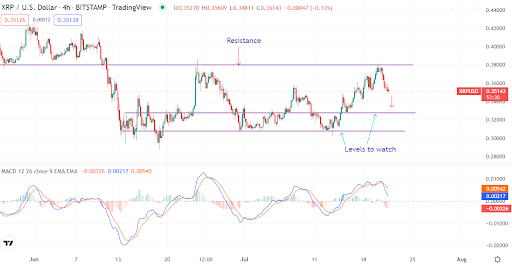
Technical analysis indicates that XRP has been rejected again at the key resistance of $0.38. The MACD indicator has crossed below the moving average, suggesting a bearish momentum. Following the latest gains, investors could be taking profits. We expect the current correction to continue. XRP could settle at a support zone of $0.33. It could also slide to another support at $0.30. Investors should watch the two levels for price action and sentiment.

Summary

XRP has a short-term bearish momentum after getting rejected at $0.38. The cryptocurrency could settle at $0.33 or $0.30.

The post Watch these levels as XRP fails at resistance that has been holding price appeared first on CoinJournal.

Bearish MACD crossover makes Chainlink vulnerable to $6.0

Chain Link Image on a cell phone

  • LINK has lost 7% due to market correction

  • LINK’s recent rally is connected to broader crypto recoveries

  • Robinhood listing and entry into Fantom mainnet reinforces Chainlink fundamentals

Cryptocurrencies have been returning huge in the past week. As is expected, market corrections follow. The corrections open up new buy opportunities. That’s exactly what’s happening to Chainlink LINK/USD after losing 7% in a day. 

Chainlink’s LINK recovered successfully from the support of $6.0 as most cryptocurrencies gained. The gains could also be a result of investor interest after Chainlink was listed on Robinhood. 

Another development that could have influenced LINK’s rally is the entry to Fantom Mainnet. Fantom said that both Chainlink Keepers and Chainlink’s Verifiable Random Function went live on its mainnet. That proved that Chainlink was a reliable Oracle provider to smart contracts like Fantom.

LINK’s rally has now hit a snag, and it is important that investors understand the cycles for the token. The technical analysis below illustrates when LINK may rally next.

LINK stalls and corrects with $6.0 in sight

Source – TradingView

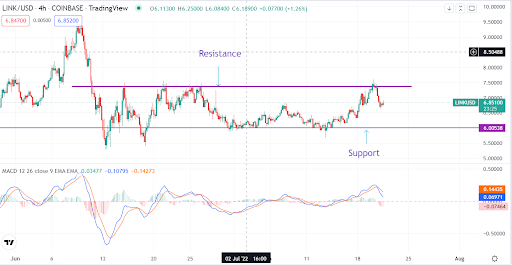
A technical outlook of LINK shows uniquely identifiable price patterns that can be useful to investors. The price has remained within the $6.0 and $7.3 range since the start of June. Keen investors would be good buying the support at $6.0 and selling at $7.3. 

As the price hits the resistance, investors can sell now and consider buying the retracement. The token is already under bear pressure as the MACD line crosses below the moving average. The next price in sight is $6.0, although that depends on the prevailing crypto sentiment.

Concluding thoughts

Chainlink’s LINK could continue to correct as technical indicators show. The buying zone is at $6.0, the established support. The established resistance to watch is $7.3. Investors should also watch for a potential breakout above $7.3 for sustained gains.

The post Bearish MACD crossover makes Chainlink vulnerable to $6.0 appeared first on CoinJournal.

Vitalik Buterin says Ethereum’s transition has been ‘long and complicated’

Ethereum network will be 55% complete after the ‘merge’, says co-founder Vitalik Buterin.

Ethereum co-founder Vitalik Buterin has hinted at the network hitting the 55% roadmap completion level after its much-anticipated “Merge.”

The countdown to the switch from proof-of-work (PoW) to proof-of-stake (PoS) is now ticking after last week’s announcement of 19 September as the date it finally happens.

Buterin was speaking at the fifth annual Ethereum Community Conference (EthCC) held in Paris.

According to him, the road towards proof-of-stake has been long and arduous for the community.

“The Ethereum protocol right now is in the middle of this long and complicated transition, and it’s a transition toward becoming a system that is more powerful and robust in so many ways,” he said.

He then talked of the “big five” developmental stages of the Ethereum protocol roadmap – the merge, the surge, verge, the purge and the splurge – with the PoS switch reflecting the “Merge” and sharding representing the “Surge.”

Only 55% complete

The merge, which is the transition so far, has achieved much and the decentralisation goal is not far off. However, there’s still much to do, with the network’s overall roadmap likely to hit only the “55% complete” level post-merge.

Completing the transition, he explained, involves “deep changes,” which he says include monetary policy (reduction of issuance), security model and transaction inclusion process.

Scalability is also going to be a big part of Ethereum’s key features – especially as the roadmap moves to the “Surge.”

As is the case, Ethereum 2.0, or ETH 2.0, will usher in the era of 100,000 transactions per second, with shard chains astronomically improving transaction per second (TPS) count from the current average of 30 TPS.

You can watch Vitalik Buterin’s EthCC address in the video below.

The post Vitalik Buterin says Ethereum’s transition has been ‘long and complicated’ appeared first on CoinJournal.

The 9 tokens SEC says are securities in Coinbase insider trading case

  • Ishan and his brother are in custody, arrested on Thursday and are facing fraud and conspiracy to commit fraud charges, while Ramini is yet to be arrested.

  • Broadly, the SEC says Ishan violated securities laws, with this the first insider trading case in the crypto sector.

  • The SEC says nine of the 25 tokens for which Ishan provided confidential information were securities.

The US Securities and Exchange Commission (SEC) has highlighted nine tokens it says are securities, the details of which come from a landmark case against a former Coinbase manager.

The SEC’s case is against Ishan Wahi, the former product manager at Coinbase and two others – Nikhil Wahi (Ishan’s brother) and Sameer Ramini, a friend. The former Coinbase manager is alleged to have leaked confidential information about token listings announcement, tipping the other two in a scheme that spanned nearly a year and involved $1.1 million in profits.

“Ahead of those announcements, which usually resulted in an increase in the assets’ prices, Nikhil Wahi and Ramani allegedly purchased at least 25 crypto assets, at least nine of which were securities, and then typically sold them shortly after the announcements for a profit,” the SEC said in a press release.

9 tokens deemed securities

The SEC has previously stated that most tokens in the crypto sector are securities, and indeed has an active case against Ripple Labs over the XRP coin.

In this latest installment of its battle to bring deemed securities under the SEC laws, it does identify nine “security” tokens.

What are these tokens? The SEC highlights them here.

LCX (LCX), Amp (AMP), Rally (RLY), Rari Governance (RGT), Power Ledger (POWR), XYO Network (XYO), DFX Finance (DFX), DerivaDAO (DDX) and Kromatika (KROM).

Commenting on these tokens, Gurbir S. Grewal, SEC’s Director of Enforcement, noted that the main concern is not “with labels, but rather the economic realities of an offering.”

“In this case, those realities affirm that a number of the crypto assets at issue were securities, and, as alleged, the defendants engaged in typical insider trading ahead of their listing on Coinbase,” he added.

The post The 9 tokens SEC says are securities in Coinbase insider trading case appeared first on CoinJournal.

JPMorgan: Retail demand is improving as ‘intense phase’ of deleveraging fades

JPMorgan says deleveraging in May and June was the most intense since 2018, but that’s getting behind the crypto ecosystem amid increased retail demand.

JPMorgan analysts are saying positivity among retail investors is on the upward trajectory, with an improved  market outlook coming on the back of huge turbulence and uncertainty.

The banking giant notes in a report cited by CoinDesk on Thursday that the unfolding improvement is down to the reducing intensity of the massive deleveraging that characterised the market crash in May and June, as well as over the last several months following the 2021 bull run.

According to JPMorgan analysts, “the extreme phase of backwardation” witnessed in the market over the last two months was the worst since 2018. However, that extreme pain period looks to be fading off amid the sharp crypto price bounces seen this past few days.

Bitcoin (BTC) jumped above $24,000 to test its highest level in over a month, with on-chain data from Glassnode showing the number of wallets in loss (7 day moving average) has dropped to a 30-day low.

Retail demand jumps amid Ethereum “Merge” news

While Bitcoin’s upside was remarkable, the main avenue of positivity was around Ethereum (ETH), the bank said.

Investor expectations are high after last week’s announcement that Ethereum’s long anticipated “Merge” would be hitting mainnet in September. The buying pressure around the excitement for cryptocurrency’s largest smart contracts platform also seeped into the rest of the market, with ETH/USD jumping above $1,500 as the overall crypto market cap crossed above $1 trillion.

For Ethereum, the number of addresses in profit (7 day moving average) has also reached a one month high.

Notably, the bounce in crypto prices isn’t reflected in crypto funds or futures market, which the bank says is indicative of demand being retail-driven.

Further evidence of retail demand is seen in the increase in the number of “smaller wallets” holding BTC or ETH, JPMorgan added

The post JPMorgan: Retail demand is improving as ‘intense phase’ of deleveraging fades appeared first on CoinJournal.