FCA allows Future Fintech to acquire UK money payment firm Khyber

  • Financial Conduct Authority (FCA) has given a nod to the acquisition of a UK money payment firm by US-based company.
  • Blockchain company Future Fintech will acquire 100% of Khyber Money for  €685,000 (about $687,534).
  • The deal is expected to close within the next three months.

Future FinTech Group Inc., a Florida-based publicly traded blockchain applications technology firm, is set to acquire UK-based money payments services firm Khyber Money Exchange following approval from the Financial Conduct Authority (FCA).

Following the approval, Future Fintech will acquire 100% of Khyber Exchange equity, at a disclosed purchase price of €685,000 (roughly $687,534).

The Nasdaq-listed fintech company, which also engages in cryptocurrency mining, operates a blockchain-based e-commerce platform and offers crypto investment management services, announced this on Friday.

FCA approves wholly-owned subsidiary

Per the firm, the FCA greenlight was given to its wholly-owned subsidiary FTFT UK Ltd, which is regulated in the United Kingdom.

“We are pleased to have received approval from the FCA to acquire Khyber Exchange since it further extends our fintech footprint and diversifies our geographical reach,” Future Fntech CEO Shanchun Huang noted.

Khyber Exchange offers global money transfer services across its agent locations, on the web vial its online portal and through mobile access. The UK-headquartered company was founded in 2009 and has offices in Italy and Germany.

The acquisition will help Future Fintech tap further into the money payment services business, which Huang said is a high margin industry and one that’s likely to boost goals towards global expansion.

Future Fintech expects the deal to close within the next three months as outlined by the FCA.

The post FCA allows Future Fintech to acquire UK money payment firm Khyber appeared first on CoinJournal.

Bitcoin price: Peter Brandt suggests possible bottom for BTC

  • Bitcoin looks to have reached levels similar to those hit before a bounce in July, veteran trader and analyst Peter Brandt says. 
  • However, with risk-off sentiment largely intact, he notes it might not be time to flip so bullish.
  • BTC/USD was trading near $21,400 at the time of writing.

Bitcoin price is about 1.2% up in the past 24 hours at the time of writing, trading above $21,400 as bulls look to push higher.

The slight gains on the daily chart have two small green candles after six consecutive red ones.

However, with the broader market largely undecided, the bellwether cryptocurrency is still vulnerable to the sell-off that pushed BTC/USD from highs above $25,000 last week.

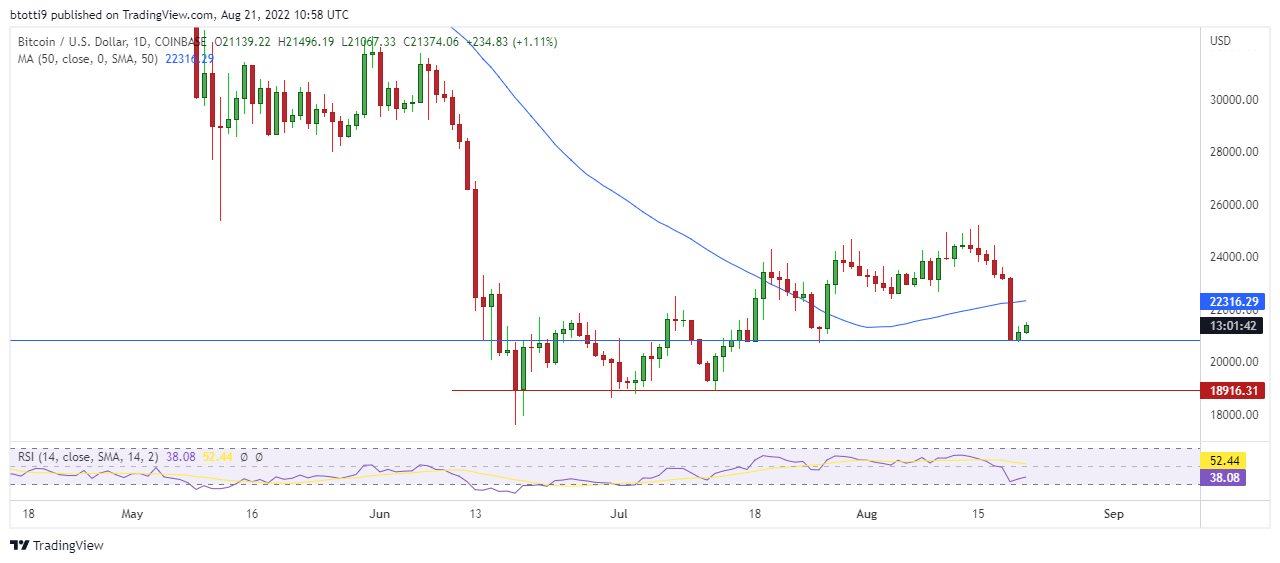
Chart showing BTCUSD price movement and key levels. Source: TradingView

Ascending wedge targets: what’s next for BTC?

On Friday, BTC price fell nearly 10% as the broader risk assets market sank on news the US Federal Reserve was intent on maintaining a hawkish approach despite data suggesting a slowing inflation.

The risk-off sentiment saw Bitcoin hit its lowest price level in over three weeks ($20.760 on Coinbase, with the pair down nearly 12% this week). Here’s what legendary trader Peter Brandt says about the BTC price movement:

The benchmark cryptocurrency is therefore poised at key downside targets, Brandt said as pointed to a chart indicating a breakdown from an ascending wedge.

It’s possible for some bounce from here if bulls hold support, but more pain is likely if the demand reload zone breaks, a scenario crypto analyst Michael van de Poppe also highlights in the tweet below.

The last major breakdown below $20,000 saw BTC/USD fall to lows around $17,600.

The post Bitcoin price: Peter Brandt suggests possible bottom for BTC appeared first on CoinJournal.

FTX revenue soared 1,000% amid last year’s crypto craze: report

  • FTX saw its 2021 revenue grow from $89 million to hit over $1 billion as the crypto market rallied.
  • Growth came amid huge expansion across the globe, CNBC said in a report citing leaked documents.
  • Despite crypto winter, FTX has looked to add to its growing portfolio of companies. 

FTX saw its revenue grow more than 1000% in 2021 as the massive bull market that took Bitcoin to highs of $69,000 pushed the cryptocurrency exchange’s revenue from below $90 million in 2020 to over $1 billion last year.

A CNBC report, citing leaked audited documents, revealed that the company, led by CEO Sam Bankman-Fried, generated the huge revenue amid a growing footprint built on crucial acquisitions.

FTX’s revenue hit $1.02 billion

In 2021, as rallying markets pulled in new money and helped crypto business establish a foothold following the previous market cycle, FTX emerged as one of those that took full advantage.

Financial success only helped to fuel global expansion for the company, adding to the overall revenue growth year-over-year, per documents the publication cited. Indeed, FTX’s revenue reportedly jumped from $89 million in 2020 to $1.02 billion in 2021 – reflecting an increase of more than 1000%.

The crypto exchange also saw its net income rise significantly – while in the previous year it stood at around $17 million, the crypto craze helped push that to $388 million. The company’s operating income went up from $14 million in 2020 to over $272 million in 2021.

Documents also showed FTX had cash holdings of nearly $2.5 billion at the end of 2022, with 27% profit margins.

FTX continues to grow its global footprint 

The revenue in Q1 2022 was $270 million, with forecasts looking at $1.1 billion for the year. This outlook is likely to be clearer with the release of Q2 figures, given the impact of crypto winter on crypto prices during the quarter.

Despite the crypto winter, Bankman-Fried’s company has looked to continue with its acquisition blitz. Evidently, the crypto turmoil seen in the first half of the year has provided an opportunity to snap up some companies on the cheap.

For instance, June saw FTX acquire Canada-based crypto trading platform Bitvo, and FTX US acquire clearing firm Embed. The deal with the latter has been key in FTX US’ offering of stocks trading. Other deals on the FTX table are for crypto lender BlockFi and Bithumb, a South Korea-based cryptocurrency exchange.

As well as these major acquisitions, FTX has struck deals and bought multiple businesses around the world. 

Notably, the leaked documents show 15 smaller firms spread across Singapore, Australia, Germany, Turkey, Switzerland and the United Arab Emirates, Cyprus and Gibraltar, among other countries.

The post FTX revenue soared 1,000% amid last year’s crypto craze: report appeared first on CoinJournal.

FDIC issues cease and desist letter to FTX US over misleading statements

  • FDIC sent the cease and desist letter to five companies, including FTX US and mentioned alleged misleading tweets from FTX US president Brett Harrison.
  • The agency wants the crypto company to ensure any misleading details are removed and compliance confirmed in writing within fifteen days.

The Federal Deposit Insurance Corporation (FDIC), a US government agency that offers deposit insurance to customers of insured banks, has warned crypto exchange FTX US over what it calls “false and misleading statements about FDIC deposit insurance.”

The agency’s cease and desist letter to the US-based crypto platform comes after the FDIC sent a similar warning to FTX US president Brett Harrison.

And other than the exchange, other four crypto-related companies also received letters from the US watchdog, according to details shared in a press release on Friday. 

The others warned are Cryptonews.com, Cryptosec.info, SmartAsset.com and FDICCrypto.com.

FTX US is not FDIC-insured 

FDIC says evidence shows the listed firms misrepresented or offered false claims “including on their websites and social media accounts,” about the insurance by FDIC of some crypto–related products or stocks.

“In one case, a company offering a so–called cryptocurrency also registered a domain name that suggests affiliation with or endorsement by the FDIC. These representations are false and misleading,” the agency warned,

On Thursday, the FDIC had written to FTX US about the issue, and highlighted a tweet Harrison shared on 20 July. In the tweet, the FTX US boss had noted that “direct deposits from employers to FTX US are stored in individually FDIC-insured bank accounts in the users’ names.”

The agency also flagged the claim that “stocks are held in FDIC-insured and SIPC-insured brokerage accounts.”

Similarly, FTX US had been described as being FDIC-insured on two of the above websites. The regulatory body says such allegations are likely to mislead and/or harm consumers. The agency said FTX US is not FDIC-insured.

In a tweet acknowledging the FDIC warning, Harrison said:

“Per the FDIC’s instruction I deleted the tweet. The tweet was written in response to questions raised on twitter regarding whether direct USD deposits from employers were held at insured banks (i.e. Evolve Bank).”

In its cease and desist demand, the FDIC asked FTX US to remove all reference to the deposit insurance claims shown to be false.

Also, other than ensuring this is not repeated at any other time or form, the exchange has to within fifteen days of receiving the letter, write to the agency to confirm compliance.

The post FDIC issues cease and desist letter to FTX US over misleading statements appeared first on CoinJournal.

Gemini launches staking for Polygon (MATIC)

  • Gemini Staking adds to the yield-generating offering Gemini Earn launched in February 2021.
  • Staking will be available for US customers (excluding New York) as well as Singapore and Hong Kong.
  • The product will support MATIC before adding ETH, SOL, DOT and AUDIO.

The Gemini crypto exchange has launched its staking feature and will support multiple cryptocurrencies for customers in the United States (except for New York), Hong Kong and Singapore.

The company, one of the earliest in the industry and which is regulated in the US and other jurisdictions, unveiled the Gemini Staking product on 18 August 2022. 

Now customers can stake their tokens and receive staking rewards in their accounts on the exchange, the firm said in its blog announcement.

Staking for MATIC on Polygon

Staking is one of the ways for crypto holders to earn rewards on their tokens, which is possible via proof-of-stake (PoS) consensus mechanism platforms.

As opposed to mining on proof-of-work (PoW) networks like Bitcoin, PoS networks allow token holders to participate in transaction processing and network security by pledging their tokens to validators or running their own nodes.

Gemini will initially support staking for MATIC, the native token of the Polygon network. Later, the platform plans to add support for leading smart contracts blockchain Ethereum (ETH) – which is set to transition to PoS via the ‘Merge’. 

Other network tokens Gemini is looking to support are Polkadot (DOT), Solana (SOL), and Audius (AUDIO).

The launch of staking adds to Gemini’s yield-generating offering Gemini Earn, which was launched in February 2021. Earn allows customers to generate yield on their crypto through interest paid on loaned assets.

The post Gemini launches staking for Polygon (MATIC) appeared first on CoinJournal.