Veritaseum Capital sues Coinbase for patent infringement

Blockchain-based software firm Veritaseum Capital has accused Coinbase of infringing on a blockchain-related patent. The firm has decided to sue the popular crypto exchange for $350 million in damages.

Speaking for Veritaseum, US law firm Brundidge & Stanger has alleged in the lawsuit that Coinbase has undermined Veritaseum’s cryptocurrency payment technology patent or the “566 patent”. The lawsuit has been filed in the U.S. District Court in Delaware.

According to Veritaseum, the patent facilitates novel devices, systems and methods which enable parties to enforce value transfer agreements with little or no trust in each other.

The firm alleges in the lawsuit that Coinbase has used this system to run many of its blockchain infrastructure services, including Coinbase Android mobile wallet, iOS mobile wallet, its Coinbase Cloud, Coinbase Commerce APIs, Query and Transact, Participate, Delegate and Validator software, Coinbase Pay, Coinbase Wallet and Coinbase Operated Public Validators.

Veritaseum has argued that the $350 million compensation is justified considering that Coinbase has gained substantial profits due to its infringement and Veritaseum Capital “sustained damages as a direct and proximate result.” 

The law firm has also pointed out that a letter warning Coinbase of the infringement was sent in June and received no favourable response: 

“Defendant had prior knowledge, should have known, or at least been willfully blind of the ‘566 Patent’. Defendant has been on notice of the ‘566 Patent’ at least as early as July 3, 2022, if not earlier from other sources or parties.”

The July letter was sent in the context of Vertiaseum’s “Coinbase: Forensic Analysis & Deep Dive” report that suggested that Coinbase was only one of the many centralized and decentralized digital asset exchanges that are employing “unlicensed patented IP” from Veritaseum.

The firm, however, has not clarified how long Coinbase has been allegedly using the patent.

Court documents confirm that Patent 566 was awarded by the U.S. Patent and Trademark Office to Vertiaseum founder Reginald ‘Reggie’ Middleton and co-inventor Mathew Bogosian in December of 2021.


The post Veritaseum Capital sues Coinbase for patent infringement appeared first on CoinJournal.

Bitcoin volatility trended downwards in Q3: report

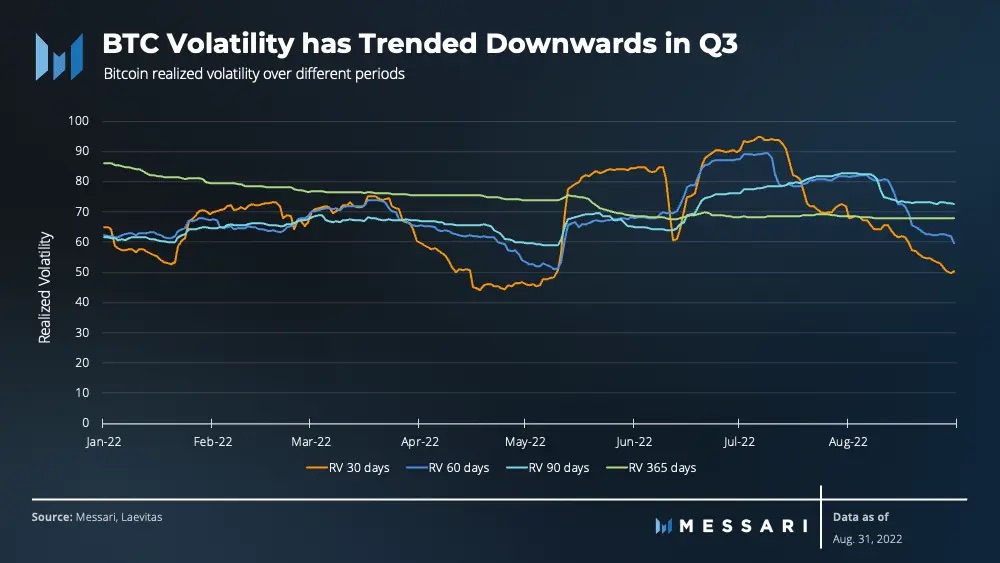
  • Bitcoin’s average 30-day volatility in August was 60%, while it stood at 80% in June.
  • In 2022, risk asset markets (crypto included) have traded lower and Bitcoin more so like a high-beta US stock.

Bitcoin (BTC) realized volatility during quarter three has trended downwards, according to the latest report on the metric from crypto intelligence and research firm Messari.

Per the research platform, the benchmark cryptocurrency recorded the lower volatility as the crypto saw a slight recovery from June lows.

So while BTC has once again dipped below $20,000 in September, the recovery from the $17,600 levels in June and the retest of key resistances near $25,000 in mid-August was key.

“Bitcoin realized volatility trended downwards as it made a gradual recovery in Q3. Average 30-day volatility for August was 60% compared to over 80% for June,” Messari’s Sami Kassab and Kuna Goel wrote in the State of Bitcoin Q3 2022 report.

BTC volatility chart showing downward trend in Q3. Source: Messari

The lower volatility for the world’s largest cryptocurrency by market cap saw the broader crypto market record much lower liquidations across the period, the analysts added. For instance, total long liquidations stood at $5 billion in August, a more than 50% drop from the $10.8 billion recorded in June.

As for total short liquidations, the figure fell to $3.5 billion last month, compared to $6.6 billion total liquidations seen in June.

BTC traded like a high-beta US tech stock

As crypto prices see-sawed over the quarter, Messari notes, Bitcoin traded more like a tech stock as it tracked the Nasdaq 100 (rebased). 

This happened not just as the federal fund rates increased across the three months, but reflected the rot going back to late 2021. Prior,  availability of easy money amid institutional adoption, had helped fuel the bull market.

“For the quarter, the average correlation between Bitcoin and NASDAQ 100 was 0.6 as inflation and rate hikes dominated the narrative. Surprisingly, digital gold and physical gold are far less correlated. The average correlation for the quarter between the two assets was 0.2,” Kassab and Goel wrote.

Overall, Q3 has seen Bitcoin essentially lose two of its key narratives – as an inflation hedge and store-of-value asset – amid the bear market crash that precipitated declines of over 72% since the all-time-highs of 2021.

Bitcoin was trading around $18,910 on Sunday afternoon, about 6% and 13% down over the past 7 days and 30 days respectively.

The post Bitcoin volatility trended downwards in Q3: report appeared first on CoinJournal.

OCEEF taps Polygon to help bring deep-sea research to Web3

Polygon to help ‘save the ocean’ group bring its state-of-the-art vessel RV Odyssey to the metaverse, democratising access and governance.

Polygon, the Ethereum scaling solution helping to bring millions of everyday users to Web3, has teamed up with conservation platform Ocean Conservation Exploration and Education Foundation to help promote deep-sea research and education.

The collaboration will see OCEEF leverage Polygon’s technology to deliver to the masses a Web3 experience of deep-sea missions in the metaverse.

Web3 experience and democratised access

Access to decentralised governance via blockchain platforms is a trend that’s quickly picking up across the globe, with benefits of transparency and accountability adding to the growth. Polygon and OCEEF’s collaboration will explore these benefits.

Using Polygon’s technology, OCEEF will open up access to RV Odyssey, a state-of-the-art research vessel that was notably featured in BBC’s Blue Planet II. 

As noted, Polygon will help democratise access and project missions via a distributed governance system, while users will help fund Odyssey through unique NFTs, the team noted in the announcement.

“We see web3 as a critical accelerator in engaging and educating people about the importance of the Ocean. Using our Polygon partnership and its carbon-neutral tech as a launchpad, we will be using technology to democratise access to the vessel through multiple web3 platforms as well as provide participants with the ability to help decide the vessel’s future itinerary and research,” Alex Moukas, founder of OCEEF said.

OCEEF will also work with web3 SaaS platform dSphere – which offers a multi-chain ecosystem integration including wallet support, NFT marketplace, smart contracts and oracles.

The post OCEEF taps Polygon to help bring deep-sea research to Web3 appeared first on CoinJournal.

Moscow stock exchange is preparing a bill to allow the trade of DFAs

We want the market to make its own choice between blockchain accounting and depositary accounting: Chairman

The Moscow Stock Exchange (MOEX) has decided to introduce a bill that will allow depositaries to issue receipts for trade in digital financial assets (DFAs), Russian newspaper Vedomosti reported earlier this week.

The bill is currently under consideration by the Russian Central Bank, which independently cannot introduce legislation.  

MOEX supervisory board chair Sergei Shvetsov told reporters at a banking forum, “Banks of Russia – XXI century,” that the bill will allow trading both in DFAs and securities based on them.

This will allow investors to choose between directly investing in DFAs or shifting the custodial risks of opening accounts in distributed registries to the accounting infrastructure via securities.

“The exchange and its subsidiaries will turn to the regulator, and I hope that they will receive the status of an exchange operator,” the chairman explained, referring to how the direct release of DFAs will work.

Shvetsov clarified that the exchange wants to let the market to make its own choice between blockchain accounting and depositary accounting. If the bill receives approval, Russian depositories will be able to hold DFAs in their accounts on the blockchain and redeem the certificate to withdraw the underlying asset whenever the client requests the same.

The behavioural habits of Russian business and the population are “dragged” into centralized structures, the chairman stated, adding that the lack of familiarity with distributed ledger technology becomes a barrier:

“When you don’t know who to call and who to sue, many people don’t want to participate. [but,] It’s a blank sheet that we can draw whatever we want on, according to the needs of the economy and investors.”

In July, State Duma finance committee chair and head of the Russian Banking Association Anatoly Aksakov called for MOEX to follow in the footsteps of the Toronto Stock Exchange and the Deutsche Boerse to become a cryptocurrency exchange.

The post Moscow stock exchange is preparing a bill to allow the trade of DFAs appeared first on CoinJournal.

Tezos upgrade Kathmandu goes live on mainnet

Kathmandu has introduced several new features set to improve network scalability and security.

Tezos, the layer 1 proof of stake blockchain designed to self-upgrade and evolve as it scales amid adoption, has successfully activated the latest protocol upgrade on the mainnet.

On Friday, the 11th upgrade dubbed Kathmandu went live on the Tezos PoS network at block 2,736,129, following a community adoption.

As noted in the proposal that ran from 9-23 September, the new upgrade comes after another named Jarkata went live on 28 June, 2022. The upgrade proposal was made by Tezos contributors and research firms Nomadic Labs, DaiLambda, Marigold, Oxhead Alpha, TriliTech, Tarides, and Functori & Tweag.

Upgrade brings new features

Kathmandu’s activation keeps with Tezos’s regular schedule and as with previous protocol changes, this adds a number of features set to massively improve on scalability.

These include smart contract optimistic rollups, pipelined block validation that’s set to improve transactional throughput, and improved randomness for enhanced network security- this is achieved via verifiable delay functions. 

Other features added include tailored governance via new permanent testnets that allow for more room for developers to experiment, event logging and increased paid storage for smart contracts.

Tezos launched in mainnet in 2018, with the network going live following an initial coin offering in 2017.

The post Tezos upgrade Kathmandu goes live on mainnet appeared first on CoinJournal.