Monero price above $140: Where next for XMR?

Monero’s price remains above $140, but XMR could find it hard to maintain this position as the broader cryptocurrency continues to underperform.

XMR, the native coin of the Monero ecosystem, is down by less than 1% over the last 24 hours and is currently trading at $140.66 per coin.

The recent poor performance has erased the gains recorded earlier this week. XMR is down by roughly 1% in the last seven days and could find it hard to maintain its position above $140.

What is driving Monero’s price lower today?

There is no apparent catalyst behind Monero’s poor performance today. Its performance coincides with that of the broader cryptocurrency market, which is down by more than 1% in the last 24 hours.

The total cryptocurrency market cap could drop below $900 billion for the first time in a month if the current bearish momentum persists. 

Bitcoin has lost more than 1% of its value today and is now trading below $19k. Meanwhile, Ether is also down by more than 1% and is currently trading around $1,280 per coin.

What’s the outlook for the Monero price?

Despite holding its position at $140, Monero would most likely drop lower over the coming hours. Its performance would depend on how the broader crypto market performs, as there is no major news coming out from the Monero ecosystem at the moment.

Failure to maintain its price above $140 could see XMR drop toward the $125 level over the next few days.

Monero technical analysis

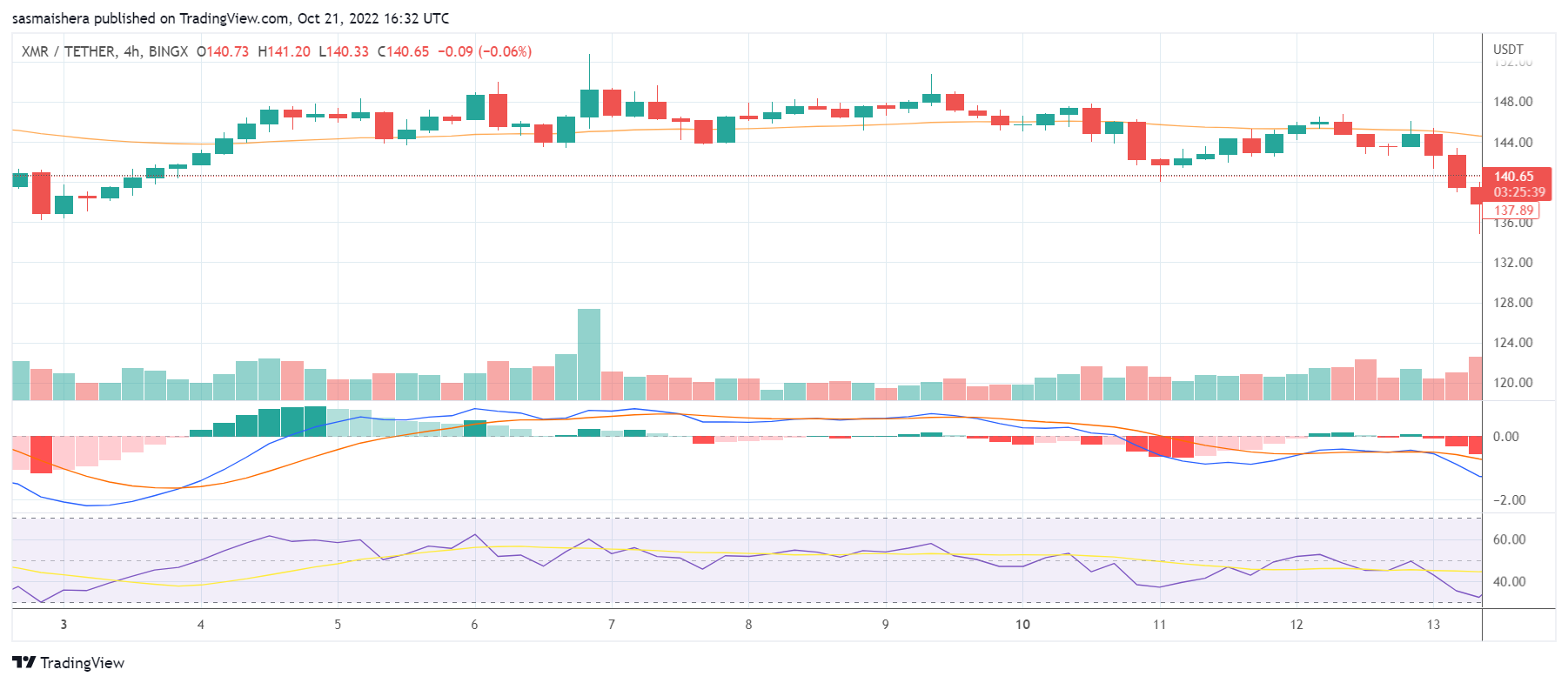
The XMR/USDT 4-hour chart has turned bearish as Monero has been underperforming over the last few days. 
XMR/USDT Chart By TradingView

The MACD line dropped into the negative zone yesterday, indicating that the bears have taken control of the Monero market. 

The 14-day relative strength index has also declined and currently stands at 43. If the bearish momentum grows stronger, it could enter the oversold region over the weekend. 

If the bearish trend continues, XMR could drop toward the $133 support level for the first time since July. However, the second major support level at $121 could hold over the coming days. 

How to buy Monero?

Follow these simple steps to buy Monero:

Step 1: Open an eToro account: 

Visit the official eToro website and open an account within a few minutes. 

Step 2: Fund your account:

Fund the newly-opened eToro account with your local fiat currency. You can deposit as much as you desire. 

Step 3: Start trading Monero:

You can immediately start trading Monero against a host of other cryptocurrencies like Bitcoin or against fiat currencies like the GBP or USD.

Where to buy Monero now

EZinvest

Buy XMR with EZinvest today

Binance

Binance is one of the largest cryptocurrency exchanges in the world. It is better suited to more experienced investors and it offers a large number of cryptocurrencies to choose from, at over 600. Binance is also known for having low trading fees and a multiple of trading options that its users can benefit from, such as; peer-to-peer trading, margin trading and spot trading.

Buy XMR with Binance today

The post Monero price above $140: Where next for XMR? appeared first on CoinJournal.

This week in crypto: The Aptos blockchain goes live

Aptos launched its blockchain on Monday, with its native coin going live on several cryptocurrency exchanges later in the week.

Aptos is now live

Aptos Labs blockchain went live on Monday, in the process, became the first of the Facebook spin-off networks to launch. After raising millions of dollars in VC funding, blockchain developers now have a chance to see how it performs compared to the other popular networks like Solana, Cardano, and Ethereum

The native APT coin also went live on numerous cryptocurrency exchanges, including Binance, FTX, Coinbase, KuCoin, and Houbi Global. The APT coin went live after the team airdropped 20 million tokens to its early testnet users.

Binance receives a licence to operate

Leading cryptocurrency exchange Binance is on a streak. The exchange gained regulatory approval to offer its services in Cyprus, making it the third country it has achieved this feat within the space of one month.

Binance gained similar licences in Kazakhstan and New Zealand a few weeks ago. In Cyprus, Binance was granted Class 3 registration as a Crypto Asset Services Provider (CASP) by Cyprus Securities and Exchange Commision (CySEC).

Digital bank N26 launches cryptocurrency trading services

The cryptocurrency market continues to grow despite the ongoing bear market. Earlier this week, N26, Europe’s first regulated mobile bank, announced that it would launch its cryptocurrency trading services in Austria. 

N26 Crypto will go live over the next few weeks, offering users access to 100 cryptocurrencies. The team said it would add more tokens on its platform once it launches. 

N26’s entry into the cryptocurrency space will see it compete with other leading fintech companies, including Robinhood, PayPal, and Revolut.

Telegram to auction off usernames via the TON blockchain

Leading messaging platform Telegram announced earlier this week that it would launch a username auction platform. 

Telegram revealed that it would launch the platform on the Open Network (TON) blockchain. With a user base of over 700 million users, Telegram said it anticipates massive growth for its upcoming platform.

Another DeFi platform losses funds to hackers

DeFi platforms have been the subject of numerous attacks since the start of the year. Earlier this week, an attacker drained 30,437 OHM tokens (roughly $300,000) from one of Olympus DAO’s smart contracts on the Ethereum network.

Security firm PeckShield reported that the attack happened because a contract failed to properly validate the attacker’s malicious fund transfer request. 

Peckshield added that the smart contract lacked a validation input in the “redeem() function,” enabling the hacker to trick input values to redeem funds. 

Fidelity Digital Assets will begin offering ETH to institutions soon

Fidelity Digital Assets announced earlier this week that it would start offering Ether to institutional investors before the end of the month. 

The firm informed its users via an email that they would soon be able to buy, sell and transfer ether, accessing the same operational excellence, robust security, and dedicated client service model provided for bitcoin investments on its platform. 

The post This week in crypto: The Aptos blockchain goes live appeared first on CoinJournal.

Is Bitcoin one event away from a world of pain?

Bitcoin has been hanging around this $20,000 level – or close to it – for quite a while now.

It’s funny how things work. Trade sideways for a couple of weeks and all the traders grow impatient.

But people: be careful what you wish for. There is reason to believe that Bitcoin’s current flirtation with $20,000 may be looked back upon as the “good old days” sometime soon.

What can we tell from previous cycles?

In looking back at previous cycles, it is notable that Bitcoin rarely traces back beyond the peak of the prior bull market. In this case, the previous bull market peaked close to Christmas in 2017, when Bitcoin exploded upwards to trade at $19,345.

It is thus noticeable that we have now dipped below this level – albeit only by a small amount. In looking at the chart, you can see this represents an outlier historically.

I don’t pay a lot of attention to support and resistance – I believe that in the current environment, the ominous macro climate is all that matters. Bitcoin, alongside the stock market, merely moves on inflation readings and the words of Jerome Powell.

However, it would be remiss to overlook psychological whims entirely. They do play a factor in all market moves, and oftentimes in crypto they can be more pronounced than most.

This is why I fear that Bitcoin is one bad news event away from a catastrophic day, and a sharp red candle. The world’s biggest cryptocurrency has been in crab motion at these levels for nearly four months now. The longer it does this, the more important that level becomes.

Additionally, the fact this crabbing is occurring around the psychologically important $20,000 number adds a little bit of symbolism and poignancy. Finally, given the fact that the peak of the previous bull has been erased, it really does bring all factors into play.

Macro still calls the shots

Of course, macro is still very much the leader. And with the state of the world so precarious right now – rising interest rises, spiralling cost of living, a war in Europe, an energy crisis – the bad news is everywhere you look. It is not hard to imagine a bad news event coming down the pipeline sometime soon.

If this event does materialise, that is when I fear for Bitcoin. I would not be surprised to see the orange coin plummet to a level not many thought possible – at least, not when talk of “supercycles” was in vogue during the pandemic surge.

It is important to note that the economy is a different beast right now to anything Bitcoin has ever experienced. People forget that Bitcoin was only launched in 2009. This means that it has never before existed in a high-interest rate environment, nor a world where the stock market was not printing outrageous gains (the S&P 500 6X’d from its nadir in the GFC to its all-time high less than a year ago).

So in this context, what good is it to blindly preach that Bitcoin has drawn down similar amounts before, only to roar back?

Today, we are squarely in the midst of a wider bear market, for the first time in crypto history.  The S&P 500 is off nearly 25% this year. Bonds are in the dumps. Even the king of the safe havens, gold, has lagged.  

Bitcoin is also a completely different asset than previous cycles. There is strong liquidity in the markets and institutional adoption. In short, it is a mainstream financial asset. It is even legal tender in a couple of countries. Nobody in financial circles has not heard of Bitcoin at this point.

So again, what can previous cycles tell us?

When does the red candle come?

Let me be clear. I have no idea when this will come, so it’s not much good. If I did, I wouldn’t be typing away on a laptop, I’d be lying on a beach somewhere sipping from a coconut I picked with my bare hands.

I’m just articulating a hunch that I would be very afraid of Bitcoin at this point. It has been treading water at this mark for quite a while – and that mark is a significant one, both in terms of the round $20K figure and the comparison to previous cycles.

Volatility is never far away from Bitcoin. So for the traders lamenting sideways action – you might look back upon these days with envy sometime soon. It would not surprise me one bit to see a negative news event and a violent wick south of $15,000.

Then again – I’m just a boy on the Internet, what do I know?

The post Is Bitcoin one event away from a world of pain? appeared first on CoinJournal.

Decentralisation is beautiful, but it also has ominous downsides

Sanctions. 

Unquestionably a buzzword within cryptocurrency circles – alongside censorship, regulation and centralisation. 

This week has proven how big an issue this is – and the growing interest of law enforcement in cryptocurrency. The United States announced Wednesday the takedown of a Russian-Venezuelan network that used Tether (USDT) to move money around illegally. 

International sanctions were levelled aggressively against Russia after the invasion of Ukraine in February. That quickly brought up the topic of cryptocurrency, and its potential ability to circumvent such sanctions, into the limelight. 

Censorship-resistance is a pillar of crypto

On the one sense, censorship resistance is great. Indeed, it is one of the backbones of cryptocurrency. Through that seductive quality of decentralisation, individuals gain the ability to take control of their wealth and avoid the influence of governments and other central entities. 

This decentralisation and censorship-resistance offers all sorts of benefits. Think of those living under untrustworthy regimes, now with an avenue to gain some control over the wealth. Citizens seeing mass inflation via incompetent governments, who can now simply buy stablecoins with minimal effort, hence storing their value in USD. 

These advantages are more or less acknowledged by everybody. To me, they present some of the reasons I am so enthralled with this odd little industry. It helps to break down financial privilege, allowing citizens of developing nations the chance to preserve their wealth. Sure, bitcoin is incredibly volatile and currently grossly unsuitable as a store of value, but cryptocurrency also extends to stablecoins, less volatile coins – there is a whole raft of options. 

Is decentralisation also a disadvantage?

Many decry Tether for the fact it is centralised. Oh – you’re subject to the whims of the US government, they argue. And they’re right. Take a look at last month’s events with Tornado Cash, the cash mixer on Ethereum, to see this. 

The government can order Tether to freeze wallets whenever it wants, and Tether must comply. They are a regulated company – and that is how regulated companies are obliged to act. 

This is why I have argued for so long about how centralised Ethereum is. The entire ecosystem is so dependent on centralised stables like Tether and Circle. If the capital flowing through the system is centralised and subject to censorship, then how can Ethereum – or DeFi at large – be decentralised?

But we need to confront the disadvantages of decentralisation, too. As magical as it is – and for all the doors it opens up – there are also very significant drawbacks. The ability of actors to circumvent international sanctions is one. This is an ominous yet very real reality – decentralised cryptocurrencies do help this. 

What happened this week?

This week’s announcement – that the US Department of Justice was pressing charges against five Russian an d two Venezuelans accused of maintaining a global network of money laundering and trade with sanctioned companies – highlights how real an issue this is. 

The Department of Justice announced that the accused facilitated the trade of hundreds of millions of barrels of oil which were subsequently shippied to Russian and Chinese buyers. Additionally, members of the cohort were accused of smuggling military technology to Russia. 

As Russia continues to terrorise Ukraine, this paints a sombre picture of cryptocurrency aiding the war effort. According to The Block, one of the accused, Russian national Yury Orekhov, reportedly told an accomplice “no worries, no stress. As soon as we start berthing, we will immediately transfer. USDT works quick like SMS”. 

Pro-Russian paramilitary groups have also reportedly used cryptocurrencies to fund their activities. Having said that, Ukraine have leveraged the crypto donation angle significantly more – raising over $100 million following a plea from its vice-president on Twitter. 

And this is with a centralised cryptocurrency like Tether, meaning the potential concerns expand to all of cryptocurrency, rather than just decentralised coins. For the latter, however, the means for law enforcement to curtail the illegal activity is greatly reduced – both an incredible blessing but also a scary prospect. 

Is it worth it?

Like a lot of things, there is good and bad here. 

It comes to whether the positives outweigh the negatives. Does the power of decentralisation and all the good it can offer the world outweigh the potential for bad actors to transact more freely?

I believe it does, but we need to be careful about how we go about this, while not overlooking the very sinister things happening at the fringes of this industry. Law enforcement has a part to play too, of course, and the developments this week show they are beginning to do that more and more. 

To close this off, decentralisation is amazing. But it’s not perfect – and that needs to be acknowledged. Hopefully the good can continue to outweigh the bad. But next time you wax lyrical about a utopian future built upon a decentralised framework, consider the fact that there are also drawdowns.  

The post Decentralisation is beautiful, but it also has ominous downsides appeared first on CoinJournal.

Crypto price analysis: Cardano (ADA), EOS and Bitcoin Cash

Cryptocurrency prices remained under intense pressure as geopolitical and central bank risks continued. Bitcoin dropped below $19,000 once again while Ethereum slipped below $1,300. As a result, the total market cap of all cryptocurrencies slipped to $907 billion. This decline happened as the crisis in the UK and Ukraine continued while hopes of a more hawkish Federal Reserve continued.

So, is it safe to buy Cardano, EOS, and Bitcoin Cash during the weekend?

Cardano price prediction

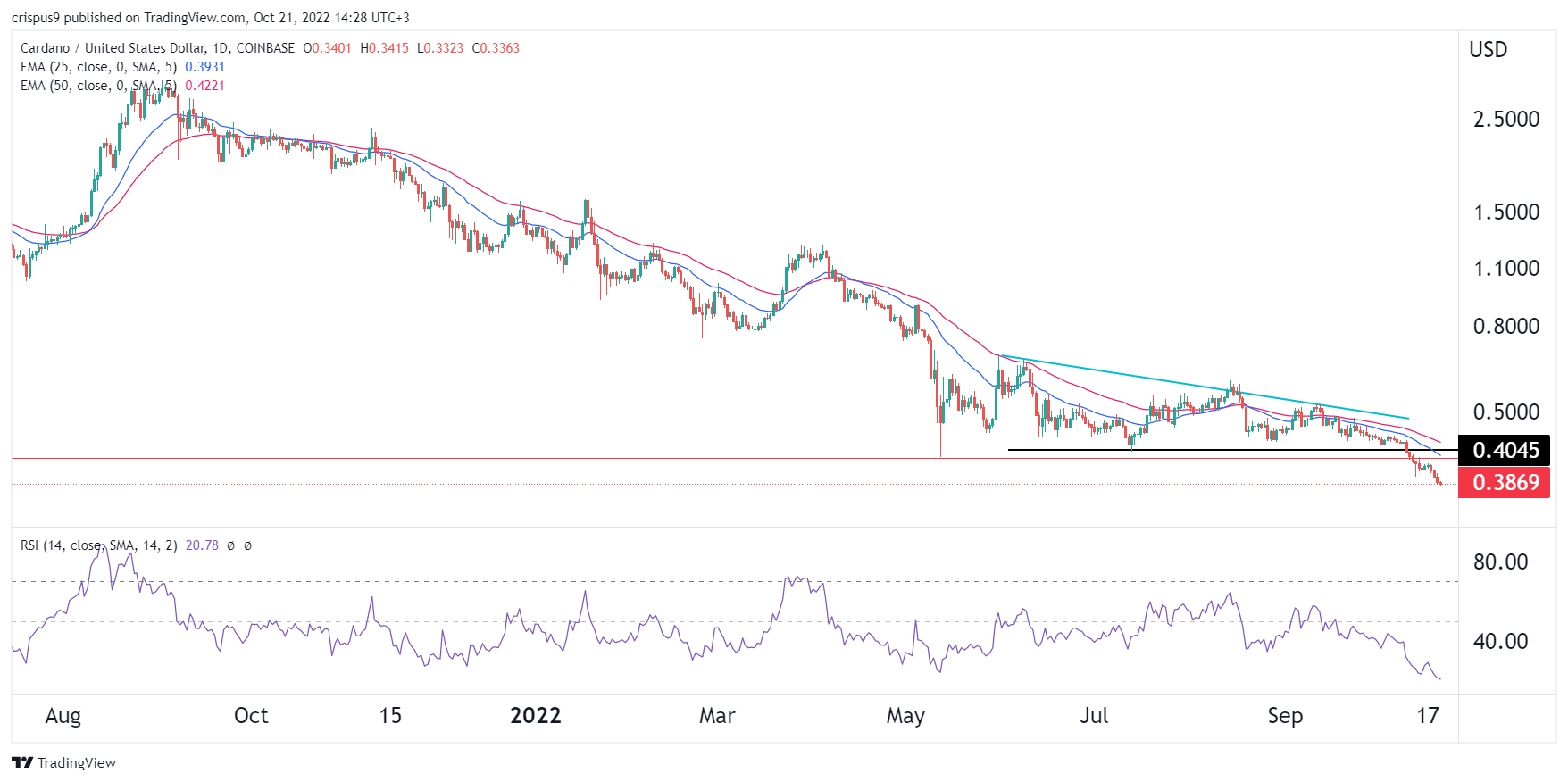
ADA price has been in a steep sell-off in the past few months. After peaking at $3 in 2021, the coin crashed to $0.3869. As a result, its total market cap has plunged from an all-time high of more than $90 billion to about $12 billion. 

Cardano’s underperformance is mostly because the hype it had in 2021 has died away. At the time, most analysts were hoping that it will become the most viable alternative to Ethereum. Today, Cardano’s ecosystem is significantly tiny than most large-cap platforms.

On the daily chart, we see that the coin crashed below the lower side of the descending triangle pattern that is shown in black. It has continued moving below the 25-day and 50-day moving averages while the Relative Strength Index (RSI) has crashed below the oversold level.

Therefore, Cardano price will likely continue falling as sellers target the key support level at $0.035, which is significantly lower than the current level.

EOS price prediction

EOS price has plunged by more than 60% this year and is significantly below its all-time high. Its recent recovery after the Antelope launch has faded. At the same time, its ecosystem has been overtaken by other newer projects like Solana and Avalanche.

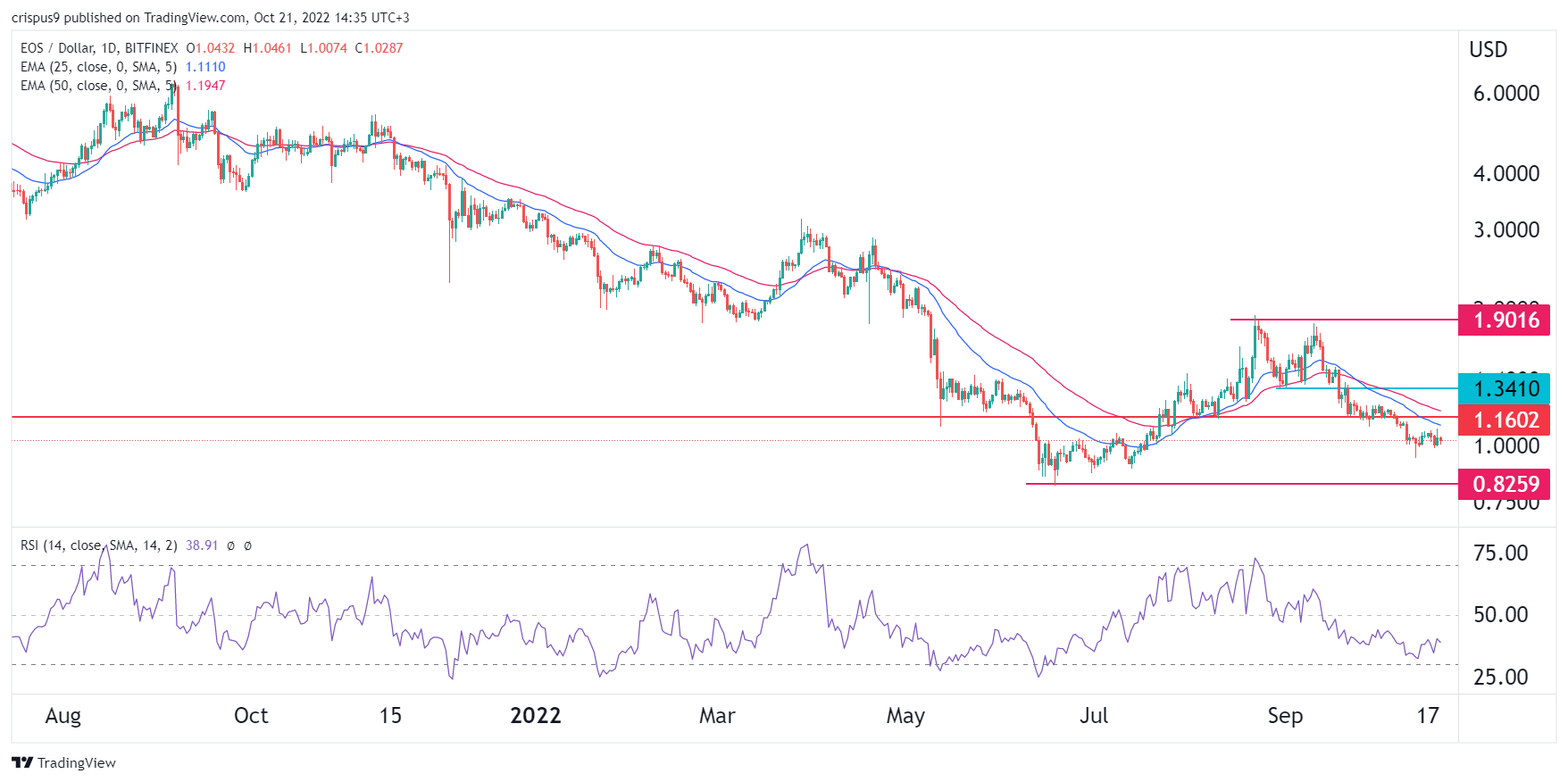
The daily chart shows that EOS formed a double-top pattern at $1.90. In price action analysis, this pattern is usually a bearish sign. The coin has managed to move below the neckline at $1.3410, which was the lowest point on September 1st. Meanwhile, the 25-day and 50-day moving averages have made a bearish crossover.

Therefore, EOS will likely continue falling as sellers target the next key support at $0.825, which was the lowest level on June 18.

Bitcoin Cash price prediction

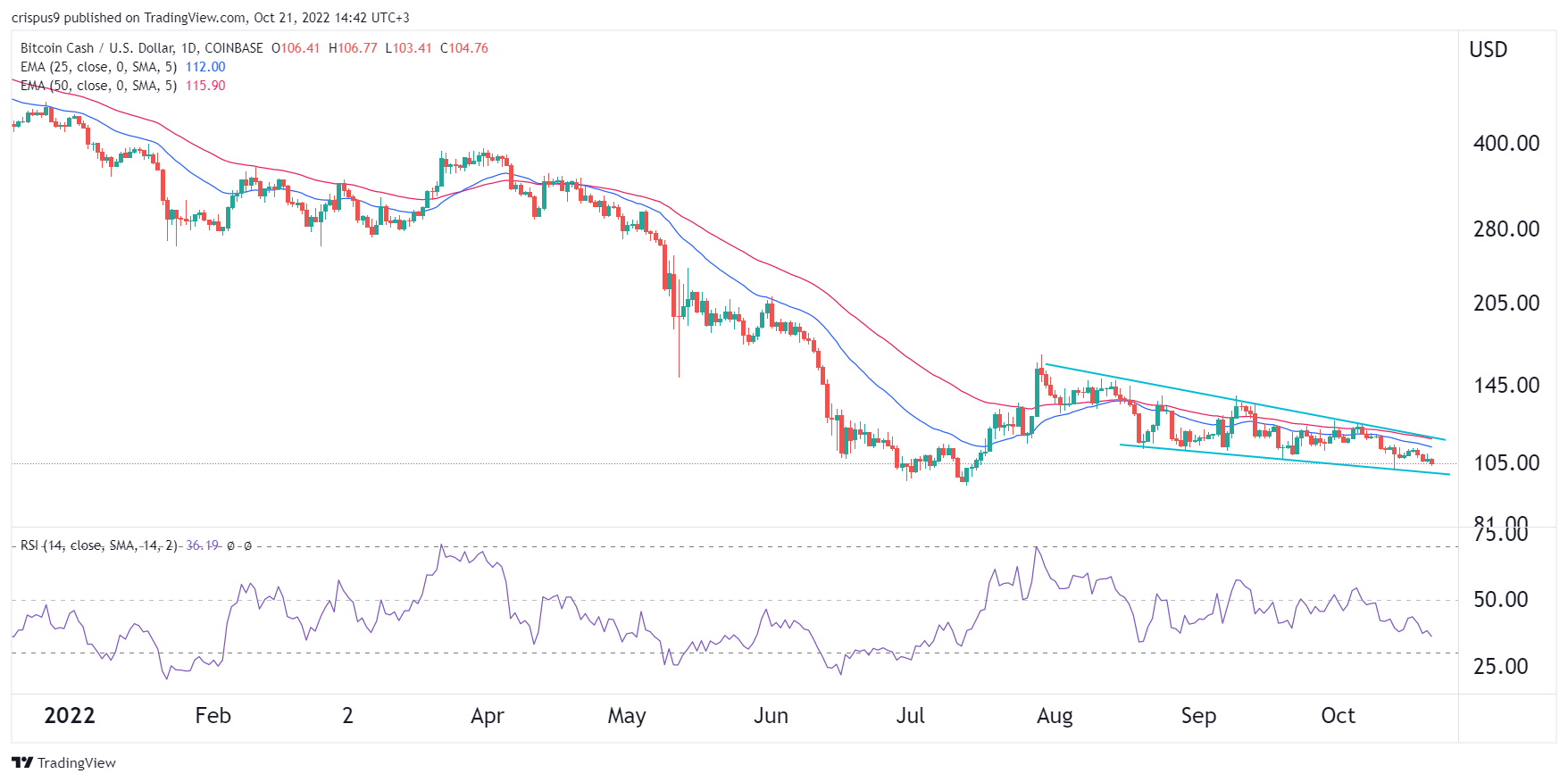
Bitcoin Cash price continued falling as a sea of red engulfed the cryptocurrency market. BCH tends to have a close correlation with BTC. On the daily chart, the coin has formed a falling wedge pattern, which is usually a bullish sign. The downward trend is being supported by the 25-day and 50-day moving averages and the Relative Strength Index.

Therefore, because of the falling wedge pattern, there is a likelihood that Bitcoin Cash will have a bullish breakout in the coming days. If this happens, the next key resistance level to watch will be at $120, which is the upper side of the wedge pattern. On the flip side, a drop below the support at $95 will invalidate the bullish view.

How to buy Bitcoin Cash

eToro

eToro is a global social investment brokerage company which offers over 75 cryptocurrencies to invest in. It offers crypto trading commission-free and users on the platform have the option to manually invest or socially invest. eToro even has a unique CopyTrader system which allows users to automatically copy the trades of popular investors.

Buy BCH with eToro today

Skilling

Skilling is a Scandinavian based cryptocurrency broker which has a desktop website as well as apps for iOS and Android devices. It supports over 50 cryptocurrencies and it has a demo account to allow users to gain familiarity with the platform. Skilling has no hidden fees, it is an officially regulated broker and it supports a wide range of payment methods.

Buy BCH with Skilling today

The post Crypto price analysis: Cardano (ADA), EOS and Bitcoin Cash appeared first on CoinJournal.