Top cryptos to buy in December

Cryptocurrency prices ended November in an upbeat tone after the upbeat statement by Jerome Powell, the Federal Reserve chair. In it, he hinted that the Federal Reserve will hike interest rates at a slower pace when it meets in December. As a result, Bitcoin climbed to $17,000 while the total market cap of all coins jumped to over $859 billion. Here are the top cryptos to buy in December.

GMX

The collapse of centralized companies like FTX, Voyager Digital, Celsius, and BlockFi has led to higher demand for decentralized projects. Most analysts believe that DEX will win against CEX because of their on-chain transparency and decentralization.

GMX is one of the fastest-growing companies in the decentralized industry. It is a decentralized perpetual exchange that makes it possible for people to trade BTC, ETH, and other top cryptocurrencies with 50x leverage. It exists on the Avalanche and Arbitrum chains and has over 173k users. According to its website, it has handled over $88 billion worth of cryptocurrencies in the past few years. 

GMX is the governance token for the network. Unlike FTT, holders of the coin receive 30% of all fees generated on its platform. GLP, on the other hand, is the liquidity provider token that accrues 70% of all fees.

GMX price will likely continue rising in December as investors focus on the growth of the decentralized exchange industry. 

How to buy GMX

Solana

Solana price had a terrible performance in November because of its exposure to FTX and Alameda Research. The two companies held SOL coins worth millions of dollars. As a result, its price crashed hard as investors dumped the coin. The two entities also held vast resources in Serum’s SRM and Bonfida’s FIDA.

Solana price also dropped as investors exited its DeFi ecosystem. The total value locked (TVL) in Solana crashed to below $500 million. At its peak, it had a TVL of over $10 billion. Still, there is a likelihood that Solana will rebound in December. For one, its NFT ecosystem has been doing well in the past few weeks.

How to buy Solana

eToro

eToro is a global social investment brokerage company which offers over 75 cryptocurrencies to invest in. It offers crypto trading commission-free and users on the platform have the option to manually invest or socially invest. eToro even has a unique CopyTrader system which allows users to automatically copy the trades of popular investors.

Buy SOL with eToro today

OKX

OKX is a top cryptocurrency exchange which offers over 140 cryptocurrencies to invest in. OKX takes customer security very seriously, they store almost all of their clients‘ funds in cold storage, and the exchange is yet to be hacked. On top of this, the exchange offers very low fees and customers can even use their crypto as collateral for loans on the platform.

Buy SOL with OKX today

MATIC

Polygon is a leading layer-2 network that helps developers solve some of the challenges in Ethereum. It has been used widely by some of the biggest blockchains in the world like Aave, Uniswap, and Balancer. In total, Polygon has seen the total value locked (TVL) collapse from over $12 billion to about $1.2 billion.  

MATIC is a good buy in December ahead of the resilience of its ecosystem and the ongoing developments. It has also formed an inverted head and shoulders pattern, which could see its price resume the bullish trend.

How to buy Polygon

eToro

eToro is a global social investment brokerage company which offers over 75 cryptocurrencies to invest in. It offers crypto trading commission-free and users on the platform have the option to manually invest or socially invest. eToro even has a unique CopyTrader system which allows users to automatically copy the trades of popular investors.

Buy MATIC with eToro today

OKX

OKX is a top cryptocurrency exchange which offers over 140 cryptocurrencies to invest in. OKX takes customer security very seriously, they store almost all of their clients‘ funds in cold storage, and the exchange is yet to be hacked. On top of this, the exchange offers very low fees and customers can even use their crypto as collateral for loans on the platform.

Buy MATIC with OKX today

The post Top cryptos to buy in December appeared first on CoinJournal.

FTX US is “fully solvent” and withdrawals could resume today, Sam Bankman-Fried

In an interview by The New York Times Andrew Ross Sorkin at the media house’s annual DealBook Summit, Sam Bankman-Fried (SBF), the former Chief Executive of the collapsed crypto exchange FTX, said the FTX US was fully solvent according to his knowledge.

KEY TAKEAWAYS

  • In the interview, SBF admitted he “screwed up” and made mistakes while CEO at FTX.
  • SBF said he should have focused more on risk management and protecting customers.
  • On philanthropy, SBF said that his donations were “mostly for pandemic prevention.”

SBF has been quite vocal about the collapse of FTX on social media platforms, especially on Twitter. His interview at the DealBook Summit on Wednesday was virtually his first time to appear in the media spotlight in person since the fall of the FTX crypto exchange.

During the interview, SBF addressed a number of issues including his role in the collapse of FTX, his philanthropy, real estate in the Bahamas, and everything else in between.

SBF admitted that he messed up and did huge mistakes as the CEO at FTX and said that he should have focused more on protecting customers and risk management.

FTX US is ‘fully solvent”

During the interview, SBF also said that he was optimistic that some customers, particularly those from the US could be sorted out although he was quick to add that he could not promise anything.

Commenting on the FTX US solvency, SBF said:

“The US platform—the US regulated platform with American users—to my knowledge, that’s fully solvent. That’s fully funded and I believe that withdrawals could be opened up today and everyone could be made whole from that.”

SBF also commented on LedgerX and FTX US derivatives saying that the FTX US derivatives and LedgerX might “even be running right now.”

LedgerX was acquired by FTX earlier this year and is reportedly preparing to transfer $175 million towards the FTX bankruptcy proceedings.

On his philanthropic nature, SBF said that his donations were “mostly for pandemic prevention.”

Commenting on his parents allegedly purchasing 19 properties worth $121 million in the Bahamas over the past two years, SBF said:

“It was not intended to be their long-term property. I don’t know how that was paid for.”

The post FTX US is “fully solvent” and withdrawals could resume today, Sam Bankman-Fried appeared first on CoinJournal.

Will UNI rally higher after Uniswap launches NFTs on its network?

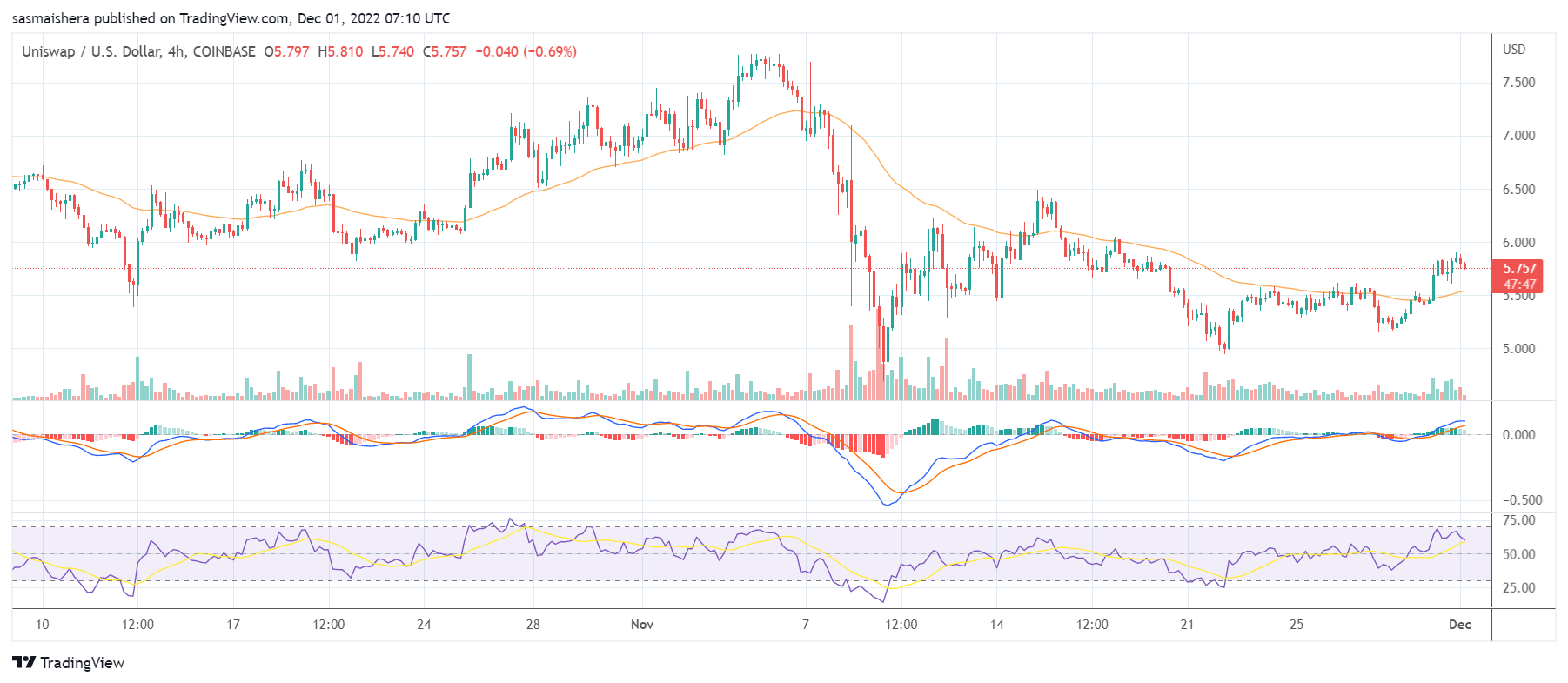
  • UNI is up by less than 1% in the last 24 hours but could rally higher before the end of the day. 

  • Uniswap announced a few hours ago that NFTs are officially live on its network. 

  • The total crypto market is slowly inching closer to the $900 billion mark. 

NFTs are now live on the Uniswap network

UNI, the native token of the Uniswap decentralised exchange, is up by less than 1% in the last 24 hours. It is underperforming against the broader crypto market but could rally higher over the next few hours.

The positive performance comes a few hours after Uniswap announced that nonfungible tokens (NFTs) are officially live on its network.

Uniswap revealed that its users can now trade NFTs across major marketplaces to find more listings and better prices. At launch, Uniswap said it would support the major NFT marketplaces, including OpenSea, X2Y2, LooksRare, Sudoswap, Larva Labs, X2Y2, Foundation, NFT20, and NFTX.

At press time, the price of Uniswap stands at $5.763 per coin. UNI is underperforming compared to the broader crypto market. The total crypto market cap stands at $860 billion, up by 1% today.

Bitcoin is also up by more than 1% in the last 24 hours and roughly 3% so far this week. The price of Bitcoin stands at $17,105 and could rally toward $17,500 over the next few hours.

Key levels to watch

The UNI/USD 4-hour chart is bullish, as Uniswap has been performing well over the last 24 hours. The technical indicators show that UNI could be ready for a breakout soon.

The 14-day RSI of 69 shows that UNI could enter the overbought region if the bulls could embark on a massive run in the coming hours or days. The MACD line is above the neutral zone, indicating bullish momentum.

If the bullish momentum continues, UNI could surge past the first major resistance level at $6.097 before the end of the day. In the event of an extended rally, UNI could test the $6.457 resistance level soon. 

Where to buy UNI now

eToro

eToro is a global social investment brokerage company which offers over 75 cryptocurrencies to invest in. It offers crypto trading commission-free and users on the platform have the option to manually invest or socially invest. eToro even has a unique CopyTrader system which allows users to automatically copy the trades of popular investors.

Buy UNI with eToro today

OKX

OKX is a top cryptocurrency exchange which offers over 140 cryptocurrencies to invest in. OKX takes customer security very seriously, they store almost all of their clients‘ funds in cold storage, and the exchange is yet to be hacked. On top of this, the exchange offers very low fees and customers can even use their crypto as collateral for loans on the platform.

Buy UNI with OKX today

The post Will UNI rally higher after Uniswap launches NFTs on its network? appeared first on CoinJournal.

The 7 Best Play-To-Earn Games For 2022

Play-to-earn gaming is a revolution set to shake up the gaming industry for good. Instead of players buying in-game items they can never actually own, play-to-earn puts ownership front and center, allowing gamers to profit directly from the games they play. 

If you’re searching for the best play-to-earn games, we’ve got your back. In this article, we’ve listed seven of the best P2E games that are leading the way in the future of gaming. Let’s dive right in.

1. Metacade (MCADE) – the Place for Discovering the Best P2E Games

Metacade is a community hub for discovering, earning more from, and influencing the world of play-to-earn games. It’s a platform that aims to be the number one destination in Web3 for players, crypto fanatics, developers, and entrepreneurs to find their part in the play-to-earn revolution. 

While it’s not a play-to-earn game itself, Metacade has big plans to direct the future of play-to-earn as GameFi’s central platform. Part of this plan is in turning Metacade into the ultimate repository for finding the best play-to-earn games, and learning how to maximise your income from play-to-earn gaming. To do this, Metacade incentivises its users to share reviews, alpha, and other useful content with the MCADE token. That’s right – you can get paid for simply sharing your thoughts and expertise with the community.

That’s not the only way you can get paid with Metacade, however. You can participate in exclusive tournaments and test games for Metacade’s developer community to earn a little extra on the side. But perhaps the feature with the greatest impact on your income will be the launch of Metacade’s job board in 2024. This will allow gamers to find part-time testing opportunities, internships, and even salaried positions working with some of the best metaverse games. 

One feature that could propel Metacade to industry-leading status is Metagrants, a way for the community to fund the best play-to-earn games they want to see developed. Metagrants will see game developers going up against dozens of other competing ideas for the Metacade community to vote on. 

The winning developers receive life-changing funding to build their vision alongside their games’ most avid fans, adding their game to Metacade’s virtual arcade. One day, Metacade plans for this arcade to be filled with dozens of the best, community-chosen P2E games.

Ultimately, Metacade’s main objective is putting gaming back into the hands of the players. As you’ll see, play-to-earn gaming has enormous potential, already drawing hundreds of thousands of players that keep coming back for more. With Metacade’s plans to generate some of the best play-to-earn games the industry will ever see, it’s coming first on our list. Keep your eye on Metacade; it could easily be a game-changer.

>>> You can participate in the Metacade pre-sale here <<<

2. The Sandbox (SAND)

The Sandbox is one of the best play-to-earn games on the market today. It’s a 3D virtual world broken up into 166,464 parcels of land, represented by the LAND NFT, that can be used to build whatever the owner can imagine, like social hubs, games, or immersive experiences. Every creation is stored on the blockchain as an NFT, giving players true ownership over whatever they build. For example, unique objects made in VoxEdit are immortalised as ASSETs, enabling them to be traded for SAND tokens or used in the Game Maker.

The Game Maker is one of The Sandbox’s most powerful features. It allows anyone, regardless of their coding or development experience, to build interactive games that can be monetised with the SAND token. This has led to incredible games and experiences created inside The Sandbox’s metaverse, like Dracula’s Castle, The Walking Dead: Stay Alive, and WMG Land, an immersive theme park built by Warner Music Group. 

Given the potential of The Sandbox to allow users to monetise their creations while exploring the games and experiences built by others, it’s our second choice as one of the best play-to-earn games.

3. Axie Infinity (SLP/AXS)

Axie Infinity is a prime example of one of the best P2E games. It’s a game built around collecting, breeding, and battling cute monsters named Axies. By winning battles, completing quests, and exploring the World of Lunacia, players can earn Smooth Love Potion (SLP) and Axie Infinity Shards (AXS) – a cryptocurrency that can be sold for fiat.

Axies can also be traded on the Axie Infinity Marketplace for profit, either by investing in Axies to sell on later or by breeding your own Axies to spawn new ones. As Axies have a set of unique attributes, some are rarer than others, with the rarest selling for hundreds of thousands of dollars.

As Axie Infinity runs on both Ethereum and the Ronin sidechain, transacting on the marketplace comes with virtually no fees. Combined with the earnings made by simply playing the game, this led to a massive surge in popularity for Axie Infinity in 2021, with reports of players in lower-income countries playing the game as they earnt more than their real-world jobs! For these reasons, Axie Infinity is ranked third in our list of the best play-to-earn games.

4. Alien Worlds (TLM)

Alien Worlds is the most popular P2E game, according to DappRadar. It’s a sci-fi-based metaverse set in space, featuring a vast universe of planets that players can visit and start mining for the game’s cryptocurrency, Trillium (TLM). There are several worlds, each with 500 plots of land that can be bought and rented out to miners for a commission. The game’s objective is to expand your mining empire while completing quests and battling other players for the chance to win TLM and NFTs to use in-game.

Players can also stake their TLM tokens in a gamified system to earn even more from their time playing Alien World. Known as Missions, players lock up their tokens for a specific period (1 to 12 weeks). The greater the amount of time, the rarer the NFTs earnt from staking. There are even planetary DAOs, which allow the planet’s citizens to have their say in key decisions that affect each world.

These features have attracted a massive user base to Alien Worlds, with over 200,000 players interacting with the game daily! This prompts us to put it as our fourth choice for the best play-to-earn games.

5. Splinterlands (DEC)

Splinterlands is a trading card game that has quickly climbed the ranks to become one of the best P2E games. It features one-to-one battles that see your cards battling it out in a style not dissimilar to Magic: The Gathering in order to rank higher on your level’s leaderboards. At the end of the in-game seasons, you’re paid Dark Energy Crystals (DEC) based on how high you rank. DEC can then be used to buy better cards, increasing your chances of winning and levelling up.

These cards can be bought and sold in-game and on third-party marketplaces, thanks to each card being its own NFT. The price of cards can range from 0.01 up to 1 ETH for some of the best cards, each with different stats that make them more or less valuable. 

An entire rental market has even opened up to help players climb the ranks while offering a passive income for those renting the cards! Splinterlands is the second most popular play-to-earn game, just before Alien Worlds, with nearly 350,000 monthly active users, according to DappRadar. This makes putting Splinterlands at number five in this list of the best play-to-earn games an easy choice.

6. Gods Unchained (GODS)

Gods Unchained is another P2E trading card game that allows players to earn the GODS token by simply playing the game. The gameplay takes place in an arena that sees players taking turns to deal damage to the other player’s 30 cards, summoning monsters and casting spells along the way.

The game has some earning mechanics that easily make it one of the best P2E games. The first is by simply winning games, which rewards players with Flux, an in-game currency. Flux can be used to rank up or upgrade cards, which can be sold on for a profit. Ranking up increases the amount of Flux you can earn after each match, meaning you can quickly gain better cards to win one of Gods Unchained’s weekly tournaments. By winning these tournaments, you earn card packs, giving you more cards to trade. 

Gods Unchained’s motto is “if you can’t sell your items, you don’t own them,” a powerful message to the game’s players that ownership is in their hands. As a whole, Gods Unchained is one of the best play-to-earn games out there, coming sixth on our list.

7. Farmers World (FWW/FWF/FWG)

Farmers World is one of the most popular play-to-earn games, amassing over 100,000 weekly players, according to DappRadar. Farmers World is a passive mining game with the goal of mining three in-game tokens: Wood (FWW), Food (FWF), and Gold (FWG).

To start farming, you need tools, which can be bought and sold as NFTs or crafted using raw materials. Once you have your tools, you can choose which area you want to focus on, like raising animals, chopping wood, or mining for gold. Each tool has its own durability index, requiring Gold to repair. You also need energy to continue mining, giving players the challenge of balancing resources, energy, and mining.

There are also Member cards, which are NFTs that can be applied to your character to mine more resources, increase the number of tools you can carry, and more, effectively allowing you to up your earnings while playing. These cards can fetch hundreds and even thousands of dollars.

Despite being one of the more passive games on our list of the best P2E games, it’s still gained a respectable user base that’s earning just by logging in and adjusting their mining! For this reason, it comes seventh on our list as one of the best play-to-earn games.

Metacade (MCADE): Hosting the Best Play-To-Earn Games

With plenty of fantastic games on this list, it’s hard to know where to start if you’re looking to make the most of play-to-earn gaming. But if you’re seeking to maximise your gains from play-to-earn, then Metacade should clearly be your first choice. 

Given that Metacade is literally a meta platform for finding and playing the best play-to-earn games, it’s effectively a direct investment into the future market of play-to-earn gaming. Regardless of any one game’s performance, the platform will always be there as a beacon of play-to-earn. With its token still in presale, Metacade represents a staggering investment opportunity to jump in early on what could be the future centre of blockchain-based gaming. 

You can participate in the Metacade pre-sale here.

The post The 7 Best Play-To-Earn Games For 2022 appeared first on CoinJournal.

Why DeFi Will Lead Us to the Next Bull Run

  • The crypto sector continues to battle masive contagion following FTX’s collapse and the 2022 bear market.
  • Despite total value locked in decentralised protocols falling significantly amid the crypto winter, DeFi still shows considerable growth over pre-pandemic levels.
  • Away from price action, DeFi and NFTs have shown massive potential to drive adoption.

In the depths of crypto winter it can be hard to predict where the next crypto bull run might come from – but the clues are certainly there.

While it’s too early to tell which assets will lead the market revival, the sector that will kickstart this rally is likely to be DeFi. Although not immune from the market malaise that’s permeated in the wake of the FTX scandal, the transparency and immutability on which DeFi is built have earned the industry plaudits amidst the recriminations.

Understanding why decentralised finance will be at the vanguard of any impending market recovery calls for a recap of how we got here.

Winter is here 

The last crypto bear market had its roots in rampant over-speculation. The ICO boom of 2017 eventually led to the ICO bust of 2018, taking vaporware projects down with it.

This cycle has been markedly different. The crypto winter of 2022 did not start with blockchain – the chill blew in from the wider global economy. 

It’s no exaggeration to say that the global economy has seen better days. Traditional finance and centralised systems have been rocked by a series of profound shocks, exacerbated by profound political mismanagement. 

Despite this, crypto bucked the trend last year, holding out against the macroeconomic headwinds. Eventually, however, the price of bitcoin began to drop from its November 2021 high and the market began its multi-month drawdown, slowly at first and then quickly.

The first major domino to fall was Terra (LUNA) and its dollar-pegged stablecoin UST. Then came Celsius, Babel, CoinLoan, Three Arrows Capital, Voyager, and BlockFi. More recently, Sam Bankman-Fried, FTX, and Alameda joined the list of the fallen, claiming plenty of collateral damage in the process.

In fact, the contagion had already worked its way through the entire crypto ecosystem during the height of the bull run. FTX was merely its apotheosis when the full extent of the cancer was discovered.

That contagion is centralisation.

It’s easy to forget the basics during the height of a bull run. When money is plentiful, greed gains a toehold, and users become complacent and soft. Crypto winter provides ample time for sombre reflection. 

The first lesson to be mulled is the simplest: decentralisation matters. Without it, the industry is only as strong as its CeFi leaders with their feet of clay.

Centralised finance asks that customers trust in a platform and hope that its leaders will do right by them. As customers of Celsius and FTX will attest, when that trust is misplaced in bad actors, there are disastrous results.

DeFi is working hard

Centralised crypto platforms may be suffering greatly, with a string of collapses this year, but decentralised finance continues to march on. The total value locked in decentralised protocols sits at $41 billion, a considerable fall from peak levels, but still showing remarkable growth from pre-pandemic figures.

The continuing resilience of DeFi represents a success story when compared to the ignominious failure of centralised crypto. DEX volumes routinely pass $1.5 billion a day while demand for onchain derivatives is growing, buoyed by FTX’s ungraceful exit. GMX (Arbitrum) and gTrade (Polygon) have joined DeFi derivatives leader dYdX in leading the charge.

Since the start of the year, dYdX has been working towards becoming fully decentralised. Version 4 is earmarked for launch in the second quarter of 2023 and will mark the evolution of the exchange into a wholly decentralised platform. dYdX chain will be built on Tendermint consensus technology and mark the arrival of the exchange on Cosmos. This will allow dYdX to offer customers “a fully decentralised, off-chain, orderbook and matching engine.”

Amidst all the brouhaha surrounding FTX’s demise and the resultant contagion that’s touched both CeFi and DeFi, the Cosmos ecosystem has been quietly getting on with business as usual. An ongoing incentivized testnet, dubbed Game of Chains, is helping validators develop confidence around Interchain Security (ICS). 

Once live, this feature will allow the Cosmos Hub to share security with “consumer chains” which will benefit from the security model supplied by billions of dollars of staked ATOMs.

Projects within the Cosmos ecosystem have been busily shipping too. Loop Markets, a platform for trading NFTs and DeFi assets, is building out its products on Juno, bolstered by a funding grant. In Q1, Loop will release Eclipse Launchpad to support new projects launching on Juno with the aid of IDOs conducted on Loop Dex.

Elsewhere, Cosmos developers Interchain Foundation have formed a Technical Advisory Board as part of their efforts to rebuild trust with the community, improve transparency and drive community engagement. From delivering better governance to improving protocol security, these efforts are helping to position Cosmos as the blockchain ecosystem likeliest to drive the next wave of DeFi innovation.

NFTs keep evolving

NFTs haven’t been immune from the year-long market downturn, with blue chip collections down an average of 75%. Step away from the price action, however, and you’ll find a sector that is brimming with possibility and purpose.

Beyond the collectibles scene, NFTs can be used for a wide number of purposes. From music to real estate, to digital IDs and real estate (both in the real world and metaverse), the applications of this technology are manifold.

In the music industry, NFTs are being used by musicians to tokenize their music and to directly profit from royalties and resales. This supports use cases like gig tickets being tokenised, removing the possibility of scalpers selling tickets on. NFTs are also being used in supply chains to improve records and make auditing simpler. Non-fungible tokens can even demonstrate ownership of real world property such as real estate rights and support fractionalization.

Conclusion

This crypto winter has its roots in the bad decisions of centralised authorities. Over the past three years, governments and central banks around the world have proven to be spectacularly poor custodians of the financial world.

Bad decision after bad decision has crashed economies, destroyed labour markets and instigated runaway inflation that’s devalued fiat currencies and eroded consumer spending power.

Crypto has not been immune from poor centralised planning either. Bad decisions in national government have been compounded by bad actors within the crypto industry itself. Centralised companies including exchanges, lenders, and venture capitalists got greedy.

The antidote to this is decentralisation. While decentralised platforms are not immune to wider economic forces, they have proven better equipped to handle the very worst of the duress. 

Decentralisation and those who stick with it will eventually emerge from this winter stronger than ever.

The post Why DeFi Will Lead Us to the Next Bull Run appeared first on CoinJournal.