
Bitgert (BRISE) forms a symmetrical triangle as popularity wanes

Bitgert price has remained under intense pressure as the platform’s popularity wanes. BRISE, its native token, has plunged to a low of $0.00000047, the lowest point since February 17. It has plunged by more than 27% from its highest point in February even as Bitcoin is hovering near the key resistance point this year.

Popularity wanes

All indications are that Bitgert is losing its popularity around the world. One way of knowing this is to check the volume of Google searchs of the coin. This is important because Google is the most popular search engine in the world. In most periods, a popular cryptocurrency or any other asset will tend to have more searches.

Google Trends data shows that the volume of the term Bitgert has crash to the lowest point since December. The same is true for other related keywords like Bitgert price and Bitgert crypto. 

Another way to look at this is to consider the activity in the network’s DeFi ecosystem. Data published by DeFi Llama shows that the total value locked (TVL) in Bitgert’s ecosystem has dropped to 4.17 trillion BRISE, which is its lowest level on record. In dollar terms, the TVL stands at about $1.96 million, down from its all-time high of over $10 million.

The most recent Bitgert news is that the developers are about to launch the iOS version of its exchange. In a Tweet, they said that the app was accepted by Apple and that they had activated the testflight. Its mainnet will go live during the weekend.

The other important Bitgert news is that the developers launched a product that makes it possible for people to launch their meme coins within a few minutes. The meme coins can then initially be traded in Bitgert’s exchange.

Bitgert price forecast
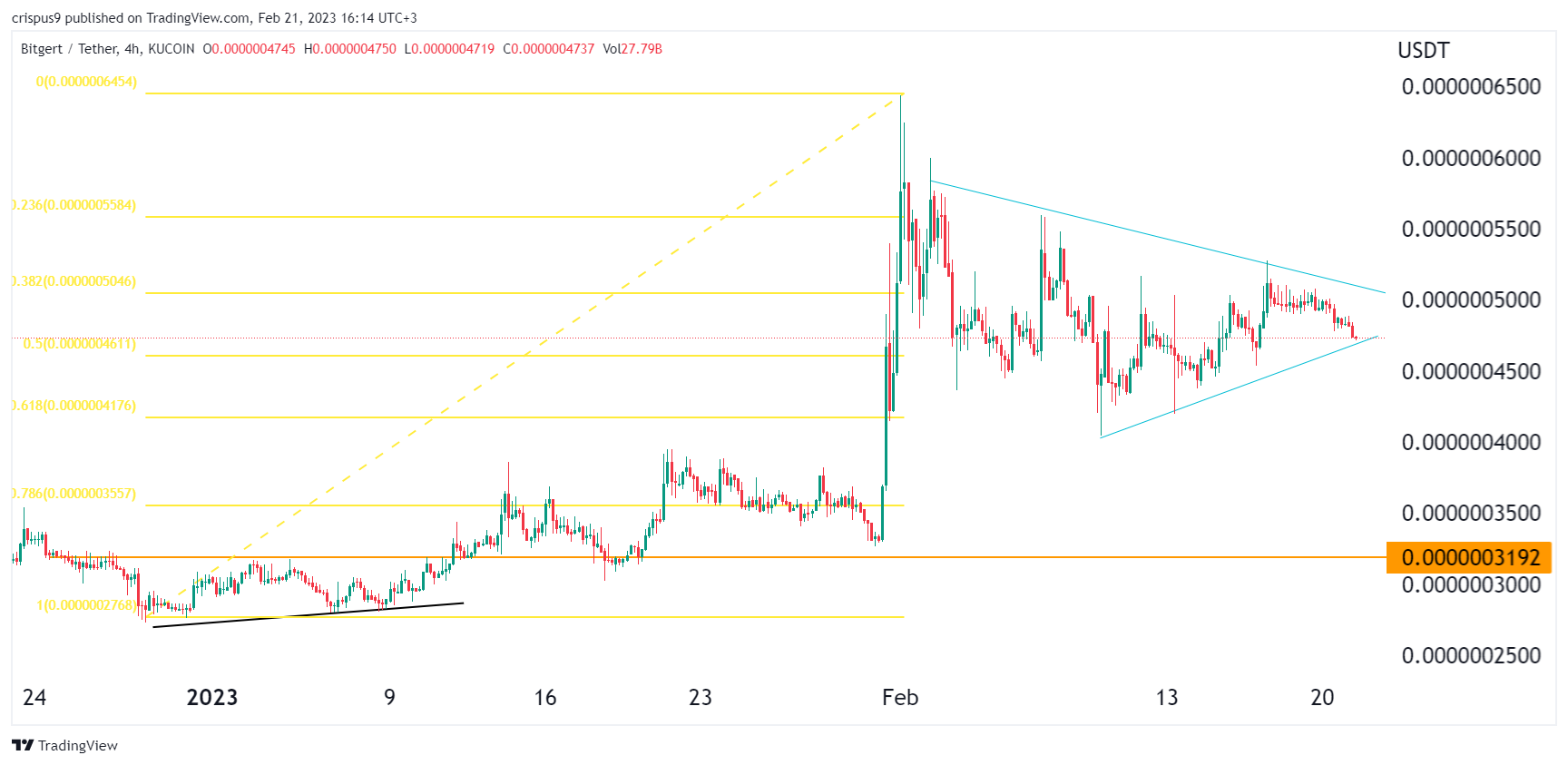
The four-hour chart shows that the BRISE price has been in a consolidation phase in the past few days. It has formed a symmetrical triangle pattern that is shown in green. It has also dropped below the 25-day moving average and is slightly above the 50% Fibonacci Retracement level. 

Therefore, the outlook for Bitgert price is neutral at this stage. A bearish view will be confirmed if it manages to move below the lower side of the triangle pattern. If this happens, the coin will plunge to a low of $0.00000042. On the other hand, a move above the upper side of the triangle at $0.00000051 will signal that bulls have prevailed.

How to buy Bitgert

As BRISE is such a new asset, it’s yet to be listed on major exchanges. You can still purchase BRISE using a DEX (decentralised exchange) though, which just means there are a few extra steps. To buy BRISE right now, follow these steps:

1. Buy BNB on a regulated exchange or broker, like Binance ›

We suggest Binance because it’s one of the world’s leading multi-asset trading platforms, an exchange and wallet all-in-one with some of the lowest fees in the industry. It’s also beginner-friendly, and has more payment methods available to users than any other available service.

2. Send your BNB to a compatible wallet like Trust Wallet or MetaMask

You’ll need to create your wallet, grab your address, and send your coins there.

3. Connect your wallet to the 1Inch DEX

Head to 1Inch, and ‚connect‘ your wallet to it.

4. You can now swap your BNB for BRISE

Now that you’re connected, you’ll be able to swap for 100s of coins including BRISE.

The post Bitgert (BRISE) forms a symmetrical triangle as popularity wanes appeared first on CoinJournal.
Bitcoin saw 78% of outflows as $32 million exited crypto asset investments

  • Bitcoin products saw $25 million in outflows last week, according to asset manager CoinShares.
  • There was $3.7 million in short Bitcoin as investor sentiment flipped negative on recent regulatory concerns.
  • But crypto prices still recorded huge moves, with BTC hitting a six-month high above $25,000.

Bitcoin price hit its highest price level in six months last week, with the flagship cryptocurrency testing bears’ resolve above the $25,300 zone.

However, digital asset management firm CoinShares says despite reaching a new year-to-date high, the flagship cryptocurrency still bore the brunt of the negative sentiment that pierced the market as US regulators upped their crackdown on multiple industry sectors.

Digital assets see $32 million in outflows

As CoinShares Head of Research James Butterfill points out in a weekly funds flow report released on Monday, Bitcoin recorded the largest share of outflows seen in the digital assets investment products last week.

Per the researcher, total crypto funds outflows totaled $32 million this past week, the largest single week outflows since December last year. But almost $25 million of the outflows were in Bitcoin products, with negative sentiment seeing short Bitcoin investment products account for $3.7 million in inflows.

Infact, as US Securities and Exchange Commission (SEC) increased its crackdown on stablecoins and staking services among other sectors of the crypto industry, crypto outflows hit $62 million. The market did record significant outflows as Bitcoin led the market in holding prices above key levels.

According to Butterfill, the mid-week flip in sentiment (with Bitcoin price soaring more than 10%) helped digital assets products register $30 million in inflows. This in turn helped push the total assets under management in exchange-traded products (ETPs) to its highest level since last August. Butterfill noted:

“The negative sentiment amongst ETP investors was not expressed in the broader market with Bitcoin prices rising by 10% over the week, this price appreciation pushed total assets under management (AuM) to US$30bn, their highest level since August 2022. We believe this is due to ETP investors being less optimistic on recent regulatory pressures in the US relative to the broader market.”

Crypto assets saw mixed flows

While Bitcoin recorded over 78% of the outflows, Ethereum products saw $7.2 million in outflows last week. Other top altcoins with large withdrawals included Cosmos ($1.6 million), Polygon ($0.8 million), and Avalanche ($0.5 million).

Yet, investment products for Aave, Binance, Fantom, XRP, and Decentraland saw inflows of between $0.36 million and $0.26 million, CoinShares highlighted in its report.

Elsewhere, while crypto assets experienced a second consecutive week of outflows, blockchain equities had a more positive outlook from investors, with $9.6 million in inflows last week. Blockchain equities have now had six consecutive weeks of inflows.

The post Bitcoin saw 78% of outflows as $32 million exited crypto asset investments appeared first on CoinJournal.

17% of BUSD supply redeemed this week. What next for Binance, BNB and crypto?


Key Takeaways

  • 17% of the BUSD supply has been pulled from exchanges in the last week
  • BNB has been curiously resilient, above the level it was pre-announcement of the BUSD shutdown
  • Regulatory trouble won’t stop anytime soon for Binance, which is already under investigation by the Departement of Justice for alegged anti-money laundering breaches 

I remember arguing in the past that one of the best things that could happen crypto would be if the industry slowly waned itself off Tether.

Whatever your opinion of the controversial stablecoin or, more specifcially, the do-they-don’t-they question of its reserves, the conversation is damaging for crypto as a whole, so I wrote. 

I did wonder how it would be possible, however. Could an entire industry just harmelesly migrate to other stablecoins, watching Tether’s market cap peacefully fade until it was no longer an enormous risk to the entire space? 

But in a curious twist of fate, the industry is actually slowly waning itself off another stablecoin. That stablecoin is BUSD, which on February 13th was announced as allegedly being in violation of securities laws, the SEC coming for its New York-based issuer, Paxos (I crafted a deep dive on what it all means here). 

And it’s all going rather smoothly, at least outside the offices of Binance. 

Balance of the BUSD exchanges on exchanges has fallen from $14.5 billion on the day of the announcement to $12.0 billion, a 17% wipeout in just over a week. 

With Paxos forced to stop minting new BUSD tokens, the stablecoin will quite literally fade into the oblivion, dollar by dollar. “BUSD market cap will only decrease over time”, as the big man himself said.

Paxos have confirmed that they will redeem BUSD at least until February 2024, while Binance have announced they will reduce trading pairs offered for the coin. Investors are already queuing for the exit, as seen by the above balance on exchanges. 

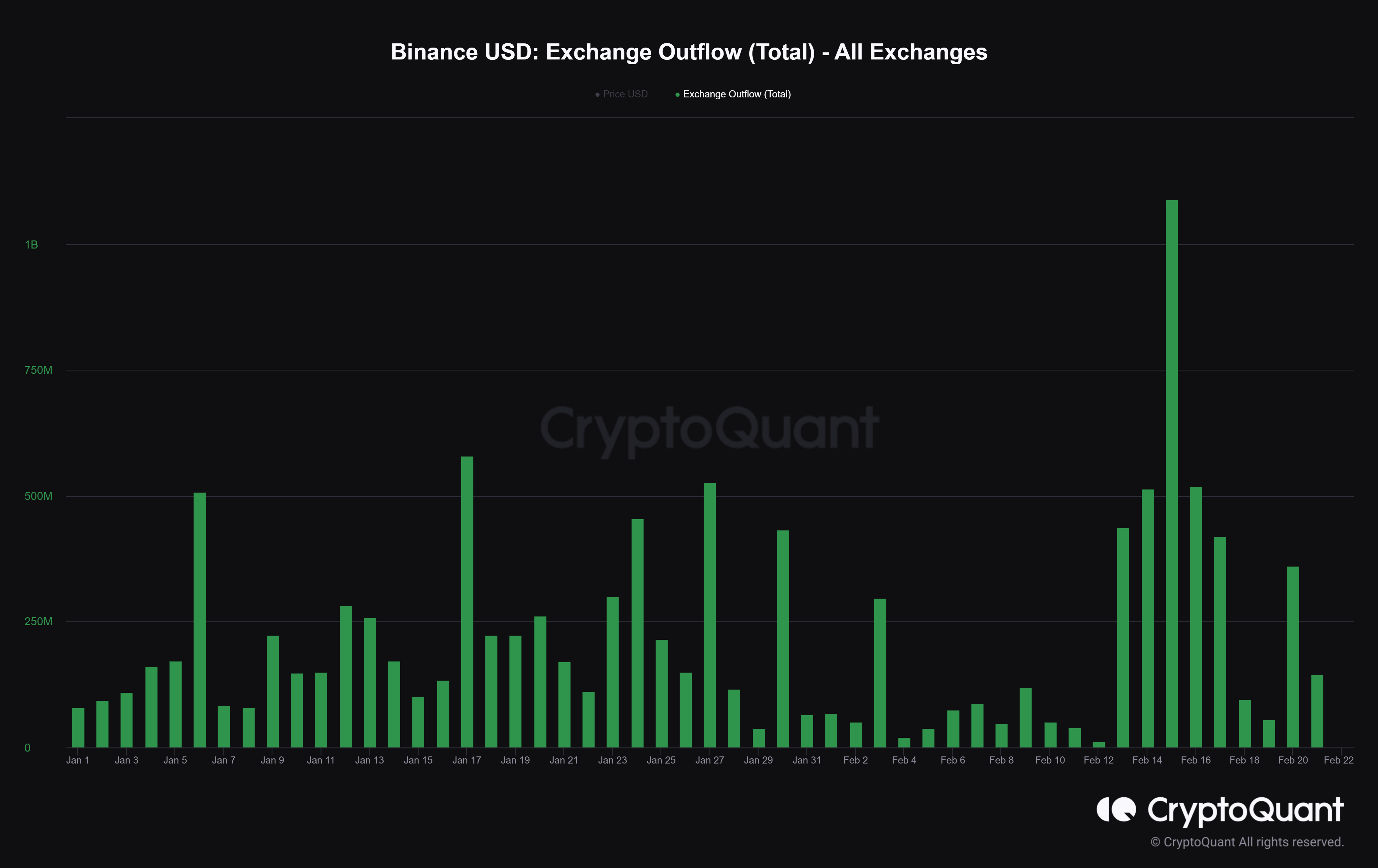
However, it hasn’t been overly dramatic. The below chart from CryptoQuant shows a definite uptick in outflows around February 13th/14th in the immediate aftermath of the announcement, yet beyond that the chart doesn’t seem overly out of whack. 

All in all, this seems to show BUSD exiting stage left in rather a rather subdued manner. Hey, it’s good to get a little calm in crypto for once, I suppose. 

Massive blow for Binance

So, panic seemingly over – for the market, at least. There is no getting around the fact that this development is a substantial blow to Binance’s business. It had designs on dominating the market, even more so that it already does. 

I wrote a deep dive into the stablecoin war last October, a war which Binance was beginning to make ground in. It announced the anit-competitive, albeit brilliant move business-wise, to delist a selection of other stablecoins, including USDC, for favour of its BUSD coin. It also autoconverted customer holdings into the latter. 

The landscape was starting to looking even rosier for the biggest crypto company on the planet. 

But the SEC blew up the party last week, reversing all Binance’s progress. A crucial method to their growth going forward, the loss of their native stablecoin is a colossal blow. 

This is why I find it surprising to look at the price action of BNB, the native token of the Binance platform. It has held up remarkably well, trading at around $310 pre-announcement before dropping to $284, only to bounce back to where it now trades at $312, more or less the same level it was before this storm. 

BNB is more valuable the more valuable Binance is, as the token has no real use case beyond the platform, where it used by customers for all sorts of features, primarily lower fees. I would have expected it to shrink somewhat in the aftermath of this news. 

It doesn’t exactly settle my stomach on the topic of native tokens. I have been critical of these in the past and will continue to do so going forward – there is no reason for these companies to create a cryptocurrency and whack it on the blockchain. 

The tokens commonly come with huge insider allocations, elastic supply mechanisms and, as is typical with all things in crypto today, cloaked in secrecy – the lack of transparency is a real concern. But that is not overly relevant for this piece, I suppose. 

When I look at BNB not moving downward, I struggle to explain why it hasn’t moved down. I think it would be natural to do so, given the haymaker taken by its parent company. Then again, plotting the token against Bitcoin since throughout the bear market shows it has actually outperformed the world’s king crypto – something alt coins are not meant to do.

A testament to Binance’s immense growth, but also a curiosity that the bear market has not been harsher. 

Final thoughts

Ultimately, BUSD appears to be winding peacefully to a close. At least, for now it does, but never rule out anything in crypto. 

Perhaps the price action of Binance’s native token, BNB, is the more surprising footnote to this. Things can change quickly in crypto, but for now, it definitely seems surprising that token has been so resilient. 

Who knows what happens next in the regulatory space? Binance is already being investigated by the Department of Justice in a case running from 2018, related to anti-money laungering laws and sanctions. The SEC throwing the book at BUSD is just the latest regualtory sour note to plague the exchange. It would seem ambitious to believe it is the last. 

After a year which saw investors crushed by scandals ranging from Luna to FTX, regulation is coming in hard. It’s not going to stop anytime soon. 

The post 17% of BUSD supply redeemed this week. What next for Binance, BNB and crypto? appeared first on CoinJournal.

FET price soaring as Fetch.ai partners with Bosch

  • Fetch.ai protocol and Bosch will collaborate in researching and developing web3 technology.
  • The two firms will invite other participants later on.
  • The partnership has added some oomph to the bullish stance of the FET token.

Artificial intelligence-focused blockchain protocol Fetch.ai and electronics giant Bosch have announced a partnership to create Fetch.ai Foundation. The foundation will research and develop Web3 technology aimed at achieving real-world Web3 use cases in various industries like mobility.

The foundation will have a three-tier governance structure and will be inspired by the decentralized innovation model of the Linux Foundation.

At the moment, the foundation’s management will be the work of Botch and Fetch.ai but will later expand to include other partners in future.

Web3 expansion in the electronics industry

Fetch.ai believe its partnership with Bosch will enable it fast track Web3 adoption in the electronics industry. Fetch.ai founder Humayun Sheikh in a statement said:

“Bosch will help us fast-track Web3 adoption in the industry and encourage other industry players to join us in this journey. More industry applications will also bring new business opportunities for the existing tech entrepreneurs in the Fetch.ai ecosystem.”

While encouraging currently-used technical applications from members, the Fetch.ai Foundation aims to encourage contribution and growth from new participants as well.

FET price surges 14%

The news about Fetch.ai partnering with Bosch has sent the price of FET, the native token of Fetch.ai, surging by about 14.67% in the past 24 hours, to trade at $0.4851 at press time.

The bullish price movement adds to previous gains that the token had witnessed based on the rising popularity of AI technology, especially with the rising admiration of the new AI-powered chatting tool ChatGPT. As discussed in a previous article, AI-based cryptocurrencies have been steadily rising since the start of the year as the discussion about artificial intelligence gained traction around the world.

The post FET price soaring as Fetch.ai partners with Bosch appeared first on CoinJournal.

Crypto exchange Huobi Global seeking license to expand in Hong Kong

  • The Chinese special administrative region is considering new licensing and regulations.
  • Huobi wants to expand its businesses in Hong Kong to include retail investors.
  • Huobi also plans to open a new exchange named Huobi Hong Kong.

Huobi Global is planning to get a license in Hong Kong to allow it to accommodate retail customers as the Chinese special administrative region considers introducing new licensing and regulatory measures.

The move comes weeks after the cryptocurrency exchange recently decided to cut its workforce by 20% as covered in our recent crypto news. And if it was to be accorded the license to expand its business in Hong Kong, the exchange will increase its staff in Hong Kong from 50 to about 200 people.

New regulatory framework in Hong Kong

Hong Kong has introduced a new regulatory framework that requires crypto exchanges to register with the Hong Kong Securities and Futures Commission (SFC) to expand their services in the city. The SFC recently opened the new licensing proposals for public comment and plans for the new laws to go into effect in June.

As a result, financial services providers including crypto exchanges like Huobi lining up to get registered under the new laws.

Besides seeking a license under the new law, Huobi also plans to open a new crypto exchange called Huobi Hong Kong to concentrate on high-net-worth retail investors and institutions. Justin Sun, the founder of Huobi, said in an interview with Nikkei Asia, that the exchange is also planning to increase its staff in Hong Kong from its current number of 50 to 200 by the end of the year.

Sun says that the friendlier stance on crypto in Hong Kong and the new regulation allowing retail investors to participate in crypto as the main motivation for the planned expansion.

Huobi also recently announced it was launching a Visa-backed crypto-to-fiat debit card for Huobi customers in the European Economic Area. 

The post Crypto exchange Huobi Global seeking license to expand in Hong Kong appeared first on CoinJournal.