BUSD briefly falls to $0.20 on Binance

  • Binance USD (BUSD) temporarily plunged to $0.20 on Binance on Wednesday.
  • The depeg against DAI happened after a single $647,000 sell order.
  • BUSD quickly regained its $1 peg, with the Binance orderbook showing a $3.38 million aggregated sell order.

Stablecoin Binance USD (BUSD) briefly depegged to 20 cents on Wednesday, with the BUSD token losing its peg against the DAI stablecoin.

The stablecoin’s plunge to $0.20 happened amid a liquidity issue on the world’s largest cryptocurrency exchange Binance.

BUSD plummets after single $647k sell order

According to on-chain data, BUSD’s sharp depeg resulted from a single $647,000 sell order. However, there was an instant move back to the dollar peg against the DAI stablecoin as arbitrage traders acted swiftly to plough the opportunity by buying the token lower and selling it on other exchanges. The action quickly saw BUSD back to $1 on Binance.

The Binance orderbook is showing a $3.38 million aggregated sell order magnitude from the $1 to $0.20 slip. As such, it now needs $3.38 million in market sell orders for the stablecoin’s price to dip to today’s low again.

The temporary depeg against DAI for BUSD comes in the wake of regulatory push from the New York Department of Financial Services (NYDFS) and US Securities and Exchange Commission (SEC). After NYDFS ordered BUSD issuer Paxos to cease minting the stablecoin, the SEC announced it was suing the company for issuing an unregistered security.

The developments affected market sentiment and saw Paxos end its relationship with Binance. On its part, Binance revealed it could look at alternative stablecoins, including the potential to revisit algorithmic options as BUSD witnessed massive withdrawals.

The post BUSD briefly falls to $0.20 on Binance appeared first on CoinJournal.

How Web3 can change social media forever

If Karl Marx were around today, he would be forced to concede that social media is the opium of the people. The current internet generation is beholden to TikTok, YouTube, Snap, Insta et al: platforms that control their data, their identity, and their freedom to interact with their fellow humans.

As the saying goes, if you’re not paying for the product, you are the product. While few begrudge social media giants the right to monetize, there is a growing sense that this has come at the expense of user experience. As disaffection with social media giants grows, web3 platforms have been making overtures to webizens. But can new tech make social media great again, or is it irreparably broken?

Time, money, and social media

It might not seem like it as we watch our 100th TikTok in a row, but time is the greatest resource we have. That’s why we grumble when our social media binging is interrupted by adverts and pop-ups. Gripe as we might, however, web2 is monetized this way because it works. The user experience might suck, but for as long as users suffer the constant interruptions and privacy intrusions, social media platforms will continue foisting them upon them.

If web users are to take control over their social media experience, they will also need to take the ball and play elsewhere on platforms whose business model is radically different. In practice, this means venturing into web3: blockchain-connected platforms that allow users to choose what they value more: time or money.

Web3’s take on the Attention Economy

In the digital age, there is increased competition for people’s attention, which has become a valuable commodity. 

The attention economy, as it’s known, has prompted the rise of new business models such as targeted advertising and subscription-based services, which rely on capturing and retaining user attention in order to generate revenue. Nowhere has this monetization model been more eagerly latched onto than in web3.

The core principles of web3 are user sovereignty, privacy, and freedom from opaque data storage and reselling. But if web3 platforms aren’t able to sell user data, how are they meant to generate revenue?

Snapmuse provides a case study in what a user-centric social media platform might resemble. It’s designed to directly connect creators and their fans, allowing vloggers to directly monetize from their staunchest supporters who earn exclusive perks in return.

This business model, which is radically different to the tried-and-tested ad model favored by web2, relies on a few things to make it work. 

Firstly, creators need to build and maintain an audience that feels passionately about their content and is willing to subsidize it. It also requires viewers and creators alike to break the chains of web2, eschewing the familiar confines of YouTube for the brave new world of web3.

Convincing web users to migrate to new social media platforms is something of a chicken and the egg problem – which Snapmuse is solving with a carrot and a stick. The web3 platform has been seeing success through convincing influencers to migrate, taking their most ardent fans with them. With YouTubers receiving just 55% of the ad revenue their shows generate, there are ample incentives for creators to take their business elsewhere.

Giving a voice to the voiceless

Not everyone is willing to spend money on supporting their favorite creators; in fact the majority would rather suffer ads and trackers galore than dip into their own pocket, even for creators whose shows they love. But if a fraction of fans are prepared to pay for content, it’s enough to create a robust economy in which creators are fairly remunerated for their time and viewers for their attention.

The emancipation of social media users is long overdue. For too long, the viewers of popular video platforms and users of social media networks have been treated as product, not people. There to be advertised at, targeted, tracked, and monetized, disenfranchised and – should they voice discontent – deplatformed.

Social media users deserve an upgrade. Web3 might not be for everyone, but if it captures a slice of the attention economy, it will have liberated millions and leveled the playing field for creators and viewers alike.

The post How Web3 can change social media forever appeared first on CoinJournal.

Ethereum’s Shanghai/Capella network upgrade is slated for Feb. 28

  • Ethereum plans to deploy the Shanghai/Capella upgrade on Sepolia testnet
  • The update is scheduled to test staked ETH withdrawals.
  • The Shanghai-Capella was earlier tested on the Zhejiang testnet but developers discovered minor bugs.

Ethereum developers have announced that they have scheduled a test run of the Shanghai/Capella (Shapella) upgrade for February 28. The test run is planned to go live on Sepolia testnet to test staked ETH withdrawals on Ethereum’s proof-of-stake blockchain.

The test on Sepolia will bring the Ethereum chain closer to the ability to withdraw the staked ETH tokens from the Beacon Chain. According to the communication from Ethereum, “The Shapella upgrade combines changes to the execution layer (Shanghai), consensus layer (Capella) and the Engine API.”

Shanghai upgrade

The upgrades on Shanghai will introduce Warm COINBASE, PUSH0 instruction, Limit and meter initcode, Beacon chain push withdrawals as operations, and Deprecate SELFDESTRUCT.

The changes can be viewed in the new Python reference implementation for the execution layer, Ethereum Execution Layer Specification (EELS).

Capella upgrade

The Capella upgrades will introduce full and partial withdrawals for validators, BLSToExecutionChange messages, which allow validators using a BLS_WITHDRAWAL_PREFIX to update it to an ETH1_ADDRESS_WITHDRAWAL_PREFIX, a prerequisite for withdrawals, and independent state and block historical accumulators to replace the original singular historical roots.

Unlocking the over 16 million staked ETH

Ethereum validators are eagerly waiting for the unlocking of the more than 16 million ETH tokens that are currently staked on the Beacon Chain smart contract which opened in 2020.

While the validators await their assets to be unlocked, the majority of the other crypto investors are waiting to see how the Ethereum price will respond to the whole process. A wider majority believe that the staked ETH withdrawals may attract more institutional interest and also trigger an ETH price surge.

The post Ethereum’s Shanghai/Capella network upgrade is slated for Feb. 28 appeared first on CoinJournal.

TrueUSD the first USD-backed stablecoin to use Chainlink ‘Proof of Reserve’ to mint

  • TrueUSD will use Chainlink Proof of Reserve (PoR) in minting the TUSD stablecoin.
  • It is the first stablecoin to use Chainlink PoR in controlling the minting process.
  • The PoR will check the balance between the total supply of TUSD and US dollars held in reserve.

TrueUSD has today announced that it will be using Chainlink (LINK) Proof of Reserve (PoR) to secure the minting of its fully collateralized USD-backed stablecoin TUSD. The news comes after TrueUSD launched TCNH, a TRON-Based stablecoin pegged to offshore Chinese Yuan in December 2022.

This makes TrueUSD the first stablecoin to programmatically control minting using real-time on-chain verification of off-chain reserves. This is a paradigm shift in decentralization, transparency, and independent verification.

How the programmed minting process will work

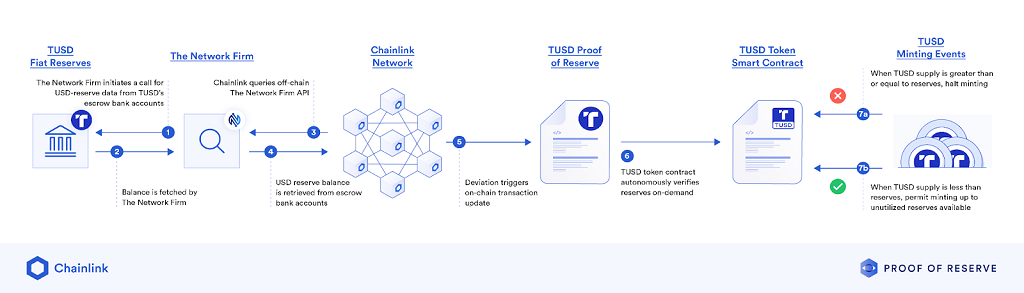
The TUSD reserve data is aggregated by The Network Firm LLP (TNF), which is an independent industry-specialized accounting firm in the US. TNF will aggregate all reserve data of US dollars held at financial institutions in real-time and serve that information on-chain through Chainlink’s oracle network. This is what is referred to as proof of reserve.

TUSD smart contract will then use this Proof of Reserve data feed to automatically check whether the total supply of TUSD would exceed the total amount of US dollars held in reserve before a new stablecoin is minted.

The automatic workflow is transparent in the smart contract code and supported by open independent data feeds thus affirming TUSD’s commitment to ensuring the stability of the ecosystem and the redeemability of the underlying dollars for clients.

TUSD users can feel confident that they have an accurate and transparent source of information about the reserves backing the TUSD stablecoin.

Commenting on the development, the co-founder of Chainlink Sergey Nazarov said:

“We are proud to support TUSD in its efforts to bring new layers of transparency, risk management, and security to its stablecoin minting process. With Chainlink Proof of Reserve, TUSD is able to provide greater levels of assurance and confidence to its users, and help bring greater stability to stablecoins and the broader crypto industry.”

The post TrueUSD the first USD-backed stablecoin to use Chainlink ‘Proof of Reserve’ to mint appeared first on CoinJournal.

Should crypto investors care about the US stock market?

  • Without the US stock market outperforming, the cryptocurrency market would have difficulty delivering a positive return in 2023
  • S&P 500 leads the cryptocurrency market
  • Crypto investors should watch US economic data closely

The cryptocurrency market had a strong start to the trading year. After suffering from a bearish market in 2022, the rally that started in 2023 brings much relief to investors in the cryptocurrency market.

The enthusiasm is understandable.

After all, Bitcoin, the leading cryptocurrency, is up +45.93% YTD. However, before getting too excited, long-term investors still look at the 1-year losses of -35.62%.

Therefore, once again, timing the markets is important. Those going long crypto at the start of 2023 enjoyed an impressive performance, while those that remained invested for one year still enjoy the so-called “crypto winter.”

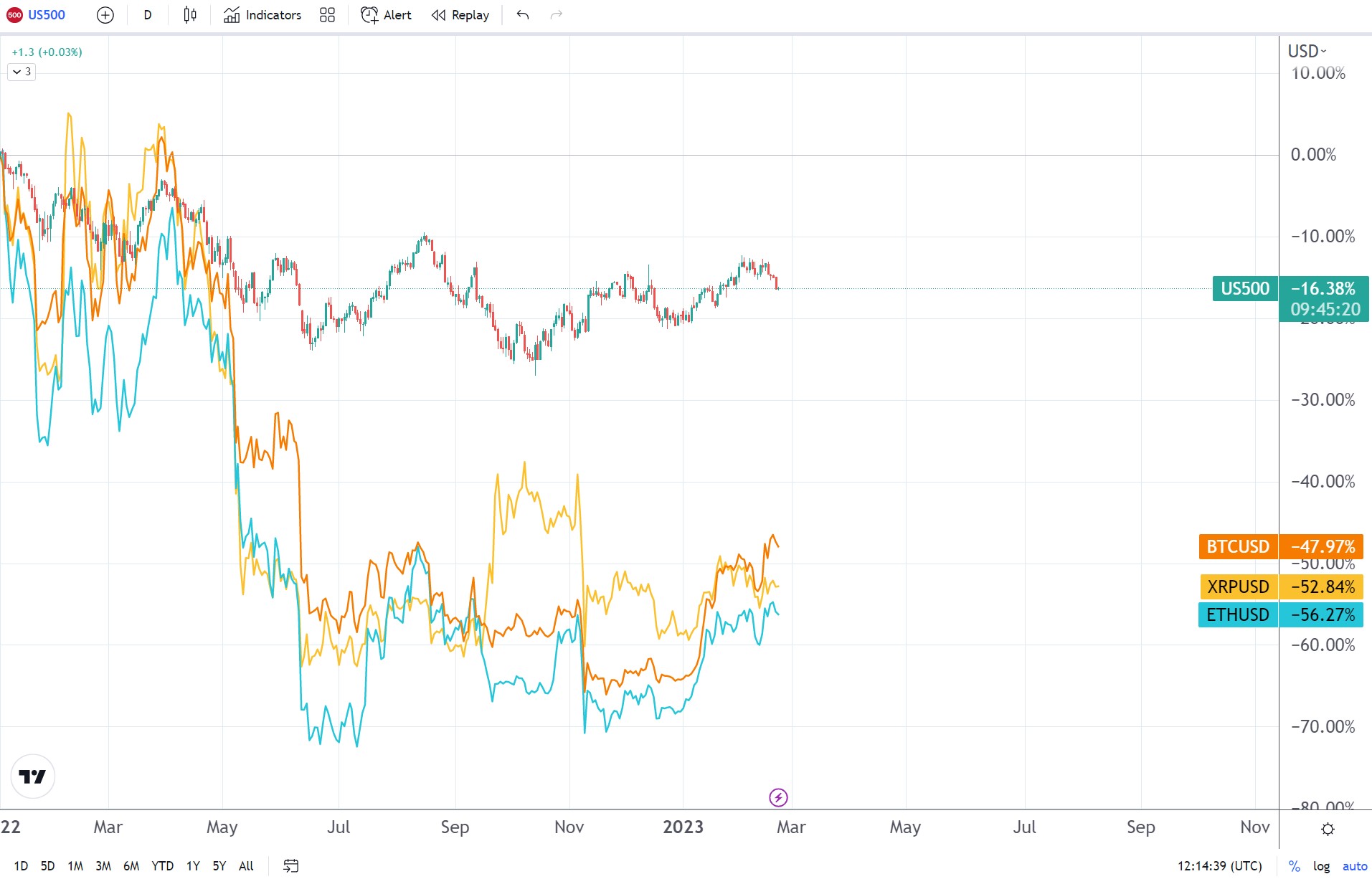
But why did the crypto market bounce? The answer lies in the chart below – because of the US stock market rally.

S&P 500 chart by TradingView

S&P 500 leads the cryptocurrency market

The chart above shows the S&P 500’s performance since the top in late 2021. Since then, the main US stock market index lost -16.36%.

Below are the three leading cryptocurrencies – Bitcoin, Ethereum, and Ripple. While they peaked a bit earlier, they lost between -60% and -70% in value from their 2021 highs to the 2022 lows.

So the bounce in the cryptocurrency market may look as being in response to investors turning their attention to the industry again, but instead, it is all about the US stock market. The S&P 500 rallied in 2023 too.

However, the dimensions of the two movements are different because of the difference between the S&P 500 and the cryptocurrency’s volatility.

In other words, given the current context, it is hard to see the cryptocurrency market’s rally continue if the S&P 500 index does not perform. Hence, crypto investors should care about the US stock market because the S&P 500 leads the gains or losses in the cryptocurrency market.

The post Should crypto investors care about the US stock market? appeared first on CoinJournal.