FIL jumps 24% as Filecoin community eyes major network upgrade

  • Filecoin’s native token FIL spiked 24% to around $6.44 on Monday.
  • The launch of the Filecoin Virtual Machine (FVM), expected on 14 March, has the community buzzing.
  • FVM brings smart contracts and network programmability to the Filecoin network.

Filecoin, a decentralised storage network that allows users to access efficient blockchain-based file storage at low, is hours away from a major network upgrade. The excitement around the new features that come with the upgrade, alongside broader market exuberance, has helped push the value of the native FIL token higher.

Filecoin price today

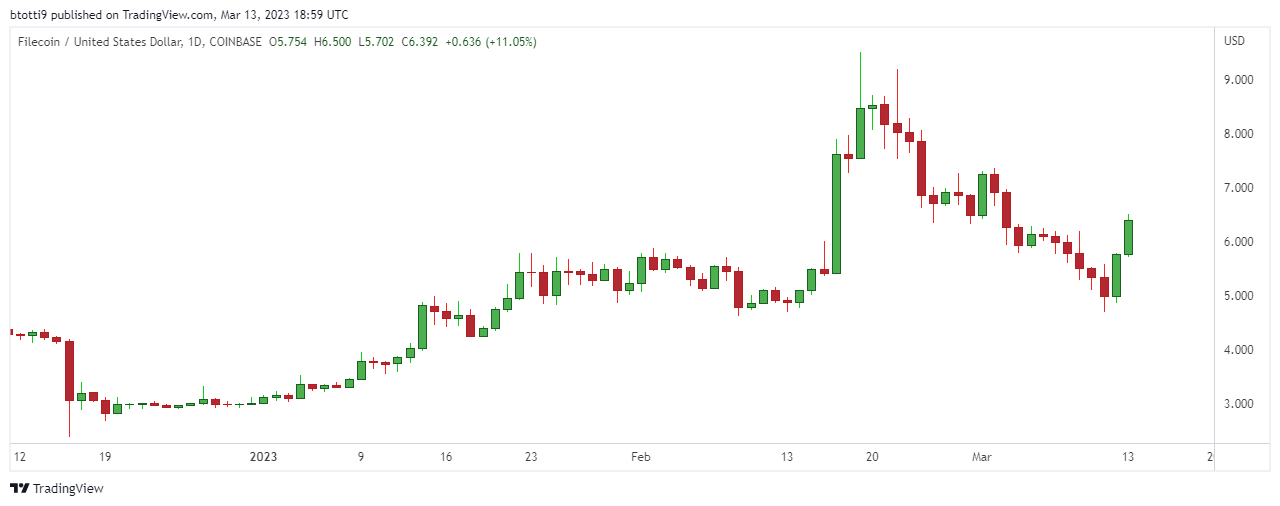
FIL was trading around $6.36 at 2:00 pm ET on Monday, up more than 24% in the past 24 hours. According to data from TradingView, the cryptocurrency’s price had touched an intraday high of $6.44 on major crypto exchange Coinbase.

Per the market data from CoinGecko, the file storage platform’s native token has jumped more than 32% over the past month.

Filecoin price chart showing FIL jumped to $6.50 on Coinbase on Monday. Source: TradingView

Why did Filecoin price rally?

The broader cryptocurrency market has rallied hard in the past 24 hours, with massive buying pressure on Monday as the markets reacted to news of the US government working to backstop failed banks. 

As CoinJournal reported, the sentiment flip saw Bitcoin add over $4,000 in 24 hours as bulls rallied to prices above $24,000. Most altcoins also soared, with the total cryptocurrency market cap rising nearly 15% to over $1.16 trillion.

But for Filecoin, as noted above, the upside momentum also included buyside pressure catalysed by an upcoming network upgrade.  In February, the Filecoin developer team announced that the Filecoin Virtual Machine (FVM) would go live in March.

The price of FIL tokens jumped more than 26% on the day after the Filecoin news reached the market. Just like then, the latest price surge comes as the developer team confirmed that FVM would go live on Tuesday, 14 March 2023. 

This is because the upgrade is set to introduce smart contracts, allowing for the creation and deployment of decentralised applications (dApps) on Filecoin. The FVM upgrade also unlocks features such as collateral lending and liquid staking.

“Basically – if you regard the Filecoin storage network as a massive decentralized data warehouse whose state is being constantly proven to the public, you can think of the FVM as a programmable controller for it,” the Filecoin team noted last week.

The post FIL jumps 24% as Filecoin community eyes major network upgrade appeared first on CoinJournal.

Crypto volatility back to FTX levels, with $791 million of liquidations in 4 days as SVB collapse rocks market


Key Takeaways

  • Crypto volatility is back up to levels last seen when FTX collapsed in November
  • $791 million of liquidations rocked investors between Thursday and Sunday
  • $383 million of longs were liquidated on Thursday and Friday, the largest 48-hour number of the year
  • News that deposits will be made whole at SVB propelled the market upwards late on Sunday, with $150 million of short sellers liquidated as Bitcoin retook $22,000
  • Despite Fed move stablising prices and 2023 showing a bounceback, the long-term implications for the crypto market are negative here and should concern investors

For once, it’s not crypto doing the collapsing. Trad-fi was feeling left out of the party, evidently, as the banking sector wobbled in a big way this weekend. 

Silicon Valley Bank (SVB) is no more, in what amounts to the largest collapse of a US bank since 2008, when Lehman Brothers pulled its best Satoshi Nakamoto impression and disappeared into the ether (pun not intended). 

While the drama may have centred in trad-fi, crypto bounced around aggressively over the weekend as a variety of knock-on effects rumbled. SVB was a crypto-friendly bank, as was Silvergate, which was announced to also be winding down last night. 

This, as well as the fact that the entire financial markets wobbled, meant crypto faced a storm. We have dug into some of the movements here at https://coinjournal.net/ to sum up the carnage. 

Liquidations 

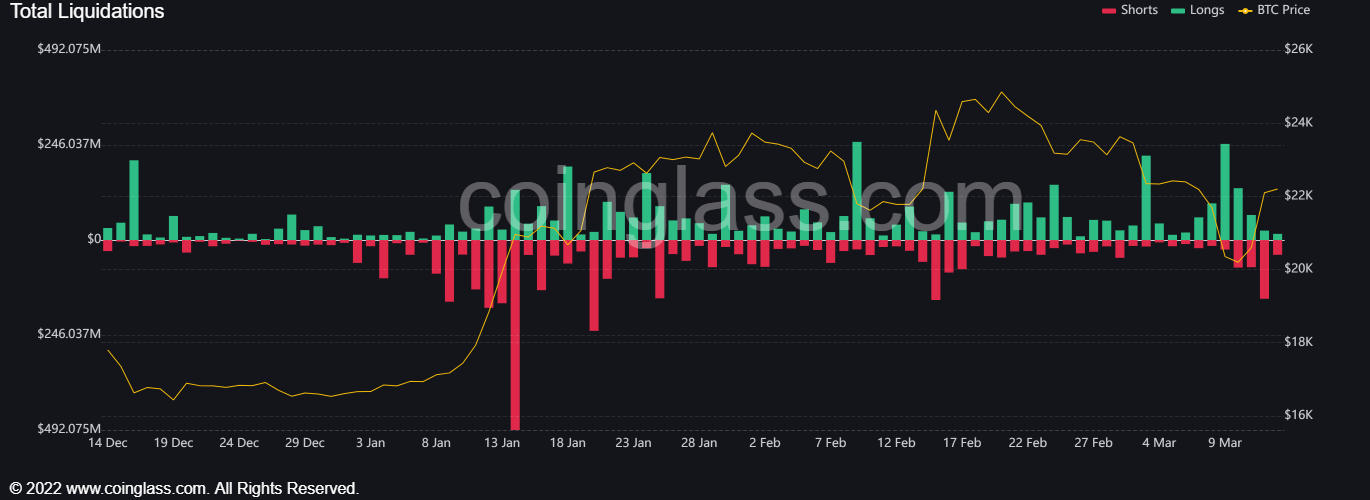
With violent price swings, liquidations were inevitable. Longs got caught out badly on Thursday and Friday, as the Bitcoin price fell south of $20,000. 

There were $249 million of long liquidations across exchanges on Thursday, with Friday bringing an additional $134 million. The $383 million of long liquidations was the most in any 48 hour period this year. 

Volatility

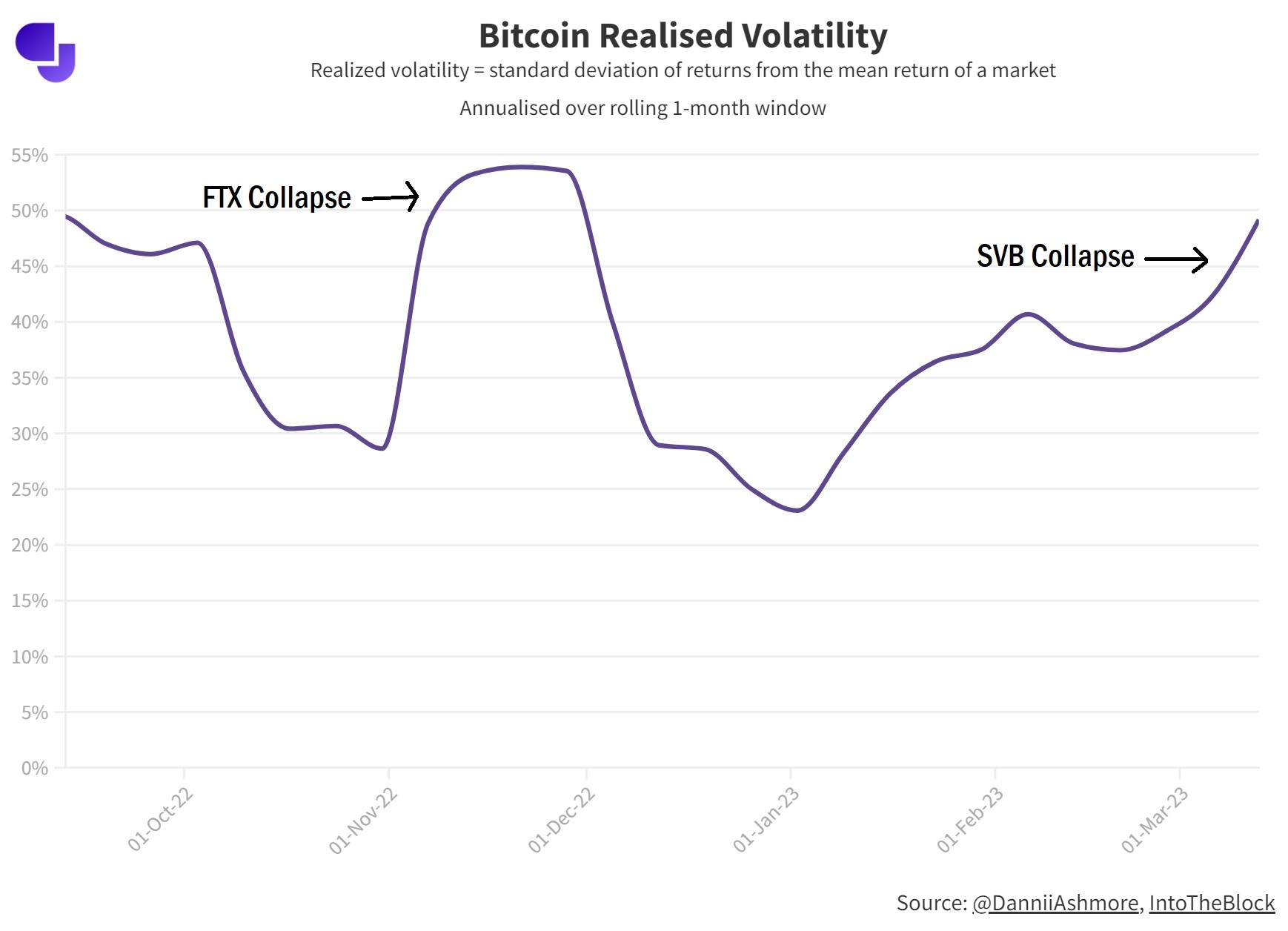
Obviously, liquidations stem from volatility. Looking at Bitcoin to dissect the extent of the movements, the volatility is now back up to levels last seen when FTX collapsed in November. 

The chart below shows that the metric had been rising steadily, before SVB going poof kicked it back up to a mark 3-Day volatility mark of 50%, last seen when Sam Bankman-Fried’s fun and games were revealed to the public.

“We have been seeing relatively muted action in the crypto markets since the FTX collapse last November” said Max Coupland, Director of CoinJournal. “The SVB event served to kick volatility back up to levels we last saw amid all the crypto scandals of last year – not only FTX, but Celsius, LUNA etc. The difference with this event is that the crash was sparked in trad-fi for a change”.

Crypto bounces back

But all is well that ends well. Or something along those lines, as despite SVB going under, the Fed announced last night, after a weekend of chaos, that all deposits at SVB would be made whole. 

The bail-out (if you can call it that, as SVB is still going under) quelled up fear in the markets that the issue could become systemic. Crypto roared back, with Bitcoin spiking back up to $22,000 at time of writing. And this time, it was shorts who got caught offside, with $150 million liquidated across the market Sunday. 

Perhaps the biggest winner of all was the world’s second-biggest stablecoin, USDC. 25% of the stablecoin’s reserves are backed by cash. Crucially, 8.25% ($3.3 billion) of reserves were (are) trapped in SVB, with the stablecoin dipping below 90 cents on several major exchanges over the weekend. 

At press time, the peg has been largely restored as the crypto market bounces upward, with Bitcoin north of $24,000.  

What next for crypto?

And so, the immediate storm appears to have been weathered in cryptoland. 

Nonetheless, the past few days present as yet another crushing blow. Three of the big crypto banks – SVB, Silvergate and Signature – are now no more. These banks allowed crypto firms to offer on-ramping from fiat into crypto 24/7 through their settlement services, in contrast to the regular banking hours of the banking sector. 

Liquidity and volume thus may dip even further in the crypto market, after a year that has already seen volumes, prices and interest in the space freefall. 

Despite the Fed stepping in to shore up deposits and hence stabilising the stablecoin market and wider crypto prices, the long-term future of the cryptocurrency industry in the US has taken another heavy body blow this weekend. And with the US being the biggest financial market in the world, that is very bad news. 

Coupled with the regulatory clampdown by the SEC in the last few months, 2023 has followed 2022 in creating a more hostile and bearish environment for the sector at large. 

So crypto investors may have seen a bounceback in prices in the last few months, but this appears to be largely macro-driven correlation with the stock market, as the underlying events in the industry – regulation, more bankruptcies, and crypto-friendly banks shuttering – have not been positive. 

If you use our data, then we would appreciate a link back to https://coinjournal.net. Crediting our work with a link helps us to keep providing you with data analysis research.

The post Crypto volatility back to FTX levels, with $791 million of liquidations in 4 days as SVB collapse rocks market appeared first on CoinJournal.

Bitcoin breaks above $24K as analysts predict what next for BTC

  • Bitcoin breaks above $24,000 as positive sentiment pushes BTC higher.
  • Analysts say BTC remains in “danger zone” unless bulls break and hold $25k.
  • IntoTheBlock analysts suggest the next major target could be $30,000.

Bitcoin broke above the $24,000 level, soaring a massive $4,000 candle in just over 24-hours to leave bulls targeting a new breakout above $25,000.

In our Bitcoin price prediction article this morning, we highlighted an analysis by popular crypto analyst Rekt Capital. In it, the analyst simply pointed to Bitcoin price having invalidated a double top formation when it rallied from under $20,000 to a weekly close above $21,770.

According to the analyst’s technical outlook for BTC, a break higher was likely given the retest of range lows on the daily chart.

While he suggested a continued range consolidation, he pointed to the potential for bulls to break higher. That came sooner as BTC forced its way above $24,000 amid a spectacular bounce for cryptocurrencies after last week’s sharp declines. But can Bitcoin maintain this upside momentum? Here are what some analysts are saying:

Bitcoin price spikes above $24K – analysts share technical outlook

At current prices, Bitcoin is about $500 “from challenging the macro downtrend,” Rekt Capital has noted. If this happens, BTC could be poised for a huge breakout – possibly with a new macro uptrend in the picture on the monthly chart.

“BTC Monthly RSI looks like it has successfully retested the 2015 & 2018 Bear Market Bottom area as new support,” he added in another tweet.

According to the analyst, Bitcoin still needs to break the macro downtrend line at $25k for a technical breakout in March. Maintaining the positive outlook could see BTC break the macro downtrend in April with breakout price point around $23,400.

Like Rekt Capital, crypto analyst Altcoin Sherpa suggests bulls aren’t completely out of the woods yet. For him, the price needs to break above and hold support at $25,000. If not, BTC remains in “a danger zone.”

“BTC: Some high time frame resistance areas, I view this current area as a danger zone. 1W 200 EMA + S/R level that price couldn’t break over a few weeks. If we flip $25k soundly, I think we blitz to 30kish areas.”

According to IntoTheBlock, Bitcoin faced a significant hurdle in the $22,650- $23,325 region after bulls’ strong bounce in the $19,000 area. This supply zone coincided with a zone where 1.14million addresses had acquired BTC, with the average price around $23,022.

But after the swift bounce above this level, on-chain data suggests the next major target is $30,000.

The post Bitcoin breaks above $24K as analysts predict what next for BTC appeared first on CoinJournal.

The Metaverse seems to be the next big thing to disrupt the digital world

People in the crypto space are talking about the Metaverse as a revolutionary innovation that will transform the Internet as we know it. As its name suggests, Metaverse means “beyond the universe”, describing a virtual reality space where users can engage with each other in real time. For example, developers can create parks, buildings or other things that don’t actually exist. 

While some perceive it as an extension of the current Internet, others see the Metaverse as an entirely new space. This concept is still in its early stages, and its exact form and use cases are still being explored.

How the Metaverse was born

The term metaverse first appeared in Neal Stephenson’s novel ‘Snow Crash’, in 1992. In the book, it referred to a virtual reality world experienced from a first-person point of view through reality goggles. 

The Metaverse existed in some form before; for instance, immersive games like World of Warcraft and Second Life have fascinating 3D worlds where you can use your avatar to interact with others. These games have different themes; while the former focuses on fun, the latter focuses on the social aspect. 

Social network platforms such as TikTok, YouTube and Facebook are also pieces of the Metaverse, even if they may not seem so at first glance. But Facebook itself is a mini-internet if you think about it, as its content has become image based. In the future, the platform will likely pivot even harder into the Metaverse, becoming graphically immersive.

Crypto and its connection to the Metaverse

The purpose of Metaverse is to give people the opportunity to experience an augmented reality that surpasses physical reality. But for the Metaverse to function correctly, it requires the immutability of the blockchain. Since hacks are a significant issue in the virtual environment, people need to operate on a secure platform. 

Fortunately, that can be achieved through blockchain, which enables fast confirmation of information and ensures secure transactions. Thus, blockchain and crypto assets are vital components of virtual reality. Both individuals and institutions can perform online transactions and check the current bitcoin price – all in real-time – by using an exchange like Binance. 

The trend towards online payments has been growing in recent years, along with the widespread adoption of e-commerce and the rising popularity of digital platforms. The COVID-19 pandemic has also accelerated this trend, as more people have turned to online shopping and digital payments due to lockdowns. 

Blockchain technology and crypto provide an additional layer of transparency to online transactions, and the increasing adoption of crypto payments by major payment processors like PayPal and Mastercard is a sign of the rising mainstream acceptance of these technologies. This trend will likely keep evolving in the future, and the Metaverse will become an environment where engagement and transactions occur in real time.

Understanding how the Metaverse works

The Metaverse can be grouped into two different categories of platforms. 

The first category involves using blockchain technology – specifically cryptos and NFTs- to create decentralized virtual worlds. These platforms, such as The Sandbox, and Decentraland, enable users to buy virtual land and develop their own digital assets and use them to create unique virtual experiences. 

The second category of Metaverse platforms focuses on offering users a virtual space where they can meet and interact with each other, and engage in different activities, like socializing, entertainment, and business. These platforms are more centralized and backed by large organizations. 

Both categories of platforms involve unique features and use cases, sharing a common goal of providing users with a virtual space where they can interact with each other and with digital objects in a seamless and immersive way.

On the Metaverse, you can do different things virtually, such as taking a trip, purchasing clothes and even going to a concert. 

The Metaverse can be a game-changer for remote collaboration, as platforms like Horizon Workrooms from Facebook enable users to meet in a virtual environment, which offers a more interactive experience than traditional video conferencing. It allows for different forms of communication, like video calls and virtual whiteboarding, enabling users to join as avatars or use their own devices. 

But a condition must be met for virtual meeting spaces to become widespread: tech companies must agree on a set of standards to ensure compatibility across various platforms, thus preventing users from switching between different virtual environments.

Core features of the Metaverse

The most common ideas surrounding the Metaverse are derived from science fiction. In this context, it is envisioned as a ‘jacked-in’ internet – a manifestation of reality which is grounded in a theme-park-like world. The core features of the Metaverse are the following:

  • Immersiveness – which means providing a highly immersive and interactive experience, enabling users to feel like they are physically present in a virtual world.

  • Interoperability – this attribute translates into bringing different virtual worlds, platforms and applications together to enable users to move seamlessly between them.

  •  Scalability – which refers to handling a great number of users and multiple use cases, including education, commerce and gaming.

  • Persistence – the Metaverse is a persistent environment, which means that the changes users make are permanent, and others can also experience them in the future. 

  • User-generated content – the Metaverse allows users to create, modify, and share their own content, like virtual objects, environments and avatars. 

  • Social – this is an essential attribute of the Metaverse, enabling users to interact and communicate with each other in real time.

  • Open Standards – the Metaverse is built on open standards, allowing for interoperability and easy integration with other platforms and services. 

The future of the Metaverse

Creating a true metaverse that perfectly mirrors real life is a complex task that may require some time to be completed. 

However, many businesses in the industry are working on developing virtual and augmented reality technology to make the metaverse experience more immersive and realistic. According to PwC- a global accounting and advising company, VR and AR could impact the global economy significantly, reaching $1.5 trillion by 2030. This drives companies like Google, Microsoft and Facebook to invest in cloud computing. 

The Metaverse is expected to become a new platform for innovation and growth, and many companies are seeking to take advantage of opportunities in areas like subscriptions, payments and advertising, the same way they did with the Internet. Plus, there may be greater integration of the Metaverse with other technologies like AI and blockchain, enabling new forms of communication and commerce. 

As more people spend time online and technology keeps evolving, the Metaverse is likely to become a significant part of people’s lives.

The post The Metaverse seems to be the next big thing to disrupt the digital world appeared first on CoinJournal.

Bitcoin price prediction: BTC weekly close invalidates double top formation

  • Bitcoin price rose to around $22,600 on Sunday after rallying 11% from below $20,000. 
  • Technical analyst Rekt Capital says Bitcoin has cancelled a double top formation.
  • A successful retest of $21,700 zone could see BTC continue short term upside recovery.

Bitcoin has retested the $22,600 level after dropping sharply to trade under $20,000 last week.

While the benchmark cryptocurrency currently trades around $22,350 and is 9% up in the past 24 hours, the short term outlook suggests an invalidation of a bearish pattern that had bears eyeing another leg towards the low $19,000s. 

Bitcoin price prediction: What next after weekly close at $21,770?

Crypto analyst Rekt Capital has updated his outlook for BTC price after the coin’s value successfully broke from below $20,000. 

According to the technical analyst, the weekly close above $21,770 could provide fresh bullish impetus as it has cancelled a double top formation on the weekly chart.

“It’s incredible how the #BTC Weekly Close of last week invalidated the Double Top formation. The Double Top initially played out to see price drop into the $19000s, but ultimately, $BTC Weekly Closed above $21770 to cancel out the Double Top,” the popular crypto analyst shared via Twitter.

As noted above, Bitcoin price rose to highs of $22,600 across major cryptocurrency exchanges late Sunday. This was after positive news around the collapsed Silicon Valley Bank buoyed stock futures and saw the de-pegged USDC bounce to just shy of its US dollar parity.

Trading Monday has seen some profit taking deals force BTC to give up gains. However, the flagship cryptocurrency has successfully retested its range low as immediate support. It is possible BTC/USD will continue this intra-range consolidation, Rekt Capital has predicted.

Looking at the technical picture as seen on the daily chart, we see another successful daily close above $21,700. While Bitcoin could continue higher, a pullback to the level might happen. Breaking higher from this zone once again could catalyse further upside momentum, with next targets in the $23,400 region.

The post Bitcoin price prediction: BTC weekly close invalidates double top formation appeared first on CoinJournal.