Bitcoin price recovery at risk amid new Credit Suisse crisis

  • Bitcoin and other financial assets now have a Credit Suisse problem.

  • Credit Suisse credit default swaps signal that the company could collapse.

  • Credit Suisse stock price plunged by 20% and reached a record low.

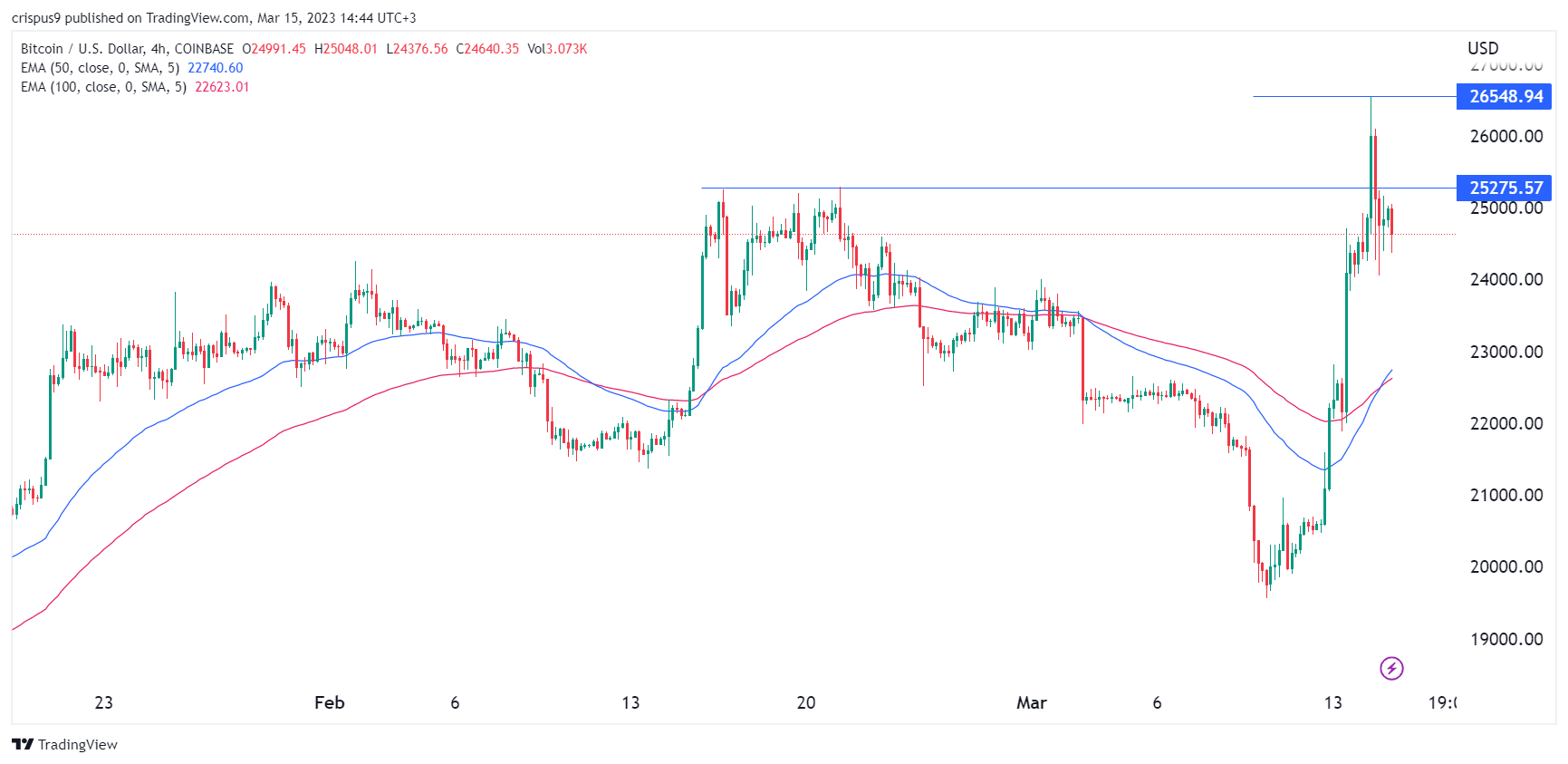
Bitcoin price came under intense pressure on Wednesday as the banking sector came under a significant strain. BTC pulled back from the year-to-date high of $26,548, to a low of $24,526. It has retreated by ~7.8% from its highest point this week.

Credit Suisse crisis deepens

Bitcoin price has been in a strong bullish trend in the past few days as investors reacted to the ongoing performance in the banking sector. After falling to a low of $19,500 last week, the coin made a spectacular recovery as it jumped to a high of $26,548. 

This rally happened after America’s regulators decided to bailout key banks like Silicon Valley Bank (SVB) and Signature Bank. They decided to provide a backstop for their depositors, many of whom were companies in the crypto industry, as we wrote here.

The most important part of the bailout was the fact that it saved USD Coin, the second-biggest stablecoin in the world. Circle, the parent company of USDC, had over $3.3 billion deposited in the company. If it had failed, the ripple effect on the crypto industry would have been dire.

Now, it seems like we have another bank crisis. Credit Suisse stock price plunged by more than 20% after the company lost confidence of another key investor. Earlier this month, the company’s biggest shareholder, Harris Associates, decided to sell its entire stake. 

And on Wednesday, Saudi National Bank said that it will not provide more finance to the company. Therefore, there are significant risks that the company will fall. Indeed, its credit default swaps have risen, signaling that investors expect the bank to fall.

A collapse of Credit Suisse would have some positives for Bitcoin prices. For one, it will lead to a pause in interest rate hikes by the Fed and other central banks.

Bitcoin price forecast

The BTC/USD price soared to a high of 26,548 on Tuesday and then pulled back to a low of 24,102. As it dropped, BTC moved below the key support level at 25,275, the highest point in February. On a positive note, the pair’s 50-day and 100-day moving averages have formed a bullish crossover. The coin has also formed what looks like a small head and shoulders pattern. 

Therefore, I suspect that it will continue falling in the next key support at $23,000. A move above the key resistance point at 25,275 will invalidate the bearish view.

How to buy Bitcoin

eToro

eToro is a global social investment brokerage company which offers over 75 cryptocurrencies to invest in. It offers crypto trading commission-free and users on the platform have the option to manually invest or socially invest. eToro even has a unique CopyTrader system which allows users to automatically copy the trades of popular investors.

Buy BTC with eToro today

Bitstamp

Bitstamp is a leading cryptocurrency exchange which offers trading in fiat currencies or popular cryptocurrencies. Bitstamp is a fully regulated company which offers users an intuitive interface, a high degree of security for your digital assets, excellent customer support and multiple withdrawal methods.

Buy BTC with Bitstamp today

The post Bitcoin price recovery at risk amid new Credit Suisse crisis appeared first on CoinJournal.

Why is Ethereum falling against Bitcoin? Maxis loudly celebrate but miss the point


Key Takeaways

  • Ethereum has fallen against Bitcoin thus far this year
  • This is unusual as the market has risen, and altcoins tend to outperform Bitcoin in bull markets
  • Nonetheless, Bitcoin maxis represent everything that is and about the space, writes our Analyst Dan Ashmore
  • Their celebrations also forget the fact that Ethereum has still crushed Bitcoin over the past five years
  • Despite Ethereum’s outperformance, Ashmore explains why Bitcoin remains the only crypto asset for him, despite his disdain of Bitcoin maximalism

I am a Bitcoin investor. But there are few things more toxic in the cryptocurrency space than Bitcoiners persecuting others for investing in different coins. 

Of course, the people who do this are only a tiny minority. Colloquially known as Bitcoin maximalists, this group are just so damn loud and aggressive that it makes it seem as if they are plenty in number. They’re not.

Do I personally invest in cryptos beyond Bitcoin? Not really, beyond a bit of fun on the side. I’m a bit of a boomer investor and hence altcoins have never made it into my long-term portfolio. But that doesn’t mean I have to spend my nights berating people online for whatever they do with their money. It’s really strange behaviour. 

Ethereum the biggest target

Ethereum, being the second biggest cryptocurrency on the planet, is naturally the biggest target of these maxis, who typically travel in packs through the virtual world, but are rarely seen outside of the Internet in broad daylight.  

And Ethereum is the reason I am crafting this piece today because Twitter, which is the always-positive kingdom in which these maxis are most commonly found, is alive with celebrations that Bitcoin is accelerating against Ethereum, with the latter falling sharply in the last few days and close to its lows this year against Bitcoin. 

A couple of things on this. And again, I am a Bitcoin investor so I don’t really have any reason to be biased here (or if anything, I do in the opposite direction). 

But sharing the 2023 chart is guilty of a little bit of cherry-picking. It is no secret that over the last few years, throughout the bull market surge of the pandemic years in 2020 and 2021, Ethereum has absolutely crushed Bitcoin. 

Since April 2020, it is up 2.53X against Bitcoin, to be precise. 

Ethereum, like most altcoins, tends to outperform Bitcoin in bull markets and underperform in bear markets. This is no secret and makes intuitive sense – it is further out on the risk spectrum and essentially trades like a levered bet on Bitcoin. Nothing mind-blowing in that. 

And hence it makes sense that Bitcoin lagged Ethereum during the bull market of 2020 and 2021. But look at the below chart since Bitcoin’s all-time high in November 2021 (we can use this as the marker for the top in the crypto market): it’s been quite steady, down only 3.5%, a near-negligible number in the volatile world of cryptoland. 

The fall of ETH vs BTC in 2023 also doesn’t really look overly dramatic with a bit of zooming out and a wider y-axis. It’s all about perspective, right? 

So ETH crushed BTC in the last bull market, and has more or less tracked it in the bear market. By all accounts, it is not much cause for celebration for the maxis. 

Why am I holding Bitcoin?

It begs the question: why am I holding Bitcoin over Ethereum? Well, I believe in the asymmetric return profile of Bitcoin and I like the way it fits in with my portfolio. I am a boomer investor at heart, a lover of diversification and a big fan of the old portfolio allocation studies. 

Stocks are and always have been the cornerstone of my portfolio, but Bitcoin presents as a nice diversifier, alongside some other asset classes.

I’m also not as bullish on Ethereum long-term. Put frankly, I am not sure I understand it fully yet. My knowledge of Bitcoin is deeper and, since I entered the space in 2017, I have been intrigued by its macro implications and how unique it is. Ethereum is more technical and, for me, I am less clear on what its place in the world is. 

That is not to hammer Ethereum. As I said, I’m not sure I understand it fully, even having bought my first ETH six years ago.

And more importantly, past performance is not indicative of future success. Perhaps the past few months are perfectly indicative of this, which I will dig into in the final section. 

Why is Bitcoin outperforming now?

It is definitely notable that Bitcoin has accelerated against its counterpart (I nearly said rival!) this year, given the market has risen across the board. Typically, this has been when ETH has made gains. 

I would love to explain why, but it is not that easy. What I tend to think is that it summarises quite how unique the current market climate is. We have a nasty mix of inflation (despite it softening in recent months) and high rates, while the world fears the possibility of a looming recession. 

Bitcoin and Ethereum have never existed in this sort of market environment before – until last year, they had never been around during anything other than a raging bull market in the financial space, with all risk assets exploding since Bitcoin’s launch close to the nadir of the GFC in 2009.

All Bitcoin and Ethereum have known is a low-rate, up-only market. So we need to bear that in mind (pun very much intended) when thinking about why market trends are shifting – the sample space is very small here and we have undoubtedly seen a transition to a new environment since the Federal Reserve began hiking rates last year. 

The other aspect of this is that the bounceback this year has come after an incredibly harrowing period in the crypto market. There could simply be too much fear and PTSD following the bloodbath of 2022 for the market to scale back into altcoins. 

Most altcoins offer minimal or no value, and hence are nothing but a byproduct of the low-rate environment which had persisted since the GFC until last year. This shift by the Fed amounts to a structural change and it is certainly harder to envision the sorts of gains that previous years brought when T-bills are available for investors at north of 4%, while the tech sector struggles through mass layoffs and collapsing share prices.

This could be contributing to Bitcoin moving quicker than altcoins, including Ethereum, compared to what it has done in prior periods of rising prices. There could just be more lasting damage in the crypto space this time around, given the high-profile scandals of FTX, Celsius, LUNA and all the other cowboys that threw the entire space into a circus. 

So just because Bitcoin has underperformed against Ethereum over the last six years does not mean that will continue into the future. Who knows, this nascent industry is barely a few years old.  

But regardless of speculation about the future, one thing that Bitcoin’s underperformance against Ethereum over the last half-decade does mean, however, is that Bitcoin maxis should really stop and think before celebrating ETH falling close to its year-to-date low against BTC. 

Then again, thinking is not a favourite pastime of that cohort. 

The post Why is Ethereum falling against Bitcoin? Maxis loudly celebrate but miss the point appeared first on CoinJournal.

Here’s why Binance is suspending sterling transfers

  • Binance cites “Paysafe” as it halts sterling transactions.
  • The announcement affects less than 1.0% of its users.
  • Binance says it’s already looking for an alternative.

Binance continues to pause deposits and withdrawals in notable currencies. On Tuesday, it suspended transactions in sterling as well – about a month after it had ceased dollar transfers.

Why did Binance pause sterling transfers

Reason cited for the halt was Paysafe – its partner for GBP transfers that paused pound transactions for new users on Monday. The service will be terminated for all users on May 22nd. According to a Paysafe spokesperson:

The U.K. regulatory environment in relation to crypto is too challenging to offer this service at this time and so this is a prudent decision on our part taken in an abundance of caution.

Binance will continue to work with Paysafe in Europe and Latin America, though. Paysafe is yet to make an official comment on the development.

Binance is hunting for an alternative solution

Binance that currently serves over 128 million customers worldwide also confirmed today that it had already started looking for an alternative to resume sterling transactions.

Binance will ensure that affected users are still able to access their GBP balances. The change affects less than 1.0% of Binance users.

Remember that the Financial Conduct Authority (FCA), in June of 2021, had warned consumers that Binance did not have permission to undertake regulated activity in the United Kingdom.

Binance is currently under investigation by the Justice Department for suspected violations including money laundering as well.

The post Here’s why Binance is suspending sterling transfers appeared first on CoinJournal.

South Korea’s Wemade partners with Space and Time to power next-generation blockchain gaming

  • Wemade and Space and Time want to use blockchain technology to power the next generation of GameFi.

  • WEMIX CEO Shane Kim says “blockchain is the future of gaming.” 

  • The partnership targets onboarding the next wave of game developers to the blockchain gaming industry.

Wemade, a leading publicly-listed South Korea-based game developer, has announced a strategic partnership with decentralised data warehousing provider Space and Time (SxT).

The collaboration will allow Wemade, a company with a market capitalization of $1.4 billion, tap into SxT’s suite of developer tools to power its growing line of blockchain and gaming services. Wemade is the game studio behind the blockbuster RPG title ‘The Legend of Mir 2’.

According to Wemade, Space and Time’s decentralised tools will help the company service over 20 play-to-earn (P2E) games, including global no.1 game MIR4. The partnership is set to work via Wemade’s blockchain gaming platform WEMIX PLAY.

Powering next-gen GameFi development

WEMIX PLAY is part of Wemade’s mega-ecosystem, which includes the mainnet WEMIX 3.0 for NFTs and DeFi and WEMIX coin that will power that ecosystem. WEMIX is also launching an Ethereum layer-2 that will leverage zero knowledge proof (ZKP) protocols to enhance scalability, user privacy and security.

The Wemade blockchain ecosystem will also benefit massively from Space and Time products, including developer access to real-time, tamperproof analytics. Other key features are access to a serverless API gateway and low cost on-chain storage.

These functionalities are key to simplified development and deployment of decentralised applications (dApps). Wemade can also utilise these features to introduce complex earning schemes in different P2E games.

According to the platform, the partnership with Space and Time is targeted at collaborating towards supercharging the next phase of GameFi development. The partnership will help the blockchain gaming industry “onboard the next wave of game developers,” said Nate Holiday, the CEO & co-founder of Space and Time.

According to WEMIX CEO Shane Kim, blockchain gaming offers gamers an opportunity to take greater control and ownership of their digital assets, and that collaborating with SxT is part of the overall goal of enhancing that.

“As the blockchain transformation of traditional games continues to grow, the partnership with Space and Time will help strengthen our blockchain infrastructure capabilities and contribute to our commitment to building an inter-game economy,” he added.

The post South Korea’s Wemade partners with Space and Time to power next-generation blockchain gaming appeared first on CoinJournal.

OKX Ventures invests in Ethereum Layer 2 platform Scroll

  • OKX Ventures invests in Ethereum L2 Scroll
  • OKX says the strategic investment is meant to support Ethereum scalability.
  • Scroll is expected to go live on the Ethereum mainnet in four months’ time.

OKX Ventures, the venture arm cryptocurrency exchange OKX, has announced a strategic investment in Scroll, a zkEVM-based zkRollup platform on Ethereum.

A press release OKX published on Tuesday said the investment is targeted at helping with Ethereum scalability via off-chain transactions.

Scroll uses zk-Rollups to boost Ethereum scalability

With Scroll built to allow for native compatibility for Ethereum-based dApps and tools, the collaboration will see the team tap into zero knowledge proofs and zkRollup technology to enhance transaction speed and lower user costs.

Scroll helps achieve the high throughput via off-chain computations, with only a validity proof submitted to the chain. This is what zkRollup is all about – taking transactions and bundling them into one before moving them off-chain for processing.

It’s a layer-2 solution designed to ensure greater usage and interaction with the mainnet without sacrificing the underlying security mechanisms. Once it goes live on Ethereum, Scroll could be applied across token transfers and specialised applications. Implementation of general-purpose smart contracts will also help with overall adoption of the Ethereum applications.

Unlike some layer-2 solutions, Scroll will not require changes to the Ethereum protocol. This is because implementation for the off-chain solution is independent of Ethereum’s layer-1 mainnet. Scroll is expected to go live on the Ethereum mainnet in four months’ time and its Alpha release is now available to all.

Scroll has seen over 672,700 unique wallet addresses and recorded more than 2,916,472 transactions.

The post OKX Ventures invests in Ethereum Layer 2 platform Scroll appeared first on CoinJournal.