
Can The ASI Token Presale Keep Pace With Cosmos’ Rally in 2023? What Every Investor Needs To Know

A widespread crypto market recovery has made investors question the future of the Cosmos price, as ATOM price action has begun to raise eyebrows. A long-term trend reversal could be on the horizon, which is expected to benefit one new project in particular.

AltSignals’ crypto presale raised over $120,000 in the first 24 hours, which has produced even more bullish momentum for the artificial intelligence blockchain movement. So, will Altsignals outperform Cosmos price action over the coming years?

Cosmos price recovers as AltSignals makes waves in Web3

The Cosmos price has begun to recover from a prolonged dip after it lost 85% of its value during the 2022 market crash. ATOM’s price has now more than doubled since the beginning of 2023, which has led many investors to forecast a long-term trend reversal for the blockchain.

While the Cosmos price continues to climb, the AltSignals token presale continues to attract major levels of interest. $ASI is an exciting new development by the AltSignals project, which has consistently shared profitable trading signals within its community since 2017.

After releasing an industry-leading algorithmic indicator called AltAlgo™, AltSignals is now venturing into the field of blockchain-based artificial intelligence (AI). The $ASI token will grant access to a new-and-improved trading toolkit that is powered by AI, as the platform is positioning itself as a leading innovator in Web3’s AI movement.

What is Cosmos (ATOM)?

Cosmos (ATOM) is a highly scalable, secure, and interoperable blockchain network. The ecosystem allows developers to build and deploy custom decentralized applications (dApps) that are free of scalability and interoperability restrictions typically found in other blockchains.

Cosmos enables developers to issue their own tokens as well as connect to other Cosmos-based blockchains through its Inter Blockchain Communication protocol (IBC). This has led to an ecosystem of connected chains that allow for the easy bridging of assets across different protocols and led to consistent demand that has helped keep the ATOM price afloat.

Cosmos price prediction: Can the ATOM price reach $20 in 2023?

The ATOM price has seen major volatility over recent years, but investors remain confident in the future of the platform. The Cosmos price is expected to reflect the ecosystem’s unique and innovative blockchain solution over the coming years, which has led to a promising ATOM price prediction.

The ATOM price prediction could reach $20 before the end of 2023, as some continuation is expected before a larger pullback for the wider crypto markets. As the Cosmos price is directly impacted by its utility, long-term investors could see the current price of $12 as a promising entry position.

What is AltSignals?

AltSignals has been one of the most successful day trading groups in Web3 since it first launched back in 2017. The platform leverages advanced algorithmic tools to deliver signals with an unprecedented level of accuracy. Some traders using AltAlgo™ have seen 10x gains to their portfolio in 19 out of 32 months on record.

The platform is now launching a suite of advanced artificial intelligence trading tools called ActualizeAI. ActualizeAI is a ground-breaking development from the project, as it is specially designed to improve the accuracy of older tools to deliver more profitable trading signals than ever before.

Blockchain-based AI project tokens have been some of those with the best performance in 2023, with many in the sector even outperforming the Cosmos price. The future of AI on the blockchain looks bright, and AltSignals’ new AI toolkit makes the new ASI token a highly sought-after investment opportunity.

How does AltSignals work?

The $ASI token can be used to gain access to the ActualizeAI stack. The stack combines machine learning with natural language processing (NLP) to analyze a range of price indicators and market sentiment. Since it is powered by AI, ActualizeAI can consider vast amounts of complex data before providing a single buy or sell signal to its users.

The machine learning element of the protocol enables ActualizeAI to continually improve its hit rate. Since AltAlgo™ already has an impressive track record, the sky seems like the limit for the new-and-improved ActualizeAI.

Users can gain access to ActualizeAI Club by purchasing the ASI token. The Club will provide greater access to ActualizeAI, beta testing opportunities for the latest tools released by AltSignals, and exclusive investment opportunities in the world of Web3. The $ASI token can also be staked to earn a passive income, or earned by participating in a variety of new features released to ActualizeAI Club.

Can ASI reach $0.50 in 2023?

The $ASI token is forecast to make major gains in the near future, as the token presale has been generating momentum for the platform’s new developments. $ASI has deflationary tokenomics, and its vast utility within ActualizeAI Club are expected to produce continually increasing levels of demand.

Experts are anticipating up to 20x gains during 2023. The presale will raise the price of $ASI from $0.012 to $0.02274, before the token is released on exchanges and enters price discovery. By the end of the year, $ASI could be worth up to $0.50 per token.

ASI vs ATOM price prediction: Which token is the best buy right now?

While the ATOM price prediction certainly looks bullish for the future, $ASI represents a growing movement in blockchain that could take the markets by storm during the next bull market. The ATOM price is, therefore, unlikely to outperform AltSignals, which is a highly promising investment opportunity during the crypto presale.

Crypto presales are the earliest stage of investment for new tokens, which is why they often produce over 100x returns for early participants. The $ASI token is rising in value each time a presale round sells out, so investors need to be quick to buy the latest AI-powered project at the best possible price.

You can participate in the AltSignals presale here.

The post Can The ASI Token Presale Keep Pace With Cosmos’ Rally in 2023? What Every Investor Needs To Know appeared first on CoinJournal.
Coinbase says ETH unstaking requests may take weeks or months to process

  • Staked ETH withdrawals are being processed on Ethereum Goerli Testnet ahead of the Shanghai upgrade.
  • Coinbase has said it expects demand for ETH unstaking to surge after the Shanghai upgrade.
  • The exchange has however said the ETH unstaking requests might take weeks or months to process.

Ethereum developers have set a target date of April 12, 2023, for the long-awaited Shanghai upgrade during the “All Core Developers Execution Layer #157 call” held on Thursday. Staked ETH withdrawals have already started being processed on Ethereum Goerli Testnet ahead of the Shanghai upgrade.

The upcoming Shanghan upgrade has caused a lot of anticipation among ETH stakers who have had their ETH tokens locked up since Ethereum announced plans for the Merge upgrade that moved it from a proof-of-work (PoW) blockchain to a proof-of-stake (PoS) blockchain. For this reason, Coinbase expects the ETH unstaking demand to be through the roof once the Shanghai upgrade goes live.

Unstaking requests to take weeks or months

Coinbase has stated that the ETH unstaking requests on its platform could end up taking weeks or months to process. This is mainly because Coinbase will not be the one processing the unstaking process. Staking requests are processed on-chain, and Coinbase will only act as a channel to pass unstaked ETH to users once the tokens are released by the protocol.

The Merge upgrade allowed staking providers like Coinbase to allow users to stake ETH on their platforms without the ability to withdraw the staked tokens.

After April 12, those who have staked ETH on platforms like Coinbase will be able to withdraw the staked Ether while also continuing to stake more ETH without being subjected to an indefinite lockup period.

All Coinbase users will be able to unstake their ETH once the Shanghai upgrade goes live.

The post Coinbase says ETH unstaking requests may take weeks or months to process appeared first on CoinJournal.

Binance.US acquisition of Voyager to proceed, bankruptcy judge rules

  • A judge at the New York bankruptcy court denied the Department of Justice’s request on Wednesday.
  • The DOJ wanted the court to stop Binance.US from completing its $1 billion deal for Voyager.
  • Judge Michael E. Wiles said pausing the deal pending government appeal would only hurt Voyager clients.

Binance.US, the US-regulated subsidiary of the world’s largest cryptocurrency exchange by trading volume Binance, should go ahead to complete its $1 billion acquisition of Voyager Digital, a bankruptcy judge has ruled.

In a court ruling on Wednesday, Michael E. Wiles, United States Bankruptcy Judge at the Southern District of New York court, denied the US government’s request to halt Binance.US’ bid for Voyager, citing the impact this is having on customers of the bankrupt crypto lender.

Judge rules Binance.US-Voyager deal to go ahead

The US Department of Justice appealed Judge Wiles’ ruling that allowed Voyager to sell its assets to Binance.US, a decision the bankruptcy judge gave on 9 March this year. In its appeal via the US Trustee’s Office, the DOJ wanted the acquisition halted until a number of legal objections were settled.

According to the government, allowing the process to continue as determined by the court could see Voyager and its staff likely absolved of tax or securities laws violations.

But in his ruling, Judge Wiles noted that the $1 billion deal that he approved last week does not include such exemptions. He added that halting the process will only hurt Voyager customers even further, with people having waited for an opportunity to access their crypto assets since the company stopped withdrawals in July last 2022.

BNB price jumps 6% after the news

Binance.US was approved to acquire Voyager for $1 billion in December 2022, as CoinJournal reported. The deal appeared to be hitting the rocks before the bankruptcy court allowed it to proceed. 

Now, following the latest ruling, an agreement between Voyager and Binance has the deal set for execution on 20 March, having originally been slated for 15 March.

The reaction to the news from the Binance community saw the price of the native BNB token jump 6% to $328 as of 11:00 am ET on Thursday. The Voyager VGX token, which rallied following last week’s court ruling, was also up today, trading 9% higher at $0.344700.

The post Binance.US acquisition of Voyager to proceed, bankruptcy judge rules appeared first on CoinJournal.

No, Bitcoin is still as correlated as ever with the stock market – A Deep Dive


Key Takeaways

  • Bitcoin’s recent surge has drawn surprise as banking sector has pulled stock market down
  • Declaring this a break in the correlation trend is a mistake, writes our Data Analyst Dan Ashmore, who says Bitcoin remains risk-on
  • Both the stock market and Bitcoin continue to trade off interest rate expectations, aside from isolated episodes of systemic risk to Bitcoin, the numbers show
  • Recent week shows a slightly softer relationship than normal, amounting to a less dramatic a less dramatic version of the price action around the FTX and Celsius collapses in 2022
  • Normal correlation bound to be resumed soon, our data shows

One of the dominant storylines over the last year or two so has been the incredibly tight relationship between Bitcoin and the stock market. 

We will get into the numbers shortly, but the mantra is that when the stock market jumps, Bitcoin jumps more. When the stock market falls, Bitcoin falls more. That is the bottom line. But is it true still true?

Some market participants are starting to think that this relationship is shifting, especially given events of the past week. The word “uncorrelated” is thrown around a lot in markets, and now some are saying Bitcoin is making progress towards that status. I’m not so sure that is correct. 

Correlation has been high since 2022 started 

Let us first look back over the price action from the start of 2022, which more or less marked the stock market peak. 

I’ll get deeper in the next section, but the best way to kick off an assessment of correlation is by the old-fashioned eye test. Let’s begin by charting Bitcoin’s returns against the Nasdaq since the start of 2022:

It is immediately clear that there is a strong pattern here. 

Before looking at correlation coefficients, by looking at the respective price action we can see that the assets have been in lockstep aside from two (visually notable) periods. The first is August 2022, when Bitcoin lagged behind the Nasdaq’s gains. It still gained, but it was outperformed by the Nasdaq – uncommon for periods of expansion. This was shortly after the contagion crisis sparked by Celsius (it filed for bankruptcy in mid-July). 

The second period of divergence that jumps out is a much more noticeable one – November 2022. As the Nasdaq surged off softer inflation readings and optimism on interest rate policy, Bitcoin fell. Not only that, but it fell dramatically, down from $20,000 to $15,000. Of course, this was thanks to Sam Bankman-Fried and the FTX collapse, a bearish shock specific to crypto, much like Celsius was. 

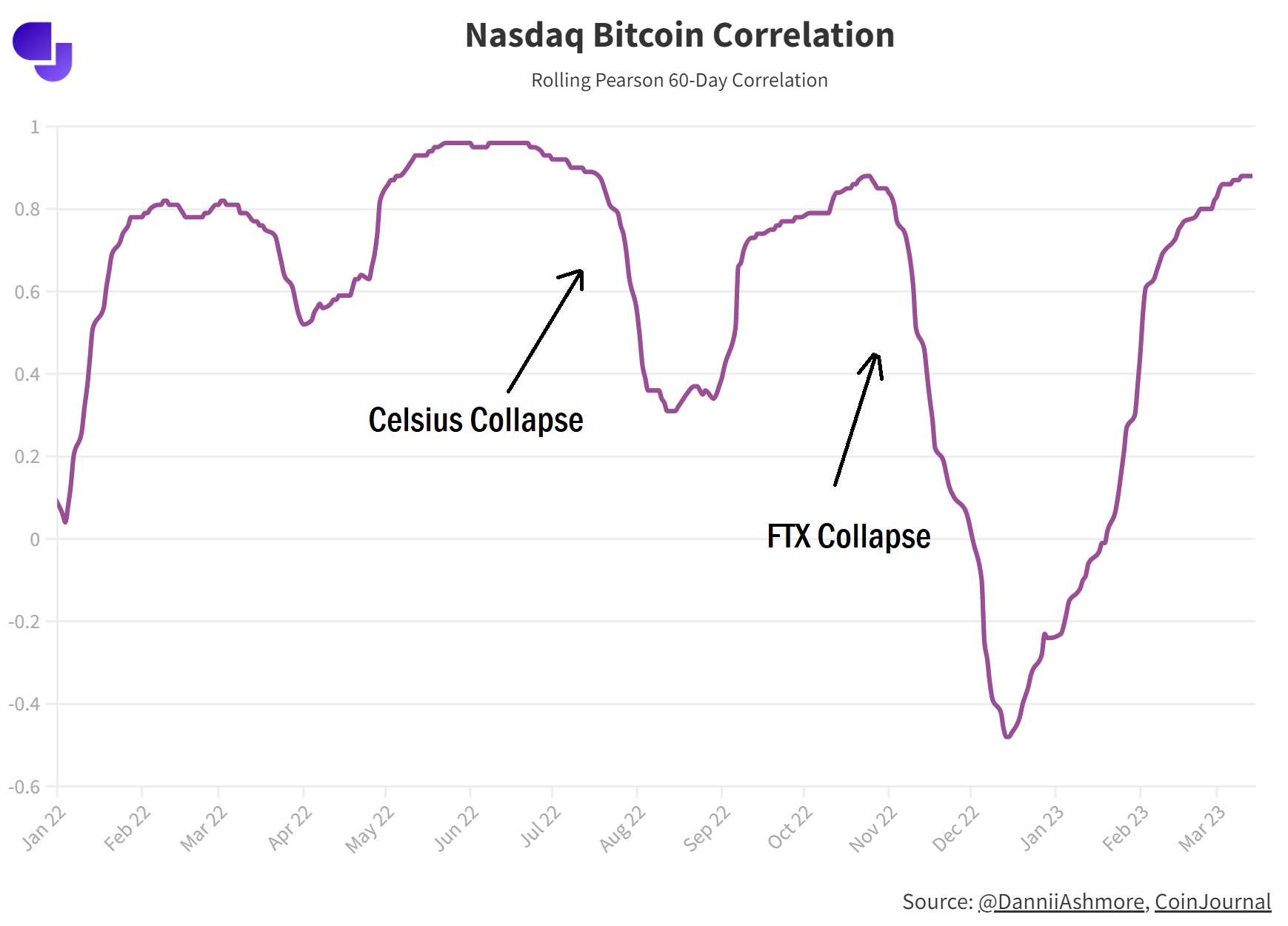
Let’s now graph the correlation itself. I won’t get too deep on the math, but I have used the 60-Day Pearson indicator and rolled it back to the start of 2022.  

The results more or less back up what we discussed above. For the uninitiated, a correlation of 1 means a perfect relationship (the word count of this article and the number of words I have written this month, for example) while a correlation of 0 means no relationship (such as my word count per month and the number of T-Rexs spotted in New York City). 

Celsius and FTX collapses are clear below, while the other dip occurs around the time of LUNA (the stock market also fell around this time as we transitioned to high interest rate policy).

Correlation can be misleading

This shows correlation, but not necessarily causation. My old maths teacher had a great way of explaining this difference. Shark bites and ice cream purchases may be correlated, but nobody would argue that digging into Ben and Jerries makes you more likely to be hunted by a great white shark.

Instead, there is a lurking variable. In this case, on sunnier days, people are more likely to both swim at the beach and buy ice cream, and it is the swimming rather than the ice cream that makes a shark bite more likely. Swimming is the lurking variable. 

While that example is exaggerated (shark bites are extremely rare, in case I’m arising a phobia of yours!), the point is a good one. In financial markets, we have another lurking variable. In truth, we have lots of them – there are an imaginable amount of variables that affect the stock market – but the big one this past year has been the Federal Reserve and its interest rate policy. 

It is not the stock market that is causing Bitcoin to move, it is interest rate policy causing both the stock market and Bitcoin to move. And in turn, expectations about inflation have been the key factor feeding into interest rate expectations. This is why we have seen repeatedly big movements around CPI announcements and Fed meetings. 

There is a saying, “correlations of risk assets go to 1 in times of crisis”. And when we transitioned into a new interest rate paradigm in April 2022, when it became clear inflation was rampant, that is exactly what happened. 

All risk assets sold off, including both stocks and equities. Bitcoin, being more volatile, of course sold off more. And since then, bar the aforementioned episodes, the correlation has held. 

Is the correlation falling?

The big question is whether this correlation is falling. Indeed, that is the ultimate vision for Bitcoin. An uncorrelated store of value, akin to a digital form of gold.

Some have looked at the price action of the past week or two and declared that this means we are seeing a lower correlation. But I think this is simply a smaller version of what we saw during the Celsius and FTX “decouplings”. A short-term dip in correlation in response to a specific event. 

Bitcoin sold off drastically in the wake of the Silicon Valley Bank (SVB) troubles, before rebounding sharply once the US administration announced it was stepping in to guarantee deposits. 

The stock market, on the other hand, also sold off but to a far lesser degree. And then with the banking turmoil striking Europe yesterday, Bitcoin held firm while markets wobbled. The declaration was that this must mean the famous decoupling is taking place. 

I believe this is a fallacy and I think the numbers agree. 

Bitcoin first sold off aggressively because SVB had the potential to be a crisis on the scale of Celsius and FTX, as Circle, the issuer of the world’s second-biggest stablecoin, USDC, holds $3.3 billion of reserves in the bank (and the original fear was that it may hold more, before the number was clarified). 

USDC hence depegged, falling to below 90 cents on many exchanges. Obviously, a USDC collapse would have been harrowing for the industry and hence Bitcoin plummeted, falling to around $20,000. 

While SVB presented an ominous threat to financial markets as a whole, the danger within cryptocurrency was elevated because of the importance of USDC to the industry, especially following the shutdown of BUSD last month.

With 25% of Circle’s reserves in cash, there was fear of insolvency until it was clarified that only 8.25% of reserves were held in SVB, before the US administration stepped in to guarantee deposits in any case. 

Once this fear was over, Bitcoin rallied back, reversing the fall when the crisis came to light. But stocks didn’t jump to the same extent. This makes sense.  

Besides, the price action was not all that dramatic and the supposed “decoupling” was hardly drastic. European banks were hit Wednesday, but Thursday has largely seen a rebound, while on a whole, the stock market is doing just fine, showing moderate gains. 

Looking at the correlation metric, it has barely moved over a longer time frame such as 60-day, and is already bouncing back. The 30-day metric shows more movement, but as with any smaller sample size, is always more volatile and less indicative. Both metrics already appear to be bouncing back in any case.

Whatever way you swing it, a simple glance at the previously mentioned chart comparing the Nasdaq to Bitcoin is all you need to know. Bitcoin is trading like an extreme-risk asset, and that much is quite clear.

The trillion dollar question is whether this will change in the future. Can Bitcoin finally decouple from risk assets and establish itself as an uncorrelated store of value? Can it become a true hedge asset?

That may happen one day. But it hasn’t happened yet.

The post No, Bitcoin is still as correlated as ever with the stock market – A Deep Dive appeared first on CoinJournal.

AllianceBlock partners with ABO Digital for structured crypto projects financing

  • AllianceBlock builds seamless gateways between TradFi and DeFi through its decentralized and trustless infrastructure.
  • ABO Digital is the private digital asset investment arm of Alpha Blue Ocean.
  • The two companies have partnered to offer alternative financing for crypto projects.

AllianceBlock has partnered with ABO Digital to offer tokenized structured products for institutions and crypto projects looking for alternative forms of financing. The partnership is another milestone for AllianceBlock in its quest to build seamless gateways between Traditional Finance (TradFi) and Decentralized Finance (DeFi).

AllianceBlock will leverage ABO Digital’s decentralized and trustless blockchain infrastructure together with the Nexera Protocol to tokenize financial instruments.

Commenting about partnership, Rachid Ajaja, the CEO of AllianceBlock said:

“Through this strategic partnership, AllianceBlock is set to revolutionize the industry by leveraging its infrastructure to tokenise traditional financial instruments and new instruments for the digital asset space, taking a giant leap forward in providing institutions with a more compliant and risk-averse way to take advantage of DeFi’s benefits. This partnership marks a significant milestone for both companies and the industry as a whole, demonstrating our commitment to innovation, compliance, and risk management. The future of finance is looking brighter than ever.”  

AllianceBlock and ABO Digital’s structured products

ABO Digital offers a variety of structured financial products including convertible bonds, debt issuance, and warrants/options, providing the capital startups need to grow their customer and revenue base. It is also exploring the provision of alternative financial investments to institutions through tokenization.

The AllianceBlock and ABO Digital’s structured products will provide crypto projects with alternative funding options like issuing tokens to market makers or venture capitalists via a Simple Agreement for Future Tokens (SAFT), to access additional liquidity from institutional capital providers with full compliance.

How the structured financial products work

Under the agreement, ABO Digital will negotiate and structure financial instruments depending on a project’s capital and liquidity requirements. AllianceBlock in collaboration with Nexera Protocol’s infrastructure and NexeraID’s identity will tokenize structured financial instruments and convert them into Actively Managed Certificates (AMCs) with full compliance for capital providers that do not want to hold digital assets.

Funds from capital providers will be locked into smart contracts and disbursed to projects only after the minimum funding threshold has been raised. The capital providers will receive a traditional AMC, with AllianceBlock managing the assets by holding the convertible bonds, debt or warrants.

ABO Digital will receive a structuring fee based on the amount raised, with AllianceBlock taking the majority of fees for managing the AMC or directly through the tokenized asset.

The post AllianceBlock partners with ABO Digital for structured crypto projects financing appeared first on CoinJournal.