
Less than $20 billion of stablecoins left on exchanges as capital continues to drain


Key Takeaways

  • Nearly $24 billion of stablecoins have left exchanges since FTX collapsed last November
  • The total marketcap of stablecoins has dipped $16 billion in that time
  • Liquidity continues to fall in the crypto space, with capital moving elsewhere despite rising prices
  • Strict regulatory climate in the US, high yields in trad-fi and uncertainty may be contributing to the pattern

Crypto prices have risen since the start of the year, but capital continues to flow out of the space. Last week brought the news that two prominent market makers, Jane Street and Jump Crypto, were scaling back operations in the US amid the continued regulatory crackdown on the sector. 

For markets that have already been suffering from thin liquidity since the Alameda insolvency last year, the news amounts to the latest blow. While rising prices may have brushed the problem under the carpet for the time being, Bitcoin markets getting drained of capital is undoubtedly a hurdle that needs to be overcome for an asset that has ambitions of establishing itself in the mainstream. 

Indeed, with liquidity so low, prices have been able to move up more rapidly, with less capital needed to shift the shallow order books on exchanges. In the short-term, this has been a boon. As inflation has come down and forecasts around the future path of interest rates have softened in the last six months, crypto has thus surged upward with less resistance in its way, Bitcoin expanding over 60% this year. 

In the long-term, however, this is not a bullish development. Thin liquidity means amplified moves downward as well as upward. And looking at the regulatory climate, things only seem to be getting worse for crypto firms based in the US, which happens to be the centre of the financial world. 

The SEC is on a warpath with the entire entire industry, clapping back at accusations that it is the lack of regulatory clarity that is causing so many issues, but rather “mass non-compliance” on the part of crypto firms. 

The money is talking. We have discussed the recent announcements of market makers, but a glance at the liquidity on exchanges also reveals the capital flight that is occurring. This week, the total balance of stablecoins on exchanges dipped below $20 billion. At the start of the year, that figure read $37.7 billion. When FTX fell in November, it was $43.5 billion. 

We have published research on this exodus before. But the flood shows no sign of drying up, and we are now at a place whereby 55% of the stablecoins on exchanges have departed since FTX and Alameda went poof in November. 

This 55% outflow represents a funnelling out of nearly $24 billion, a massive chunk when considering the entire stablecoin market cap is currently only $130 billion. Interestingly, the market cap was $146 billion when FTX went down, meaning the total stablecoin drawdown has “only” been $16 billion.

This suggests stablecoins are being moved elsewhere in the blockchain world, as well as fleeing the crypto space altogether. But with T-bills yielding an easy 5% while the regulatory climate around crypto continues to worsen, it is not a surprise to see investors’ heads turned. When considering the fear around custody of assets after FTX collapsed, and the fact the macro climate remains uncertain, this makes more sense again. 

Whatever happened, the main point here is that liquidity in the crypto space continues to be drained. Most order books are as shallow as they have been in over two years, and Bitcoin’s volatility remains high (even with the last couple of weeks feeling relatively serene, Bitcoin has still dropped 12%). As for other cryptos, the effect is even more pronounced. If this liquidity issue doesn’t change, crypto will have a tough time establishing itself as a force on the mainstream stage. 

The post Less than $20 billion of stablecoins left on exchanges as capital continues to drain appeared first on CoinJournal.
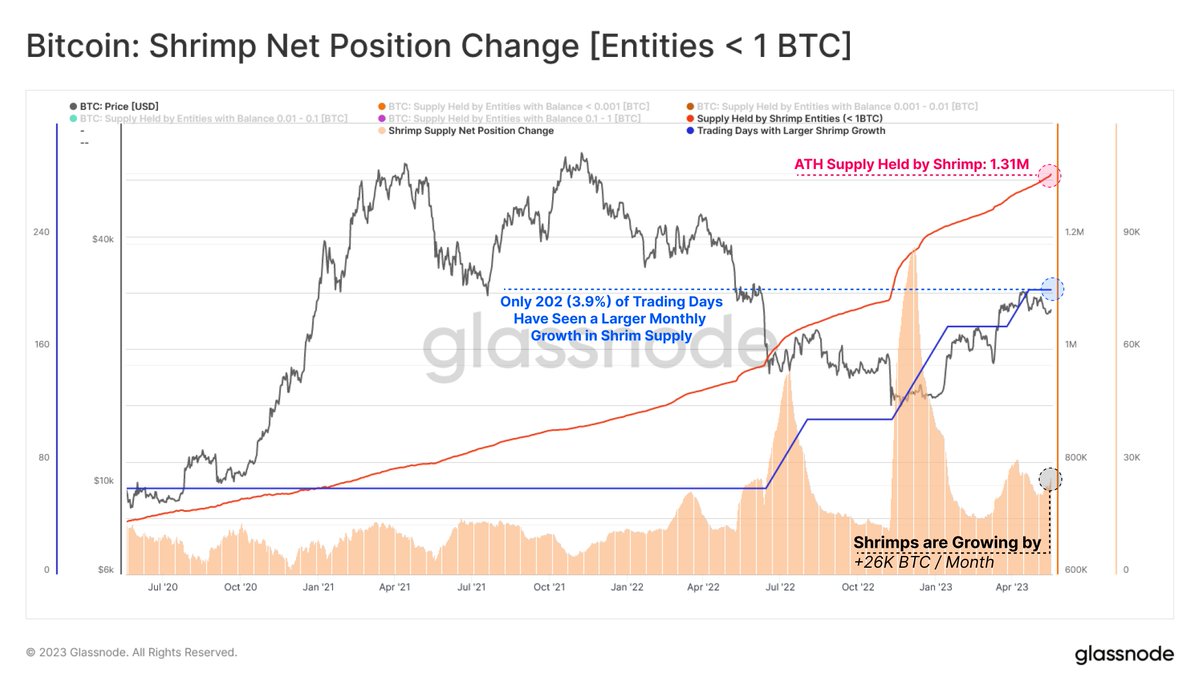
Bitcoin supply held by shrimps hits all-time high of 1.31 BTC

  • Bitcoin wallets with less than 1 BTC now hold an all-time high of 1.31 million coins.
  • Shrimps have been adding an average of 26,000 BTC every month, data shows.
  • The growth of the shrimp cohort is a positive development for the Bitcoin network.

The amount of Bitcoin held by “shrimps” – those wallet entities that currently hold less than 1 BTC) has reached a new all-time high.

According to data from Glassnode, shrimps have increased their total holdings to 1.31 million BTC. The cohort has witnessed the gradual increase in holdings over the past several months.

Shrimps grow holdings by +26,000 BTC every month

Per data Glassnode shared via Twitter, the shrimp cohort has experienced a significant expansion of their holdings in 2023. This followed a similar trend last year, with the buying among this group coming despite the greater volatility that hit the market.

Specifically, shrimps have added 26,000 or more Bitcoin every month. Since July 2020, only 202 (3.9%) trading days have recorded a larger monthly growth.

The suggestion from this is that retail investors have been aggressive in accumulating BTC, with the dips seen during the bear market providing investors with an opportunity to buy Bitcoin at low prices.

The chart below shows the growth in the amount of BTC held by wallet addresses with less than 1 bitcoin. As you can see, the amount held by these entities has increased significantly in June/July 2022 and again in November/December and January 2023.

Increase in small holders is a positive for the long-term health of Bitcoin’s network as the metric suggests retail investors are confident in the cryptocurrency’s growth and long term potential.

The post Bitcoin supply held by shrimps hits all-time high of 1.31 BTC appeared first on CoinJournal.

Polygon price prediction: Will Matic recover above $1 after recent partnerships?

Key takeaways

  • MATIC is up by only 3% over the past seven days despite Polygon announcing a series of interesting partnerships. 

  • Antimetal launched its AI-powered cloud cost optimization platform on Polygon.

  • MATIC could be eyeing the $1 mark, but the fundamentals of the broader crypto market could play a huge role.

MATIC continues to trade below $1

MATIC, the native coin of the Polygon ecosystem, is trading below the $1 mark. The coin has less than 1% of its value over the past 24 hours. At press time, the price of Polygon stands at $0.8748 per coin.

The performance comes despite Polygon announcing several key partnerships this week. 

Earlier this week, AntiMetal launched its AI-powered cloud cost optimization platform on the Polygon blockchain. 

The partnership was followed by Horizon integrating Sequence’s wallet and developer stack on Polygon providing enterprises and app developers the ability to customize and extend blockspace.

In the same vein, Sandeep Nailwal, the CEO of Polygon, also launched a web3 fellowship program.

Will MATIC move past the $1 soon?

MATIC has been underperforming over the past few days due to the fundamentals of the broader cryptocurrency market. 

The coin could rally past the $1 mark soon if the fundamentals of the broader cryptocurrency market improve. Bitcoin continues to trade below $27k and could likely drop lower if the bulls fail to defend the $26,400 support level.

The technical indicators on the 4-hour chart show that MATIC is outperforming the broader cryptocurrency market. The MACD line remains above the neutral zone, indicating that the bulls still continue to control the market.

The 14-day relative strength index of 52 shows that MATIC could be entering the oversold region if the market sentiment persists. 

Where to buy MATIC now

eToro

eToro is a global social investment brokerage company which offers over 75 cryptocurrencies to invest in. It offers crypto trading commission-free and users on the platform have the option to manually invest or socially invest. eToro even has a unique CopyTrader system which allows users to automatically copy the trades of popular investors.

Buy MATIC with eToro today

Bitstamp

Bitstamp is a leading cryptocurrency exchange which offers trading in fiat currencies or popular cryptocurrencies. Bitstamp is a fully regulated company which offers users an intuitive interface, a high degree of security for your digital assets, excellent customer support and multiple withdrawal methods.

Buy MATIC with Bitstamp today

The post Polygon price prediction: Will Matic recover above $1 after recent partnerships? appeared first on CoinJournal.

Coinbase’s zero-fee subscription service out of beta and expanded outside the US

  • Coinbase has rolled out a new subscription service called Coinbase One.
  • The service will give members access to $0 trading fees among other benefits.
  • The Coinbase One is expected to roll out across 35 countries in the near future.

After staying in Beta since 2021, Coinbase has officially opened its zero-fee subscription service called Coinbase One. The service has also been expanded outside the US into countries like the United Kingdom, Germany, and Ireland.

Through Coinbase One, customers will have the option of paying $29.99 per month to enjoy zero trading fees and higher staking rewards. Customers can pay for the subscription using their linked bank account (ACH) or linked debit card.

Zero trading fees on Coinbase

According to the statement issued by Coinbase, the Coinbase One service allows customers to access $0 trading fees, dedicated 24/7 phone support, $1M Account Protection, and pre-filled Form 8949 in Coinbase Taxes.

The statement by Coinbase in part reads:

“Eligible users may sign up for Coinbase One which is an automatically renewing subscription requiring recurring payments. A Coinbase One subscription grants you the benefits of: (a) a waiver of Coinbase fees for buying, selling, and converting digital currencies on the Coinbase platform (which does not include Coinbase Pro’s order matching platform), provided that a spread in the price is still included in all buys, sells, and conversion of digital currencies on the Coinbase trading platform (learn more about fees here); (b) a dedicated customer support line available twenty-four (24) hours a day, seven (7) days a week, three-hundred and sixty-five (365) days a year; and (c) Coinbase Account Protection. Coinbase may modify or suspend this program at any time upon notice.”

However, the fee-free trading volume limit as found in customers’ account settings will apply. When customers trade over their set trading volume limit, they will be responsible for paying regular trading fees.

Widening international reach

Coinbase aims to expand the Coinbase One service in 35 countries in the future as Coinbase tries to widen its international reach.

The move also comes just a month after Coinbase unveiled a global crypto exchange following the tightening regulatory environment.

The post Coinbase’s zero-fee subscription service out of beta and expanded outside the US appeared first on CoinJournal.

No, Bitcoin has never seen a bear market before – This time it’s different


Key Takeaways

  • Bitcoin has been through many bear markets before, always surging back to higher highs
  • Dan Ashmore, our Head of Research, cautions against naive extrapolation of past returns, however
  • Until this past year, stock markets had done nothing but rise during Bitcoin’s existence
  • Bitcoin was launched in 2009 as the stock markets bottomed, and the bull run afterward was one of the longest in history
  • This needs to be considered, cautions Ashmore, whilst sample size of Bitcoin trading with any sort of liquidity is also small

Bitcoin is volatile. Also true: water is wet and the sky is blue. 

A quick glance at a Bitcoin chart will tell you all you need to know about the meteoric rises and bone crushing pullbacks that the asset has produced over the years. In truth, it should be plotted on a scale, too. 

When looking at Bitcoin markets, therefore, it is tempting to jump to the conclusion that “we have been here before”. Bull markets and bear markets, easy come and easy go. Or, as Jeff Bridges put it so poetically in the Big Lebowski, “strikes and gutters, ups and downs”. 

While Bitcoin has drawn down many times before and, at least previously, always bounced back, I believe it is naive to extrapolate past resurgences into the present. Because no, we have not been here before. 

To be clear, I am not saying Bitcoin will not rise to new heights again. It easily could (I hold Bitcoin as part of my portfolio, albeit via a monitored allocation and obeying the boring all adages of diversification and risk management, but hey – that is for another time). My point, however, is that we have zero point of reference for the current situation. Despite a surge of 75% in the last six months, Bitcoin is 60% off its high in Q4 of 2021, with many investors underwater if they opened positions in the past three years as Bitcoin truly established itself on the mainstream stage.  

Let me explain why things are different this time around, and why assuming with blind confidence that Bitcoin will surge upward imminently may be misguided. First, the below are the biggest peak-to-trough drawdowns in Bitcoin history (the recent/current one is highlighted in yellow): 

Clearly, Bitcoin has been here before. Right? 

Well, no it hasn’t. Look at the dates of the above: all these drawdowns are from 2012 onwards. This is because Bitcoin was only launched in 2009. Indeed, it didn’t really have any sort of liquidity or infrastructure (such as exchanges or a marketplace) until 2012 (and even then, liquidity was extremely thin). 

And consider what has happened in the wider economy since Bitcoin was launched in 2009. On March 9th 2009, two months after Bitcoin launched, the Nasdaq hit a low of 1268. The S&P 500 did the same, hitting a nadir of 676. 

Since then, markets have enjoyed one of the most remarkable, longest and explosive bull runs in recent history, as basement-level interest rates propelled asset prices to dizzying all-time highs. By late 2021 at their peaks, the Nasdaq hit a level of 16,057, the S&P 500 4,793. Since those aforementioned lows in March 2009, that represents returns of 12.7X and 7.1X respectively. A historic period of gains.

Presenting the returns of both the Nasdaq and S&P 500 since Bitcoin was launched in January 2009 (note – this goes back a couple of months before the trough of the stock market in March of that year and hence the returns are not as empathic as above) shows the run in markets visually throughout Bitcoin’s life:

Or perhaps the next chart is better, showing quite how boisterous the stock market throughout Bitcoin’s life during the period up to and including 2021. 

Therefore, every single dip in Bitcoin’s history took place whilst the wider financial markets were humming along swimmingly. This all changed in 2022, of course, when inflation spiralled and the world’s central banks began hiking rates at the fastest rate in recent memory. 

Suddenly, for the first time in Bitcoin’s existence, it was ticking along block-by-block while financial markets elsewhere were falling. And they were falling quickly, the S&P 500 shedding nearly 20% in 2022, the Nasdaq losing over a third of its value. Not only were these losses the worst of any period in Bitcoin’s life, they were, aside from minor falls in 2011 and 2018, the only losses it had ever seen. 

Therefore, this time is different. Blind faith in Bitcoin bouncing back aggressively because of the simple conclusion that it has done so before is a dangerous assumption to make. Again, Bitcoin could easily do exactly this, but it would be foolish to assume it is a guarantee because it has happened in the past. 

The reality is that, until this past year, the world had no idea how Bitcoin would trade outside of the zero-interest rate vacuum that we have been operating in for the past decade. There is no trade history for Bitcoin going back to previous recessions, no chart one can pull up to assess how it weathered inflation in the 1970s, no reference point to anything but a stock market printing green candle after green candle. 

Not only did all those previous resurgences come amid a period of cheap money and expanding central bank balance sheets, but Bitcoin markets were also incredibly illiquid. It took barely a drop of capital to move prices, as Bitcoin exploded from a fraction of a cent to thousands of dollars per coin. Bitcoin’s existence has been brief itself, at 14 years, but its status as a financial asset of any sort of liquidity is even briefer again. 

So, for one last time: this is not a piece making any forecasts about the future of Bitcoin. I don’t want to wade into such murky waters (not here, anyway!). Rather, it is a piece cautioning that we have such a small sample size to work with when it comes to Bitcoin, and it is important to be cognisant of that when assessing how it trades. 

Bitcoin has never experienced a bear market in the wider economy before. Until now. Overlooking that critical fact is a dangerous game to play.

The post No, Bitcoin has never seen a bear market before – This time it’s different appeared first on CoinJournal.