Ledger to delay controversial key recovery feature, CEO says

  • Ledger has decided to delay its recovery feature as it open-sources the code, CEO Pascal Gauthier said in a letter.
  • The Ledger Recover feature won’t be rolled out until the open sourcing is complete, he noted.
  • Gauthier also apologised for the way the company handled the communication around the feature’s release.

Ledger is delaying the rollout of its recovery feature, CEO Pascal Gauthier has announced.

According to details in a letter the CEO of the hardware wallet provider addressed to customers and the broader cryptocurrency community, the planned implementation of Ledger Recover will remain on hold until the company releases its code.

“We have made the decision to accelerate the open sourcing roadmap! We will include as much of the Ledger operating system as possible, starting with core components of the OS, and Ledger Recover, which won’t be released until this work is complete,” he noted.

Other than that, Ledger plans to open source the recovery protocol, a move the company believes will enable the crypto community to benefit from increased room for making choices regarding the self-custody of their assets. The service will also remain fully optional.

“We’ve listened to our customers; we are accelerating a roadmap that’s been in progress, and regardless, the security of your Ledger remains unchanged,” the Ledger exec added.

Ledger CEO apologises to crypto community

Ledger announced the recovery service last week, revealing that users would be able to secure the encrypted backups of seed phrases via custodians. 

The feature was to allow crypto holders access and restore private keys after they lose or forget seed phrases. The Ledger Recover is an opt-in feature that will require customers to complete a Know-Your-Customer (KYC) check. 

Criticism of Ledger’s move was massive, with the industry shocked by how the company proceeded to handle the uproar.

In his letter, Gauthier apologised “for the way this was communicated.” The wallet provider’s leadership is also set to hold an AMA on Tuesday, 23 May 2023 at 12:30 pm ET where the Ledger Recover service will be expounded on.

The post Ledger to delay controversial key recovery feature, CEO says appeared first on CoinJournal.

Here’s why Render Token (RNDR) price is rising

  • At press time, Render Token (RNDR) was trading at $2.66, up 7.73% in the last 24 hours.
  • The price of RNDR has increased by 42.49% over the last seven days.
  • Render recently released a new Render Network Foundation website.

Render Token has been in the limelight in the past month and mainly in the last two weeks because of the rising RNDR price.

There has been a lot going on around the distributed GPU rendering network built on top of the Ethereum blockchain as it aims to connect more artists and studios in need of GPU computing power with mining partners willing to rent their GPU capabilities out.

Why is the Render Token price surging?

There are several Render Token news responsible for the current RNDR bullish trend.

The most recent announcement was made on May 22  and it was announcing revisions to the C4D plugin for Octane that includes a brand new feature, an ORBX export command tailored exclusively for RNDR Jobs, available through the live viewer. The announcement resulted in a 6% RNDR price surge.

The other crypto news about Render Network was on May 19, when Render launched its new Render Network Foundation website featuring an all-new community hub for The Render Network, including art showcases from some of the amazing creators in the Render Network community.

The new website provides a simple, easy way to find information about the Render Network. Users can access the Artist portal, Knowledge Base, information about participating in Render Network Governance, and links to Render Network’s social sub-communities.

The post Here’s why Render Token (RNDR) price is rising appeared first on CoinJournal.

Why are Bitcoin transaction fees rising, and what are BRC-20 tokens?


Key Takeaways

  • BRC-20 tokens were launched on Bitcoin in March 2023
  • Transaction fees spiked to all-time highs in May 2023 as network activity spiked
  • Bringing memes and NFTs to Bitcoin has caused controversy
  • Some argue the rising fees are vital to the security of the network, while others scoff at the activity for getting away from Bitcoin’s “vision”

We live in an inflationary world. Food prices, rent, energy – everything feels more expensive. That is not limited to the fiat world, however. Bitcoin users have noticed a hike in fees recently. So why is this happening, and what does it mean for Bitcoin? And what does this weird concept of NFTs on Bitcoin have to do with anything?

Bitcoin fees rocket upwards in May

Firstly, let us look at a chart presenting Bitcoin fees over the last three years to show the spike in fees. Clearly, the vertical jump in the first week of May is glaring. 

While Bitcoin fees may rise in future regardless (and we will get to that in a moment), the outlier that is this wild spike in May 2023 is down to something I never thought I would say with regards to Bitcoin: memes.

Specifically, the BRC-20 protocol, which is a token standard inspired by ERC-20 tokens on Ethereum. To explain this, we first need to look at Bitcoin Ordinals, because that is what has made this all possible. And yes, it is all on the Bitcoin blockchain. 

What are Bitcoin Ordinals?

Bitcoin was always viewed as the “pure” blockchain. There was no room for non-fungibility, meaning each Bitcoin is the same as another Bitcoin. No NFT nonsense here, thank you very much. 

This changed in January 2023 when the Ordinal protocol was invented. In simple terms, the Ordinals protocol is a system for marking each satoshi, the smallest denomination of a Bitcoin (every Bitcoin is divided into 10 million satoshis). These marked satoshis can then be tracked and differentiated from other satoshis, meaning they are technically “non-fungible”. And so, against all odds, we (sort of) have Bitcoin NFTs. 

The marks on satoshis have become known as “inscriptions”. These inscriptions were made possible by the Taproot upgrade to the Bitcoin network in November 2021. The protocol is known as Ordinals, named due to the fact the transfer scheme for satoshis relies on the order of transactions. 

While this all sounds a little complex, in comparison to NFTs on other blockchains, it is very primitive and basic. There are no smart contracts here. Sidechains are not necessary. Everything is inscribed directly on the Bitcoin blockchain. 

What are BRC-20 tokens?

Two months after Ordinals arrived in the world, an experimental token standard, named BRC-20 in a nod to ERC-20 tokens on Ethereum, were launched in March 2023. This token standard creates fungible tokens within the Ordinal protocol. You may suspect where this is going. The ability to trade fungible tokens within this protocol of Bitcoin? Yes, memes. 

In the below chart, I have presented the top 10 BRC-20 tokens by market cap. As one will be able to deduce pretty swiftly when looking at the names, a lot of these are memes. 

(sidenote – eagle-eyed readers may also be able to deduce from the supply of some of these tokens that they are memes. Personally, I enjoy the nod to Satoshi Nakamoto with the 21 million supply of so many on the board). 

What has all this got to do with fees?

So, back to fees. The rise of Bitcoin Ordinals has thrown up an interesting dilemma. These inscribed satoshis are now competing for block space with conventional Bitcoin transactions. On the Bitcoin network, more activity leads to more fees, and this is why we have been seeing a spike in fees. As the BRC-20 tokens have taken off, we have seen Bitcoin’s network clog up and fees jump. 

This has caused a debate. Some argue against these higher fees, lamenting the waste of time that NFTs and memes are, getting in the way of what Bitcoin is “meant” to be. On the other side, fees are vital for the security of the Bitcoin network. Additionally, once the final supply of 21 million Bitcoins is hit in 2140, miners will need to survive solely on fees. Indeed, as block rewards step down with each halving, mining fees become an ever larger portion of miners’ income, and hence these fees are a crucial incentive for miners and a driver of the hash power for Bitcoin. 

Personally, my take on this is somewhat between the two extremes. I have every confidence that these memes and NFTs and whatever else trading on the Bitcoin network are inherently valueless. Then again, I don’t care much for NFTs in general. However, I don’t see the rising fees as an issue. 

The key here is that the hash rate is still rising. This contrasts to April 2021, which was another time period when Bitcoin fees spiked violently, the average transaction on the network costing a staggering $70. This was due to a crash in the hash rate, which is very much a concern for Bitcoin’s security and stability as a network. 

This is different. Rising fees due to increased activity is fine. That is true regardless of the transaction: regular, meme, NFT or other. It really doesn’t matter. Besides, the scalability issue with Bitcoin is well known, and fee spikes encourage people to look at solutions such as sidechains, like the popular Lightning network which bundles transactions together off-chain. But there are other Layer-2s besides Lightning, such as Liquid and Rootstock, to name a couple.

The prediction that the Bitcoin blockchain will become a base settlement layer has been around for some time. The existence of what is likely a fad, i.e. these tokens and Ordinals, is relatively harmless and shouldn’t change much in the overall scheme of things. The fee and scalability issue will always be here, regardless of what is driving it. And this is exactly why we have the Lightning network, and why people are continuing to innovate to come up with Layer-2 or other solutions. 

The post Why are Bitcoin transaction fees rising, and what are BRC-20 tokens? appeared first on CoinJournal.

Rakkar Digital obtains TSCP License in Hong Kong, launches custodian services

  • Rakkar Digital is a Singapore-based company providing digital asset custodian services to institutional and enterprise clients across Southeast Asia and Hong Kong.
  • Rakkar Digital has obtained TSCP License in Hong Kong.
  • Rakkar Digital launched custodian services immediately after receiving the license.

Rakkar Digital has announced the launch of Rakkar Digital Asset Custodian, powered by Fireblocks’ MPC-CMP direct custody technology. Fireblocks, Collider and MarketAcross hosted a Web3 startups event at the beginning of the year.

The announcement comes right on the heels of Rakkar Digital obtaining a Trust or Company Service Provider (TCSP) Licence in Hong Kong. The company completed a $10 million seed funding investment in June 2022 by SCB 10X, the venture capital arm of Siam Commercial Bank.

Rakkar Digital Asset Custodian services

Rakkar Digital addresses the vulnerability to cyber threats within the digital asset industry as the industry grows by providing institutional-grade qualified custodian services to its clients.

As a TCSP licensee, Rakkar Digital must comply with Anti-Money Laundering and Counter-Terrorist Financing Ordinance (AMLO). This ensures that due diligence requirements are met, and proper safeguards are in place to prevent money laundering or terrorist financing activities.

Commenting on the development, Arthit Sriumporn, founder and CEO of Rakkar Digital, said:

“From day one, we had a strong passion to build reliable infrastructure for the industry. We have come a long way with the launch of our institutional-grade qualified custodian services. We will continue to improve our products and services based on our core values: trust, security and authenticity. These milestones demonstrate our commitment to providing secure and reliable digital asset custodian services to institutional clients in the region.”

The Rakkar Digital Asset Custodian is built on cutting-edge technology and robust security measures with Fireblocks’ ultra-secure MPC-CMP technology, and hardware isolation enabling multi-layer security while maintaining flexibility.

The post Rakkar Digital obtains TSCP License in Hong Kong, launches custodian services appeared first on CoinJournal.

KAVA in danger of erasing gains after 40% spike – here’s what happened?

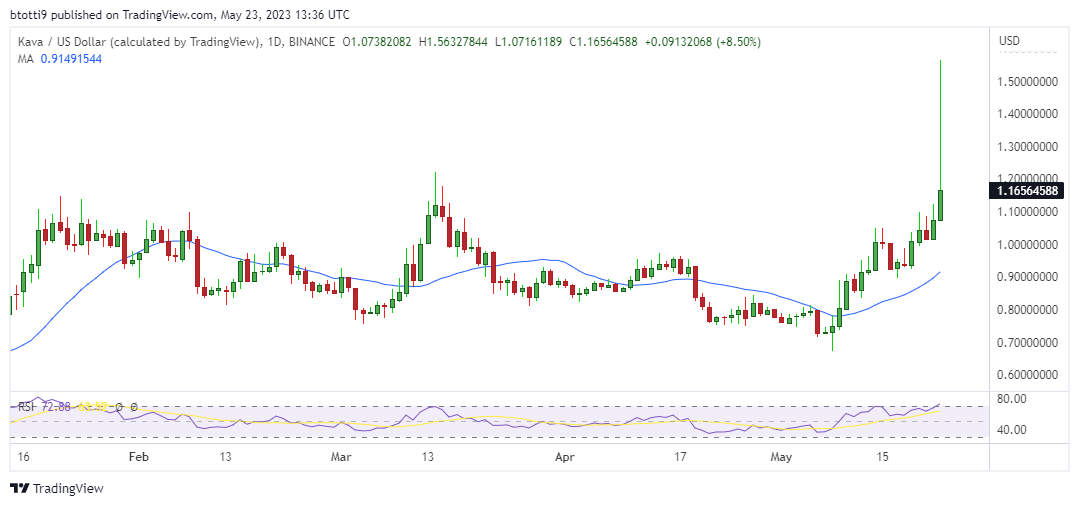
  • KAVA price jumped more than 40% despite the overall market lull, reaching highs of $1.56 on Binance.
  • While there was no clear trigger for the surge, Kava has had a few major developments in recent weeks.
  • KAVA currently trades around $1.17 and is in danger of giving up all the gains if profit taking deals intensify.

The price of KAVA is up about 9% in the past 24 hours as at 9:30 am ET on Tuesday, 23 May. The KAVA/USD pair is trading around $1.16 amid increasing pressure from profit takers. 

But before the current sell-off pressure, the price of the Cosmos zone token had rallied more than 40% to hit its highest level since November 2022.

Kava price sliding after rally to multi-month high

The price of KAVA rose to $1.56 on leading cryptocurrency exchange Binance, with the token spiking 44% from lows of $1.08.  The token’s value was up nearly 63% in the past 30 days.

Kava price jumped more than 40% on Tuesday morning as shown in this chart. Source: TradingView

Kava is a highly scalable Layer-1 blockchain that combines the speed and interoperability of Cosmos and the developer power of the Ethereum Virtual Machine (EVM). There was no apparent trigger for the huge move today. However, here’s why the token’s value might have rallied so hard for a brief moment before investors likely started taking profits.

Although likely a normal pump episode, the price gains follow the recent launch of the KAVA 13 mainnet and the announcement of a new integration with a leading data indexing platform SubQuery. SubQuery’s indexer tool is available across Osmosis, Cronos and Fetch.ai in the Cosmos ecosystem.

The blockchain developer toolkit is also available for Web3 developers across Ethereum, Polygon, BNB, Flare, NEAR, Polkadot, Avalanche, and Algorand. It is offered as a data-as-a-service solution that allows users to focus on core project use cases and the front-end, all without having to first build a custom backend for data processing.

Kava also announced a $5000 giveaway as it celebrated the launch of NFTs and GameFi on its chain.

What next for the KAVA price?

Today’s price surge for KAVA appears to have been an outlier of sorts given the overall outlook of the crypto market. It’s possible such gains will not hold and any correction that follows could wipe all the upside movement.

KAVA/USD might thus retreat to support at $1.10 or lower if current levels near $1.20 fail to hold. On the flipside, an uptick across the market or fresh pump based on new KAVA news could see buyers target a retest of today’s highs.

The post KAVA in danger of erasing gains after 40% spike – here’s what happened? appeared first on CoinJournal.