3 reasons why Bitcoin price remains resilient

  • Binance and Coinbase are sued by the SEC
  • Bitcoin price remains resilient
  • Scarcity, inflation rate halving, and an increase in the number of users help Bitcoin

Once again, cryptocurrency investors are tested. In a span of 24h, several things challenged the market again.

First, Binance, one of the largest crypto exchanges in the world, was sued by the Securities and Exchange Commission with thirteen charges. Second, Coinbase was sued by the same authority for operating as an unlicensed broker in the US.

Moreover, the SEC filed court documents to freeze Binance’s US assets. Given how strategically important these two players are for the industry, how come Bitcoin price remains resilient? Here are three reasons that might explain such resilience:

  • Scarcity
  • Increased number of holders
  • Halving inflation rate

Scarcity

The upper limit of supply is mathematically fixed at 21 million. This scarcity makes Bitcoin attractive in the eyes of many investors, as it resembles a digital store of value.

The number of users/holders increases

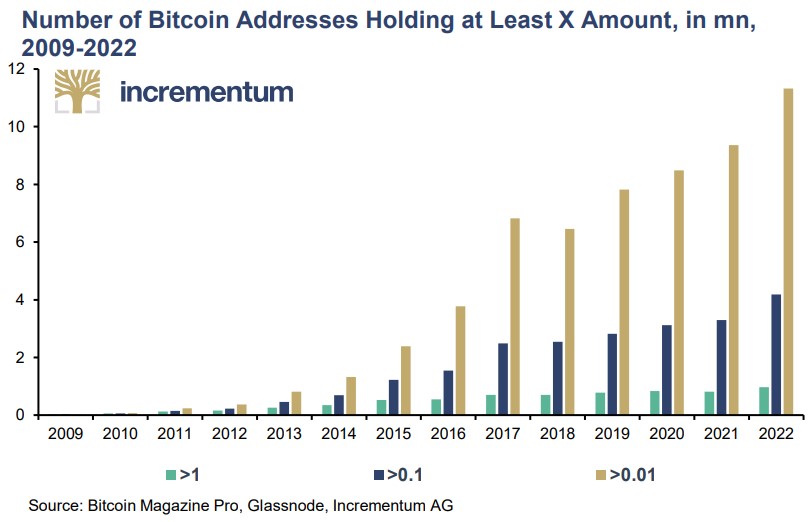
More and more people use or hold Bitcoin. Throughout the years, the number of users and holders increased considerably despite the industry being challenged constantly by fraudsters or, in this case, lawsuits.

Inflation rate halving

By April 2024, Bitcoin’s inflation rate halves again. It means that it will be lower than that of gold, which makes it an attractive asset to those looking for a hedge against inflation in times when inflation reached alarming levels, even in the developed world.

The post 3 reasons why Bitcoin price remains resilient appeared first on CoinJournal.

Stacks price outlook: What next for STX after going vertical?

  • Stacks crypto price jumped to the upper side of the descending channel.

  • The coin jumped because of its close relationship with Bitcoin.

  • This rebound could be part of a dead cat bounce.

Stacks price has staged a strong comeback in the past two days even as concerns about regulations in the US continued. STX has jumped by more than 15% in the past 24 hours. In all, it has jumped by over 22% from the lowest level on Tuesday.

A possible reason for the rally

Stacks is a unique blockchain that creates a layer where developers can create applications for the Bitcoin ecosystem. According to its website, the network has over $901 million locked in its staking ecosystem. In the past few months, the network has distributed over 2000 BTCs to stakers.

It is unclear why Stacks price has jumped sharply in the past 24 hours. A likely reason is that this rally in sync with that of other coins. Bitcoin has risen by over 3% in the past 24 hours while other altcoins like Terra Classic and Pepe have jumped by double digits in the same period.

The other reason is that Bitcoin’s ecosystem is growing, helped by Ordinals, the popular NFT platform. Data by TokenTerminal shows that Bitcoin fee revenue in the past 30 days came in at over $102.7 million, making it the second most profitable network in the industry. 

Additional data by CryptoSlam shows that the total Ordinals sales jumped to a record high in May. Sales soared to over $195 million in May from the previous $33.2 million. 

While Stacks has no association with Ordinals, its success means that more developers could move to its ecosystem soon.

Further, STX price rose because Bitcoin seems safe in the ongoing war on exchanges like Coinbase and Binance. The agency highlighted some of the tokens that it sees as being securities. Bitcoin was not one of them.

Stacks price prediction

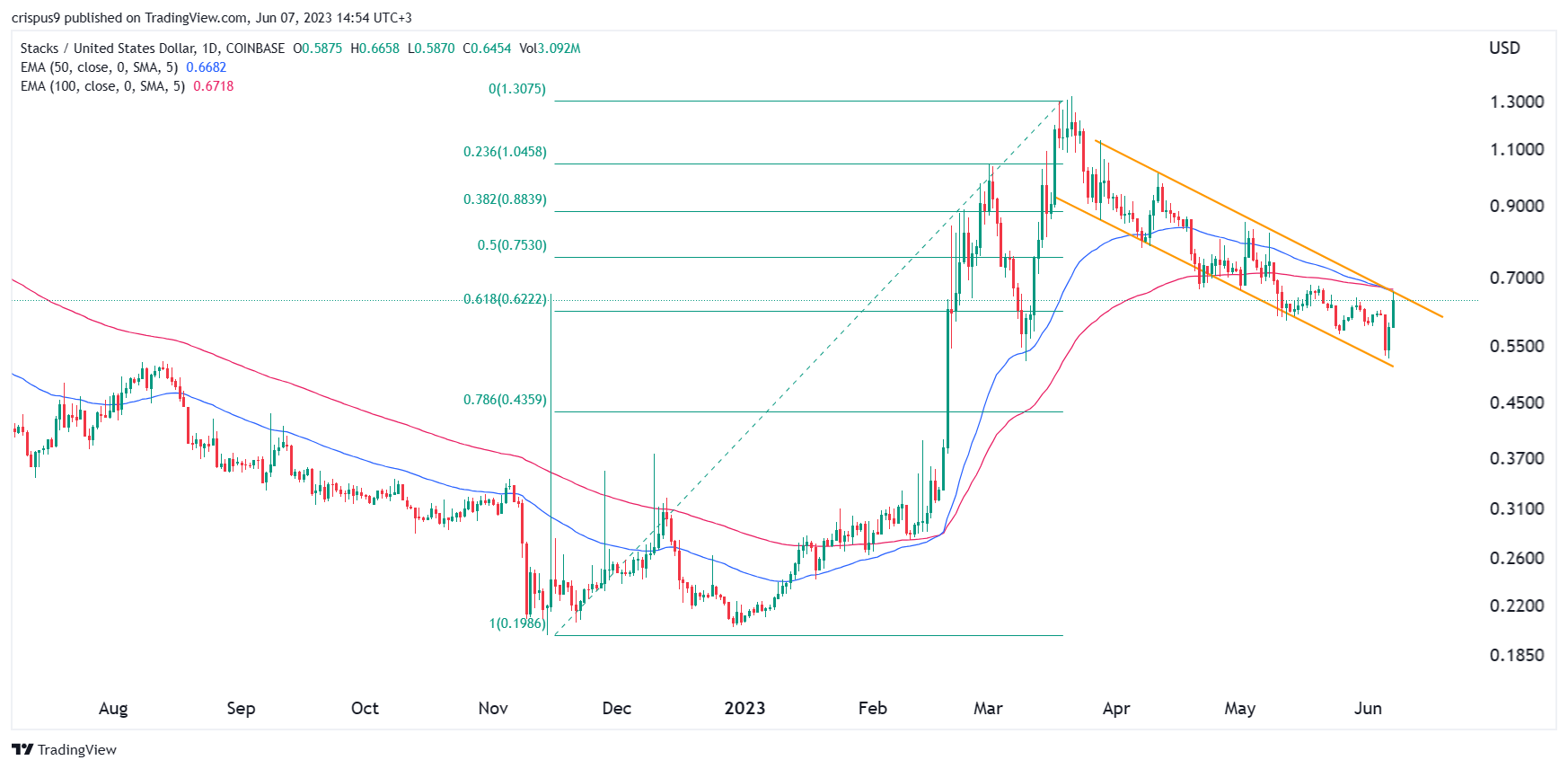
The other reason why STX price has jumped is that this could be a dead cat bounce, which happens after an asset dips sharply. On the daily chart, we see that the coin retested the upper side of the descending channel shown in orange. Most importantly, Stacks’ 50-day and 100-day moving averages have made a bearish crossover.

Therefore, I believe that the coin has more downside to go unless it moves above the two moving averages. If this happens, the next level to watch will be at $0.5200, the lower side of the channel.

How to buy Stacks

Swapzone

Buy STX with Swapzone today

Bitvavo

Buy STX with Bitvavo today

The post Stacks price outlook: What next for STX after going vertical? appeared first on CoinJournal.

The SEC is seeking court order to freeze Binance US’s assets

  • The SEC has reportedly asked a US federal court to freeze the entire assets of Binance US.
  • This comes two days after The SEC sued Binance for breaching federal securities laws.
  • The move is aimed at preventing the dissipation of Binance US’s available assets for any judgment.

Events surrounding US Securities and Exchanges Commission’s (SEC) legal battle with the world’s largest crypto exchange Binance could take a drastic after reports emerged that the SEC is seeking to freeze Binance US assets.

The SEC has reportedly sought an express court order from a US federal court to freeze all the assets of Binance US.

Why is the SEC so adamant about Binance?

According to sources familiar with new development, the SEC is moving to prevent a possible “dissipation of available assets for any judgment, given the defendants’ years of violate conduct, disregard of the laws of the United States.”

The sources say the freezing order only applies to Binance’s two US holding companies that allegedly have accounts at various financial institutions, including Axos Bank, Prime Trust, and the now-defunct Silvergate Bank.

If the court order is granted, Binance US will be forced to send back customers’ fiat and cryptocurrencies. The move signals SEC’s commitment to taking more drastic actions against Binance and its founder, Changpeng Zhao (CZ).

The post The SEC is seeking court order to freeze Binance US’s assets appeared first on CoinJournal.

Bitcoin mining difficulty hits all-time high, above 50 trillion hashes


Key Takeaways

  • Bitcoin mining difficulty has surpassed 50 trillion hashes for the first time ever
  • Higher difficulty means more competition and less profit for miners, but also more security for the Bitcoin network
  • Higher mining difficulty means greater energy input required to mine Bitcoin, meaning greater cost for miners
  • Mining stocks have underperformed Bitcoin significantly over the last year

It has never been so difficult to mine Bitcoin. Literally. Bitcoin mining difficulty continues to rise incessantly, surpassing the 50 trillion hash mark for the first time ever last week.

What is Bitcoin mining difficulty?

If it were not for the Bitcoin mining difficulty adjustment, blocks would be appended to the blockchain at an increasing speed as more miners joined the Bitcoin network. In such a way, the Bitcoin mining difficulty adjusts via an automatic algorithm to ensure blocks are appended to the ever-growing blockchain at consistent 10 minute intervals.

As more miners join the network, difficulty rises. In such a way, blocks do not get discovered quicker as more miners join the network. This difficulty adjustment is thus vital to ensure the supply of Bitcoin is released at a pre-programmed pace, as outlined by the anonymous Satoshi Nakamoto in the Bitcoin whitepaper. 

This explains how, in the early days, mining could be carried out on a personal laptop, because Bitcoin was so niche and miners were so few and far between – hence the mining difficulty was far lower. This is why you hear stories of miners who find (or lose) stashes of Bitcoin on old hard drives which were close to worthless when they were mined. 

Today, however, Bitcoin is well and truly in the mainstream, and mining difficulty has risen accordingly. Most mining is carried out by supercomputers, while there are many public companies carrying out the task.  

What does increasing mining difficulty mean?

Mining difficulty is increasing because more computational power is being put towards Bitcoin mining. The hash rate is what we refer to as the computational power of the Bitcoin network. Looking at the chart, this is at an all-time high – which makes intuitive sense, given mining difficulty is also at an all-time high. 

For the Bitcoin network as a whole, this is a good thing. Bitcoin’s hash rate is a crucial indicator of the security of the network. A higher hash rate means Bitcoin is more resistant to an attack by a malevolent actor. This is because the higher the hash rate, the more expensive and implausible it is for an actor (or a group of actors) to seize control of 51% of the network, when Bitcoin could be exposed to what is known as a 51% attack (coins could be double spent and the veracity of the blockchain would be in doubt). 

However, there are downsides to this, too. I detailed this in depth last week in a report on Bitcoin mining stocks. In summary, more hash power means greater cost for miners, as the increased difficulty means a greater amount of energy is required to power the computers working to validate the transactions on the blockchain. This is why miners margins are getting cut into as more miners join the network (rising electricity costs also do not help). 

“The rapid decline in the Bitcoin price, down from $68,000 at the peak of the bull market in late 2021, has obviously hurt the mining industry”, says Max Coupland, director of CoinJournal. “However, that is far from the only problem facing miners. The mining difficulty hitting an all-time high means greater amounts of energy are required to mine, at a time when inflation and the Russian war have pushed the price of energy up immensely”. 

The mining industry is hence extremely volatile, as not only is it sensitive to the volatility of Bitcoin itself, but it also suffers from rising energy costs. The below chart demonstrates how mining stocks have underperformed Bitcoin in recent times. It looks at the Valkyrie Bitcoin Miners ETF, which tracks mining companies and was launched in February 2022. 

With Bitcoin mining difficulty hitting an all-time high, racing past the 50 trillion hash mark for the first time ever, things won’t get any easier for miners. However, like always, it will ultimately come down to the Bitcoin price. With block rewards and transaction fees recouped in the form of Bitcoin, and the entire industry built upon this asset, mining companies will go as far as the Bitcoin price takes them.

If you use our data, then we would appreciate a link back to https://coinjournal.net. Crediting our work with a link helps us to keep providing you with data analysis research.

The post Bitcoin mining difficulty hits all-time high, above 50 trillion hashes appeared first on CoinJournal.

Bitcoin unfazed by SEC suing Coinbase and Binance

  • The SEC is suing Coinbase and Binance, in yet another scandal in the crypto industry 
  • Bitcoin price remains unfazed
  • A bullish breakout might be triggered by the Fed not hiking the funds rate again 

The cryptocurrency industry faces, yet again, another test of confidence. The Securities and Exchange Commission (SEC) announced that it was suing Coinbase and Binance in a move that scared cryptocurrency traders operating on the two exchanges. 

But what had the potential of triggering a bearish move in the main cryptocurrency markets turned out to have zero impact. In particular, Bitcoin shows resilience, trading in a consolidation area before its next move. 

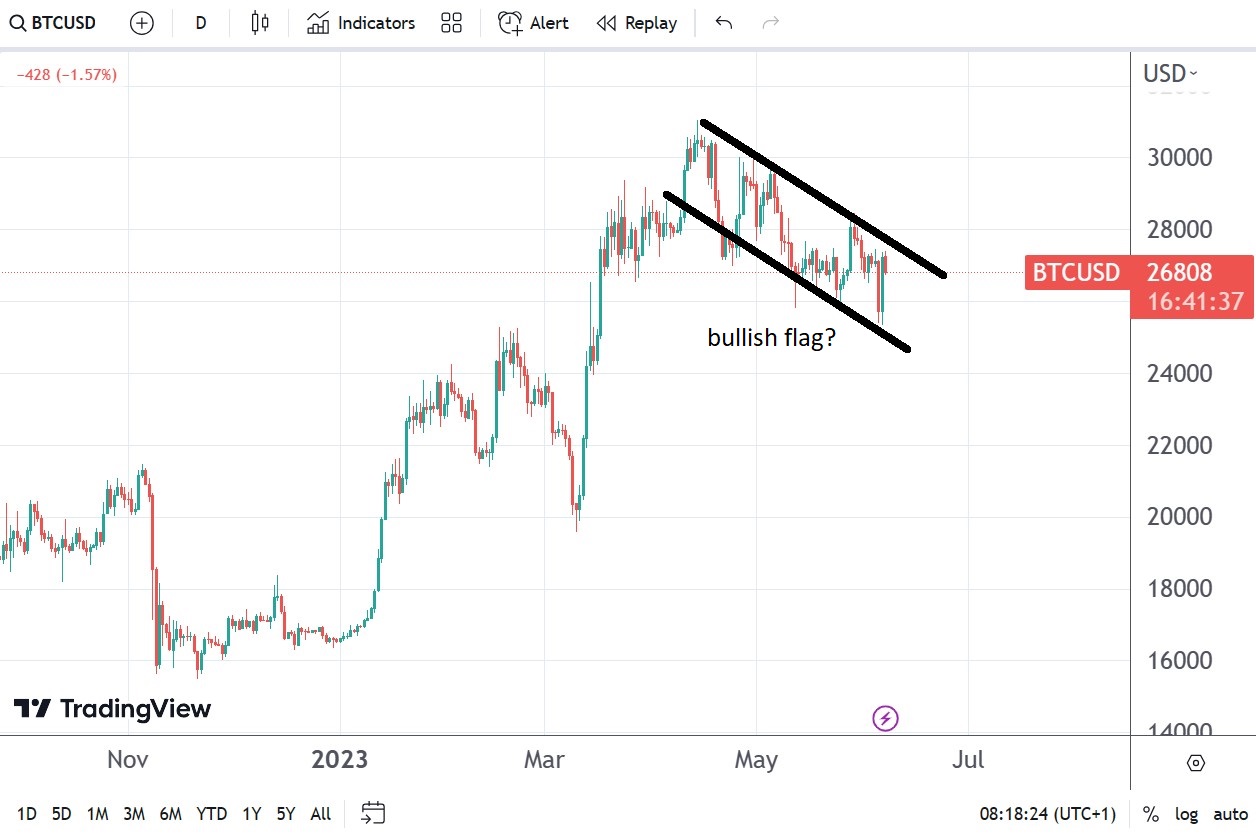
Bitcoin chart by TradingView

Is Bitcoin forming a bullish flag pattern?

One of the reasons why Bitcoin is resilient to such news is that it has become much more correlated with traditional markets. For instance, the tech sector’s movements influence Bitcoin much more than anything else. 

Tech stocks surged in 2023, and so did Bitcoin. 

After failing at $30k, it entered a consolidation which continues still. At this point, it looks like Bitcoin forms a bullish flag pattern, but only if the market makes a new yearly high one may be sure the consolidation ended. 

Therefore, to trade this bullish flag, one needs two things. One is to wait for the market to move first and trade above $30k again. Such a move will signal that the bullish consolidation is over, and it is time to trade the measured move. 

In this case, the measured move is about $10k projected from the upper edge of the flag. That gives us a target of $38k for Bitcoin, should it make a new high for the year. 

All in all, the recent scandals might prove, once again, Bitcoin’s resilience. The cryptocurrency moves in line with the US dollar and the tech sector, and so, if the Federal Reserve decides to pause and not hike the funds rate at the next week’s meeting, Bitcoin’s chances of squeezing higher increase significantly. 

The post Bitcoin unfazed by SEC suing Coinbase and Binance appeared first on CoinJournal.