Coinbase may be losing retail crypto traders to Robinhood: Mizuho

  • Mizuho analyst says Coinbase may be losing share in retail crypto trading.
  • Dan Dolev continues to see downside in the crypto exchange to $27 a share.
  • Coinbase stock is currently down 35% versus its year-to-date high in March.

Coinbase Global Inc remains at the risk of having its stock price cut in half, says Dan Dolev. He’s a Senior Analyst at Mizuho.

Coinbase stock could crash to $27

Dolev maintained his “underperform” rating on the crypto exchange today. His $27 price objective suggests shares could tank an alarming 50% from here.

The analyst is super bearish on Coinbase stock partially because he suspects that it’s losing share in retail trading to peer Robinhood Markets Inc.

Our analysis suggests that COIN’s share of combined COIN retail + Hood crypto volumes trended lower in April vs. the approx. 65% ratio in the prior three quarters.

Part of it may be related to the lawsuit the U.S. Securities and Exchange Commission filed against the crypto company last week.

Coinbase has increased trading fees

Dan Dolev also cited trading fees as a possible reason why Coinbase Global Inc is losing to Robinhood.

The crypto exchange has resorted to higher fees for small-ticket traders to offset volume declines which may have pushed them to Robinhood as it has refrained from increasing fees so far, the Mizuho analyst told clients in a research note today.

If we assume that COIN maintained share and retail take rate held constant at 168bps in April … this would imply $117 million of retail transactions for April.

In comparison, the company recently reported a lower $110 million of total transaction revenue in April. Coinbase stock is currently down 35% versus its year-to-date high.

The post Coinbase may be losing retail crypto traders to Robinhood: Mizuho appeared first on CoinJournal.

Coinbase partners with Bitkey Wallet to promote Bitcoin self-custody

  • Coinbase’s partnership with Bitkey, Block’s self-custody bitcoin wallet, will span six continents.
  • The platforms will integrate Coinbase Pay to allow users buy/sell or transfer Bitcoin to their Bitkey self-custody wallet.
  • Coinbase said the collaboration will allow customers to easily buy, store and manage their BTC.

Coinbase and Bitkey, the self-custody Bitcoin (BTC) wallet built by the Block, Inc., have announced a global partnership that will see the two companies promote self-custody usage.

The partnership, which will span six continents, will see Bitkey users buy and sell BTC on Coinbase, as well as transfer their holdings to their self-custody Bitkey wallets. The wallet includes a mobile app, hardware device and set of recovery tools, the companies said in a blog announcement on Thursday.

According to the announcement, Coinbase and Bitkey will leverage Coinbase Pay to allow customers easy access to fiat-to-crypto onramps, the US-based crypto exchange noted in the blog post. It is a key component to powering the next adoption phase of the Bitcoin economy.

“At Bitkey, we’re building a self-custody bitcoin wallet designed to empower the next 100 million people to truly own and manage their Bitcoin – safely and easily,” Lindsey Grossman, Business Lead at Bitkey said.

“Partners play a key role in bringing self-custody to a wider group of people around the world, and we are incredibly proud to have partnered with leading companies like Coinbase to make self-custody both secure and easy to use.”

Bitkey launches global beta program

The collaboration between Coinbase and Bitkey is kicking off as the self-custody wallet launches its global beta program. 

Customers in the beta program will be able to transfer their Bitcoin from centralized exchanges to Bitkey’s self-custody wallet. Buying and selling as well as direct transfers between Coinbase and Bitkey will be enabled when the wallet launches to the public later this year.

As noted above, Bitkey and Coinbase will offer the service to customers in six continents. Some of the countries include the US, Canada, the UK, Brazil, and Australia.

The post Coinbase partners with Bitkey Wallet to promote Bitcoin self-custody appeared first on CoinJournal.

Binance introduces Bitcoin mining cloud services amid regulatory pressure

Key takeaways

  • Binance users interested in Bitcoin mining can now subscribe to Binance’s cloud mining services starting today.

  • The new service comes despite Binance currently facing regulatory pressure in the United States. 

Binance launches its Bitcoin mining cloud services

The world’s largest cryptocurrency exchange by daily trading volume, Binance, has launched new Bitcoin subscription-based cloud mining products. 

Starting today, June 15, Binance users interested in Bitcoin mining but who don’t have the hardware can subscribe to the cryptocurrency exchange’s cloud mining services and purchase hashrates.

At the moment, the cryptocurrency exchange is selling 1 Terahash per second (Th/s) at $10.7280. As a user purchases more hashrate. The probability of higher income in terms of the Bitcoin earned through mining increases.

Binance revealed that its BTC mining subscription service would be active for six months. For each TH/s purchased, users stand a chance to earn 0.0004338 BTC during the 180-day period. 

The product is currently available on the Binance global website, which means that it is not available to its users in the United States.

Binance continues to face regulatory pressure

This latest development comes at a time when Binance is facing regulatory pressure in the United States. 

The United States Securities and Exchange Commission (SEC) sued Binance earlier this month for allegedly breaking securities laws. The regulatory agency has also filed for a temporary restraining order to freeze Binance.US’s assets. 

Binance.US has already hired former SEC enforcement co-director George Canellos as part of its legal team as it defends itself against the regulatory agency’s allegations. 

Last week, Binance.US announced the suspension of USD deposits on its platform as it transitions into an all-crypto exchange. 

The SEC also sued rival cryptocurrency exchange Coinbase for failing to register as a broker, national securities exchange or clearing agency.

The post Binance introduces Bitcoin mining cloud services amid regulatory pressure appeared first on CoinJournal.

Bitcoin correlation with stocks at 5-year low as regulatory crackdown takes toll


Key Takeaways

  • Our Head of Research, Dan Ashmore, digs into Bitcoin’s relationship with stocks
  • Correlation between Bitcoin and the Nasdaq is at its lowest point since 2018
  • The Nasdaq is up 10% in the last month as stocks have surged off softer forecasts around interest rates and the macro climate
  • Bitcoin is down 9% in the same time frame, the US regulatory crackdown spreading fear about crypto’s future in the country 
  • Ashmore writes that the break in correlation surpasses what was seen in November 2022 amid the FTX collapse, when Bitcoin fell to $15,000 while stocks increased off positive inflation readings

After ten consecutive interest rate hikes, the US Federal Reserve this week paused its rate hiking policy. The move was nearly unanimously anticipated by the market and movement after the meeting was relatively minimal.  

However, over the past month, markets have been flying. The S&P 500 is up 6% in the last 30 days, now only 8.8% off an all-time high, despite being 27% below the mark in October. The Nasdaq is up 10% over the same timeframe – that is 15% below its all-time high from November 2021 but a tremendous resurgence considering it shed a third of its value in 2022.  

And yet, something is being left behind: Bitcoin. 

Bitcoin is now trading below $25,000 for the first time in three months. I put together a deep dive in March analysing the its underlying price movement to show how tightly it trades with the stock market. This was at a time when Bitcoin was rallying and banks were wobbling amid the Silicon Valley Bank fiasco. Suddenly, it was fashionable to declare Bitcoin as decoupling from the stock market. Ultimately, that wasn’t true. However, something very interesting has happened in the last month. 

First, take a look at the path of the Nasdaq and Bitcoin since the start of 2022, which roughly coincides with the start of the bear market: 

Clearly, the two have moved in lockstep. But two episodes jump out: the first is November 2022, when Bitcoin fell and the Nasdaq surged. The second is this past month. We discussed the 10% jump in the Nasdaq over the last month. However, Bitcoin has fallen 9% in the same timeframe. This marks a clear departure from what we would expect. Plotting the correlation (using 60-Day Pearson) shows this more directly:

I touched on November 2022 above, and the swift fall in correlation can be seen on the chart. This was when FTX collapsed, sending the crypto market into a tailspin. At the same time, however, stocks raced upwards as softer inflation numbers were met by lower expectations around the future path of interest rates. 

There were also less dramatic (but equally temporary) decouplings between Bitcoin and stocks in April/May 2022 and June/July 2022. On the chart below, I have pencilled in incidents which occurred during these periods:
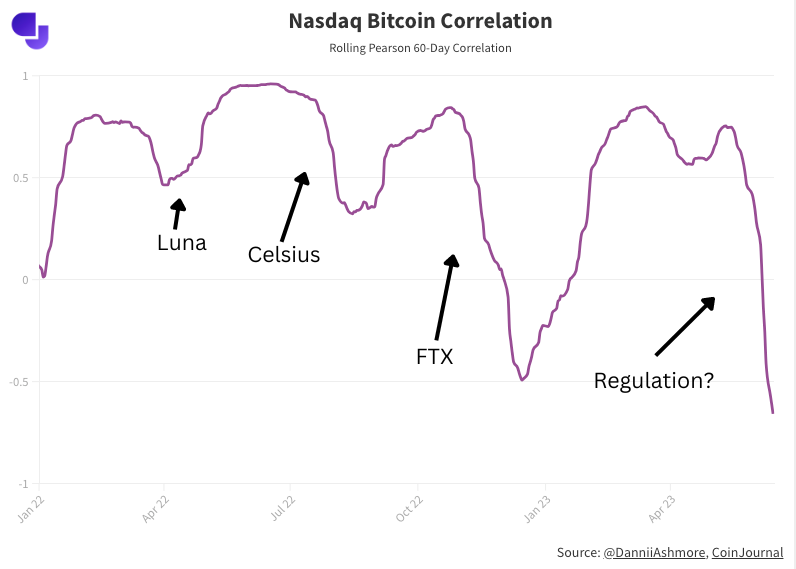
Indeed, what is different about November (FTX) and today is that we see a Bitcoin fall happening at the same time as a Nasdaq surge. While the Luna and Celsius incidents hurt crypto immensely, they came as stocks were also struggling and so the effect is not as dramatic in terms of correlation breaks (although is still tangible on the chart).

But today, we are seeing the biggest break in the correlation trend over the last couple of years – surpassing even FTX. The 60-Day Pearson currently sits at -0.66, whereas the lowest it hit during the FTX crisis was -0.49. 

Regulatory crackdown is suppressing prices

The reason is obvious. The great regulatory crackdown in the US is freaking the market out, and for very good reason. The two biggest crypto companies on the planet, Binance and Coinbase, were both sued last week. 

Crypto.com has suspended its institutional exchange, citing weak demand amid the regulatory woes. eToro and Robinhood pulled a bunch of tokens from their platforms following confirmation from the SEC that it viewed them as securities. Liquidity is dropping like a stone. 

I wrote in-depth about the concern following the announcement of the Coinbase lawsuit last week, so I won’t rehash it here (that analysis is here). While I believe Bitcoin should be able to weather the storm long-term, the picture appears far murkier for other cryptocurrencies. 

Make no mistake about it, the crypto industry faces a massive problem as long as lawmakers continue to turn the screw. The crisis very much feels existential for a lot of the crypto market. 

Regarding Bitcoin, enthusiasts dream of a day when it can decouple and claim that title of uncorrelated hedge asset, or a store-of-value, akin to gold. I’ve done a lot of work around what that hypothetical future could look like, or what could lead the market to that point. But for now this remains just that: hypothetical.  Because while the correlation is at its lowest point in five years, it is not being driven by fundamentals and thus will inevitably spike back up. This is nothing more than the market reacting to what is a very bearish development around regulation in the US. 

It’s not how investors hoped a decoupling would come. But if anyone doubted the market’s fear over the regulatory woes, or questioned why Bitcoin had not fallen more, looking at the break in correlation paints a very clear picture of how detrimental Gary Gensler’s games have been to the cryptocurrency industry. 

In truth, it is not hyperbole to say that this is the most out of whack Bitcoin’s correlation has ever been whilst trading as a mainstream financial asset. Because back when it last happened in 2018, Bitcoin traded with such thin liquidity that its price action is largely irrelevant to draw conclusions from going forward. 

The post Bitcoin correlation with stocks at 5-year low as regulatory crackdown takes toll appeared first on CoinJournal.

Crypto price prediction: XRP, Hedera Hashgraph, Stacks

  • Cryptocurrencies plunged hard after the latest Federal Reserve decision.

  • Bitcoin dropped below the key support levels at $25,300 and $25,000.

  • XRP has formed a double-top pattern on the daily chart.

Cryptocurrency prices dipped sharply this week amid significant monetary policy and regulatory concerns. Bitcoin crashed below the important support at $25,000 while most altcoins erased their 2023 gains. This sell-off accelerated after the Federal Reserve pointed to two more rate hikes later this year. In this article, we will explain what to expect in XRP, Hedera Hashgraph, and Stacks.

XRP price prediction

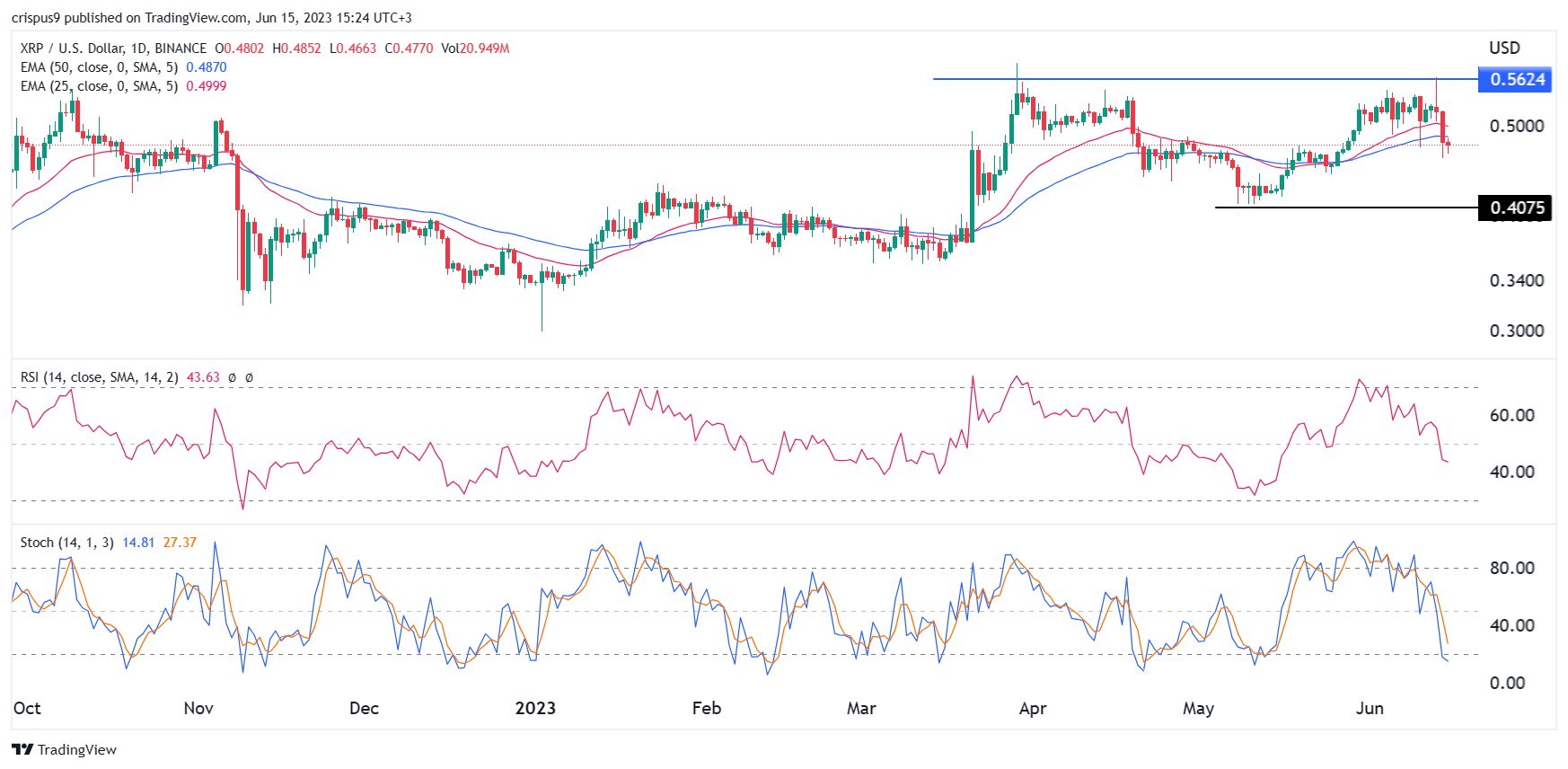
The XRP price drifted downwards this week after it jumped to a high of $0.5624. Its highest point was an important level since it was also the year-to-date high. This means that the coin has formed a double-top pattern, which is usually a bearish signal. The neckline of this price is at $0.4075, the lowest level on May 11.

At the same time, Ripple price managed to cross the 25-day and 50-day exponential moving averages, signaling that bears are gaining traction. The Relative Strength Index (RSI) crossed the key level st 50 while one line of the Stochastic Oscillator indicator dropped below the oversold level. XRP price also formed a small shooting star pattern. 

Therefore, the outlook of Ripple is bearish, with the next level to watch being at the neckline of the double-bottom pattern at $0.4075. 

How to buy XRP

inv-news-table coins=”XRP” limit=”2″]

Hedera Hashgraph price prediction

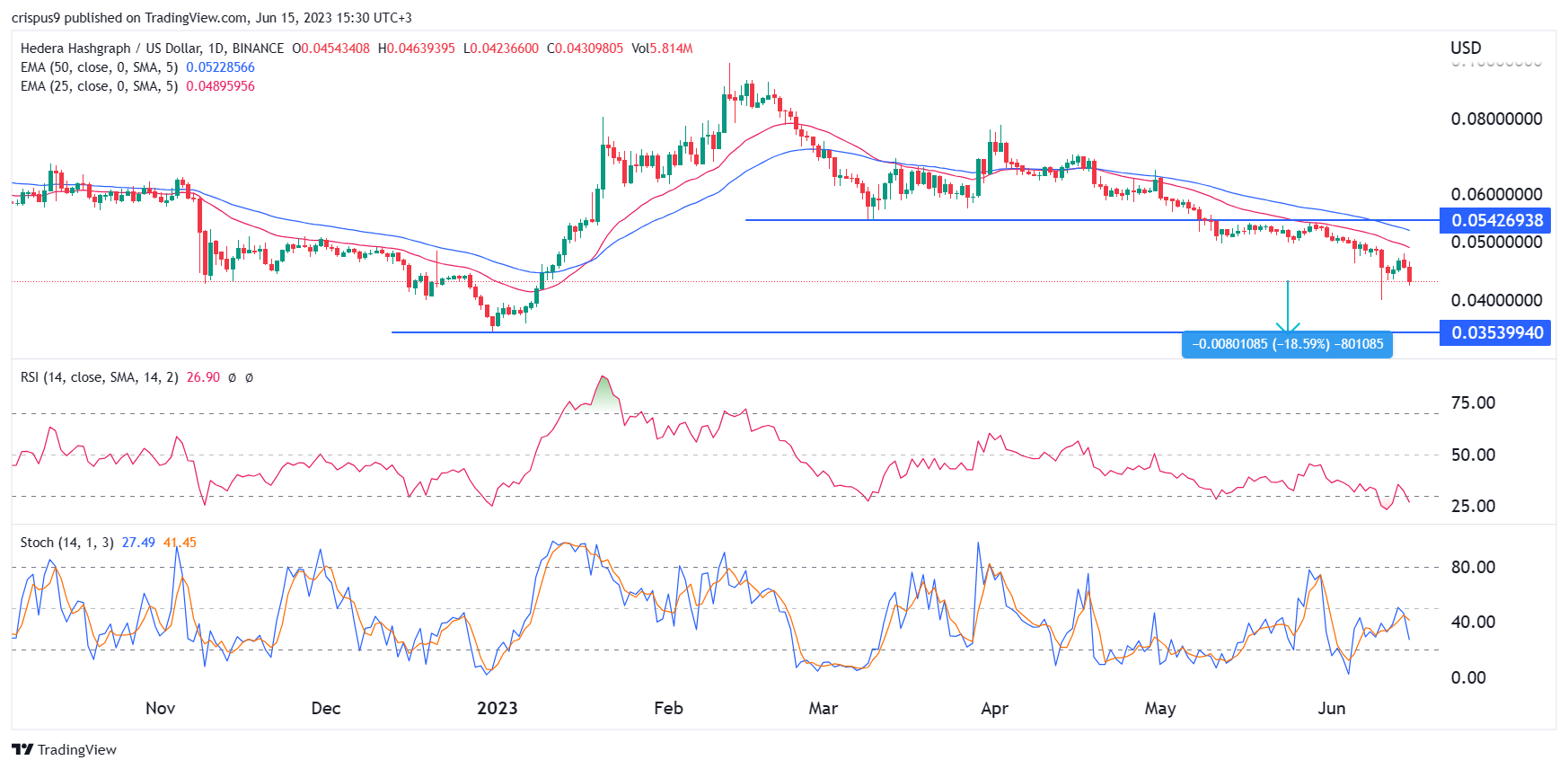
Hedera Hashgraph is a major blockchain project that seeks to become a good and faster alternative to Ethereum. It is faster, cheaper, and governed by leading companies like Google, IBM, and LG. Like other cryptocurrencies, the HBAR price has been in a strong downward trend in the past few months. It has erased about 40% from its highest level this year.

HBAR price has dropped below the important support level at $0.0542, the lowest level on March 10th. The token has moved below the 25-period and 50-period moving averages. At the same time, the Relative Strength Index (RSI) has continued falling. Therefore, there is a likelihood that the coin will continue falling as sellers target the next key support level at $0.035, which is about 18.5% below the current level.

How to buy Hedera Hashgraph

inv-news-table coins=”HBAR” limit=”2″]

Stacks price prediction

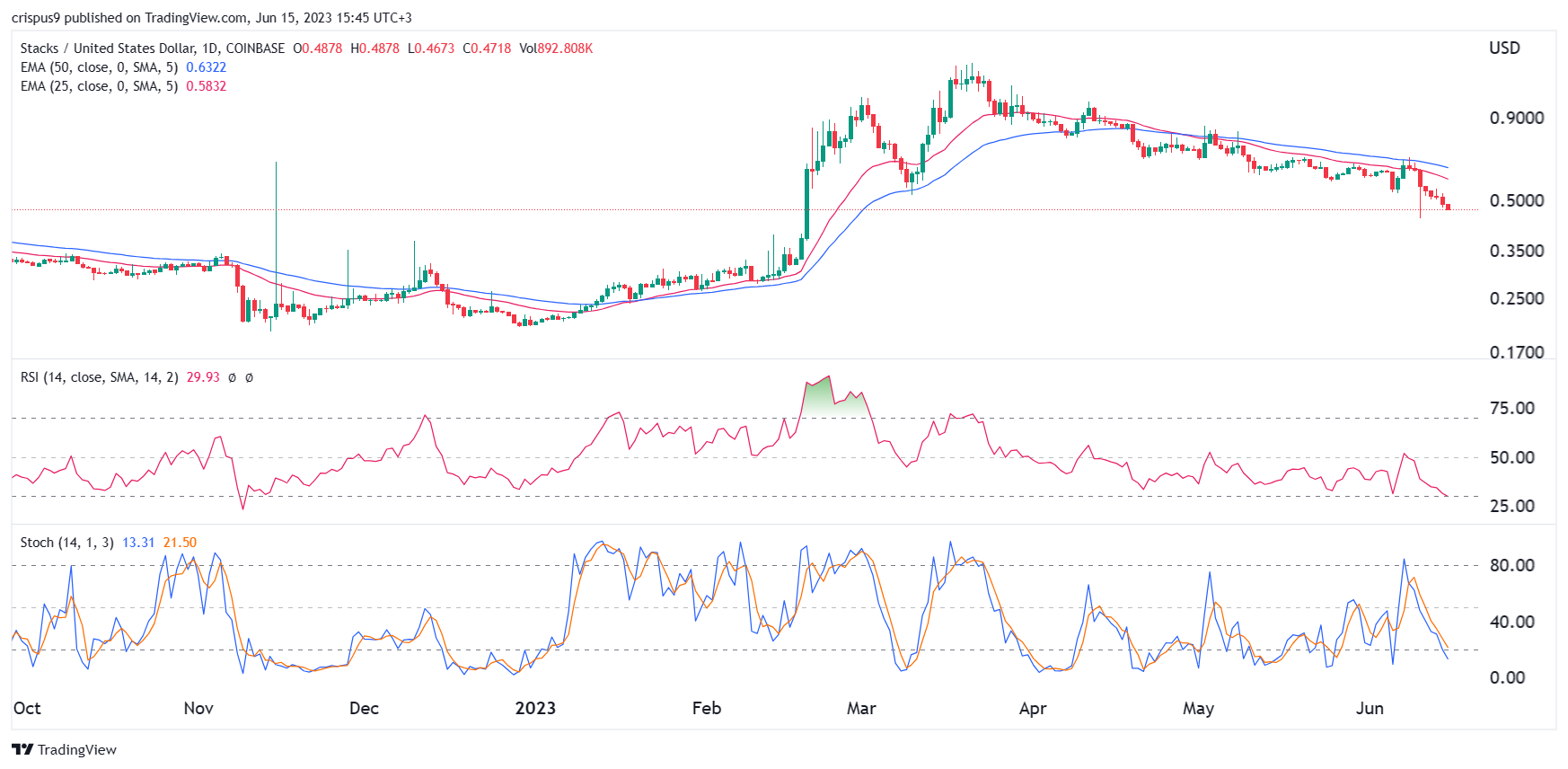
Stacks price has been in a strong bearish trend despite the rising interest of Bitcoin development. STX managed to move below the lower side of the descending channel shown in orange. At the same time, the coin has dropped below the 25-day and 50-day EMA. On the daily chart, it has moved below the 61.8% Fibonacci Retracement level.

Stacks has also moved below the psychological level of $0.50. Therefore, there is a likelihood that the coin will continue falling as sellers target the next level at $0.35.

How to buy Stacks

inv-news-table coins=”STX” limit=”2″]

The post Crypto price prediction: XRP, Hedera Hashgraph, Stacks appeared first on CoinJournal.