
Why is Ethereum outperforming Bitcoin since the Merge?


Key Takeaways

  • Ever since the Merge went live in September, Ether has underperformed Bitcoin significantly 
  • This is despite the supply of Ethereum falling post-Merge
  • More Ether is also being staked since the Shapella upgrade in April 
  • Demand has fallen with regard to Bitcoin, however, overriding the lower supply
  • Regulatory crackdown and greater institutional interest in Bitcoin appears to be driving the divergence, writes our Head of Research

One of the more interesting trends to follow within crypto is that of the ETH / BTC chart. In other words, how the world’s two largest cryptocurrencies move in relation to one another. Now ten months on from the Ethereum Merge, it feels like a good time to re-analyse the relationship.

The Merge completely transformed Ethereum, switching the network to a proof-of-stake mechanism rather than the proof-of-work mechanism it was on previously. On the other hand, Bitcoin remains (and always will be) a proof-of-work blockchain. 

This means that the fundamentals underlying the Ethereum network have flipped. Perhaps this is most noticeable when plotting the total circulating supply of ETH. The Merge going live in September 2022 sticks out like a sore thumb, with the supply (slightly) contracting from that date. 

Zooming in on the post-Merge period in the next chart shows the contraction. The supply has reduced at an average rate of 0.15% per month. Prior to the Merge, the supply grew by 0.41% per month.  

Moreover, the supply of liquid Ether has contracted even further than the above charts show. Looking at the total value of staked Ether, the pattern was relatively steady from when the staking contract opened in November 2020. This trend more or less continued as the Merge went live in September 2022. However, as seen on the next chart, the amount of staked Ether spiked notably in April of this year, as the Shapella upgrade went live. 
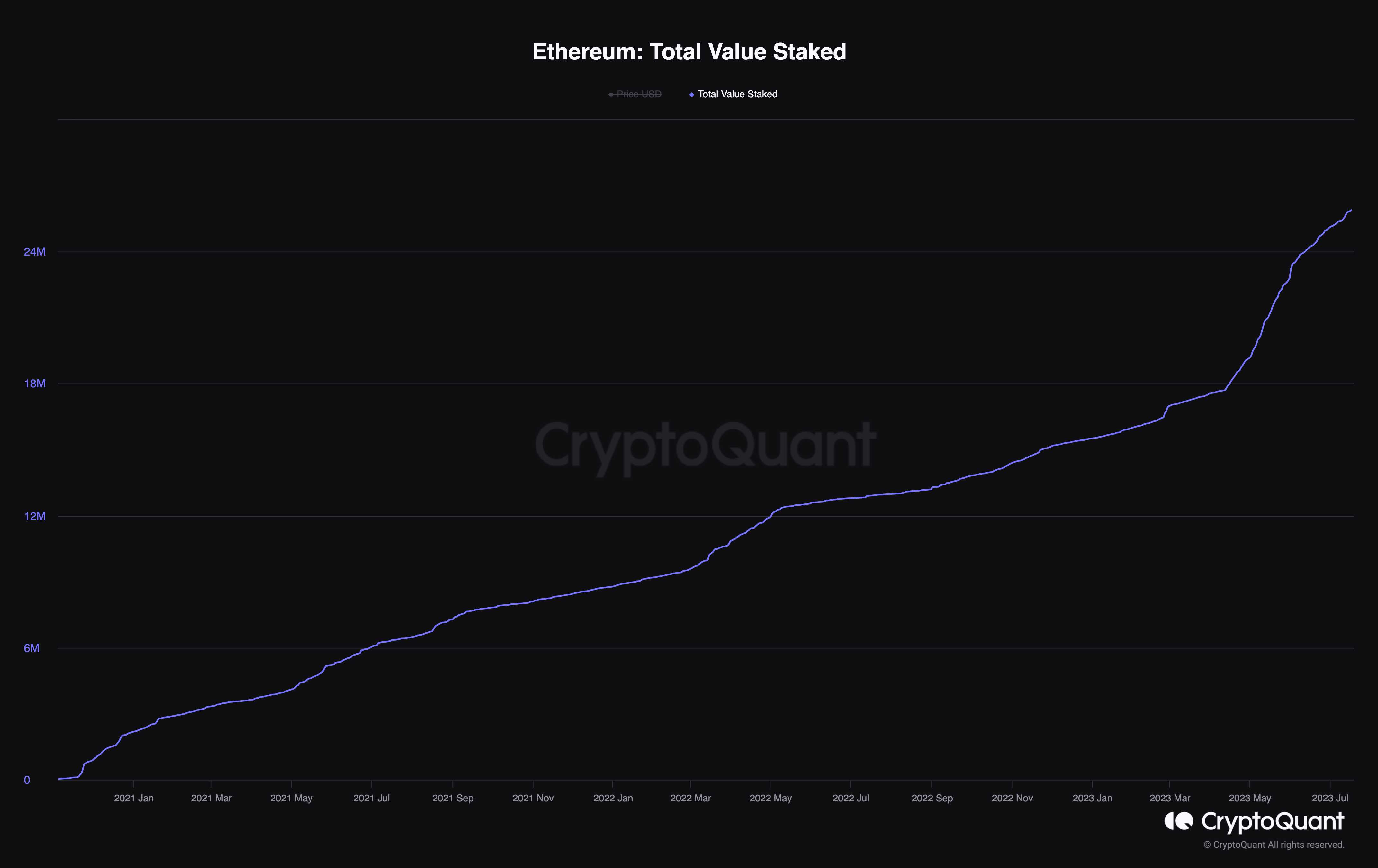
This Shapella upgrade, also known as Shanghai, allowed staked Ether to finally be sold, with some of the early stakers having locked up their tokens since Q4 of 2020. Despite concern that this would lead to a vast amount of Ether flooding the market and denting the price, the opposite has happened. With the indefinite lock-up restriction no longer a factor, the Ether staked has spiked noticeably, with the trend far steeper in the three months since. 

But how has this structural break on the supply side affected Ether’s performance against Bitcoin? Less supply equals a higher price, right? Well, no actually. Almost on a dime from when the Merge went live, ETH has fallen relative to Bitcoin, as I have plotted on the below chart (the black line denotes the Merge in September). 

The reason, of course, is that price is governed by supply and demand, rather than just supply. And while supply has contracted, the demand side of the equation has not held up – at least relative to Bitcoin.

Ether underperforms Bitcoin

Two months after the Merge, FTX collapsed, sending the entire crypto sector for a spin. As is customary in times of price decline, Bitcoin fell less than the rest of the market. Thus, Ether falling against Bitcoin in the aftermath of the crash is not surprising. 

However, thus far in 2023, the crypto market has been on fire, with token prices accelerating across the board as the macro climate has softened amid falling inflation. The Nasdaq jumped 32% in the first six months of the year, its best half-year return since 1983. And yet, despite the crypto market riding this wave, Ether fell further still against Bitcoin, something which seemingly bucks the trend. 

The reason is most likely regulation. The great regulatory crackdown in the US has been brutal on crypto, but Bitcoin has not been as squarely in the crosshairs as a lot of the market. This has led to Bitcoin dominance rising to its highest level in two years, now comprising over 50% of the entire cryptocurrency market cap. It opened the year at 42% (it was also roughly at this level at the time of the Ethereum Merge in September). 
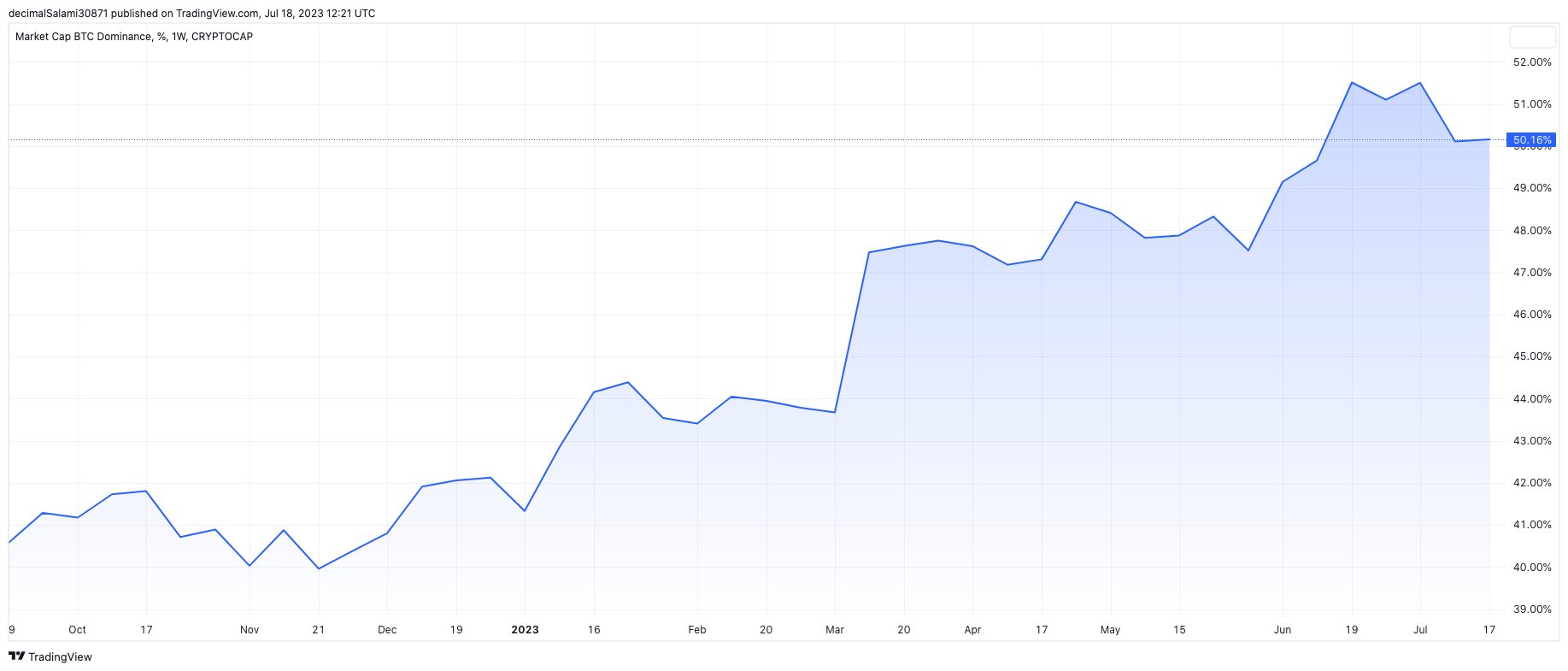
This comes amid sentiment that Bitcoin could be carving out its own niche in the space. This is the view that many in the space have long held (and a Bitcoin maximalist’s sworn mantra), but the difference now is that the law appears to be coming around to the same point of view. I’ll let Coinbase CEO Brian Armstong put it more succinctly than I: 

“We go back to 2021, we wanted to become a public company, we described everything about our business, the assets that we list on our platform, how we do staking. The SEC at that point allowed us to become a public company”.

“A totally different tone started to happen (about a year ago),” Armstrong continued. “We kind of got this information from the SEC that, well actually everything other than Bitcoin is a security.”

Although Ether was not present on the list of tokens announced by the SEC that comprised securities, a list which included some other popular cryptos such as MATIC, SOL and ATOM, it has not been immune. Viewed more or less in a grey area, Ether nonetheless has suffered as the regulatory blows kept coming. While last week’s XRP ruling is positive for the space, and there will be many more twists and turns to come, it still feels like Bitcoin has separated itself from the crowd. 

Further reinforcing this view is the slew of Bitcoin ETFs submitted for approval from some of the world’s biggest asset managers, including Blackrock. Denied repeatedly to date, the presence of big names backing Bitcoin amid this suffocating US legal environment is another boon for the orange coin. And while one could (rightly) hypothesise that a Bitcoin ETF would make an Ether ETF more likely, there is no denying that Bitcoin has pulled further ahead in the race. 

This has led to a situation in 2023 where Bitcoin has outperformed Ether, which seems surprising when the latter has tended to outperform the former during prior periods of price expansion. But it is always important to remember how brief the trading history for both Ether and Bitcoin is. Ether was only launched in 2015, and it was another couple of years before it traded with any genuine liquidity. So, leaning on past performance must always be done with a pinch of salt. Additionally, the crypto market has never experienced a macro environment like this. 

Finally, any hopes that the Merge would accelerate Ether into the stratosphere perhaps overlooked how much of the upgrade was priced in. This was in the works for a long time, repeatedly delayed before it finally came and went. 

All in all, this has led to Ether lagging Bitcoin, with the latter increasing its dominance over not only Ether, but the crypto market as a whole. Things are changing quickly in crypto, and Bitcoin has been weathering the turbulent waters better than altcoins in recent months, primarily due to the legal climate. 

Then again, the way prices have been going, Ether investors can’t be too unhappy – despite Ether’s second-place medal, it is still up 57% thus far this year. It could be worse, even if they did back the wrong horse. 

The post Why is Ethereum outperforming Bitcoin since the Merge? appeared first on CoinJournal.
Brian Armstrong to meet House Democrats about crypto legislation

Key takeaways

  • Coinbase CEO will meet with House Democrats to discuss crypto regulation.

  • Armstrong wants clearer rules on crypto from Washington.

Coinbase CEO wants clearer crypto regulation in the US

Coinbase Inc. Chief Executive Officer Brian Armstrong is set to meet with House Democrats behind closed doors Wednesday morning. This is according to a Bloomberg report on Monday, citing sources familiar with the plans. 

According to the report, Armstrong will speak privately with lawmakers from the New Democrat Coalition about cryptocurrency legislation and related issues, including tax, national security, privacy and climate. 

This latest cryptocurrency news comes as Coinbase faces a lawsuit by the Securities and Exchange Commission.

Recently, lawmakers from the House and Senate have introduced bills that would bring clarity to the cryptocurrency industry in the United States. However, the divided nature of Congress makes it unclear whether the bills would be adopted soon. 

Coinbase continues to battle SEC in court

On June 6, the US SEC charged Coinbase with violating federal securities law, adding that the cryptocurrency exchange was operating as an unlicenced broker, national securities exchange and clearing agency.

The cryptocurrency exchange responded, saying that the SEC’s action violates due process and constitutes an abuse of discretion. 

On June 29th, Coinbase submitted a motion to the United States District Court for the Southern District of New York, asking that the SEC complaint charges be dismissed for lack of merit.

Coinbase’s stock price has grown by nearly 200% since the start of the year, thanks to Bitcoin’s price rallying by nearly 50% during that period. At the start of the year, COIN was trading at $40 per share but currently stands at $105.55. 

The post Brian Armstrong to meet House Democrats about crypto legislation appeared first on CoinJournal.

Chainlink price prediction: LINK just formed a double top pattern

  • Chainlink announced a new plan to expand in the traditional finance industry.

  • It unveiled the Cross-Chain Interoperability Protocol (CCIP).

  • The coin has formed a double-top pattern on the 4H chart.

Chainlink price rose to a high of $7.32, the highest level since April 26th. At its peak on Tuesday, the LINK token was up by more than 53% from the lowest level in June. It has outperformed other coins like Bitcoin and Ethereum.

Chainlink expands its offerings

Chainlink is the biggest oracle network in the blockchain industry. An oracle is a network that links off-chain data to the on-chain. It is widely used to provide price feeds in decentralized and centralized exchanges.

Chainlink has been growing its ecosystem in the past few years. In June, the developers announced that they had begun testing connecting banks to the blockchain by partnering with Swift.

In a statement on Tuesday, the company unveiled Chainlink’s Cross-chain Interoperability Protocol (CCIP). CCIP is designed to connect traditional financial institutions to the blockchain. The initial blockchains will be Avalanche, Ethereum, Optimism, and Polygon. Early adopters in this testing were Synthetix and Aave.

Therefore, LINK price jumped as investors hope that the network will see more action in the coming months. 

Data compiled by DeFi Llama shows that the network has a total value secured (TVS) of over $21.85 billion. This makes it the biggest oracle provider in the world. The other big oracles are Chronicle, WINKLink, Pyth, TWAP, and RedStone.

Chainlink price prediction

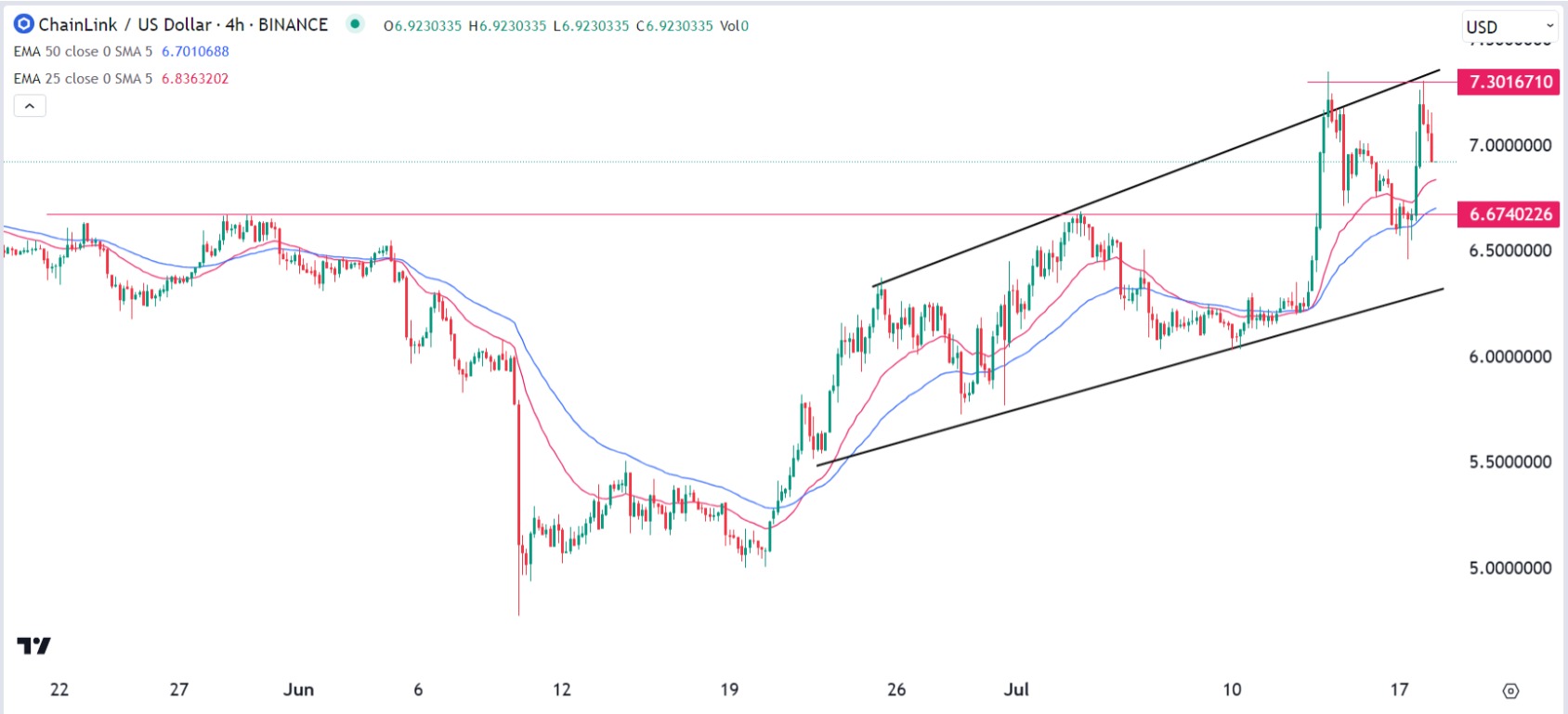
LINK price has been in a strong bullish trend in the past few days. On the 4H chart, the coin has moved above the 25-period and 50-period moving averages. It has also formed an ascending channel shown in black. The price is a few points below the upper side of the channel.

Most importantly, Chainlink has formed a double-top pattern at $7.30. In price action analysis, this pattern is usually a bearish sign. The neckline of this pattern is at $6.50. Therefore, despite the new product launch, there is a likelihood that LINK price will have a bearish breakout.

If this happens, the next level to watch will be at $6.50, which is ~6.50% below the current level. On the flip side, a move above the double-top level of $7.30 will invalidate the bearish view.

How to buy Chainlink

eToro

eToro is a multi-asset investment platform with more than 2000 assets, including stocks, ETF’s, indices, commodities and Cryptoassets. eToro offers over 60+ Cryptoassets to invest or invest in their CryptoPortfolio where investors can benefit from the accumulated growth of Bitcoin, Ethereum, XRP, Litecoin and other leading cryptocurrencies. eToro users can connect with, learn from, and copy or get copied by other users.

Buy LINK with eToro today

Bitstamp

World’s longest-standing crypto exchange. Since 2011 Bitstamp has been providing a secure and reliable trading venue to over four million individuals and a range of institutional partners.

Buy LINK with Bitstamp today

The post Chainlink price prediction: LINK just formed a double top pattern appeared first on CoinJournal.

CROWN Token Project launches limited-edition NFTs on ADOT marketplace

  • The NFT collection will unlock opportunities for lovers of animated films, starting with Legend of Two Heroes.
  • CROWN Token’s NFTs will be available on the platform’s ADOT NFT marketplace.
  • The Legend of the Two Heroes NFT series features 590 NFT mints from 39 NFTs.

CROWN Token Project, a Web3 platform that bridges the traditional IPs market with blockchain, has launched its first non-fungible token (NFT) collection.

The NFTs debut is on ADOT, the CROWN Token’s own NFT marketplace, and will roll out with a limited-edition of the animated film Legend of the Two Heroes.

According to a press release shared with CoinJournal on Tuesday, July 18, the NFT series will showcase characters from the $15 million budget film from Hong Kong director Hernan Yau and renowned screenwriter Robert Lence. 

Toy Story, Beauty and the Beast and Shrek are some of the feature masterpieces to incorporate Lence’s scripts.

590 mints across 39 NFTs

While Legend of the Two Heroes is in post-production and is scheduled for global release early next year, CROWN Token says its NFT series on the feature film will be open for minting beginning July 19, 2023. The timing of the mint will see NFT holders included in the film’s creation, right from ideation to release on the big screen.

Pan Lorattawut, CEO of VUCA Digital which manages the CROWN Token Project, said:

“It’s exciting to see this project with our ADOT marketplace come to life. We want NFT holders to be involved in the animated action film’s creation in every possible way. This is one of the ways we not only reward our ecosystem, but continue to expand the benefits of IPs.”

The limited NFT series will allow for 590 mints spread across 39 NFTs, with each NFT having 15 mints. Meanwhile, there will also be 5 rare NFTs each of which will have only 1 mint. Collectors can only buy the rare NFTs with CROWN Token, the platform said.

The top three main characters in the film to feature in the NFTs will later be added to an upcoming MMO role-playing game.

A character from Legend of the Two Heroes. Source: CROWN Token Project

Although the global NFTs market size shrank alongside the broader crypto industry during the crypto winter, projections are that the market size will expand at a CAGR of 27.6% to $342 billion by 2032. 

According to a report by Market Research Future (MRFR), key drivers of this growth will include cryptocurrency use and rising global demand for digital art.

CROWN Token Project expects its ADOT Marketplace to experience growth in coming years, with the utility of its token expanding as a result. CROWN Token is a crypto project by VUCA Digital, a blockchain consulting firm affiliated to IP management firm T&B Media Global.

The post CROWN Token Project launches limited-edition NFTs on ADOT marketplace appeared first on CoinJournal.

Judge orders Ripple, SEC to agree to possible settlement dates

  • US Judge Analisa Torres referred Ripple vs. SEC case to Magistrate Judge Sarah Netburn.
  • Last week’s ruling was that XRP was not a security.
  • The Ripple vs. SEC case continues but Judge Netburn has suggested both Ripple and SEC can agree to possible settlement conference dates if they believe it to be “productive” at this stage.

The latest Ripple news is that US Magistrate Judge Sarah Netburn has ordered both Ripple and the US Securities and Exchange Commission (SEC) to agree on possible dates for a settlement conference.

The order came not long after Judge Analisa Torres of the US District Court for the Southern District of New York referred the next phase of the Ripple vs. SEC court battle to Judge Netburn.

According to a court document filed on July 17, Judge Netburn, who will now preside over the General Pretrial, has recommended that the parties come to this agreement 6-8 weeks beforehand, referencing the court’s busy schedule.  As noted in the judge’s order, the parties should agree to three mutually convenient dates. 

Will SEC and Ripple want to settle?

The pretrial phase includes aspects of the case around “scheduling, discovery and non-dispositive pretrial motions.” It is also likely the stage where the parties would want to settle. While the anticipation is that the SEC might want Ripple to settle, the coming days could make it clear whether any of the two sides view this as a route to take.

Fox Business journalist Eleanor Terrett shared the outlook on Twitter:

Last week, Judge Torres effectively declared XRP not a security and sparked a massive rally for the token and the broader crypto market. 

Even though the outcome of the rest of the case is anybody’s guess, the crypto industry believes Ripple’s partial victory provided a watershed moment that could translate into the much needed regulatory clarity.

The post Judge orders Ripple, SEC to agree to possible settlement dates appeared first on CoinJournal.