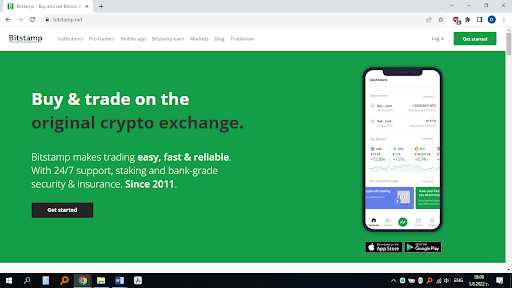
All about Bitstamp: The who, how, and why

Bitstamp is a crypto exchange suitable for fee-conscious traders, as its fees are lower than what many competing exchanges charge. 

You can trade, buy, and sell crypto on this user-friendly exchange, which works well for everyone from novices to advanced traders. As a downside, major cryptos like Binance Coin and Solana are missing from its lineup.

How it works

To open an account, enter and verify your email address and choose a secure and unique password. Then, link to Google Authenticator or another multifactor authentication app.

The exchange has strict Know Your Customer (KYC) requirements in place, which all users must fulfill. They will ask you to upload an image of an official photo ID and a recording of yourself reading a code of three digits.

Your account is sent to undergo review after you submit your pictures and personal details, which include your Social Security number.

You’ll soon be informed that your account is active. Then, you can make your first deposit to the platform. Deposits and withdrawals are possible via international wire transfer or ACH transfers from a bank account, credit card, or debit card. The cheapest option is bank transfer because no fees are charged.

You can buy crypto on the desktop version of the exchange and on the mobile app, which is compatible with Android and Apple.

Cryptos available

·         Bitcoin

·         Ethereum

·         Stellar Lumens

·         Uniswap

·         Tether

·         Litecoin

·         USD Coin

·         Bitcoin Cash

·         Chainlink

·         Gemini Dollar

·         XRP (for customers outside the US)

Fees range from 0.50% for trades under $10,000 to 0.005% for trades under $20,000,000,000.

Key features

Bitstamp features a simple fee structure, where trading fees depend on the user’s monthly trading volume. High-volume traders enjoy very low fees.

Top-notch security

Bitstamp features top-notch security with 98% of assets in a cold wallet. Wallets that aren’t online are immune to cyberattacks. The remaining 2% held online is used for everyday trading.

Bitstamp’s insurance policy adds another layer of protection. The insurance is effective in cases of theft following a breach of the exchange. If someone misuses your login details and steals from your individual account, your loss won’t be covered.

The exchange’s optional security measures are address whitelisting and two-factor authentication (2FA). The former lets the users choose the addresses where they can receive withdrawals from their accounts.

Intuitive

Crypto trading on Bitstamp doesn’t come with much of a learning curve. You can learn how to trade cryptocurrency quickly and without any hassles on this platform.

Top-rated app

Bitstamp’s mobile app has a 4/5 rating on Google Play based on ‎11,519 votes at the time of writing. Its rating on the App Store is almost perfect – 4.9/5 – based on ‎130 reviews. The app offers full trading functionality.

Earn crypto rewards

Bitstamp Earn is available to those who want to earn crypto rewards. This feature lets users stake specific cryptocurrencies and use them to generate funds. However, it’s not available to US customers.

Three platforms

Bitstamp has three platforms. The main one is Bitstamp.net, and there are also Bitstamp Tradeview and Bitstamp Mobile. The second one has more advanced trading forms and charting features. 

Pros

  •          Easy to use

  •          Competitive trading fees

  •          Advanced platform available

  •          Highly rated mobile app

  •          Earn rewards with crypto staking

Cons

  •          Limited options for staking

  •      Just two currencies are available for staking on Bitstamp

Benefits of using Bitstamp

Everyone who wants to trade crypto on their phone and computer and is looking for an intuitive exchange with low fees will see the benefit of using Bitstamp.

What makes it different from competitors?

The maximum trading fee on the exchange is 0.50%. In comparison, Coinbase charges a 0.50% spread on the main platform plus a transaction fee.

On the other hand, Coinbase has more than 150 assets to trade compared to Bitstamp’s 54. Just two currencies are available for staking on Bitstamp compared to Coinbase’s six.

Bitstamp charges the same trading fees regardless of the platform you choose. Gemini charges lower trading fees to use its advanced platform. It’s all a matter of preference with Bitstamp.

Our final say

The bottom line: Bitstamp has a simple and intuitive platform that novices will appreciate. The main platform features competitive fees. It’s definitely convenient not to have to choose the advanced trading platform just to pay lower fees.

Bitstamp is enshrined in tradition as one of the first digital asset exchanges in history. It’s committed to supporting cryptocurrency users.

As a downside, the list of currencies supported is relatively limited. The exchange has neither lending nor margin trading features. You can stake just two currencies, and the returns are somewhat meager. The highest APR we found was just 5%, but that makes it sustainable.

The post All about Bitstamp: The who, how, and why appeared first on CoinJournal.

CurateDAO launches decentralized Pinterest-like data curations on Avalanche

CurateDAO has released decentralized Pinterest-like data curations supported by incentives on Avalanche blockchain. The integration has made the CurateDAO curate-to-earn protocol features available on Avalanche.

In a nutshell, users will be able to assemble boards similar to the ones on Pinterest and earn AVAX tokens if other users use the boards.

CurateDAO uses a Web2 application-like interface and the integration with Avalanche will offer low transaction fees and high throughput.

CurateDAO curate-to-earn protocol

The CurateDAO curate-to-earn protocol boards are decentralized and use smart contracts to distribute revenue among content creators and curators.

Users can access curated lists on CurateDAO including metaverse governance books, futuristic snakes, Web3 apps, and Codes for NYC bathrooms among others.

CurateDAO, however, aims at migrating to a subnet to increase its reach with the help of the Blizzard grant fund it received from Avalanche.

According to CurateDAO’s founder, Michael Fischer, CurateDAO is at the moment the best platform for helping users find the best content while rewarding data scouts and curators.

How CurateDAO works

Curators first mint a curation and define the guidelines for the information to be provided within the curation. Scouts then find data for the curation following the set guidelines.

The scouts then stake some money in the curation, which is returned to them once the curation is accepted. It is the prerogative of the curator to accept or deny the provided curation.

The accepted curations then earn money through affiliate links, benefactors, paid subscriptions, and advertisements. What is earned is then dived between the scouts and curators based on their contributions.

The post CurateDAO launches decentralized Pinterest-like data curations on Avalanche appeared first on CoinJournal.

Crypto futures exchange CoinFLEX has filed for restructuring in Seychelles

CoinFLEX, a renowned crypto futures exchange, has filed for restructuring in a Seychelles court.

This comes two months after the exchange temporarily halted withdrawals before allowing a limited withdrawal mid-last month.

The recent move with filing for restructuring is part of the exchange’s efforts to address a shortfall caused by a counterparty that failed to make a margin call.

The exchange has however said that it intends to get approval from depositors and the court on a proposal to give recovery value USD (rvUSD) tokens, equity, and locked FLEX coins to depositors.

Portraying optimism, the Chief Executive Officer of CoinFlex, Mark Lamb, said:

“We look forward to welcoming a new group of shareholders to CoinFLEX and are glad to be in a jurisdiction where we can quickly resolve this situation and return maximum value to depositors.”

Previous events

On June 23, CoinFLEX suspended withdrawals citing the harsh crypto market conditions and uncertainty involving a counterparty. The exchange then went ahead to suspend the trading of its native token, FLEX Coin (FLEX), Spot trading, and perpetual contract trading.

On July 22, the exchange proposed a plan to compensate depositors amid its efforts to recover the over $84 million debt owed by a “large individual customer.”

Mid-July, CoinFLEX partly reopened withdrawals allowing customers to withdraw 10% of their assets for a week. It also went ahead to cut down its workforce in order to lower the cost of running its business.

The crypto exchange has also outlined its focus on recovery plans that would enable it to regain insolvency. The firm said it was open to new acquisitions, and equity investors.

The post Crypto futures exchange CoinFLEX has filed for restructuring in Seychelles appeared first on CoinJournal.

German crypto bank Nuri files for insolvency citing a “lasting strain”

Nuri, a German startup crypto bank, yesterday evening announced that it had filed for insolvency after what it calls a “lasting strain” on its business liquidity due to “significant macroeconomic headwinds and the cooling down of public and private capital markets.”

The startup bank said that 2022 has been a difficult year coming from the Corona pandemic and current political market uncertainties following the ongoing Russian invasion of Ukraine.

The crypto bank which has about 500,000 customers also cited other factors including major crypto sell-offs and the insolvency of Celsius and other crypto funds.

In a tweet, Nuri however assured its customers the move will not affect their services and customer funds and investments. The tweet reads:

“Nuri filed for insolvency on Tuesday, August 9th, 2022. This does not affect our services, customer funds or investments.”

Seeking the safest path forward

Nuri has maintained that the insolvency does not affect the funds of their users’ accounts saying that all funds are safe because of a partnership with Solarisbank AG.

Customers will still have access to their accounts and they can deposit and withdraw all funds freely at any time. The bank also stated that its services will remain unchanged and its app, product, and services will continue to run normally.

Nuri crypto bank

Nuri, formerly named Bitwala, is headquartered in Berlin and was founded in 2015.

It offers crypto savings accounts, portfolio investment portfolios called Nuri Pots, and crypto trading services. Most notably, Nuri charges 1% trading fees on crypto trading.

The post German crypto bank Nuri files for insolvency citing a “lasting strain” appeared first on CoinJournal.

Stellar (XLM) and Avalanche (AVAX) take off after listing on Robinhood

Stellar (XLM) and Avalanche (AVAX) coins are rallying after Robinhood announced today that it has added them to the list of tradable digital assets on the popular trading app.

 At the time of writing, XLM was trading at $0.1314 up 6.04% over the past 24 hours while AVAX was trading at $29.73 up 7.5% over the past 24 hours.

Both Avalanche and Stellar Lumen coins have been on a bullish trend since the beginning of August and the news of listing on Robinhood could send the prices of the tokens skyrocketing to new highs. The news has also come at a time when investors and crypto traders believe the crypto market is making a U-turn from its recent bear market.

Robinhood’s expansive crypto offering

Robinhood, which is predominantly known for stock trading, is known for its conservative listing policy especially when it comes to digital assets. But it has significantly expanded its crypto offering list this year.

Robinhood ventured into cryptocurrency in February 2018 by listing Bitcoin and a very small selection of altcoins. Later that year, the popular meme coin, Dogecoin (DOGE) was listed on Robinhood. The listing of Dogecoin sent the price of DOGE skyrocketing and forced the likes of Shiba Inu to start petitioning the trading app to also list it.

In early April 2022, the popular trading app added Solana (SOL), Shiba Inu (SHIB), and Polygon (MATIC) before adding Chainlink (LINK) in late June.

Early this year, Robinhood also started rolling out crypto wallets to allow users to withdraw cryptocurrencies from exchanges. 

The post Stellar (XLM) and Avalanche (AVAX) take off after listing on Robinhood appeared first on CoinJournal.