Terra Luna Classic soars as Binance implements LUNC burn

Terra Luna Classic (LUNC), the original version of the collapsed cryptocurrency Terra Luna, is smashing upwards on Monday afternoon, with massive gains sending the coin to highs seen early last week.

The LUNC/USD pair was trading around $0.00029885 at the time of writing, with intraday highs of $0.00031905 across major exchanges that list the coin.

According to CoinGecko data, the cryptocurrency has surged by more than 40% in the past 24 hours – most of the gains coming after what is good news in the form of Binance support for the cryptocurrency’s burn mechanism.

Binance implements LUNC burn

On Monday, Binance CEO Changpeng Zhao announced that the crypto exchange, the world’s largest by trading volume, would implement a 1.2% tax rate burn as the Terra Luna Classic community looks to reduce the coin’s supply.

“Binance will implement a burn mechanism to burn all trading fees on LUNC spot and margin trading pairs by sending them to the LUNC burn address. The specific amount of LUNC to be burned, its equivalent value in USDT, and on-chain transaction ID will be updated each week in this announcement until further notice,” the exchange informed its customers.

Zhao also commented on the LUNC tax burn, noting the platform is implementing the model as LUNC holders would not have supported an earlier announced opt-in proposal. He tweeted:

As for what happens to the fees, Binance noted: “Trading fees on LUNC spot and margin trading pairs that collected in a token other than LUNC (e.g., USDT, BUSD and BNB) will be converted to LUNC with the real-time exchange rates on Binance every Monday at 00:00:00 (UTC).”

In the past 24 hours, Terra Luna Classic has registered a daily trading volume of just over $2.4 billion, with CoinGecko data showing a circulating supply of 6,901,298,301,199 LUNC.

The post Terra Luna Classic soars as Binance implements LUNC burn appeared first on CoinJournal.

Binance reintroduces futures trading in South Africa

  • Binance had ceased offering crypto derivative products to customers in South Africa in October 2021.
  • The platform will now offer its crypto futures products via regulated platform FiveWest OTC Desk.
  • Brickhouse Trading Limited, a member of Binance group of companies, will offer the products as a jurisdic representative of FiveWest.

Binance, a leading blockchain ecosystem and top cryptocurrency exchange platform, has announced its relaunching its crypto futures products in South Africa,

The exchange, which revealed the development on Monday, eligible South African customers can start accessing futures trading on the platform as from 26 September 2022.

Eligible customers to access futures products

Binance’s reentry with margined trading products for the African nation’s market comes several months after it moved out due to regulatory and compliance issues.

In October last year, the exchange halted its derivatives-related products in the country – with the need to comply with local regulations forcing it to cease offerings for futures, options, margin and leveraged tokens.

On Monday, the exchange told its users in the country that USD-Margined and COIN-Margined perpetual as well as delivery Futures contracts were now available.

South African users can access these products on Binance again, with the platform partnering with regulated financial services FiveWest OTC Desk. 

The Changpeng Zhao-led crypto company noted that it has a juristic representative arrangement with the authorised provider – a collaboration that will work via Binance affiliate Brickhouse Trading Ltd.

According to Binance, customers will still access the same products as before.

“The type of products offered and related product specifications have not changed from Binance’s previous Futures offering in South Africa. Only the manner in which the services are provided have changed. Users may still connect into the Binance platform and access the same market-leading liquidity,” the exchange’s team wrote.

The post Binance reintroduces futures trading in South Africa appeared first on CoinJournal.

Bitcoin volatility trended downwards in Q3: report

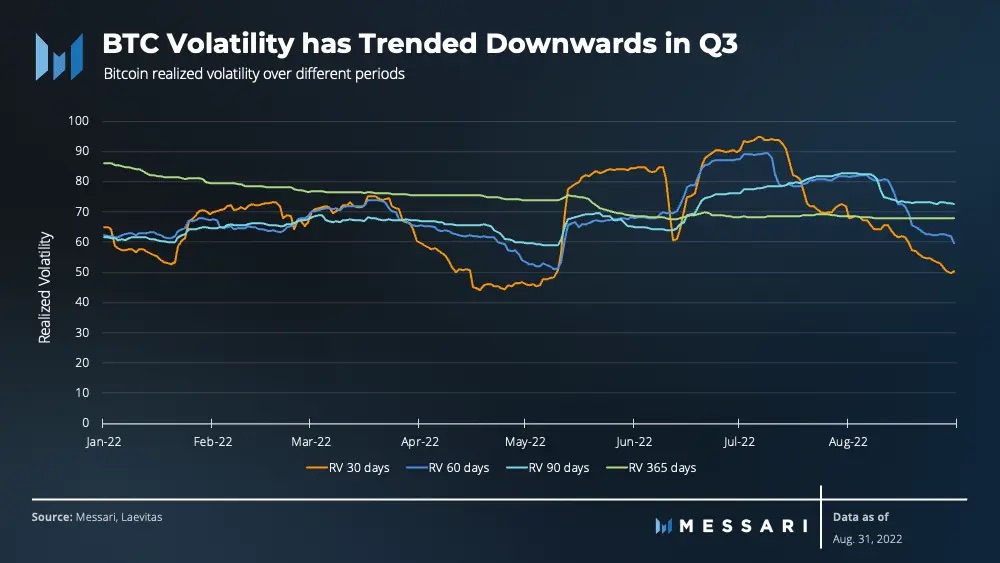
  • Bitcoin’s average 30-day volatility in August was 60%, while it stood at 80% in June.
  • In 2022, risk asset markets (crypto included) have traded lower and Bitcoin more so like a high-beta US stock.

Bitcoin (BTC) realized volatility during quarter three has trended downwards, according to the latest report on the metric from crypto intelligence and research firm Messari.

Per the research platform, the benchmark cryptocurrency recorded the lower volatility as the crypto saw a slight recovery from June lows.

So while BTC has once again dipped below $20,000 in September, the recovery from the $17,600 levels in June and the retest of key resistances near $25,000 in mid-August was key.

“Bitcoin realized volatility trended downwards as it made a gradual recovery in Q3. Average 30-day volatility for August was 60% compared to over 80% for June,” Messari’s Sami Kassab and Kuna Goel wrote in the State of Bitcoin Q3 2022 report.

BTC volatility chart showing downward trend in Q3. Source: Messari

The lower volatility for the world’s largest cryptocurrency by market cap saw the broader crypto market record much lower liquidations across the period, the analysts added. For instance, total long liquidations stood at $5 billion in August, a more than 50% drop from the $10.8 billion recorded in June.

As for total short liquidations, the figure fell to $3.5 billion last month, compared to $6.6 billion total liquidations seen in June.

BTC traded like a high-beta US tech stock

As crypto prices see-sawed over the quarter, Messari notes, Bitcoin traded more like a tech stock as it tracked the Nasdaq 100 (rebased). 

This happened not just as the federal fund rates increased across the three months, but reflected the rot going back to late 2021. Prior,  availability of easy money amid institutional adoption, had helped fuel the bull market.

“For the quarter, the average correlation between Bitcoin and NASDAQ 100 was 0.6 as inflation and rate hikes dominated the narrative. Surprisingly, digital gold and physical gold are far less correlated. The average correlation for the quarter between the two assets was 0.2,” Kassab and Goel wrote.

Overall, Q3 has seen Bitcoin essentially lose two of its key narratives – as an inflation hedge and store-of-value asset – amid the bear market crash that precipitated declines of over 72% since the all-time-highs of 2021.

Bitcoin was trading around $18,910 on Sunday afternoon, about 6% and 13% down over the past 7 days and 30 days respectively.

The post Bitcoin volatility trended downwards in Q3: report appeared first on CoinJournal.

Tezos upgrade Kathmandu goes live on mainnet

Kathmandu has introduced several new features set to improve network scalability and security.

Tezos, the layer 1 proof of stake blockchain designed to self-upgrade and evolve as it scales amid adoption, has successfully activated the latest protocol upgrade on the mainnet.

On Friday, the 11th upgrade dubbed Kathmandu went live on the Tezos PoS network at block 2,736,129, following a community adoption.

As noted in the proposal that ran from 9-23 September, the new upgrade comes after another named Jarkata went live on 28 June, 2022. The upgrade proposal was made by Tezos contributors and research firms Nomadic Labs, DaiLambda, Marigold, Oxhead Alpha, TriliTech, Tarides, and Functori & Tweag.

Upgrade brings new features

Kathmandu’s activation keeps with Tezos’s regular schedule and as with previous protocol changes, this adds a number of features set to massively improve on scalability.

These include smart contract optimistic rollups, pipelined block validation that’s set to improve transactional throughput, and improved randomness for enhanced network security- this is achieved via verifiable delay functions. 

Other features added include tailored governance via new permanent testnets that allow for more room for developers to experiment, event logging and increased paid storage for smart contracts.

Tezos launched in mainnet in 2018, with the network going live following an initial coin offering in 2017.

The post Tezos upgrade Kathmandu goes live on mainnet appeared first on CoinJournal.

Tether’s USDT launches on Polkadot

Tether’s USDT is now live on 11 blockchain networks and ecosystems, including Ethereum, Tron and Solana.

Tether, the company behind the world’s largest and most widely used US dollar-pegged stablecoin USDT, has announced that tokens are now live on the Polkadot (DOT) blockchain.

USDT, with a market capitalisation of more than $68 billion, is currently the third largest by market cap behind Bitcoin (BTC) and Ethereum (ETH).

USDT now on Polkadot

Polkadot is a decentralised blockchain platform supporting a thriving Web3 ecosystem, and the launch of the USDT stablecoin is another milestone set to boost network growth and benefit the community of users.

“Polkadot is on a trajectory of growth and evolution this year and we believe Tether’s addition will be essential in helping it continue to thrive,” Tether CTO Paolo Ardoino said in a statement.

With this launch, USDT is adding a liquid and stable token to the network’s DeFi space and will allow users to easily move in and out – a factor not to be downplayed in a volatile market.

Tether is now available on 11 blockchain networks, including top smart contracts and largest Proof-of-Stake network Ethereum, Tron, Avalanche, Solana, Kusama, Ethereum, Algorand, and EOS.

USDT is also live on NEAR, Liquid Network, Omni, and Bitcoin Cash’s Standard Ledger Protocol. 

The post Tether’s USDT launches on Polkadot appeared first on CoinJournal.