Robinhood announces plans to delist Bitcoin SV (BSV) before end of January

  • Robinhood on Wednesday said it has stopped accepting Bitcoin SV.
  • It has also said that it will delist the cryptocurrency starting January 25.
  • Any Bitcoin SV in customers’ accounts after January 25 will be automatically sold.

Online trading app Robinhood on Wednesday said through a statement on its website that it has stopped accepting Bitcoin SV (BSV) deposits as it prepares to delist the cryptocurrency on January 25.

Between now and January 25, users hold and sell BSV but after the deadline, the platform will not support Bitcoin SV trades, purchases, or transfers. Additionally, any BSV held in users’ accounts will be sold at market value and the proceeds will be given to the respective users.

Regular review of supported cryptocurrencies

While making the announcement, Robinhood said the move has been arrived at based on its regular review of the cryptocurrencies that it offers. It, however, never gave a specific reason for dropping the cryptocurrency.

The company’s statement read:

“We have a rigorous framework in place to help us regularly review the crypto we offer on Robinhood,” a spokesperson told CoinDesk in a statement. “We are extremely selective about the assets we offer as we build toward our goal of making Robinhood Crypto the most trusted, lowest cost, and easiest to use on-ramp to crypto.”

What is Bitcoin SV (BSV)?

BSV is the native token of the Bitcoin Satoshi Vision (Bitcoin SV) blockchain which was launched in 2018 following a hard fork from the Bitcoin Cash blockchain. Bitcoin Cash is itself a hard fork of the original Bitcoin blockchain.

The BSV was added to Robinhood almost immediately after the hard fork from Bitcoin Cash.

Following the announcement, the price of BSV dropped from a high of $44.41 to as low as $37 although it had slightly retraced upwards to trade at $40.73 at press time.

The post Robinhood announces plans to delist Bitcoin SV (BSV) before end of January appeared first on CoinJournal.

Bitcoin SV price drops after Robinhood news

  • Bitcoin SV dropped from highs near $45 to lows of $37 on major crypto exchanges.
  • The BSV price fell as the market reacted to news from online trading app Robinhood, which will remove the coin from its crypto offerings later this month.
  • BSV is a cryptocurrency forked from Bitcoin Cash in 2018.

Bitcoin SV price fell more than 15% on Wednesday, trading down from highs near $45 to hit lows of $37 on major cryptocurrency exchanges.

According to data from CoinGecko, the price of the native Bitcoin SV blockchain token had risen over the past week as crypto began 2023 with a relief rally.

But on Wednesday, the Bitcoin fork token plummeted amid news from online trading app Robinhood. Per a crypto update the platform provided on its website, support for BSV will end on 25 January 2023 at 06:59 pm ET.

What does this mean for users?

According to Robinhood, customers can still buy, sell, hold or transfer BSV up to the indicated deadline. But while this is possible until then, the trading app will sell any BSV still held in Robinhood Crypto accounts at market value, the statement warned customers. 

Once this step is taken, any proceeds from BSV sales will be credited to customers’ accounts.

Robinhood explained its delisting of the BSV coin as a result of a regular review of the platform’s crypto offerings. As of the announcement, the decision did not impact any other coins, with the statement emphasizing that users’ crypto remained safe on Robinhood.

Bitcoin SV, or Bitcoin Satoshi Vision at the time of its fork from the Bitcoin Cash (BCH) coin in 2018, was trading around $40 at 13:02 pm ET. It remains more than 10% down in the past 24 hours and is over 91% down from its all-time high of $489 reached in April 2021.

The post Bitcoin SV price drops after Robinhood news appeared first on CoinJournal.

GALA price falls after Gala Games deletes Hollywood star partnership tweet

  • At the time of writing, GALA token had dropped by more than 11%.
  • Gala Games is under fire after secretly deleting a tweet announcing their partnership with Hollywood stars.
  • This comes after GALA shot up by more than 70%to above $0.051.

Metaverse cryptocurrency GALA price has dropped considerably in the past few hours after the parent firm Gala Games deleted a tweet announcing its partnership with several Hollywood stars including The Rock.  What has irked most crypto followers is that Gala Games deleted the tweet without offering any explanation.

The tweet that Gala Games had posted on Monday stating that it was working with Dwayne “The Rock”, Mark Wahlberg, and Johnson pushed the price of GALA up by more than 70%, the highest price the token has reached since September 2022.

The tweet stated that the game development platform was “developing two films with the Rock (aka Dwayne Johnson) and Mark Wahlberg! Two absolutely huge forces in the entertainment industry. You’ve seen their work on screen, but I think their presence might be even more powerful off the screen and we are so happy to get the chance to work with them.”

Gala Game’s silence after deleting post

Several Twitter handles have been created questioning how genuine the announcement was.  

Nevertheless, despite today’s pullback, GALA still remains the top mover for the month among the gaming tokens. GALA has gained about 130% while The Sandbox’s SAND token has only surged by 30%, and Decentraland’s MANA has risen by 22%.

The post GALA price falls after Gala Games deletes Hollywood star partnership tweet appeared first on CoinJournal.

Its the calm before the storm in crypto markets


Key Takeaways

  • Crypto volatility has come down and extreme on-chain activity subsided in period of relative calm
  • Several concerning developments around Genesis, Gemini and DCG are still ongoing, however
  • Volatility could also spark up once the US inflation data is revealed this week
  • Period is reminiscent of the low drama environment pre-FTX in October 


After a tumultuous rollercoaster following the shocking demise of FTX, a period of notable serenity has descended upon cryptocurrency markets. 

With 2022 being a complete and utter bloodbath, it almost feels suspicious that there is even a couple of weeks of low drama in the digital market space. 

But the metrics show that the last few weeks have been among the quietest of the last couple of years. Given the fear of contagion that transpired out of FTX’s collapse, that is a good thing. 

Fear still elevated in crypto circles

Having said that, there is plenty to be concerned about right now. As Coinbase CEO Brian Armstrong stated yesterday when he announced Coinbase was cutting an additional 20% of its workforce, there are likely “more shoes to drop” and there is “still a lot of market fear” out there. 

Crypto lender Genesis last week laid off 30% of its workforce and is reportedly mulling bankruptcy. Crypto exchange Gemini, founded by the Winklevoss twins, has $900 million of customer assets stuck in limbo with Genesis, its sole lending partner for its Earn product. 

The twins have demanded Barry Silbert, CEOP of Digital Currency Group (DCG), which owns Genesis, to step down, accusing him of defrauding Gemini Earn customers. 

DCG fired back, calling it “another desperate and unconstructive publicity stunt from Cameron Winklevoss to deflect blame”. It also affirmed it was “preserving all legal remedies in response to these malicious, false, and defamatory attacks).  

DCG is also the parent company of the Grayscale Bitcoin Trust, which has seen a massive discount to its net asset value, peaking at 50% in the aftermath of the FTX collapse as investors questioned whether reserves were safe (I wrote about GBTC yesterday).  

Markets stand firm for now

For now, while all these episodes play out, the markets are standing firm. Action has been relatively muted, and in fact there has been a tangible return to normal levels for a lot of on-chain activity that went wacky over recent periods. 

The below snapshot shows the net transfer volume in and out of exchanges. Since the start of the year, the action has been tepid, having spiked to extreme levels in November and December as first FTX collapsed and then the questions spiked about the health of Binance. 
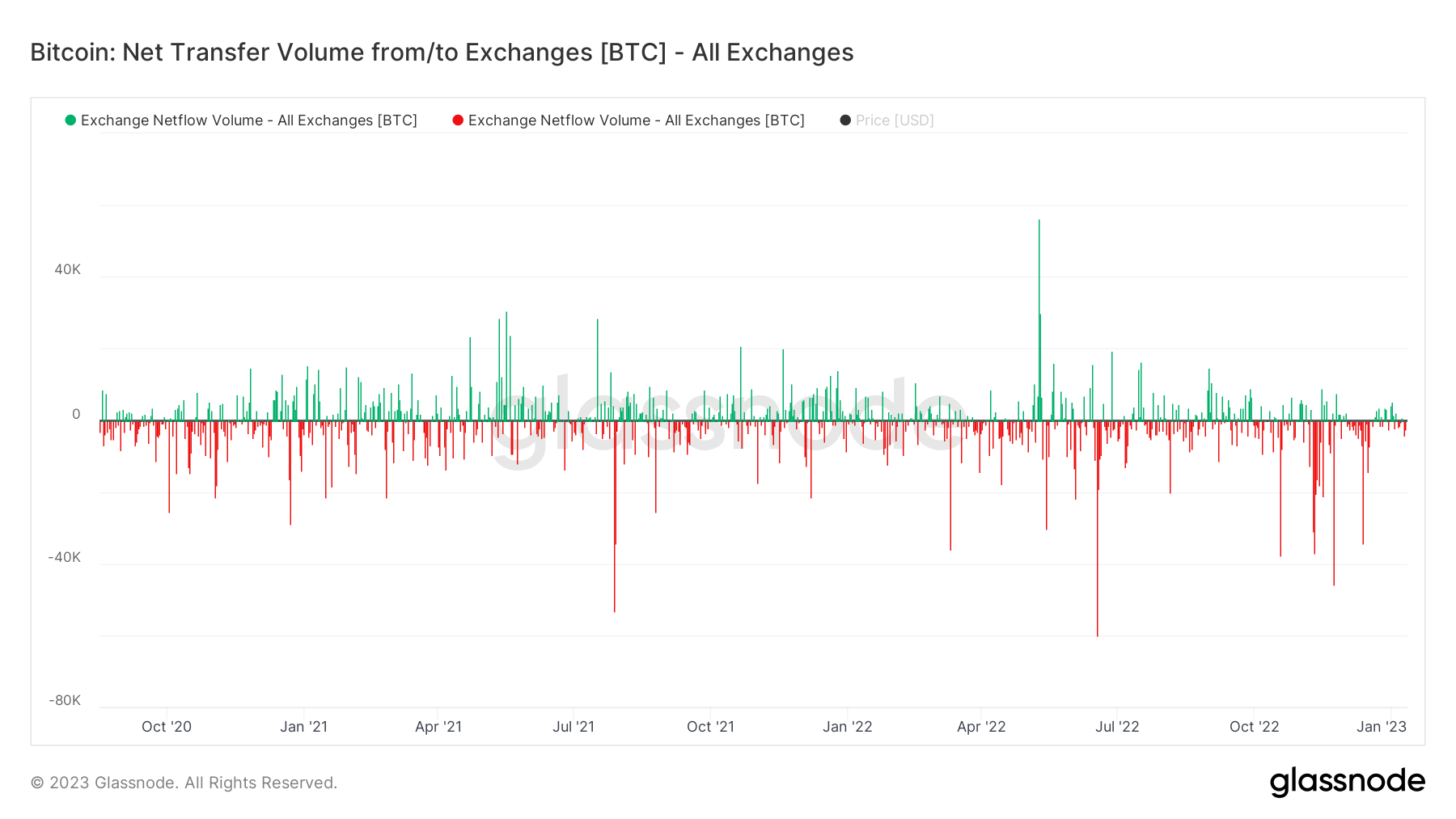
This notion that activity has returned to normal is reinforced when looking a the volatility of Bitcoin. The world’s biggest cryptocurrency has been trading sideways for a while now, and the 30-Day Pearson measure of volatility shows how there was a perceptible drop back down to pre-FTX levels in December. 

Macro climate looking more optimistic

It hasn’t just been a respite from within crypto circles. The broader macro environment is looking at least a bit brighter today than it did last month. Inflation is still rampant, but there have been two consecutive readings below expectation, and there is renewed hope that it may have peaked.

The most recent round of interest rate hikes kicked rates up 50 bps as opposed to 75 bps in the two prior months, and while Fed chair Jerome Powell and other central bank chiefs have affirmed that rates will continue to rise until inflation is conquered, the market has moved cautiously upward after European inflation came in at 9.2%, compared to 10.1% last month.

Next up is the US CPI reading on Thursday, which will – as always – be a vitally important day in markets. Expect volatility in crypto markets as coins stare at the number to try to assess what Jerome Powell may do with regard to interest rate policy.

After all, we know by now that crypto is very much holding the stock market’s hand – apart from when, you know, high-profile executives are revealed to be fraudulent (FTX), or top 10 coins cease to exist (LUNA).

Never a dull moment for long in crypto

Back in late October, Bitcoin was seemingly locked in crab motion around $20,000. With traders getting impatient, I warned how crypto could be one event away from a nasty downward wick. T

Three weeks later, FTX collapsed. I never imagined this would happen, and the timing was coincidental, but the premise of the piece reminds me of how I feel now. It’s amazing how short memories are in markets, but we have been here before.

Crypto won’t stay silent for long, and the asset class is far from out of the woods yet. The aforementioned ongoings around DCG, GBTC, Genesis and Gemini are just a few of the million things that could turn south at any moment.

There is also the story around Binance chief Changpeng Zhao being under investigation for money laundering offences by the SEC, there is Coinbase laying off 20% of its workforce following a 905 drawdown in its share price, and God knows what will come out of testimonies in the Sam Bankman-Fried court proceedings.

And then there is macro, where anything could happen to inflation, the Russian war in Ukraine or myriad other variables. It’s been a quiet couple of weeks but don’t worry – the madness will return soon.

The post Its the calm before the storm in crypto markets appeared first on CoinJournal.

Thailand SEC goes after cryptocurrency exchange Zipmex amid buyout

  • Zimpex is in the process of being acquired by V Ventures.
  • The Thailand SEC is probing the exchange for breaching local rules.
  • These are allegations that Zimpex has been operating as a digital asset fund manager in Thailand without permission.

Cryptocurrency exchange Zimpex has found itself in trouble after Thailand’s Security Exchange Commission (SEC) launched a probe into the exchange for allegedly breaching local rules.

Zipmex has been facing liquidity crisis and it even halted withdrawals in July 2022. It obtained a three months moratorium in August to resolve the liquidity issues and is at the moment in the process of being bought out by V Venture, a subsidiary of Thoresen Thai Agencies PCL for a total of about $100 million.

Why the Thai SEC is after Zipmex

According to a report by Bloomberg, Thailand authorities are investigating activities that they believe could have violated the business rules for digital asset providers in the country. The SEC has given Zipmex until January 12 to clarify if it has been operating as a “digital asset fund manager” in Thailand without permission.

If it is true that the exchange operated as a digital fund manager in Thailand, it ought to have obtained a permit for it to be allowed to conduct business in the country.

The post Thailand SEC goes after cryptocurrency exchange Zipmex amid buyout appeared first on CoinJournal.