Axie Infinity price shoots up 40% today: today’s top gainer

  • Axie Infinity (AXS) has hit a high of $13.83 today.
  • AXS is today’s top gainer followed by STEPN coin.
  • Here is a deep dive into what is causing today’s price surge.

After a calm weekend with most cryptocurrencies consolidating their previous gains, Axie Infinity has started the week with a bang after climbing to a four-month high of $13.83.

AXS has traded below $12 since mid-September and dropped to as low as $6 towards the end of 2022. The token has however turned the tables and staged a steady recovery since the start of 2023 with today being one of the greatest days for the token in recent history. 

At press time, the token was trading at $12.86 after a slight pullback from a high of $13.83.

But what is pushing the price of AXS up and how far will it go? Here are the forces behind today’s AXS rally.

What is pushing Axie Infinity price up?

Although the crypto winter brought the price of the Axie Infinity token down from its all-time high (ATH) of $165.37 to trading below $10, the increased gaming activity on the Axie Infinity blockchain is largely behind the ongoing bullish price action.

Axie Infinity is branded as a blockchain-based battling game owned and operated by players around the world. Inspired by such games as Tamagotchi and Pokémon, and the ability of players to collect, breed, raise, battle, and trade token-based creatures the Axie Infinity ecosystem has seen increased growth since the start of 2023.

Axie Infinity currently ranks as the most successful play-to-earn (P2E) game within the blockchain industry and the booming sentiment among gaming tokens has also boosted AXS performance with many investors now anxious to see what the future holds for the token. 

The post Axie Infinity price shoots up 40% today: today’s top gainer appeared first on CoinJournal.

Bitcoin hits 5-month high as bulls push BTC above $23K

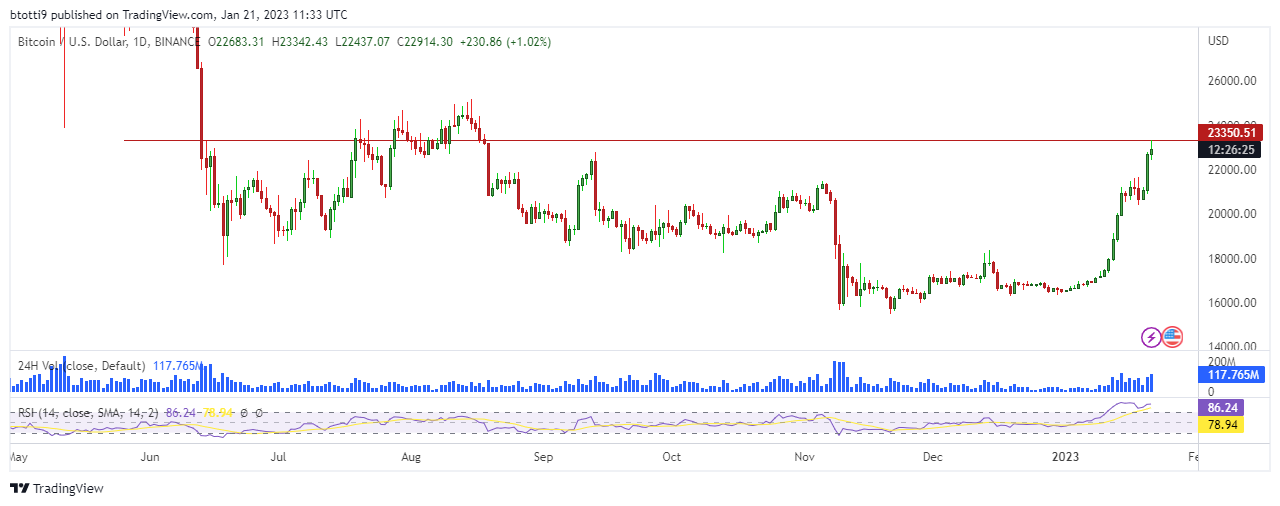
  • Bitcoin hit highs of $23,342 on Binance, with a breakout above $22k extending year-to-date gains.
  • BTC price is up 30% in a month and has recovered 47% since the decline to $15,500 lows.
  • Short liquidations were around $376 million in the past 24 hours.

Bitcoin price roared to highs above $23,000 on Saturday morning, rising to $23,342 on Binance as the price of the world’s largest cryptocurrency by market cap hit levels last seen in mid-August 2022.

BTC was changing hands around $22,900 at the time of writing, about 9% up in the past 24 hours after shedding some of the gains. 

The price of Bitcoin was, however, still 35% up in the past 30 days, and as crypto trader and analyst Rekt Capital pointed out earlier this morning, BTC had rallied over 47% since falling to lows of $15,500 amid the FTX dump.

Bitcoin price chart showing BTC rally to $23,000 on 21 January, 2023. Source: TradingView

 On-chain data platform Santiment noted just before today’s break above $23k that Bitcoin’s price rally has come amid a bullish outlook from large BTC investors. As the firm highlights in the chart below, whale addresses with 1,000 to 10,000 BTC have in the past two weeks accumulated over 64,638 bitcoins worth more than $1.46 billion.

Over $376 million in shorts liquidated

As Bitcoin raced to highs near $23,350, liquidation data showed that in the past 24 hours, about 80,497 traders had been liquidated.

According to Coinglass, the largest short liquidation was on Bitmex where an order worth $4.53million was rekt. The total liquidations as of 06:10 am ET on 21 January were $376.61 million. 

Notably, total liquidations are not at the levels seen when BTC/USD broke above $20,000 last week towards erasing all post-FTX losses. Nonetheless, it still shows some traders are convinced this could be a gigantic bull trap. 

But as it is, further upside momentum could see bulls target $25,000 or possibly higher if sentiment across risk markets helps bouy buy pressure.

The post Bitcoin hits 5-month high as bulls push BTC above $23K appeared first on CoinJournal.

Nexo to pay $45 million to settle SEC charges

  • Nexo reached a $45 million settlement with US regulators, including the SEC.
  • The crypto lender allegedly offered unregistered securities via its Earn Interest Product.
  • Nexo will pay $22.5 to state regulators and the rest to the SEC, with this expected in the next 12 months.

Nexo, a Cayman Islands corporation founded in 2018 and a leading crypto lender, will pay $45 million as settlement with the US Securities and Exchange Commission (SEC) and the North American Securities Administrators Association (NASAA).

NASAA announced the settlement late Thursday, noting Nexo had agreed to pay the penalties following the outcome of a comprehensive investigation into an interest product the crypto platform allegedly offered to US customers.

Nexo settlement closes multi-year investigation

According to the press release announcing the settlement, the charges related to Nexo’s offering and sale of alleged unregistered securities via its Earned Interest Product (EIP). The regulatory watchdog noted 17 US state securities regulators had agreed to the reported settlement, with more set to accept it.

“This settlement recognises the important work of state securities regulators and the SEC in making sure that those who are investing their hard-earned money have all the information necessary to understand the risks and rewards of their decisions,” said Charlie Clark, Director, Washington Department of Financial Institutions Agency.

Nexo commented on the landmark settlement via a blog release, confirming it had been reached on a “no-admit-no-deny basis.” This closes a multi-year probe into Nexo’s offerings, particularly its interest bearing accounts.

According to Nexo, the regulators’ inquiries over the past year or so showed the company had not engaged in any fraud. 

“We are content with this unified resolution which unequivocally puts an end to all speculations around Nexo’s relations to the United States. We can now focus on what we do best – build seamless financial solutions for our worldwide audience,” said Nexo co-founder Antoni Trenchev.

The crypto lender will pay $22.5 million to state securities regulators and the rest to the SEC, with the payments made over the next 12 months. Notably. Nexo was in the process of a phased out exit from the United States market. 

Nexo’s native token NEXO rose in the aftermath of the announcement, and was changing hands around $0.84 on Friday afternoon. The NEXO price was up by more than 17% in the past 24 hours as at 12:10 pm ET

The post Nexo to pay $45 million to settle SEC charges appeared first on CoinJournal.

Fantom launches on-chain funding system Ecosystem Vault

  • Fantom Foundation, the platform behind the Fantom (FTM) blockchain announced the launch of Ecosystem Vault on Friday.
  • Vault is a decentralised funding mechanism that will be financed by 10% of FTM transaction fees.
  • The funds in the vault are available to projects that get 55% approval in community-driven governance vote.

Fantom, a scalable Layer-1 blockchain platform, has officially launched Ecosystem Vault, a decentralised funding pool that will empower and help builders deploy new community-driven projects on the blockchain.

Vault to boost Fantom’s dApps ecosystem

Announcing that Vault was officially live, Fantom noted in a blog post that the funding mechanism will encompass governance proposals from the community.

The project represents Fantom’s continuing evolution as the community eyes further decentralisation, the Fantom Foundation team wrote.

Vault’s on-chain mechanism allows for a funding profile where projects and developers seeking to build decentralised apps (dApps) in the ecosystem can secure financing. As noted above, the funding pool also gives the Fantom community a chance to contribute to the growth of the blockchain via their funding decisions.

Per the Fantom Foundation, the Ecosystem Vault will get funds from 10% of transaction fees. The community controls these funds, which are a result of a reduction in the burn rate of native token FTM.  

Anyone can apply for the funds in the Vault, a process that requires applicants to create a Fantom Governance proposal (has 100 FTM fee). Afterwards, the proposal will need approval from 55% of the community based on 55% quorum. The Foundation tweeted:

As of Friday, 20 January, 2023 at 11:06 am ET, the vault held roughly 69,247 FTM tokens valued at just over $21,000.

The post Fantom launches on-chain funding system Ecosystem Vault appeared first on CoinJournal.

How To Mark Yourself Safe From The Flood Of Crypto Frauds?

Some individuals are under the impression that it will take the place of the conventional financial system and are excited to be a part of the transition.

What could possibly go wrong here? Maybe you are not linked with reliable trading bots like bitcoin prime and your investments are con artists who have the intention of using their crypto token holdings to become wealthy very rapidly, and their methods are improving each day. 

A cursory glance at crypto fraud, along with some steps you may do to protect yourself, is presented here.

What is a crypto scam?

Mining is the process that must be carried out between the two parties. This requires users to execute complex mathematical computations on behalf of everybody on the network, send off some details about themselves, and then wait for their reward.

Few individuals have a firm grasp on how cryptocurrencies function because of their complexity and the emergence of new cryptocurrencies. In other words, you risk losing your money to con artists who are hoping you’ll invest in their scheme.

It’s crucial to know about potential threats before taking any chances, whether they come in the form of phishing schemes or fraudulent apps promising free currency.

Unleashing the reason behind crypto fraud expansion

There is a lot of public interest in the crypto market, which is highly volatile. The fact that there are more people to swindle is enough to make this an appealing environment for fraudsters.

The Federal Trade Commission estimates an increase in complaints about cryptocurrency scams from 2021. In 2020, crypto fraud cost consumers a maximum of $130 million. The following year reports skyrocketed, and by 2021, the United States had lost $680 million.

Some frauds may go unreported because as many as 35% of victims didn’t realize they could do so. As a result, this year’s losses may be considerably greater.

A few of the reasons why scammers stick around in this industry are listed below:

  • Because cryptocurrencies are digital, hackers need just access to a computer to launch assaults.

  • When money is transferred, it can’t be retrieved unless the recipient cancels the transaction.

  • As a decentralized system, cryptocurrencies offer no guarantee of payment to their owners. 

  • A person’s identity will not be revealed during this procedure. You can avoid storing sensitive data as the crypto regulatory landscape develops. The source of funds can be traced, however, fraudsters might complicate matters by using several wallets. It’s already hard enough to figure out who the wallet owners are.

  • Anyone with cryptocurrency holdings is vulnerable to a crypto scam. To counter this, though, you have a few options for safety.

Protecting your trading account from hackers 

VPN service

To protect yourself from intrusions like this, consider signing up for a VPN.

In order to ensure the security of your cryptocurrency transactions, you may wish to sign up for a VPN service. If you invest for a year or more in advance, you can save money on a VPN service that normally costs between $5 to $15 per month.

VPNs offer usefulness outside of the crypto realm, such as when you want to watch foreign TV or hide your online behavior from your ISP.

A big NO for public Wi-Fi

There will be occasions when you need to access the internet away from home, and the allure of free public Wi-Fi in a local cafe or restaurant is understandable.

However, you may wish to stay away from free public Wi-Fi if you’re conducting cryptocurrency transactions. Anyone in the vicinity can listen in on your web traffic using a program like Wireshark if you’re utilizing a free, open Wi-Fi network. 

They can usually detect if you are browsing crypto sites based on the data they collect. The possibility exists that they can even see your financial dealings.

While this won’t directly lead to the theft of your cryptocurrency, a fraudster may decide to pay much particular examination to you if they notice you making purchases or browsing crypto sites with a big dollar amount. You don’t want that type of focus, do you?

Password 

It’s tempting to use the same login for your wallet that you use for your favorite website, but you should avoid this.

If you use the same password for your wallet as you do for a site, then the hacker will have access to your key vault if your website password is compromised. (The key vault is typically taken during attacks of this nature.)

An attacker may theoretically use key-logging spyware to track your keystrokes while you type in your password or retrieve your unprotected vault data from your PC’s RAM, regardless of how complex your password is.

These methods are quite clever, and to our knowledge, no crypto user has ever had their seed words compromised in this fashion. Unfortunately, this type of crime may become increasingly widespread as cryptocurrency usage grows. 

Therefore, using a trading bot like bitcoin prime are others is a must. 

Hardware Wallet

A hardware wallet is a USB gadget that can contain your key vault and is one of the finest ways to keep your cryptocurrency secure. The device is built in such a way that your seed words remain encrypted even if they are removed.

It is very difficult for a hacker to infiltrate a hardware wallet with malware because it does not have access to the Internet.

You must pair your hardware wallet with your smartphone or tablet via USB or Bluetooth before each transaction. To conduct transactions without disclosing your private key to a potentially malware-infected device, the wallet generates a signature and transmits it to your internet-connected device.

Even if your hardware wallet were taken, the attacker would have a hard time accessing your cryptocurrency because of the PIN code.

Authentication Software

The security of your online wallet can be bolstered by using a third-party authenticator tool like Google Authenticator for two-factor authentication. 

Since authenticator apps don’t use SMS text communication to give you the pullout code, an attacker who gains access to your phone’s service or who is able to mirror your messages will still be unable to obtain your withdrawal code.

Using an authenticator app means the hacker must physically obtain your device in order to access the 2FA code. As an additional safeguard, it outperforms the use of simple text messages.

It is possible for an attacker to circumvent the safety of the exchange even if you have two-factor authentication turned on. 

It’s possible that the exchange’s withdrawal hold policy or other safeguards will prevent you from withdrawing your cryptocurrency in the event of a hack. 

Summing Up 

There is a growth in criminal behavior when the cryptocurrency market reaches new heights because more people are downloading wallets and joining sites for the first time.

As we’ve seen, there are many ways to keep your cryptocurrency safe from this new breed of the crook, including two-factor authentication, pulling from an exchange, loading up the seed words, staying away from free public Wi-Fi, and utilizing a virtual private network (VPN).

Scammers will no doubt think of new ways to steal cryptocurrency in the future; we’ll be certain to keep this page as necessary. For the time being, these are among the best methods for keeping your crypto safe.

The post How To Mark Yourself Safe From The Flood Of Crypto Frauds? appeared first on CoinJournal.